In contrast to the nearly three hours, between midnight and 03:00 that I spent swapping out the dead alternator yesterday, the last 24 hours have been decidedly uneventful.
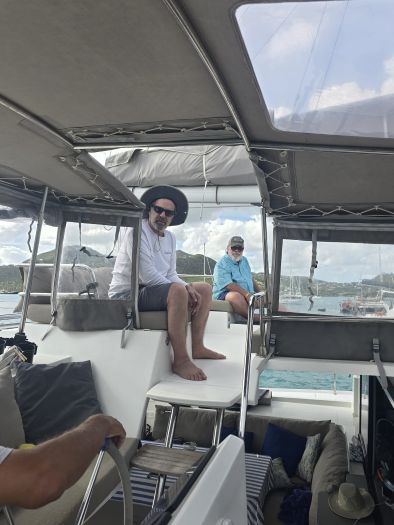
My crew Steve and Peter have settled into the rhythm of passage making and I am happy to say that not a lot has happened.
Brenda likes to say that when we are cruising that “nothing happens aboard Pandora until noon”, typifying the relaxed approach to getting stuff done aboard.
One basic truth is that even the simplest task takes a lot of time when you are on a boat. Whether it is meal prep, general cleaning or fixing broken stuff, somehow the next day rolls around with a lot of sameness.
Swapping out the alternator only meant taking off a handful of bolts but getting to them was anything but simple and required a good amount of sweat reaching around a hot engine and it took a long time. Time that I should have been sleeping.
When I got up this morning, I noticed that I had a few more bruises likely related to my midnight contortions.
Sadly, decent wind continues to allude us but we are hopeful that it will begin to fill in later today.
As we loaf along, waiting for wind to fill in, engine rumbling away, Steve challenged us to a game of hearts. I have never played and the rules seemed a bit daunting to me. Fortunately, a brief rise in wind called the game off after a few rounds…
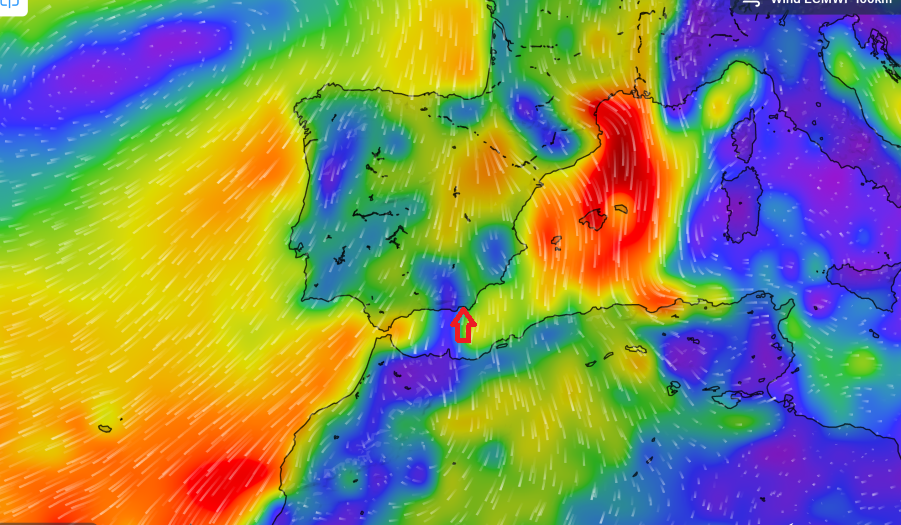
As I have mentioned in past posts, strong north winds are common off the west coast of Portugal and while the wind to date has been frustratingly light so far, we should have more than enough wind to move us along smartly for at least the last several hundred miles.
Even when there has been wind, it has either been too light or from behind us so that we have been unable to keep up a decent speed. As a result, we have motored a lot and today I decided to transfer some of the fuel I have in jugs to the port tank. We have plenty of fuel and transferring from can to tank is yet another SLOW activity aboard Pandora.
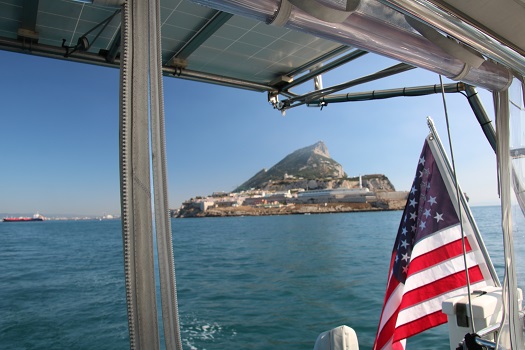
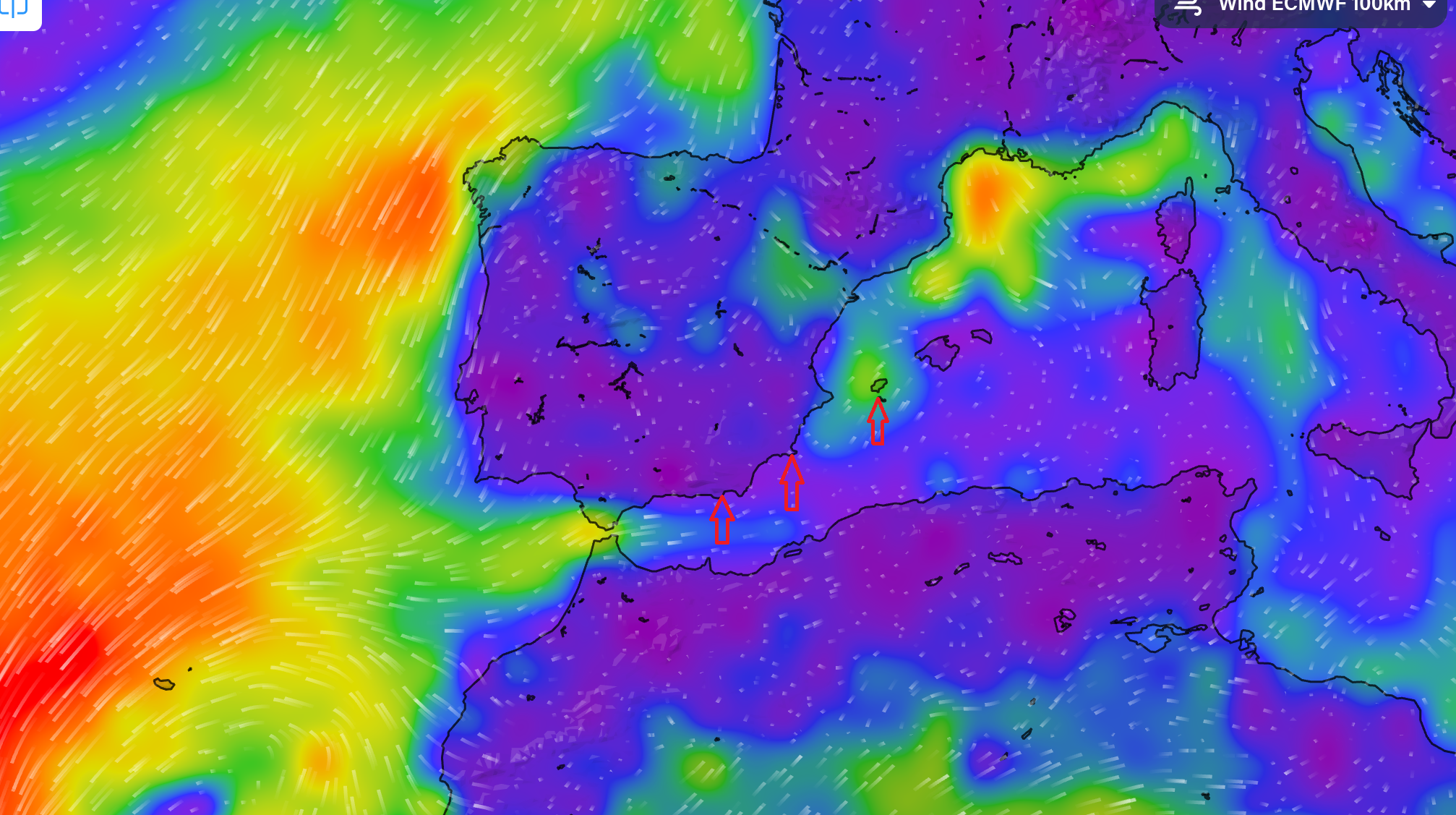
We are facing a deadline late on Wednesday evening to finish our transit of Gibraltar before strong easterly winds will begin blowing from the east. While I prefer more leisurely sailing we will need to make up speed as we have not covered enough distance each day to ensure that we pass Gibraltar before adverse winds make progress impossible.
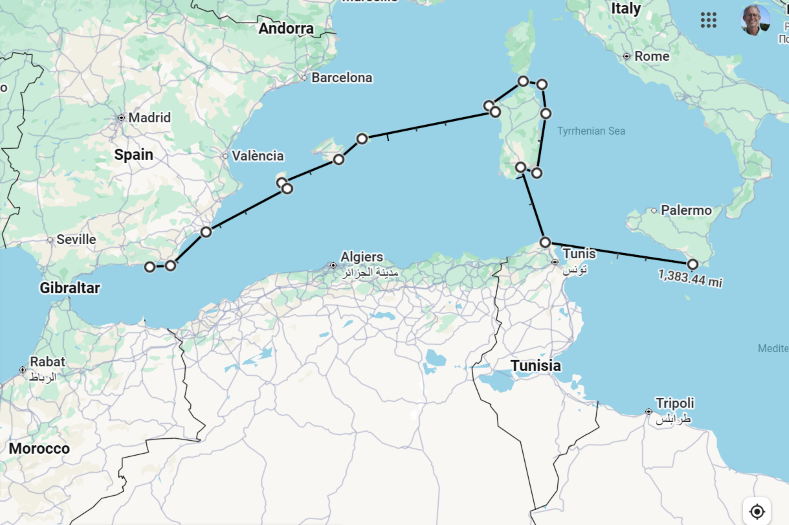
As I write this we are about 300 miles into our 1,000 mile run and it will be a nailbiter hoping that we get through Gibraltar before the wind turns against us.
Perhaps I will close with a lovely sunrise photo, just in case you might have missed the countless sunrise photos I have already posted this season.
I guess that is about it for now, a post that is nearly as interesting as our day has been.
So far, a good day and not a lot happened aboard Pandora, so far…
My friend Mark loves to say that “everything on your boat is broken you just don’t know it yet”.
That is so true an on just about every passage something important breaks.
A belt, water pump and more things than I can count have given up the ghost on passage and on our first day out, Pandora acted true to form.
Yesterday after a days of preparation, we dropped our lines and headed out, bound for Gibraltar.
As expected, there was very little wind so we had to motorsail for about the first 18 hours and finally, about dawn today the wind picked up enough to sail sans engine. Well, at least some of the time.
On passage I carefully log information every few hours about boat speed, wind speed, location and other stats that help me keep track of how things are going. I also log the battery status so that if anything unusual happens I will see it. Is the solar keeping up with the loads, is the engine charger working well?
At midnight as I logged the numbers, I noticed that the battery charge was dropping even though the engine was running. That wasn’t right and it was clear that the alternator was not putting out power.
We tried several tests to confirm that indeed the engine was not charging the batteries.
I have an alarming number of spare parts assuming that “everything is broken” and along with a spare for every pump on the boat, I carry a spare high output alternator,
It has been sitting in storage for seven years just waiting for the “old” one to fail and it did last night.
So, at midnight I turned off the engine, now 175 degrees, and carefully removed the very hot alternator. The entire process took more than two hours but I got it back together.
We turned on the engine, held our breath, and NOTHING… No charging at all. Same problem.
Ok, now what. I took a deep breath, checked everything again looked all around and discovered one tiny wire that was not attached. I plugged it in. Started the engine and… still nothing.
We turned off the engine again and I scratched my head…
Not ready to give up we started the engine again. This time I waited longer and much to my surprise the power slowly came up to full charging, more than 100 amps at 24v.
What happened? I had forgotten that on a big alternator the voltage regulator is designed to “spool up” the load slowly to minimize the shock to the system and I had forgotten that.
Problem solved and after two hot hours working on the engine, problem solved…
Now I will take the old alternator and have it tested to see if it has indeed failed and if so, have it rebuilt.
I am not absolutely certain that the old one failed or if there might be a wire somewhere that was jostled during the “repair” and now works.
The point is that aboard Pandora “everything is broken you just don’t know it yet”.
Yes, Mark is right and like him, I keep a LOT of spare parts aboard, just in case.
Of course, if I was to carry spare parts for literally everything there would not be any room for us so all I can do is to carry parts that seem “likely to break” and hope for the best.
I do not know what I would have done if I did not have a spare alternator to charge the batteries but I do have a small Honda generator and that would have helped at least a bit. And, of course, we have solar panels and a wind generator…
All better now.
Well at least until I discover another part of Pandora that needs fixing.
Let’s just hope that I have a spare…
It was a long night but all is forgotten, thanks to having a spare and a beautiful sunrise.
Oh yeah, as I write this the wind continues to be fickle so the engine, now charging happily, is off for a bit and then on again.
We have to keep moving with about 850 miles to go even a half not difference in boats speed will mean a difference of 12 hours of passage time to Gibraltar.
It’s hard to believe that I am scheduled to depart for Gibraltar today. It’s been a wonderful month in the Azores and I am so glad that we were able to explore a number of the islands. After a week here in Sao Miguel, my crew has arrived, Chris Parker says that the weather is good for the run so here we go.
Pandora is about ready with her dink securely strapped on deck. A bit more to do but almost ready. Interestingly, sister ship to “old Pandora” our Saga 43, is on the dock next to us. It’s hard to recall much about our SAGA as it’s been so long since we sold her. “New Pandora” does look a lot different, that’s for sure.
Sadly, the electronic orca pinger, deterrent, thingy, never showed up and after visiting three DHL and local delivery offices yesterday, it was determined that the package was lost. You would think that at least they would know something. I do hope that it finally shows up so that it can be returned to the seller. , Thursday as I don’t want to be out $600 for something that I never received.
I have sweated about being attacked by an orca for some months now and hopefully I will be able to make it to Gibraltar without a hit. Fingers crossed.
I have been following www.orcas.pt to see who has been hit and where and it shows that for the last month, there have been fairly few attacks. Fingers crossed.
Since leaving Trinidad in April I have traveled over 3,000 miles and stopped more times than I can count as I made my way north through the eastern Caribbean to St Maarten where I met crew for the 800 mile run to Bermuda.
After taking on new crew in Bermuda we headed the 1,850 miles to Horta, enjoying the best passage I have ever had for that 12 day run. Perfect conditions and we only ran the engine for less than a day. Amazing.
This run promises to be easy, sans orcas, as well with fairly light and moderate winds on or aft of the beam. If anything, we will have to run the engine a bit but I hope not.
Normally the winds off of the western coast of Portugal are very strong from the north but they are forecast as being fairly light. That would be nice.
And we might even get all the way to Gibraltar without stopping. Of course, the orcas might have something to say about that…
Yesterday Brenda flew to Scotland for two weeks for some travel and to give a talk at the Dovecot Studio, a tapestry workshop where the subject of her book taught for many years. She also has a behind-the-scenes tour of the Archie Brennan’s work, the subject of her book “Archie Brennan, Tapestry as Modern Art”, that was donated to the National Museum of Scotland. I am excited for her.
So, Brenda to Scotland and me heading on what will be the final leg of my 4,000 mile run from Trinidad to Almeria Spain where Pandora will be hauled for the season.
It is always challenging to predict weather for an ocean passage and the 900 mile run to Gibraltar is no exception. The primary issue is that you approach the coast of Portugal the wind is generally much stronger and when it is blowing hard from the north, which is most of the time, there will be an easterly wind blowing out through the straights of gibraltar.
Fortunately, the current forecast looks quite moderate and if we are lucky, we will be able to make it through the straight and into Gibraltar with a favorable wind, and without stopping. Well, that assumes that the orcas don’t “stop” me along the way.
Last evening, my last in the Azores, I headed to a lovely little restaurant for a dinner alone, just me and my tablet to catch up on the always upsetting news from the US. In spite of all that, I had a lovely octopus salad and some local wine along with some fresh from the oven bread, the best I have had in the islands.
It was a nice walk through the historic area on my way back to Pandora in the twilight. It was interesting to see some decorations that had been recently hung. I am pretty sure that these exact pieces were hung in Horta while we were there. Traveling decorations…
On one of the evenings that Brenda and I stayed out after dark. No easy feat as that’s way after “cruisers midnight” it was magical. The buildings are beautifully lit at night.
The ever present tile walkways, wet from earlier rain.
I will miss Brenda and look forward to joining her in Almeria when I arrive with Pandora. We will stay there for a week, putting Pandora away for the season and then will drive to Madrid and tour there for a few days before flying home.
It’s been a wonderful visit to the Azores and while I don’t know if I will ever be here by boat again, perhaps our travels will bring us back at some point.
For now, focused on Gibraltar, the last 1,000 miles…
Wish me luck.
Note: You can sign up to receive a notice when I post, which I expect to do most days during my passage in the upper right of this page.
And, you can track our progress under “where in the world is Pandora?” at the top of the page or by following this link to my Garmin tracking page to see where we are.
It’s been nearly a month since I made landfall in Horta with the Salty Dawg Azores rally. As I write this, Brenda and I are now in a marina in San Miquel, our last stop before she flies to Scotland on the 16th giving us more a week to tour the island together before she departs.
Over the next few days my crew, Steve and Peter will arrive with their partners who will also tour the island before everyone flies out and the guys move aboard to prepare for our run to the Med.
As I write this It is not completely clear to me where our first landfall will be, perhaps in Lagos, on the southern coast of Portugal, Morocco or maybe Gibraltar, at the mouth of the Med itself.
I say that as so much has to do with the orca “situation” and the uncertainty about how well the “Pinger” i have ordered from a company in Germany, will be at deterring attacks on our rudder. Some suggest that making a beeline for Logos in Portugal and then hugging the coastline until Gibraltar is best or going toward Tangier and pass on the southern coastline into the Med. I suppose I will have to decide on what course we will take, but not yet.
After a very nice few days in Sao Jeorge, Brenda and I left mid-day on Monday to make the 140nm run from there to San Miguel, a run that was somewhat spoiled by a very large number of squalls that hit us.
I suspect that had I used a Chris Parker, our weather router, he would have cautioned me on this but I didn’t so he didn’t. I got very little sleep so I was pretty beat when we arrived and while I rallied to have a very nice lunch out I was in bed by 19:00 and slept for 11 hours.
Our good by view of Sao Jeorge.
And, of course, one last photo of Pico, our constant companion since arriving.
Unlike many of the squalls on prior voyages, these did not bring increased winds, but killed the wind totally from the gradient winds of 15-18kts that were powering us along. The wind died to perhaps 5kts, and stayed that way for an hour or more but the seas were still up with a one meter chop, so the boat wallowed terribly until the wind returned. Pandora’s uneven and sometimes violent motion did not sit well with Brenda and once she was sick it was clear that nothing was going to solve the problem except “sitting under an apple tree,” which was not an option.
That was very unfortunate as the near dozen squalls that we had overnight was a lot in comparison with a single squall during my nearly two week passage to Horta from Bermuda. Brenda has all the luck.
As the biggest island in the Azores, San Miquel is very cosmopolitan, with the historic areas mixed with modern offices and hotels.
The marina is huge. And while I wasn’t able to book a slip in advance, as I approached the marina I was told “there are a number of open slips, just pick one and tie up”. After weeks of being told that the marina in Horta was packed and we’d have to raft to someone, this was a welcome change.
And for less than $200/week you get a slip on a very nice floating dock with free water and electric. The marina has a lot of boats that look like they have not moved in years so clearly living here is a very economical option for the “house or income deprived”.
This view represents perhaps 50% of the marina. And, there is Pandora in the slip at the end on the left.
Of course, what post is complete without a photo of Pandora up close?
Can’t sail here and yet want to be in the marina? Rent a house boat.
They are pretty neat and in a terrific location to tour the city. However, you won’t be alone as there is a whole row of them.
But, just like Pandora, you will have easy access to the city and the beautiful promenade along the waterfront.
And so begins the second day of our last visit in the Azores before we head our separate ways, Brenda and me, until she flies to Almeria Spain on August 1st where we will meet up again.
I will be giving a number of talks about our trip in the Azores and my passage there from the Caribbean so I thought it fitting to fly a few burgees, just in case I need them to illustrate the point…
I guess that’s about enough for now. On with our day. Lunch and dinner out and a bit of exploring.
Hopefully I will be able to stay awake long enough to have dinner out.
A few days ago we departed Horta, bound for Sao Jorge, a mere 21 miles away. Sadly, the wind was not cooperative and making that “mere” 21 miles felt like 40. We had to tack and sail hard on the wind for the entire way, making for an unpleasant day.
And here we are a few days later and that run felt good compared to the rolling anchorage that we were in for the first few says. Most of these tiny harbors are nothing more than a breakwater with an even smaller marina behind yet another breakwater.
We were told that most of the time these marinas, as small as they are, can accommodate the limited number of cruising boats that head there way. However, with all of the festivals that happen in June traffic was busier than normal and all the slips were filled.
The wind has been light but from a variety of directions and for a good amount of time, blowing into the mouth of the harbor. As a result, for several days we were rolling all night long, a full 20 degrees, ten degrees in each direction. This is enough to cause things to bang around in the cabinets and for dishes to slide across the counters. Fortunately, for the last two days, it’s been much nicer and today, our last day, it’s flat calm.
Our friend Bill on Kalunamoo has a “scale” to measure rolling that goes from 0-7 and I would say that conditions were a solid 6.
In a tiny harbor it is often tough to drop the anchor with enough room to avoid banging into another boat, especially when the depth is 40′ or more as so much scope is needed. On our first night, as the wind died, but not the waves, and a light breeze swung us around, we “T boned” another boat, banging into her on a 90 degree angle. The sound was deafening and woke us to the call of “Pandora, Pandora” from our unlucky neighbor.
We shortened up our scope, anchor chain, and pulled away a bit. The next morning I stopped by to check to see what sort of damage we had caused and fortunately it was a very minor scratch on their rubrail. Fortunately, their rail was at the exact height of our bow sprit. Lucky us. No harm done.
Fortunately for me, Brenda loves the island so much that rolling or not, we are happy to be here and a few days ago we rented a car to tour the island and see the sights.
Everyone has told us that each island has its one characteristics which I see now that we are visiting the third island.
For sure, Horta is the most cosmopolitan when compared to Pico and Sao Jorge and as witnessed by a few rolly days, Horta has the only decent harbor. Sao Jorge is largely an agrarian island with only about 7,500 people in spite of being roughly the same size as Antigua that has 90,000. I expect that there are way more cows and goats here than people. It’s a nice mix and as you’d expect, cheese is their biggest product.
Pico has a more traditional atmosphere when it comes to homes, with many built of rough volcanic stone. That is not to say that Sao Jorge is not traditional, as it is, but the rough stone homes are not the dominant style, with more with smooth cement walls very common. As is the case everywhere, the roofs are clay tiles, which gives each island a wonderful feel.
And, Pico, the mountain, dominates the skyline pretty much wherever you go. This view of Pico from Pandora this morning was particularly iconic and a wonderful way to start the day.
The fact that the rolling had pretty much stopped, didn’t hurt.
The marina is so tiny it’s clear that only a government would go to the trouble to build one here as the cost is so high that it would never turn a profit. And the prices they charge, dirt cheap, would never begin to cover even the upkeep. While there is a small airport, most of the movement from nearby islands is by ferry and they show up completely full several times a day, mostly from Horta.
This photo does not begin to show the small scale of the marina. In fact, one of the reasons that Pandora isn’t able to get a slip is that we are too big for all but a few slips. That is in very sharp contrast to the Caribbean where Pandora is on the tiny side.
The entrance is very narrow and I can only imagine what it would be like to enter it with a sea running. The scale of the wall is apparent here. Big waves in the winter, I’ll bet.
The road out of town is a series of switchbacks as the mountain is quite steep.
The harbor viewed from an overlook a short distance outside of town.
The big dock is for supply ships that bring in everything that is needed on the island. In the short time that we have been here two have come and gone.
The harbor doesn’t look particularly tight but there are a lot more boats now than when this photo was taken. And, with nearly 50′ of water it takes over 150′ of chain to anchor and that makes for a huge swing when the wind changes direction. Boats have to be quite far apart so as to avoid bumping, like we did on the first night.
Pandora close up.
The waterfront is very charming, and as is the case in most harbor side towns, the local churches dominate.
As in Horta, the sidewalks are mosaic and streets cobblestone.
The entire island is well kept and unlike much of rural America, no junk cars or old stuff littering the landscape. This civic garden is particularly lovely. Flowers in abundance and not a single spec of litter.
One of Brenda’s goals in visiting these islands is to see handwork so we drove to the other end of the island, a 45 minute drive to go about 17km on windy roads, and visited a weaving studio. Of course, she bought a few pieces. I, on the other hand, was more interested, and she was as well, in what we learned was the only operating coffee plantation in the Azores.
It is a very tiny operation, tended by one family very close to the coastline. There was a cafe, serving their own coffee, a weaving studio on the second level and the coffee growing out back.
The studio was so clean I wondered how much weaving was actually going on.
When we toured the coffee plantation, actually more like a garden, Peter of Pete’s Cafe Sport in Horta, showed up with his family. It seems that he takes “vacations” to Sao George. Who knew?
The beans were ripening on the trees. I was told that the leaves come off and new ones grow but at this point the trees looked half dead compared to the lushness all around. I was assured that this was normal.
Each bean is picked as it turns red. Very labor intensive. Picked one bean at a time.
And put on a cement slab to dry. Their entire yearly production is only about 400 kilos. A tiny business at best, I’d say.
Like nearly every home on the island, wine grapes growing over a patio.
Like on the other islands, the government takes pains in making sure that there are lots of fun places to hang out. This is a grilling station. I thought it was a bus stop.
It was adjacent to this beautiful picnic area.
Which happened to be right near the ruins of an old water mill. Two actually, as one was behind trees up a series of stone steps. The “river” was dry and I expect that is only runs when it’s particularly rainy and then they would jump to and grind stuff with the mill. The site was complete with a post displaying a QR code which was the only reason that I knew it was a mill.
We went to the very end of the island to see the old lighthouse, down an endless dirt road.
The lighthouse is decommissioned in 1964 after damage from an earthquake. It operated for less than ten years. It’s a huge complex but is now in ruins. We viewed it from a lookout station high up on the hill.
We viewed it from a lookout station high up on the hill.
There were a number of steep steps getting there.
But what a view.
And a lone stand of trees on the ridge.
Along the way, lots of livestock. Of course, cows.
Cows and flowers.
And goats. Cute goats in no particular rush.
Of course, a hydrangea lined roadway. The iconic view of the Azores.
One “must see” sight is a forest preserve in the middle of the island. We came upon it without actually trying as it is on one of the few roads through the middle of the island. It is a dense stand of trees, flowers and ferns. Note the lichen growing on the trunks of these cedars.
There are lovely paths that wind through the woods.
While hydrangea grow everywhere along the road, they also grow in the shade.
And beautiful tree ferns.
These emerging fronds are as thick as a wrist.
The ferns grow to great heights.
This area used to be near a village as witnessed by these old washing basins. They would have been fed by a spring. Each square basin has it’s own spillway to feed water where women washed clothes.
As dense as the forest is, the boundaries are abrupt, ending with pasture. I am guessing that this area was once dense forest everywhere but cut down for construction and to make room for livestock.
Yesterday we stayed local and spent a good deal of the afternoon aboard. Fortunate for us, Sunday was the annual bull fight. Actually, this isn’t much of a fight, more of a “bull taunting” by 20 somethings that tease the bulls.
I say “aboard Pandora” as the entire spectacle, and it is very popular, takes place on the commercial pier on the waterfront. It’s quite something to see the crowds line the tops of 40′ shipping containers that are lined up against the breakwater. This image is just a very small part of the waterfront.
Bulls were brought in and released on the pier to chase the “taunters”. No bulls were harmed in the making of this spectacle, just really annoyed.
This went on for several hours, with a succession of bulls employed, and was so much fun to watch. Pandora was anchored nearby so Brenda and I sat on deck with a glass of wine, cheering them on.
As the bulls run back and forth, some of the participants had to jump in the water to avoid getting hit by the very pissed off bull. I have to say that it is more show and danger, but great fun. I was trying to imagine something like this happening in the US as there were mothers with strollers on top of the huge containers with every opportunity to drop 20′ to a cement pier.
In the US there would be an army of police keeping everyone in place and an equally aggressive group of lawyers hoping for someone to be hurt so they could sue the city or whomever they could blame.
Alas, I only saw two police and a single ambulance. No loss of life or even an injury it seems. Nice to see good old fashioned fun for all ages, something that is scarce in the US with such a massive concern about placing blame if things go badly.
Within moments of the crowd dispersing the machinery came out to clear the “bleachers” and get the port back in shape to accept the next ship.
In less than an hour, the last of dozens of containers were moved and the port was ready for business.
A great fun day for the citizens, and a few pissed off bulls, on Sao Jeorge and we were there.
All the while, Mount Pico kept watch over the crowd.
This afternoon we head out to San Miquel, a 140nm run. We should arrive early tomorrow morning. It’s been a while since Brenda has done an overnight. Details to come.