


Turning water into wine. Why bother…
Well, it’s over, Brenda and I are back home after two weeks in France and it’s time to begin focusing on Pandora’s run south to Antigua. Of course, today I’ll have to pick her up from the Hinkley yard in Stamford where she was having her waterline “tweaked”. From there she will be in Essex for about a week or so of provisioning and on to Annapolis for the sailboat show and then to Hampton VA to participate in the Salty Dawg Rally to Antigua. For those of you that are familiar with my work in Antigua, I serve as port officer there for the rally and am responsible for all the arrival events for the fleet.
Normally, during a two week trip, I’d have put up a few posts but this trip was much more of a whirlwind than we are used to, changing hotels nearly every day and covering a lot of ground and of course, trying to keep up with two 30 somethings, our son Christopher and his partner Melody. “Hey mom and dad, dinner was great, we are heading out for a 10 mile run before bed”.
I think I need a vacation!
Anyway, the trip was great fun, we saw a lot and now that I am back home I can’t really get my head around all that happened and put it down in a post.
However, as this supposed to be a blog is about boating stuff, I’ll focus on some of the boats we saw and there were plenty.
When we arrived in France, our first stop was to spend a few days in Paris. We decided to sign up for a two day pass on one of the water taxis on the Seine and spent many hours walking along the river. The amount of traffic on that part of the river was amazing. This photo shows one of the tour boats that we went on. They surely aren’t lookers, not even a little. 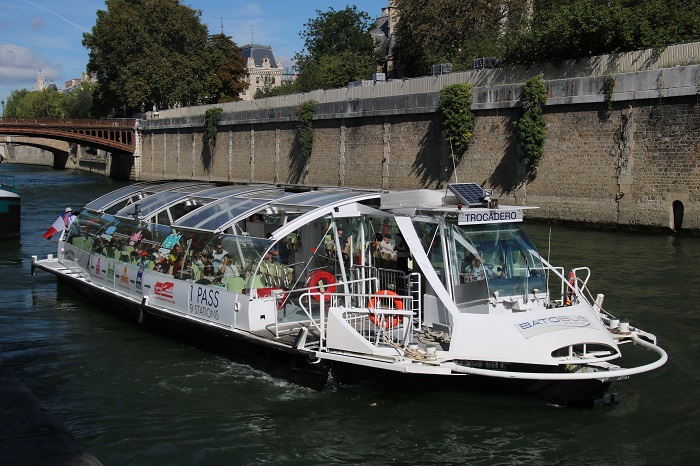 However, their design is clearly dictated by function and as passengers have to see everything there’s glass on the sides and top for maximum viewing suggesting more of a floating greenhouse than boat.
Beautiful views in every direction along the river. 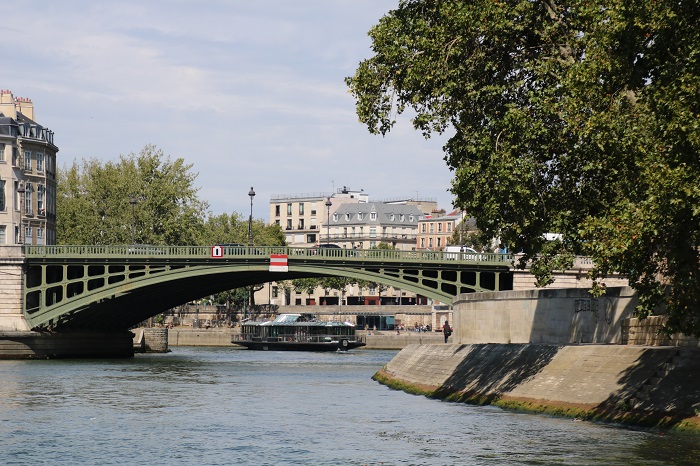 Tour boats aside, loads of lovely boats, or should I say houseboats, some private homes and many serving as sort of B&B mini hotels rented out to tourists. In some areas they were moored three deep.
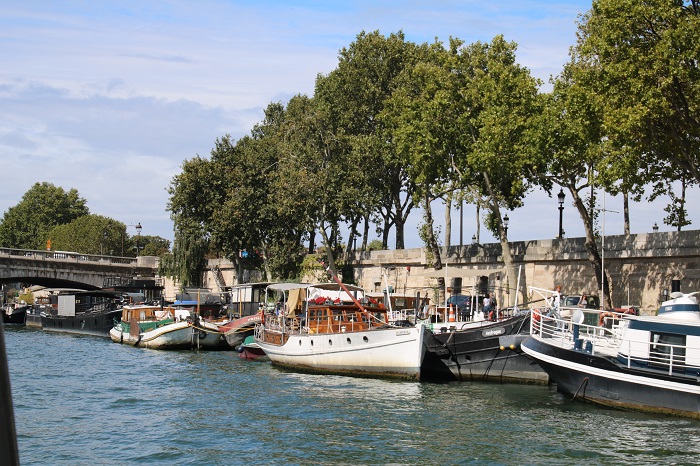 Often quite colorful.
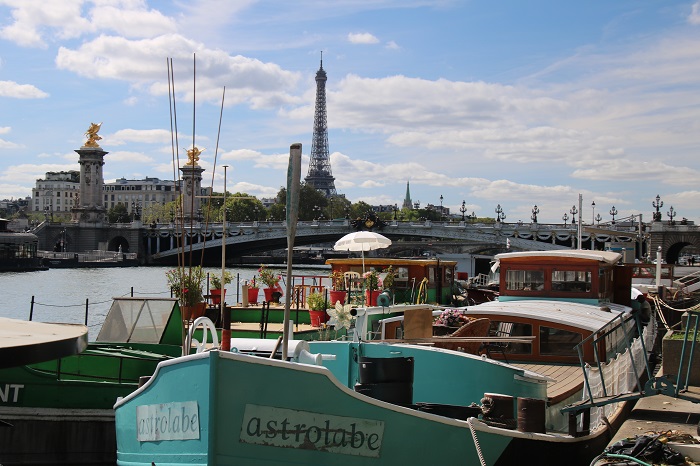 Loved this blue one. My favorite color.
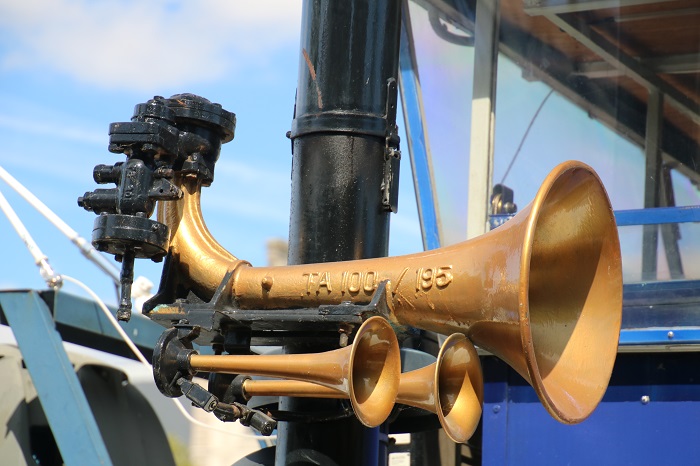
 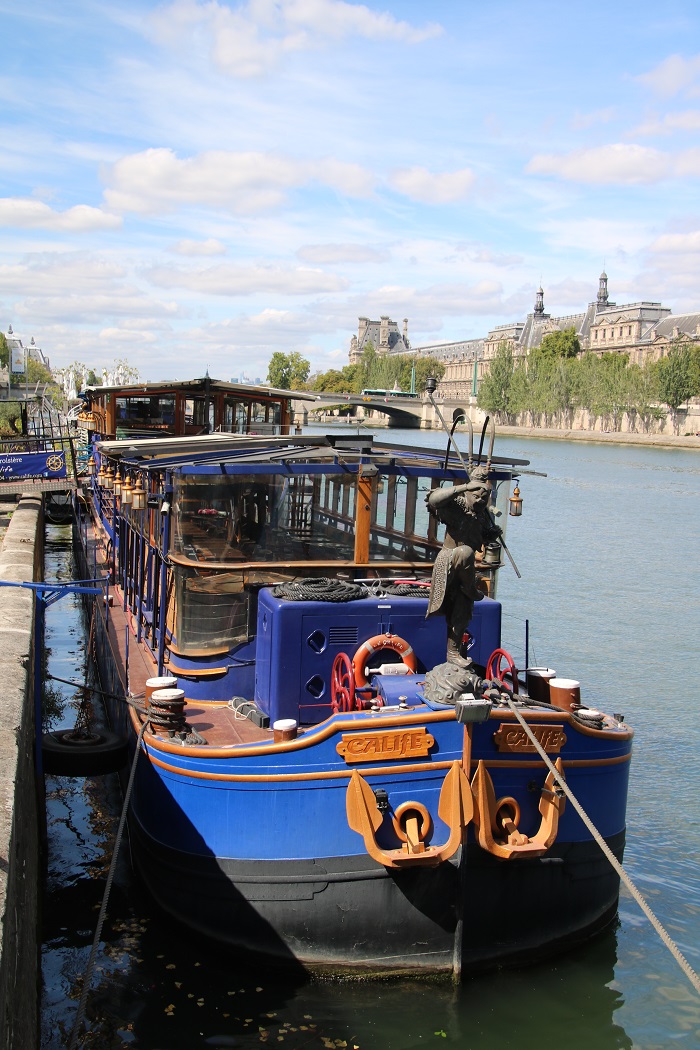 Wonderful details.
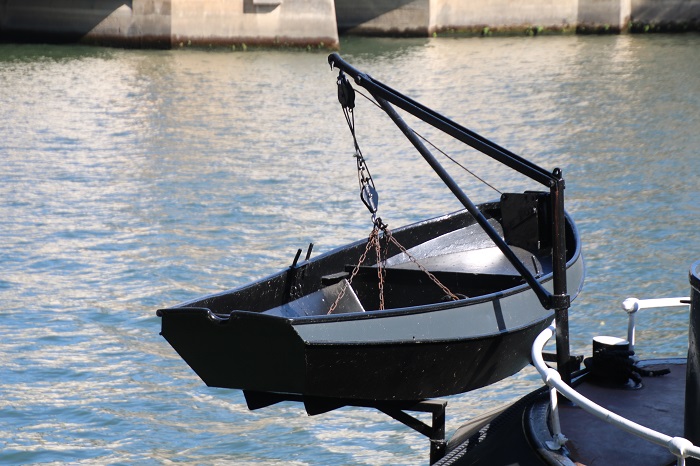
  Interesting dinks including this one welded from steel.
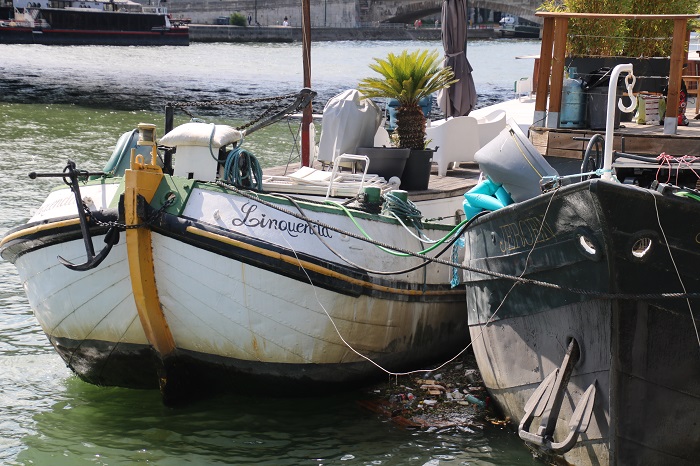
  Beautiful lines but she could use a bit of paint.
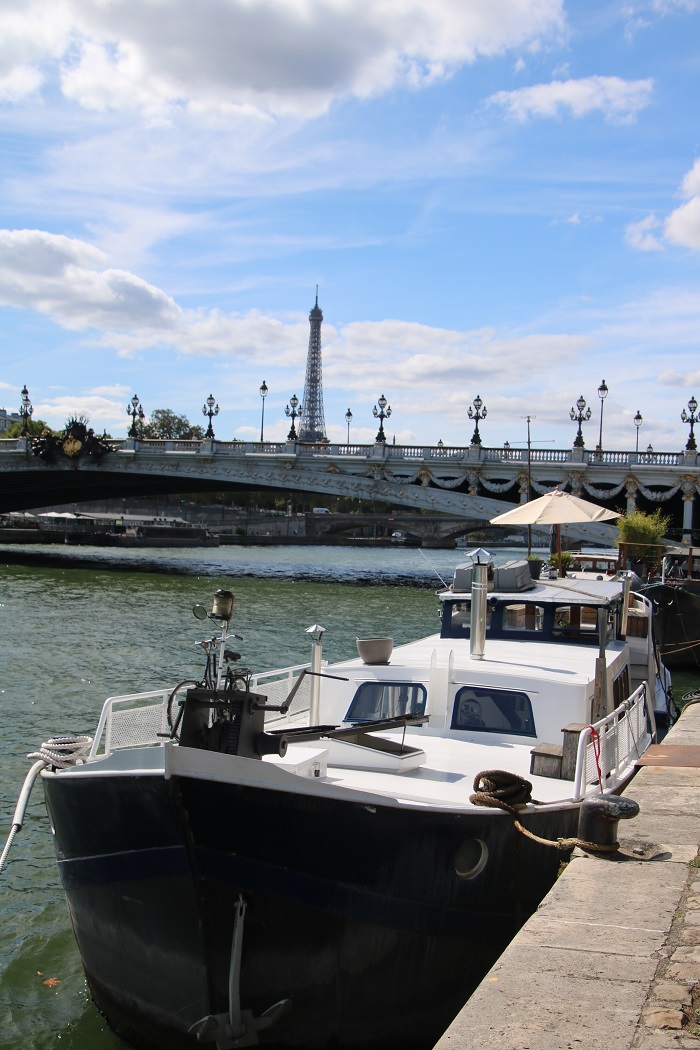
  What a great spot to tie up. Many were moored in locations that offered with a great view of the Eiffel tower, like this one.
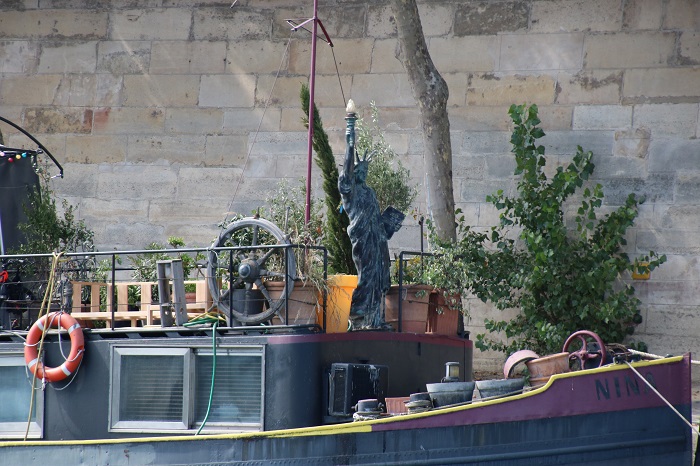
 This houseboat featured another landmark from France although now in NY Harbor.
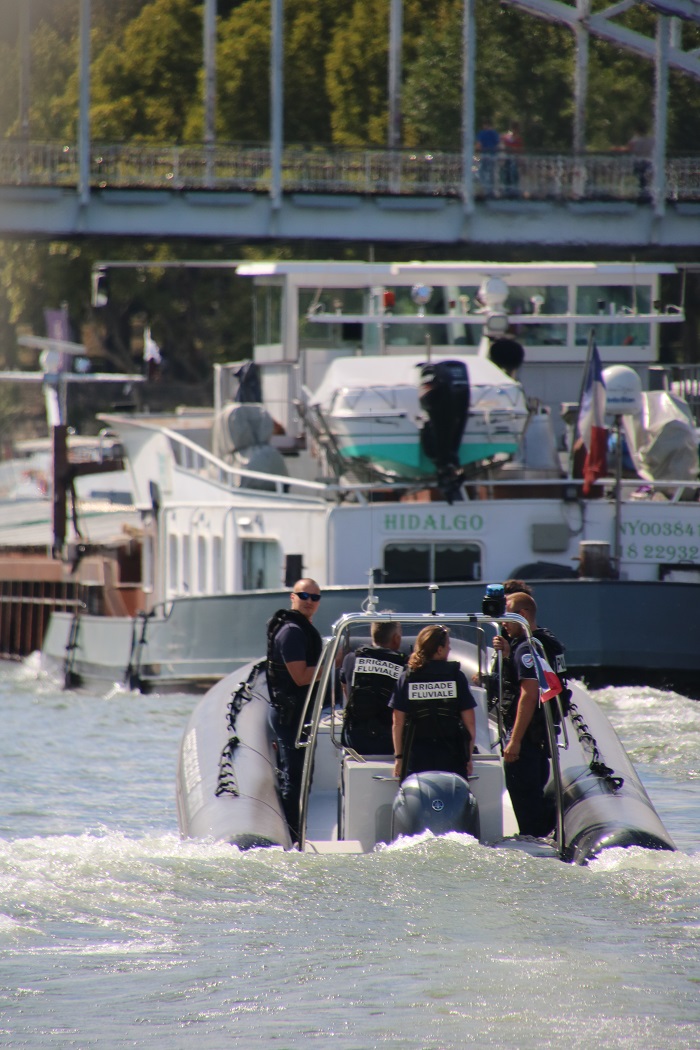
  There was an active police presence and it seemed that they were always going full tilt and leaving a big wake. This was one of their more sedate moments.
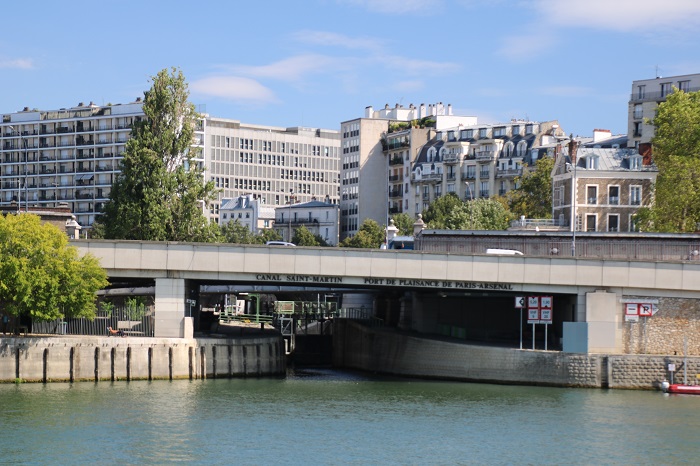
  You can get all the way from the English Channel to the north and the Med to the south via the extensive canal system. This is the entrance to a canal that heads all the way up to The English Channel. A good part of this particular stretch of the canal is fully underground beneath city streets. I saw some ventilation grates along road medians. I wonder if they are lit? I guess there must be some sort of canal traffic control as I doubt that there are any passing lanes.
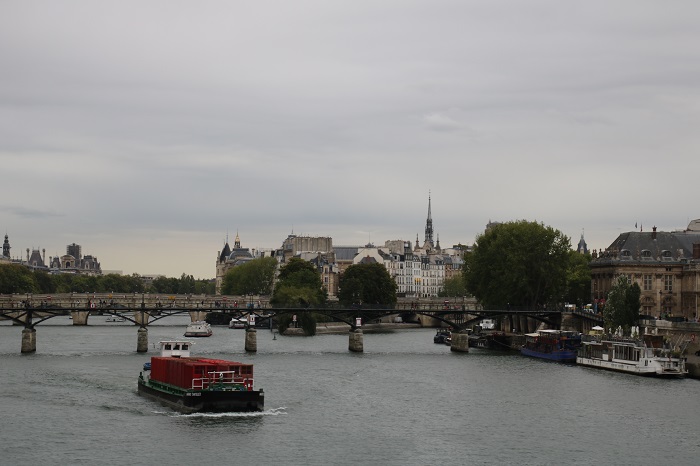
 There is a huge amount of commercial traffic.
 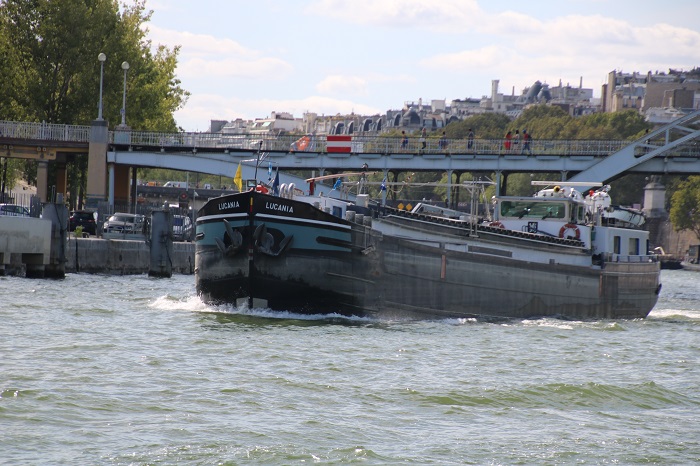 And the barges, all low enough to fit under the city bridges, often sport a vehicle and crane to help the crew get around, two in this case. His and hers? His and other his?
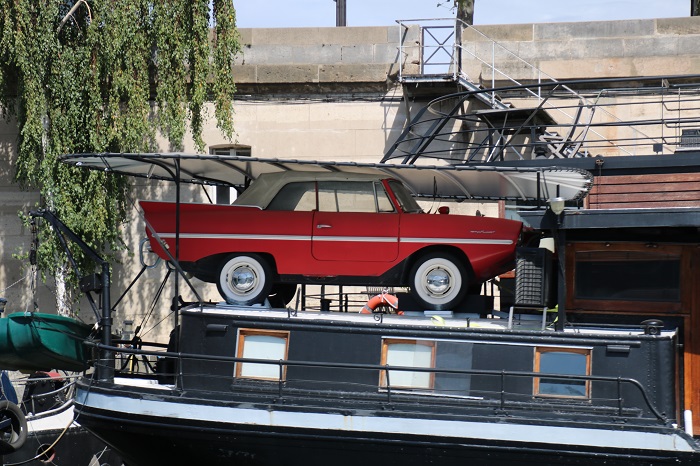
 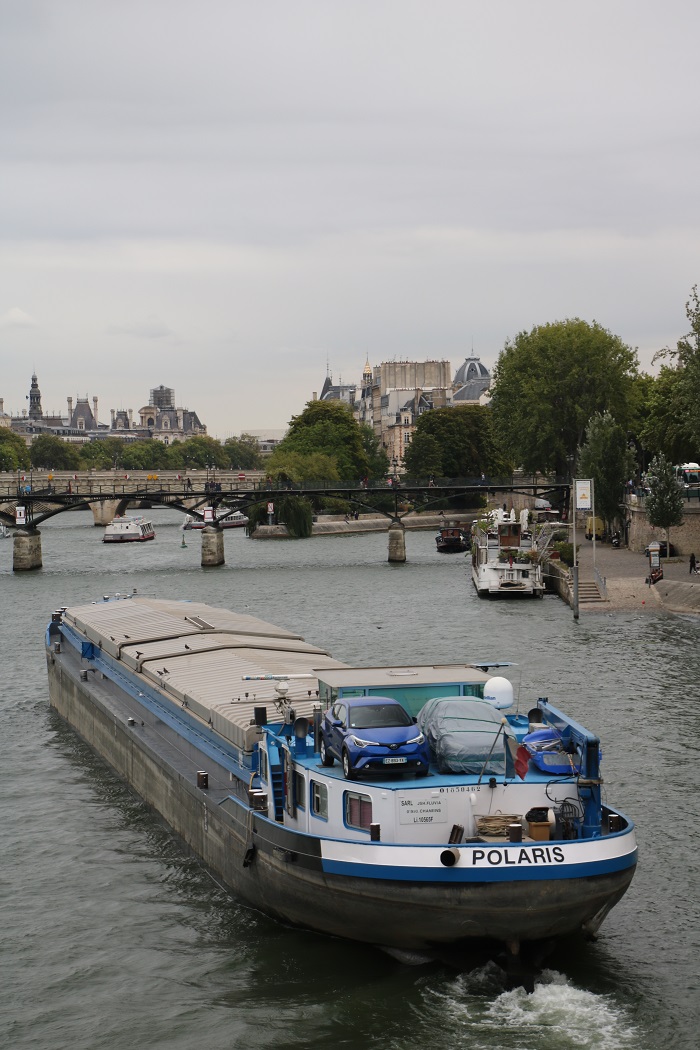 This one was on the back of a houseboat and it even has a cover to protect it from the elements. Not sure how they’d get it on shore though.
 This upscale tour boat had particularly beautiful lines. Love the stern.
  The views along the river were spectacular and that makes sense as when the city was built, water was the simplest way to get around.
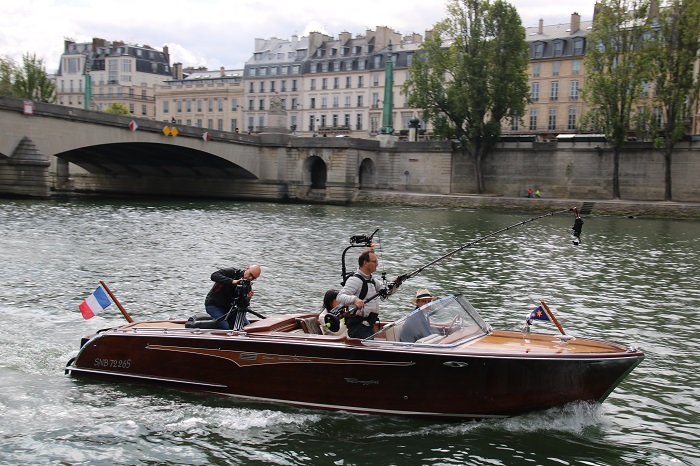
 And speaking of getting around. This beautiful runabout featured two passengers in period clothing and a film crew. Wonder what movie they were filming or was it just a sophisticated selfie stick. “Frank, FRANK, put that stupid thing away. We ALREADY have enough pictures! And, WHO is that creep in the back of the boat anyway?”
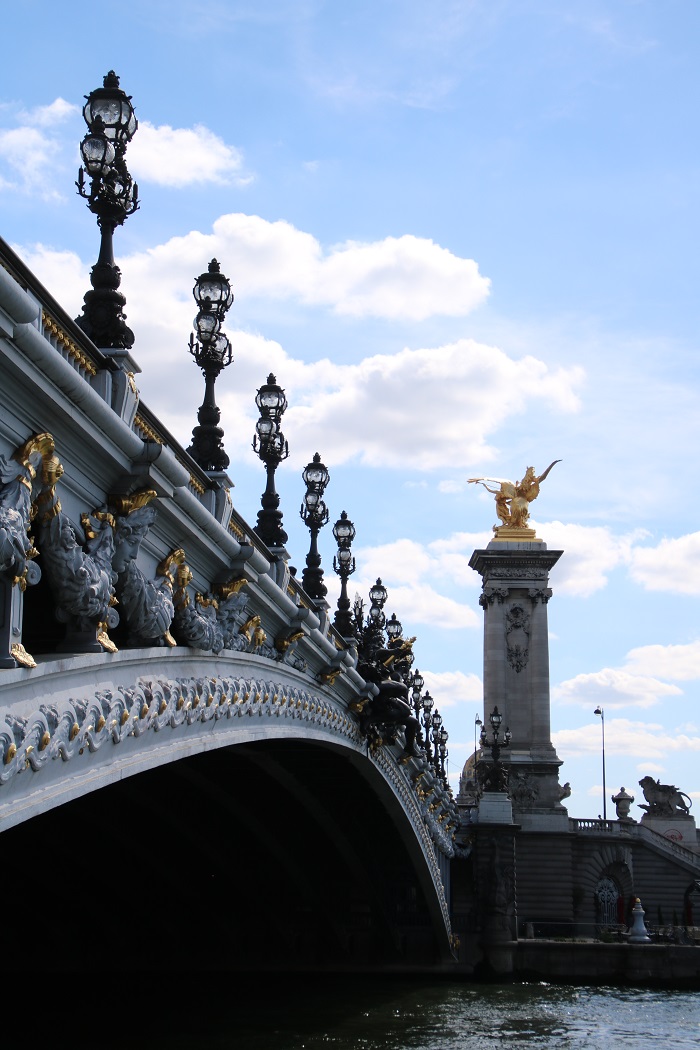
 And, where there is water there are bridges.
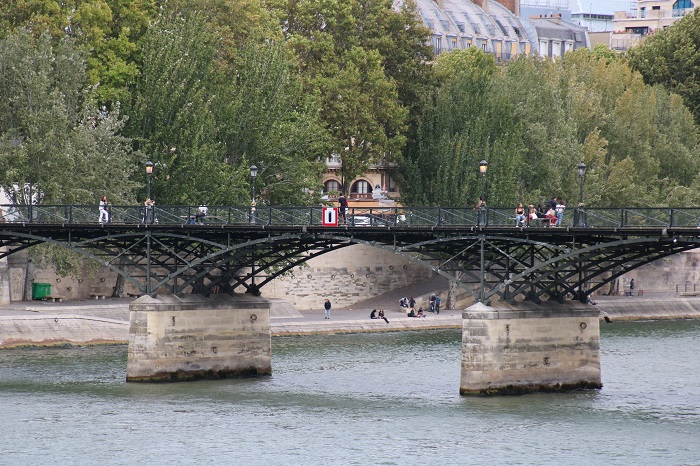 Each more spectacular than the last.
  And, some really nice fountains.
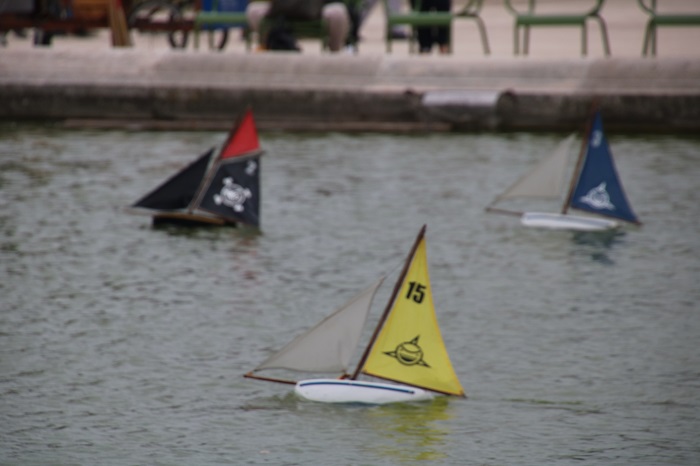
 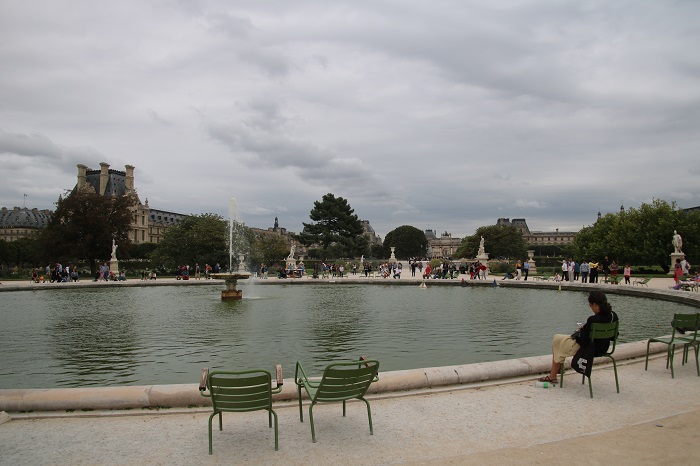 Complete with fleets of small boats.
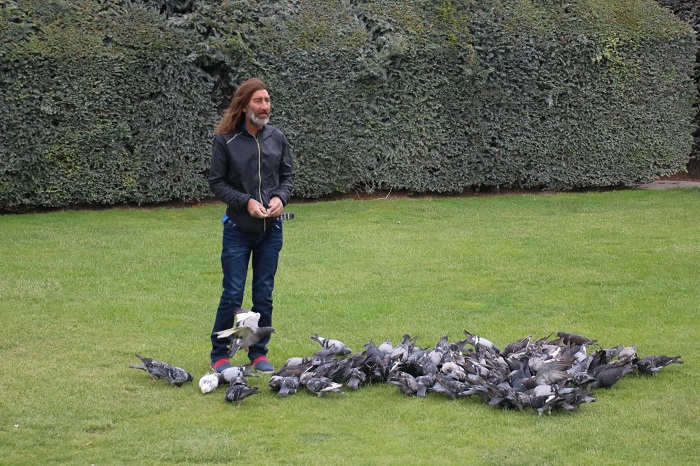
  And this guy nearby feeding pigeons. Obviously someone they knew and loved.
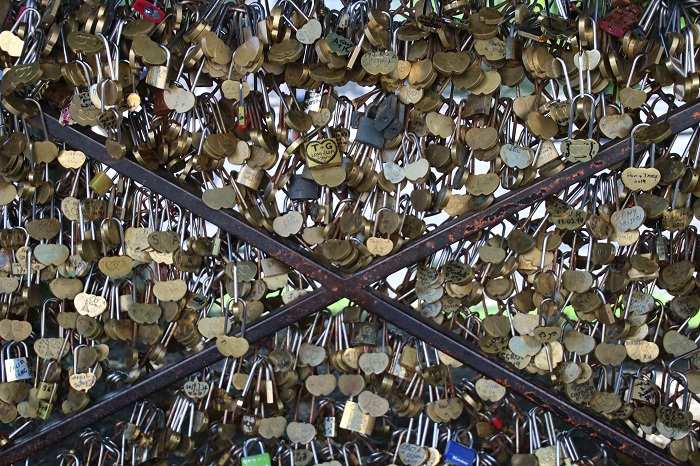
  And speaking of love, a custom in Paris is to purchase a lock, put your name, and that of your lover on it and “lock” your love to something. Some places are so packed…
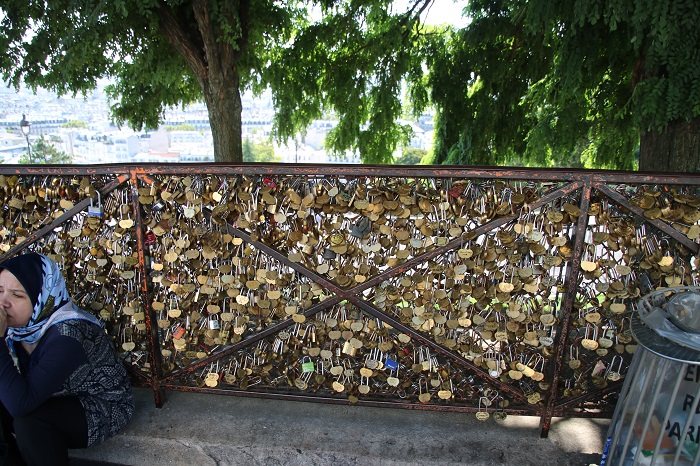 You can’t believe so much love, I guess.
  And speaking of love. The whole idea of the trip to France was brought up by Melody, our son’s partner, as they were invited to a wedding and asked us if we’d like to come along. Oh boy, was Brenda on that idea. I was the official photographer of Chris and Melody outside the church where the wedding was held. We lurked outside waiting for the crowd to let out.
 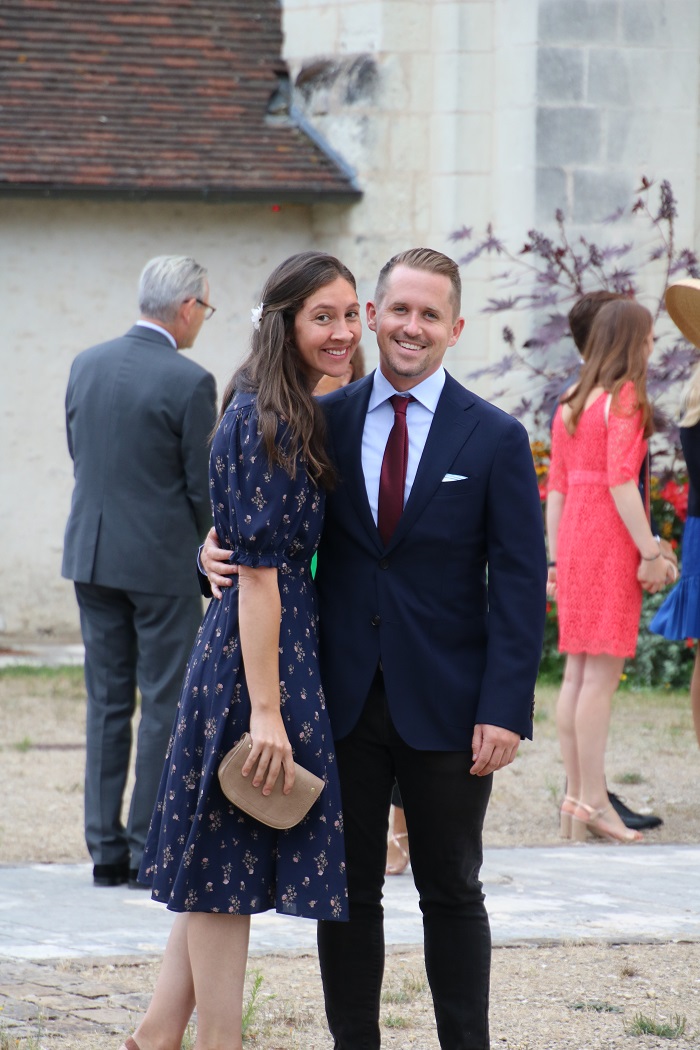 The reception, we learned, was in, no kidding, a castle with a real live mote. It was the family home of the bride’s grandmother who was too infirm to join in the party but watched from an upstairs window.
As we moved often from one hotel to the next, we were able to try many places in our two weeks on the road and I do mean on the road as we rented a car and put a lot of miles on it. Anyway, we too spent time in a hotel with a mote. How about this place? George Washington might not have slept here but we did. 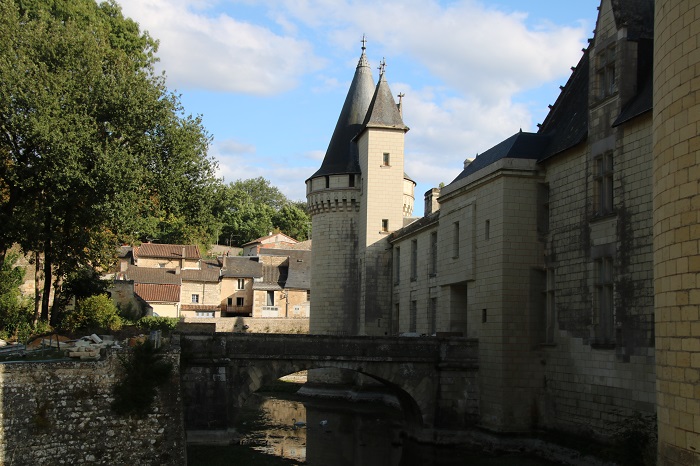 We finished up our trip with a few more days in Paris and spent time in many cafes, actually more than one each day. So much food to sample.
 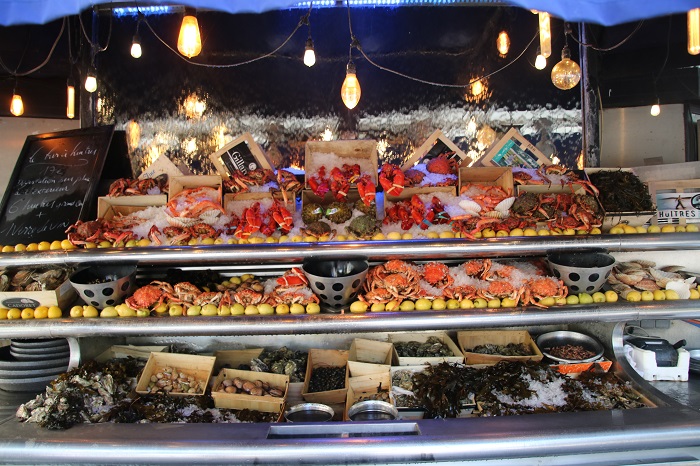 Actually, so much food everywhere and beautifully displayed.
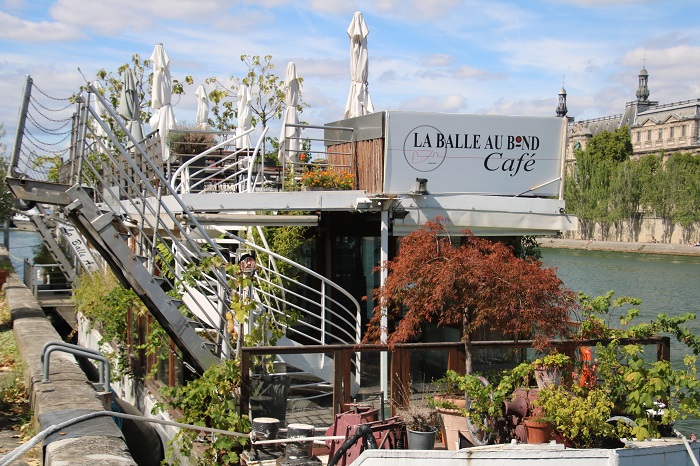
 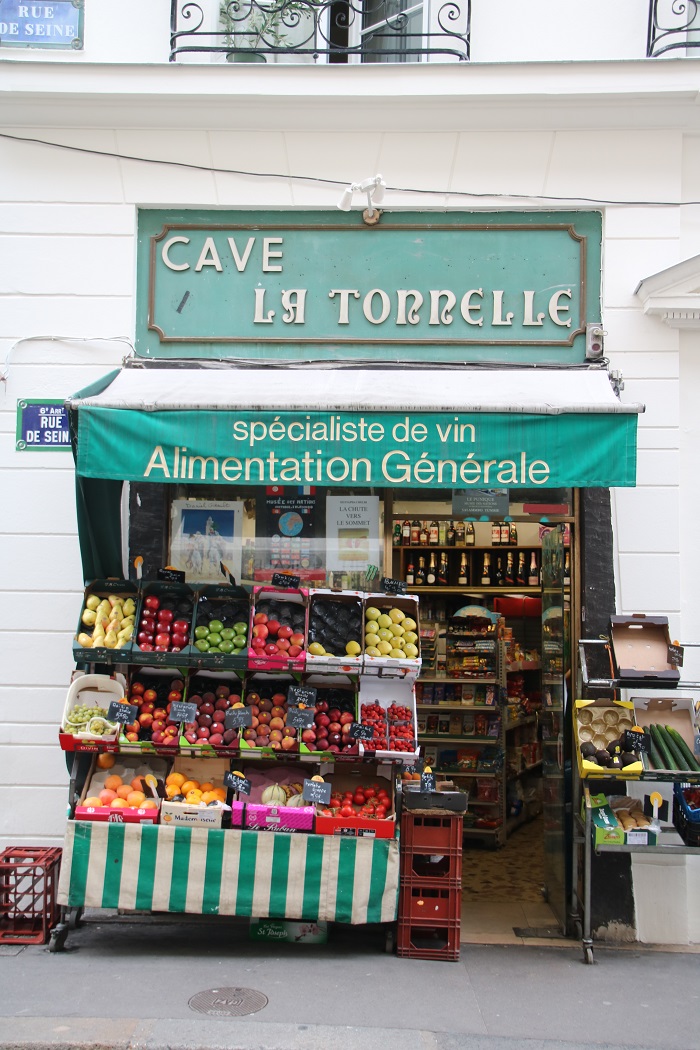 Places to eat aboard.
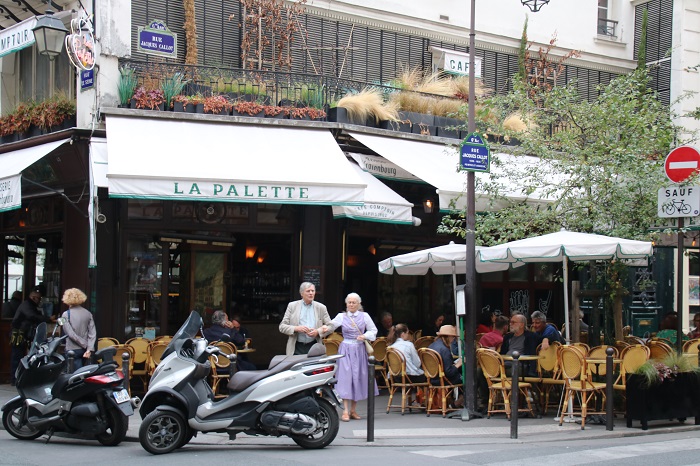
  Places to eat on every street corner. Parisians love to eat outdoors.
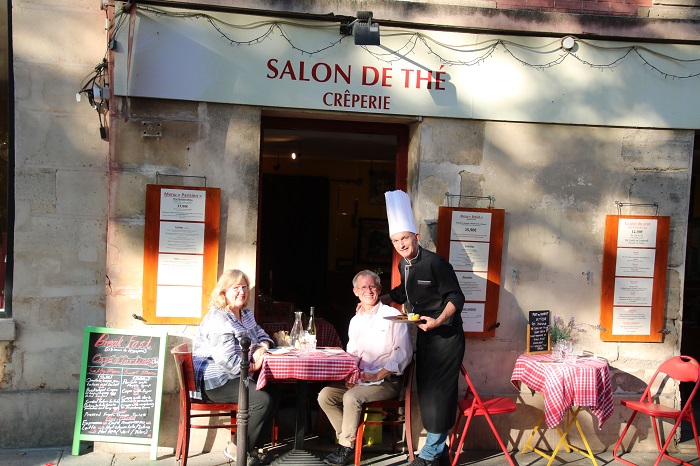
 So did we. Loved the hat on the chef who served us. Our last dinner together in Paris before heading home Note the list to starboard in this photo. The waiter too it seems. After all that wine, and it’s cheaper than soda so why not, I had a bit of a list as well.
  Yes, in Paris wine costs about the same, sometimes less than soda so why not have wine? And there are so many types to try we had a tough time deciding which to have.
In Paris, there’s no need to turn water in to wine, why bother, as it costs about the same amount as water and wine is so much more fun to drink.
Well, that’s about all I have to say right now. Have to finish packing for a weekend aboard Pandora, meeting up with some friends in Oyster Bay. It’ll be like old times, not that the “new times” are all that bad.
We did just return from Paris after all. Just sayin…
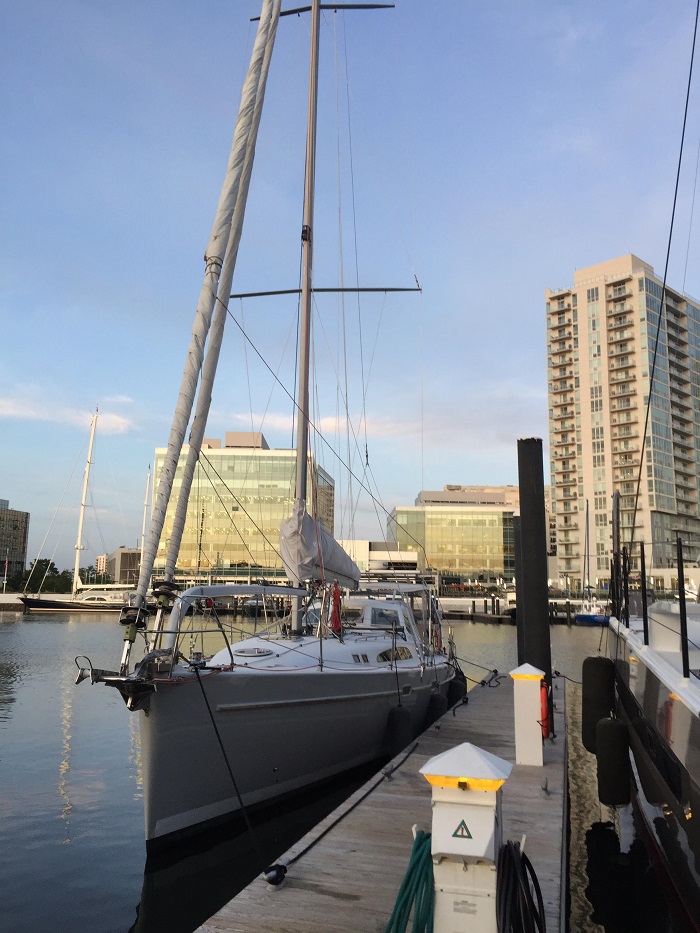 While she looks pretty big in that photo, she looks positively diminutive in this one, next to the big cat.
 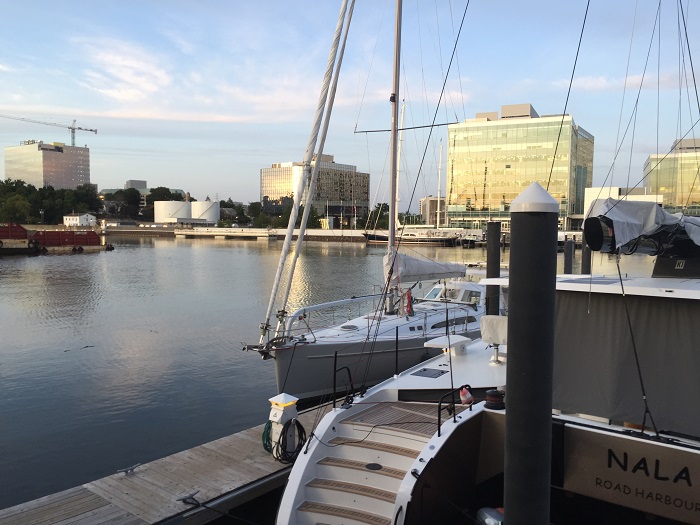 I was told to leave Pandora in a slip near the lift and she was out of the water before I even called the next morning. Here she is on the hard. I sure hope that they put more supports under her and also add chains to keep them from slipping out.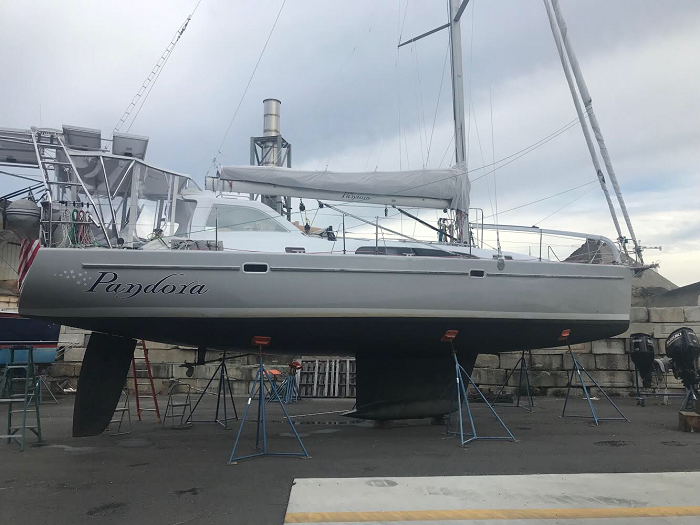
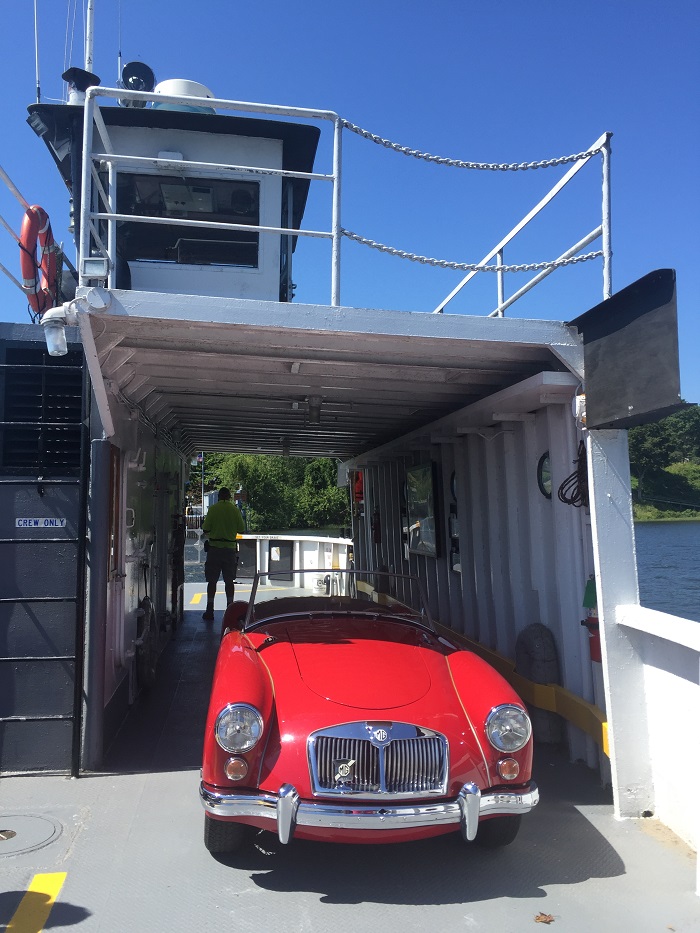 After nearly two years, I can’t believe that it’s nearly time to head to Antigua again. Let’s hope that there isn’t some sort of catastrophic hurricane that gets in the way.
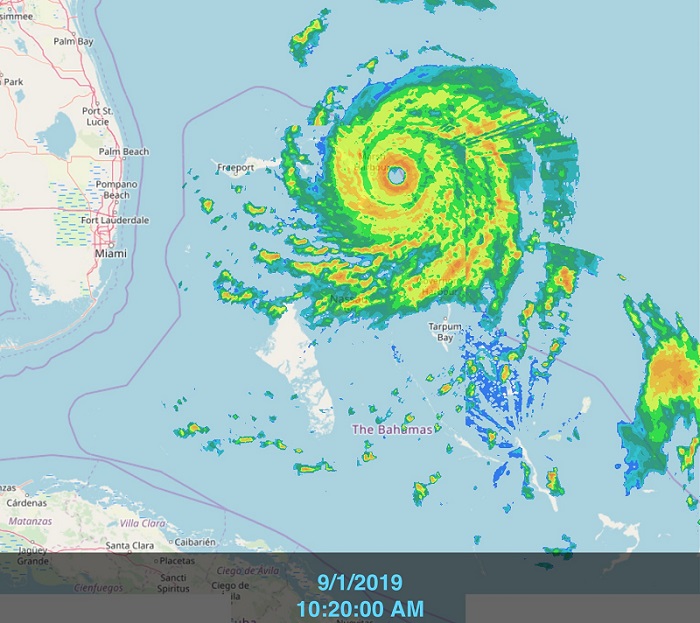 While Pandora is in good shape to make the run to Antigua and crew is in place, I sure hope that nothing happens in the next two months to change the rules like Dorian is doing in the Bahamas as I write this post.
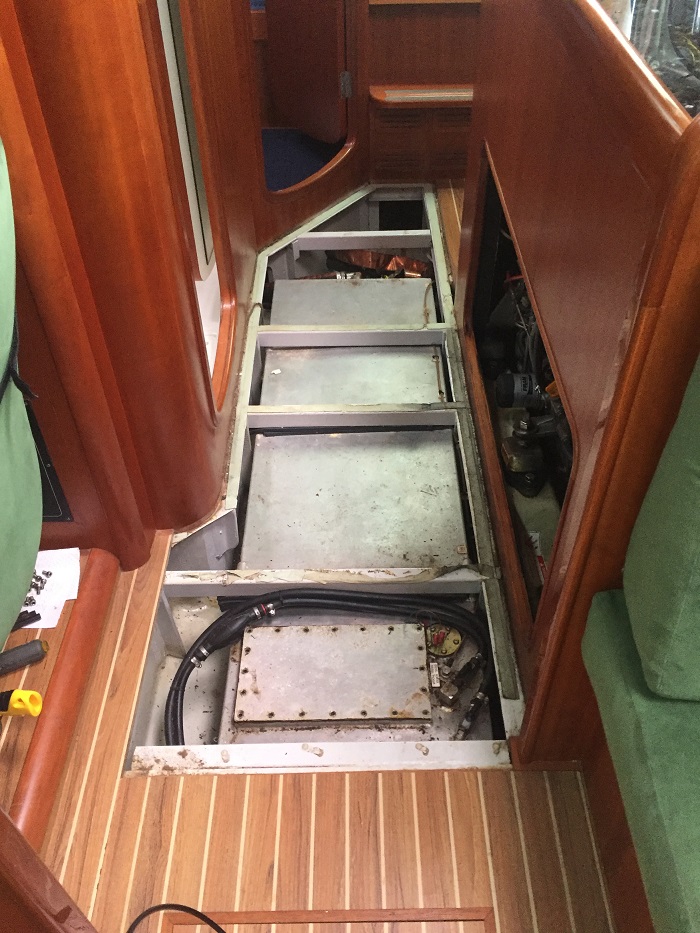 So, out came the tank. Removing it took several hours but it wasn’t all that difficult and all the hoses came off fairly easily, lubricated by fuel, I guess.
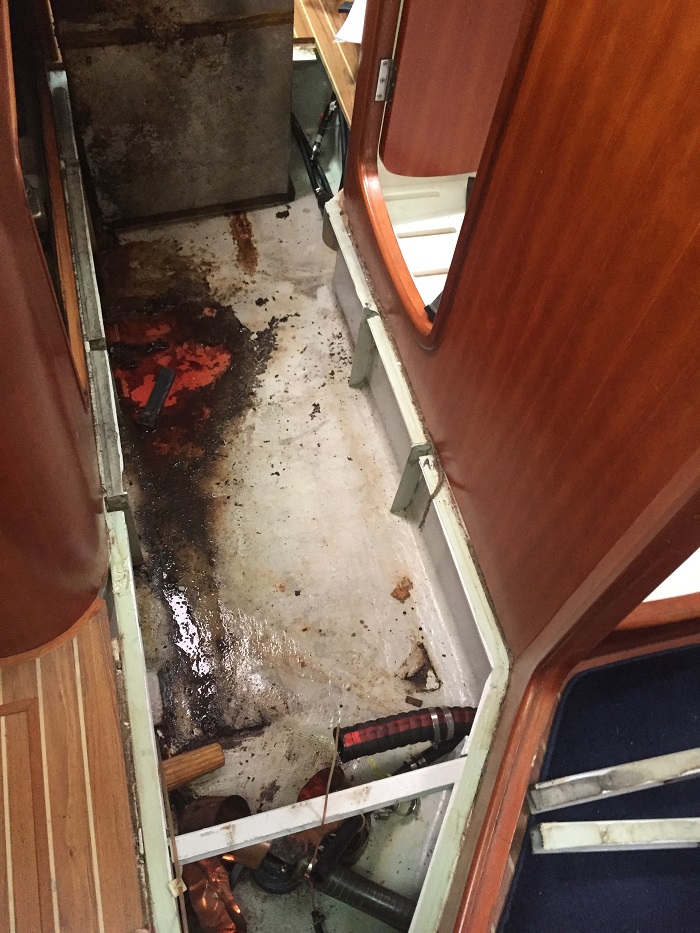 There was a nasty corroded spot on the bottom of the tank, located directly over the mess of fuel and crud on the hull. It seems that someone had left a stainless screw under the tank when the boat was built and after 12 years electrolysis did it’s work and “ate” a hole in the aluminum tank. Stainless screws, being a “noble metal” always wins over aluminum which is less noble and easily corroded. Something as simple as a dropped screw in 2007, when Pandora was built, was all that it took.
 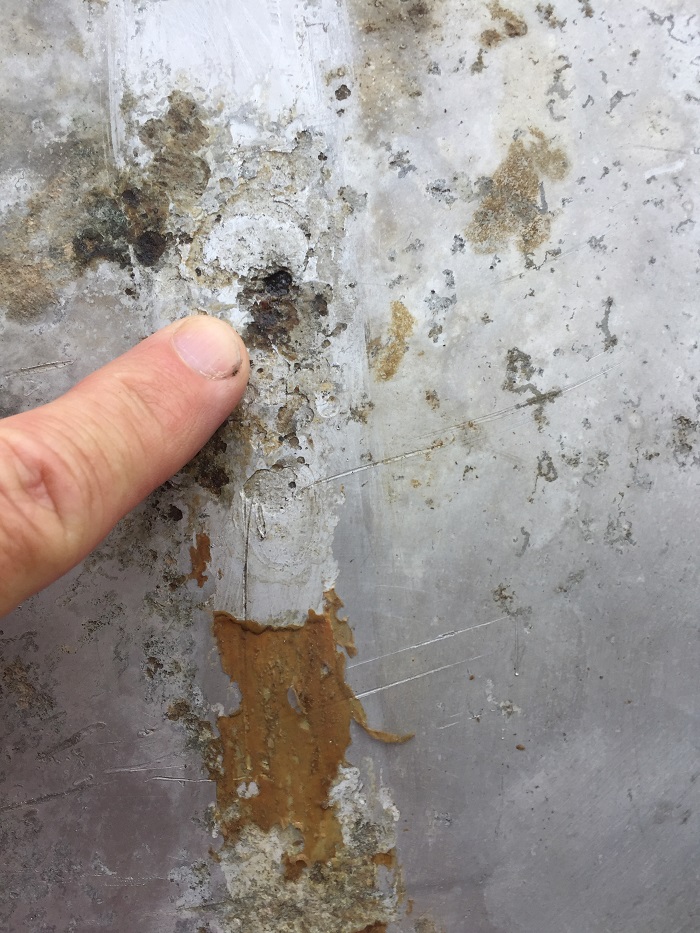 That combined with the fact that the tank was resting directly on the hull itself caused the problem. The proper installation of the tank would be to have it resting on neoprene strips or something else to isolate it from direct contact with the fiberglass hull. This way it would have been isolated from any abrasion, salt or errant fastenings that might be left under the tank.
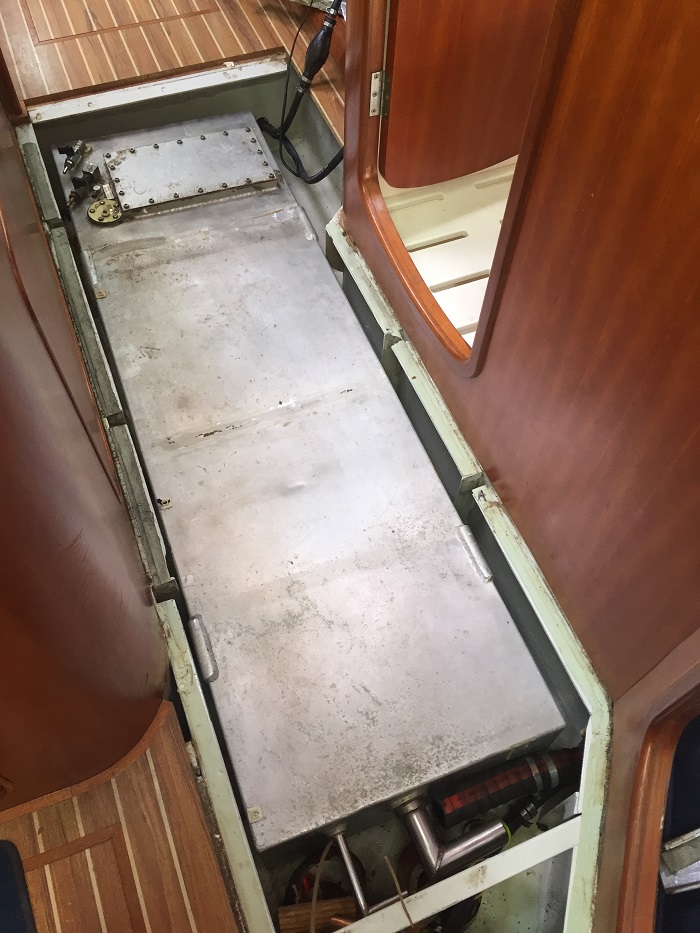 After putting all the hoses back in place, I reinstalled the floor braces, fiberglass “I” beams across the tank. These are pressed down on additional neoprene gaskets to ensure that the tank was not going to move around in rough conditions.
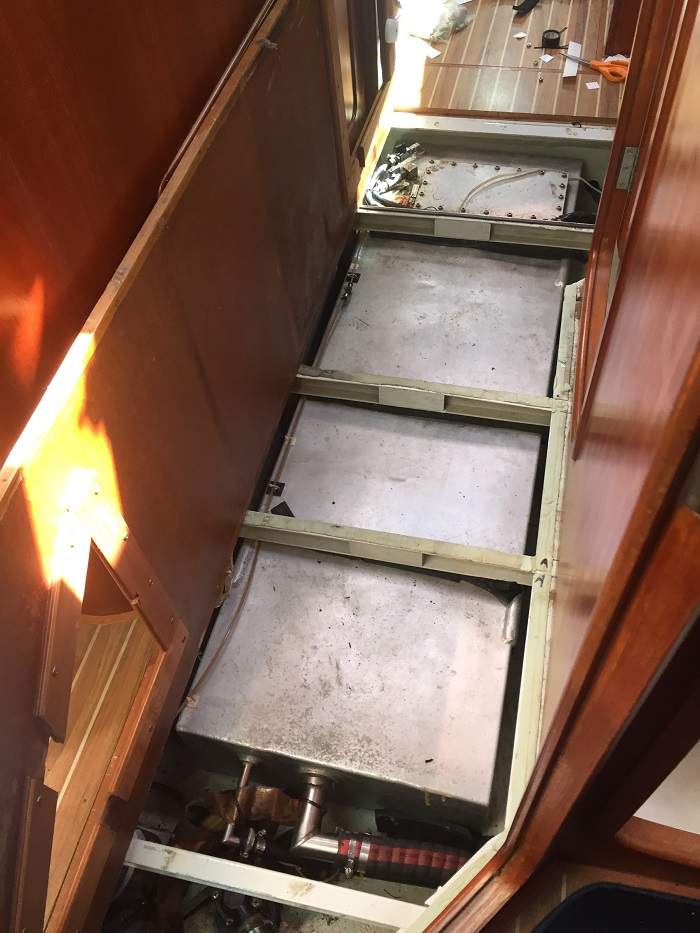 After putting the cabin sole back in place, I siphoned all the fuel back into the tank, less the 7 gallons, mixed with nasty bilge water, that I took from the bilge and voila, good as new. Actually, I am hoping better than new.
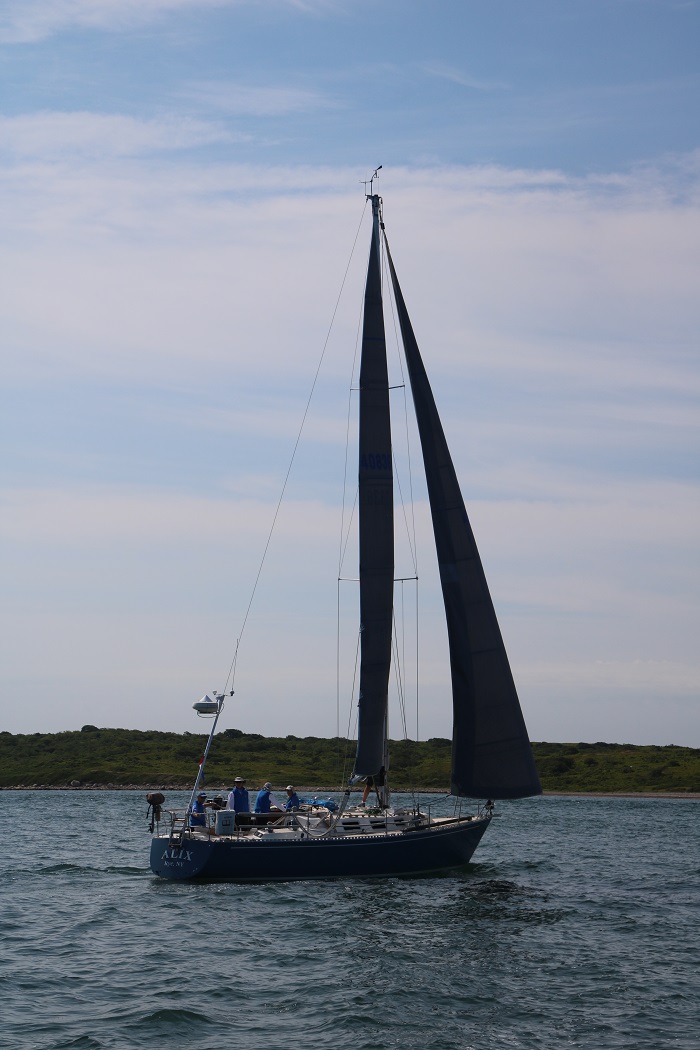 Along with a good supply of moral and anchoring support, I also supplied water for the crew to shower aboard Pandora, well, at least until my water-maker stopped functioning about midway through the week. Of course, that was in addition to an occasional rum punch and Klondike ice cream bar for the crew. However, expect that the showers trumped everything else. Nothing like a shower for the crew after a day of racing on the water but somehow ice cream aboard Pandora seemed to be a close second.
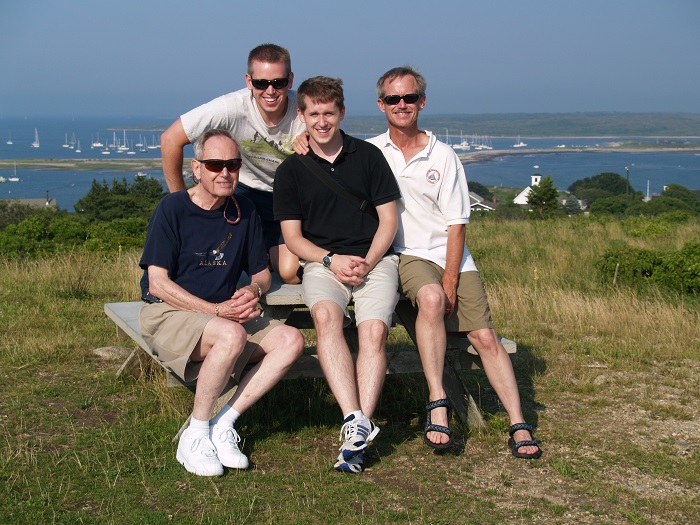
 Day one took us to Cuttyhunk Harbor, a place that holds a very special history for me as I have have visited it with every one of our boats, beginning way back in the early 80s on our 20′ catboat Tao. It was also a spot I visited with my boys and dad a few years before he died. It was the last time he was aboard and a very special time for us all. Here’s Dad, Rob and Chris photographed with me at the highest point on the island. This photo always makes me feel a bit teary.
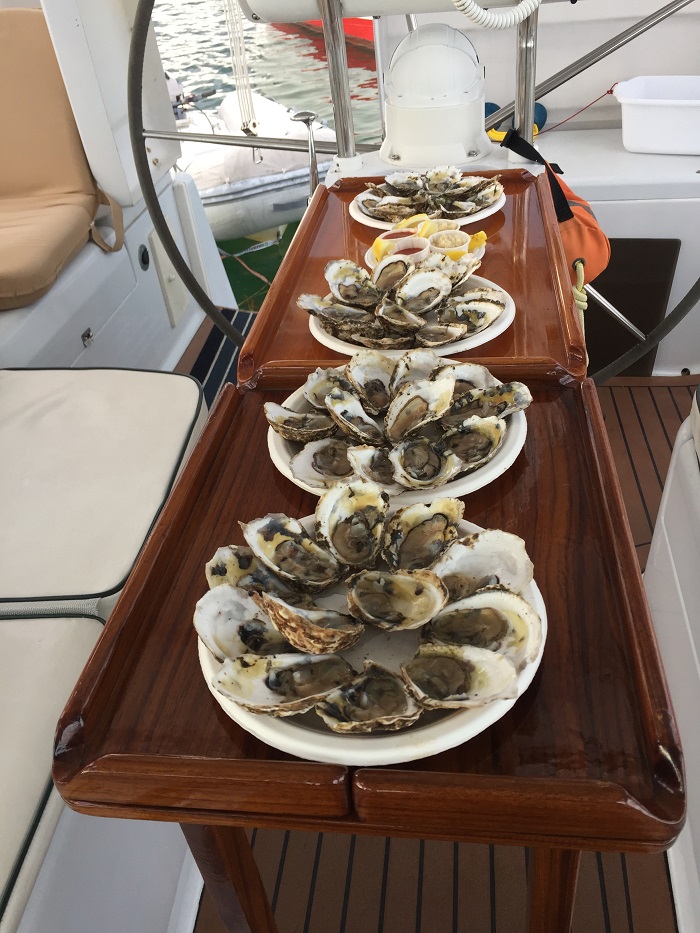
 The crew of Pandora and Alix shared some of the famous Cuttyhunk oysters on in the harbor washed down by some “Pandora imported” Caribbean rum fueled rum punch.
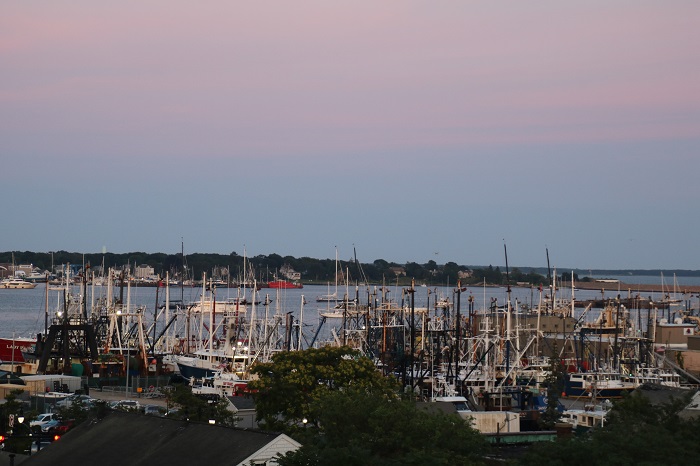
  Our next stop was New Bedford, a somewhat gritty, but in a nice way, fishing port. This is the view from the observation deck of the New Bedford Whaling Museum, where we had a terrific cocktail party.
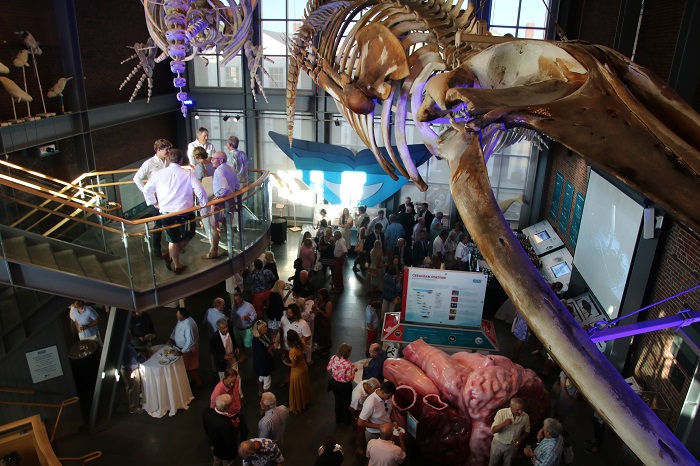
  The food and drink flowed liberally.
 As I entered the harbor earlier in the day, I was passed by Columbia, the reproduction of a Grand Banks fishing schooner built in Panama City FL. I was aboard her for a tour in Antigua two winters ago. She’s a wonderful yacht. I
 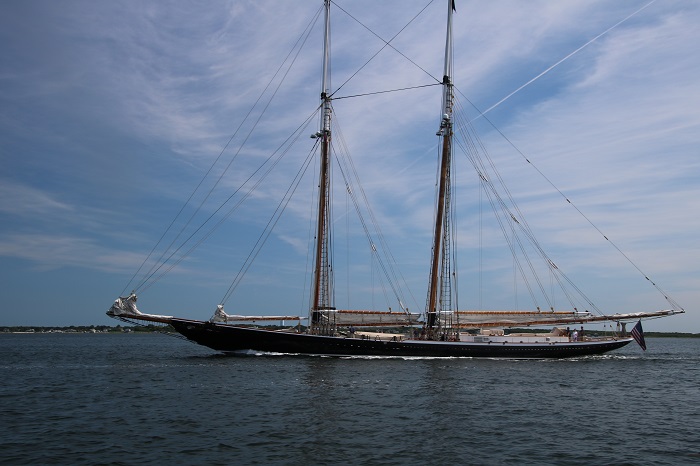 She’s even more impressive up close after her most recent refit.
 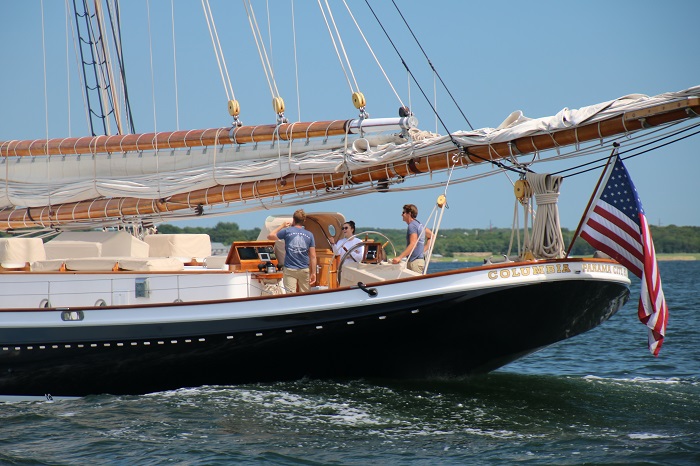 I particularly love this angle. What beautiful lines.
 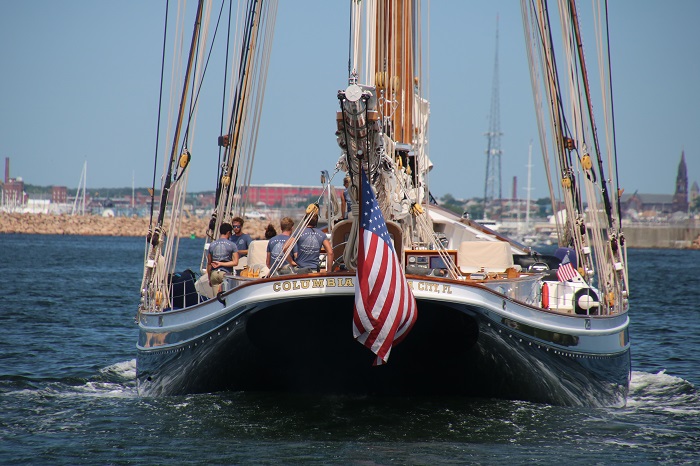 The next day, and yes, we were only there for one day, was to head to Edgartown on Martha’s Vineyard. Happily, we spent two days there, our only “lay day”.
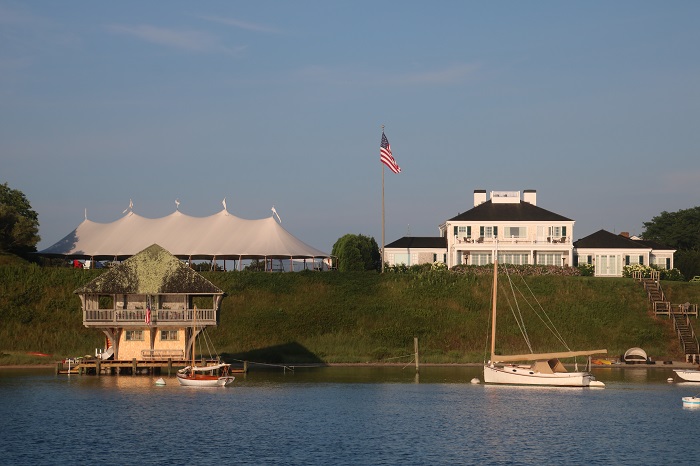 Pandora was on a mooring directly out in front of the place, tied up with Brilliant, another boat on the cruise. Her owners also happen to be members of the Essex Yacht Club. There family has deep ties to Edgartown, deep enough to snag a mooring in the most perfect spot imaginable it seems.
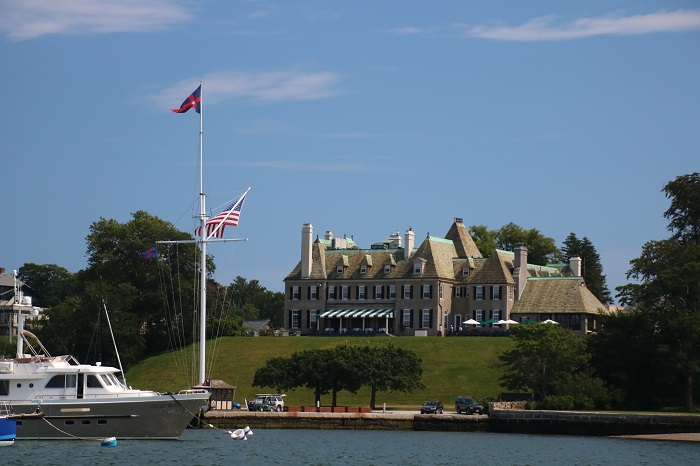
 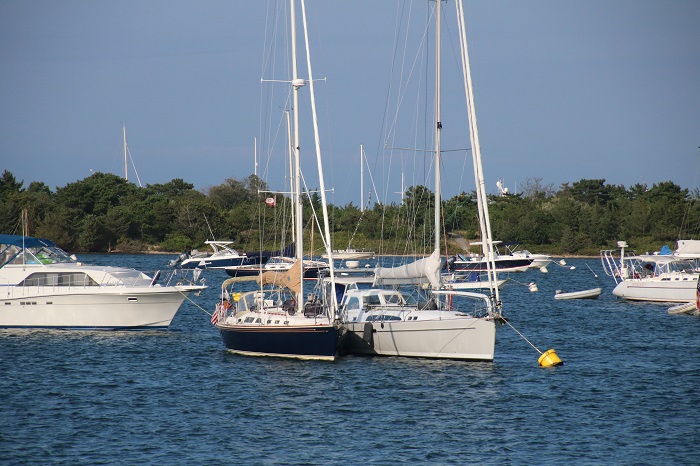 We took a Edgartown Yacht Club launch to the reception. There’s Pandora rafted with Brilliant on a mooring directly beyond the boathouse and to the right. Perfect location, right?
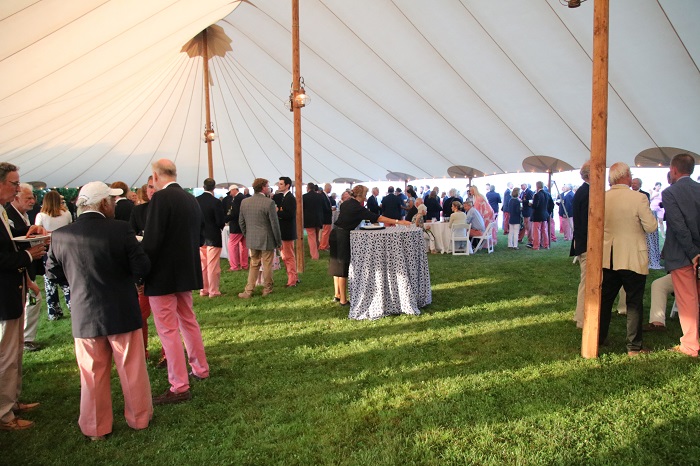
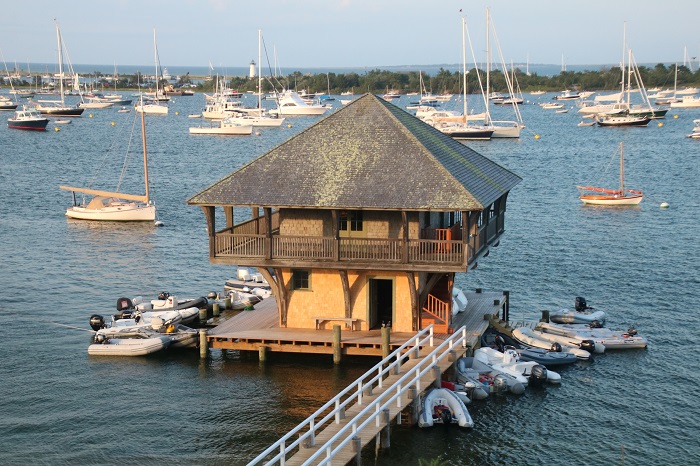 It was a lovely summer evening and a perfect spot to survey the harbor. Jacket and “Nantucket red” slacks required. I now have both shorts and slacks in that particular color.
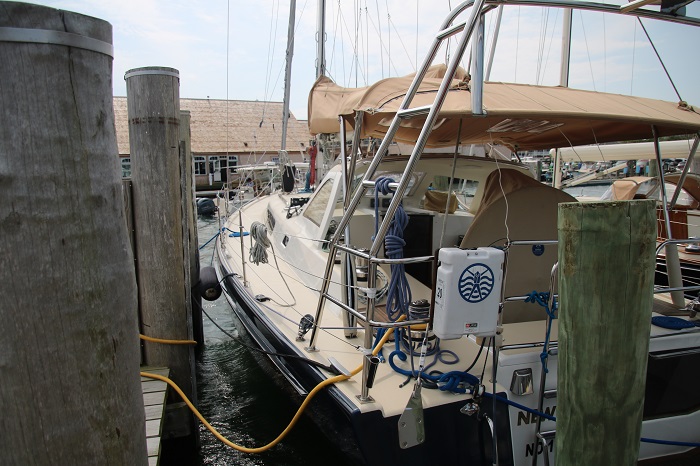
  The next day was a “lay day” so we could enjoy Edgartown, one of my favorite spots to visit before the “march” got underway again. Interestingly, Pandora’s “sistership”, hull #2 of three, has a slip there for part of the summer. She is owned by two attorneys from PA, one keeps a home in Edgartown and the other near three mile harbor, in the Hamptons. She’s the same design as Pandora but different in many ways, including a much smaller hard dodger and none of the cruising gear that is so important on Pandora. She is perfectly maintained. I wish my decks were as perfect as hers.
 Craig and I took a walking tour of some of the historic homes in Edgartown, arranged through the
 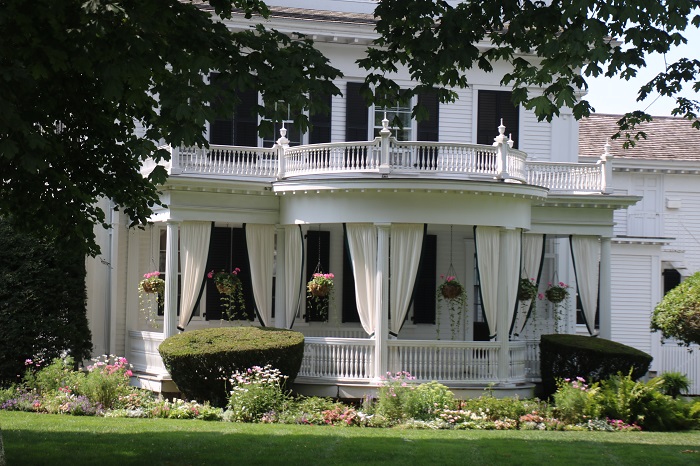 I took a long walk around town on my own. There are so many lovely homes and beautiful gardens to admire.
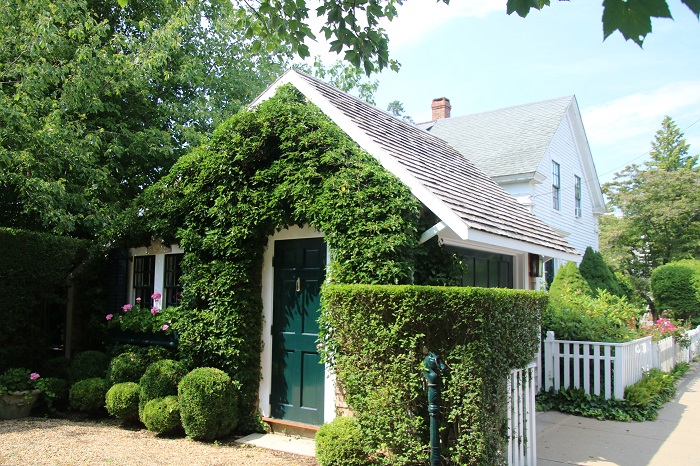
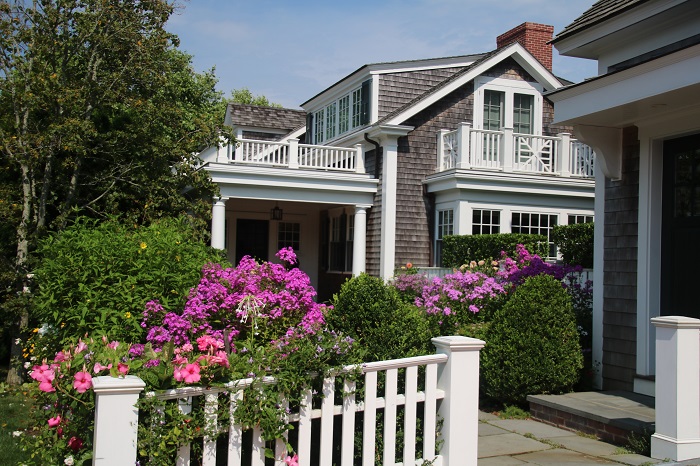 How about this ivy covered garage. The gardens at many of the homes make it clear that they are not managed by their owners, who probably get plenty of “exercise” writing checks.
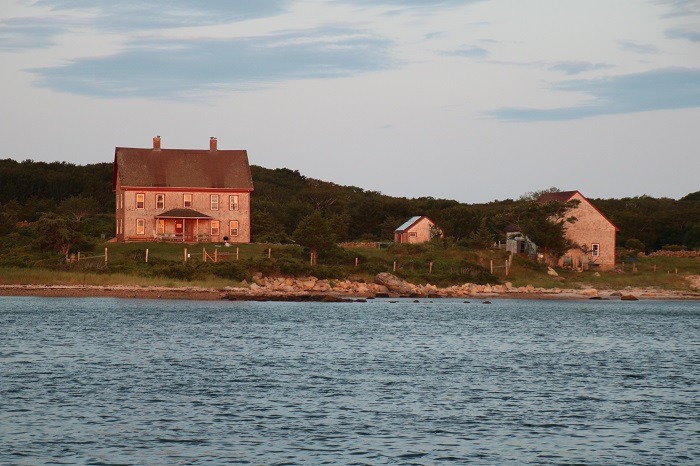
  Our next stop was Tarpaulin Cove on the west side of Naushon. This cove, more of an “indent” on the eastern side of the island, was once a popular spot for schooners to anchor and wait for the tides around West Chop, Martha’s Vineyard, a place where the tide runs hard. It is very secluded and while it’s private, as part of the Forbes Family Trust that controls the island, you can enjoy the long sandy beaches that rim the cove for nearly a mile.
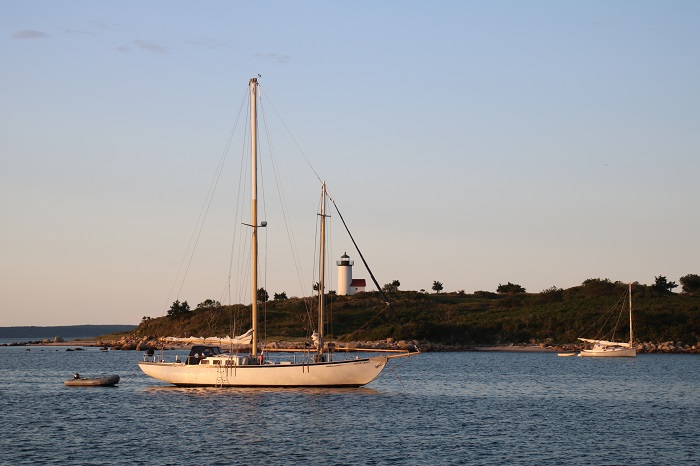
 And, of course, a charming lighthouse. Many of the boats on the cruise stopped in the cove for the night.
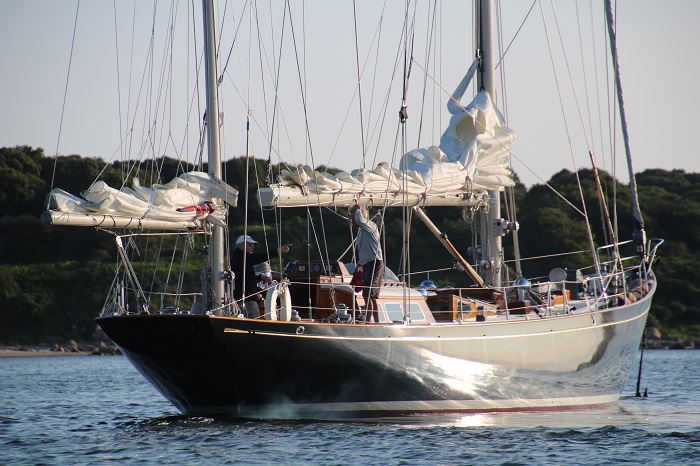
 Some of the yachts on the cruise were remarkable including this lovely yawl, Bolero. She was built at the Nevins Yard in City Island, launched in 1949 for the Brown family. The same Brown University family and once owners of the NYYC clubhouse, Harbor Court, in Newport. This is indeed a famous yacht.
  I met her current owner Ed, at a cocktail party the night we were in Tarpaulin Cove aboard Enticer, this beautiful 1935 Trumpy. We spoke about Bolero and he offered me a tour which I enjoyed when we returned to Newport. I’ll write about that visit in a subsequent post. Man, what a boat.
 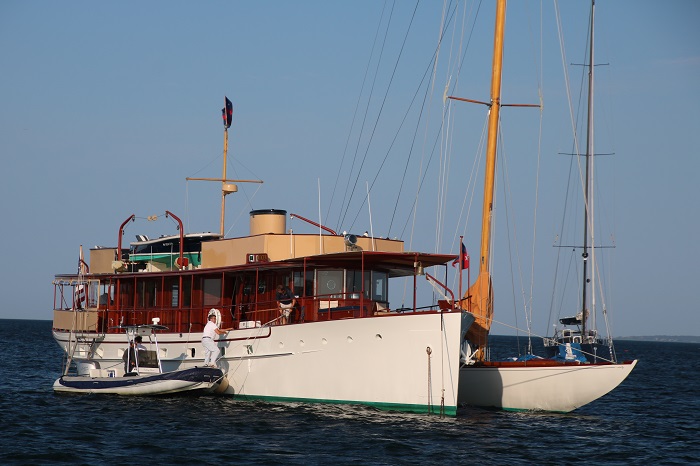 Anyway, back to Enticer. Notice that there is a boat rafted up to her. That’s Onawa, one of six identical boats built at the Abeking & Rasmussen yard in Germany. The design was the original model for the America’s Cup 12 meter rule for members of the NYYC. Onawa was launched in 1928 for Cameron Forbes of Boston, once an owner of the island where we were anchored. The island is still in the Forbes family.
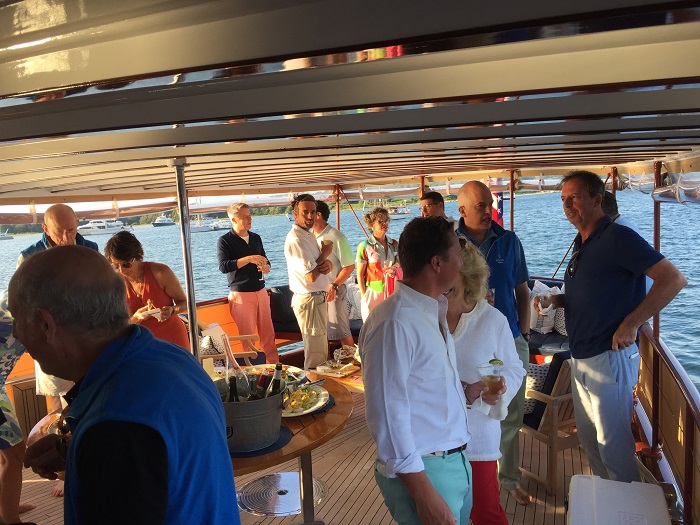 Some of the crew of Alix, including my friend Craig David, the owner and skipper of Alix, David, to the left.
 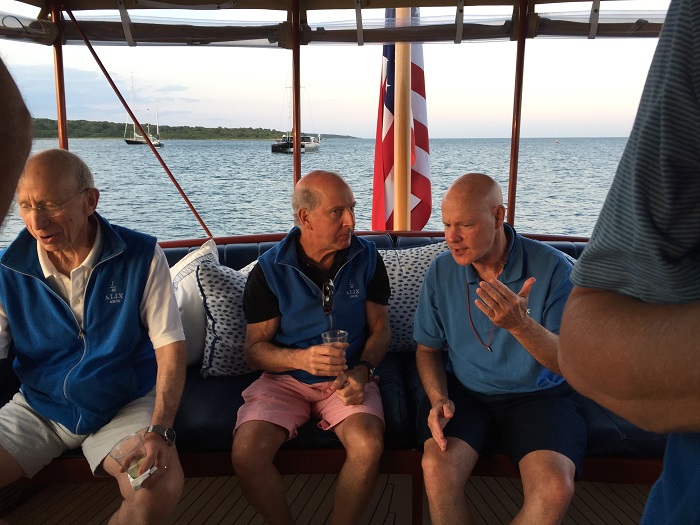 Onawa, rafted alongside, was open for tours. I met her captain Barb and we talked about the history of the yacht. She was headed to Nantucket for a charter the next week and there was some discussion about my helping out as crew. I would have loved that but my schedule was too tight. Alas, the busy life of a retired guy. So much for the lazy days of summer. Had I been available, would I have been invited? I guess I’ll never know. I really hope to visit Onawa again and take some proper photos for a post. Until then,
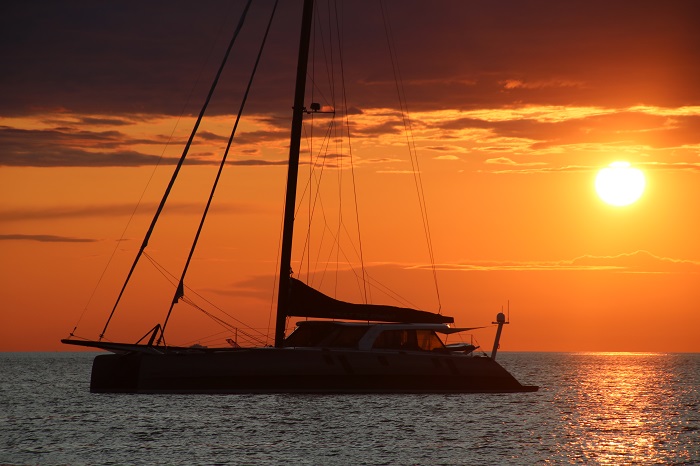
 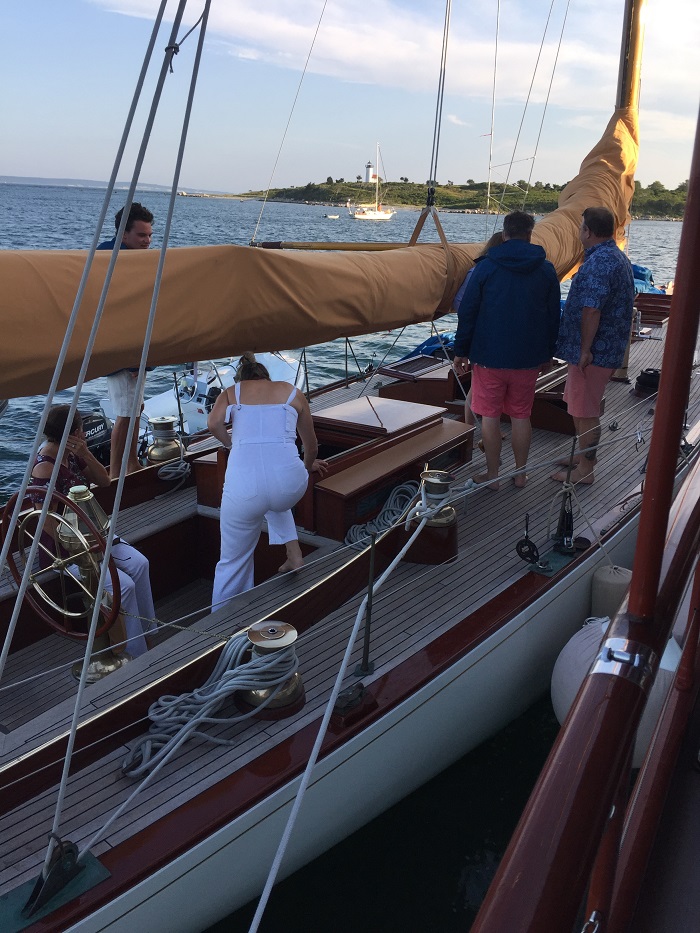 The next morning the sun rose, framing one of the beautiful carbon cats that were on the cruise. This one had passed me a few days earlier doing nearly 20kts.
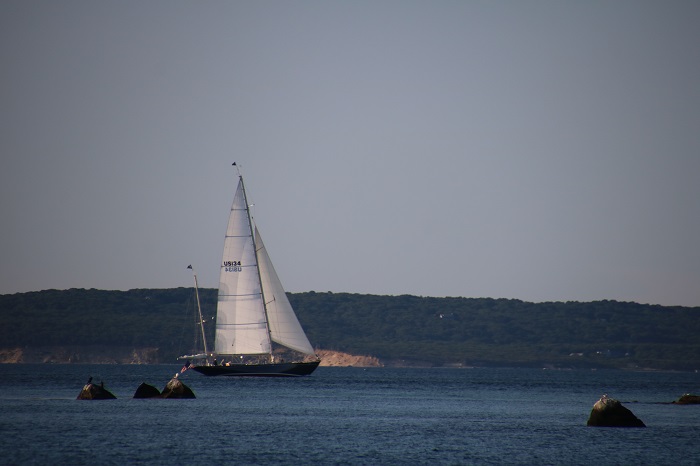
 A short while later Bolero sailed majestically out of the harbor, headed back to Newport. Now, that’s another boat I hope to sail on someday. Her captain, Casey, told me that she will be in the Caribbean this winter. I will too. Hmm…
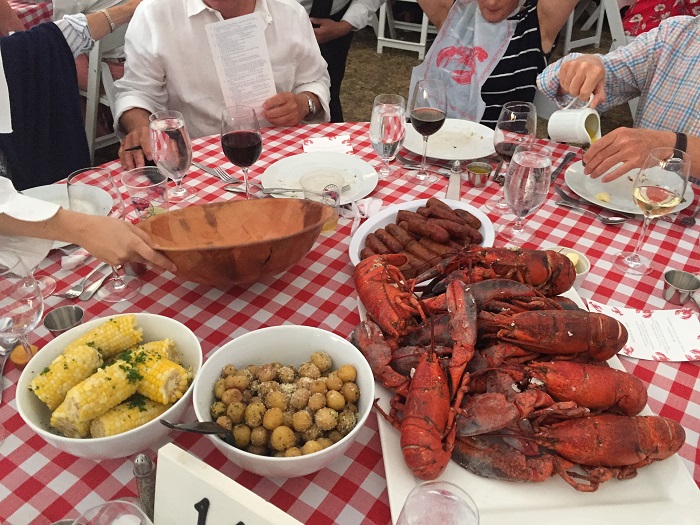
 Unlike Bolero, my run back to Newport wasn’t all that great, motorsailing into the wind. The wrap-up dinner for the cruise was held, as was the opening night, at Harbor Court. A cocktail party followed by a lobster dinner with all the trimmings.
 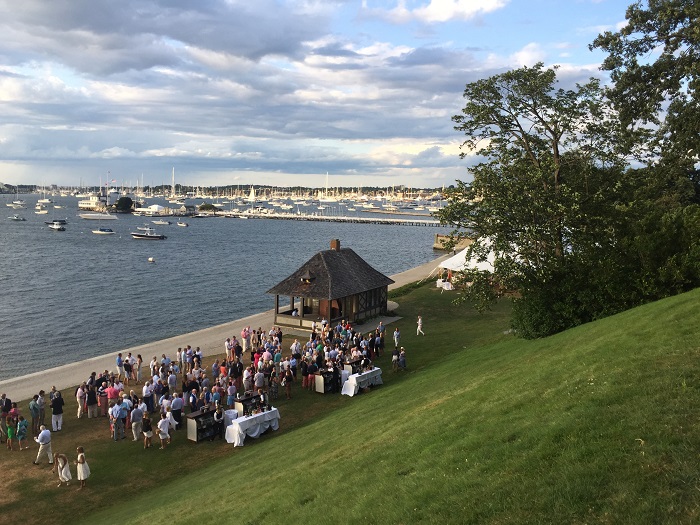 Dinner was brought out family style by a line of waiters holding platters dramatically high over their heads, marching along in a line. It was quite a spectacle and plenty tasty.
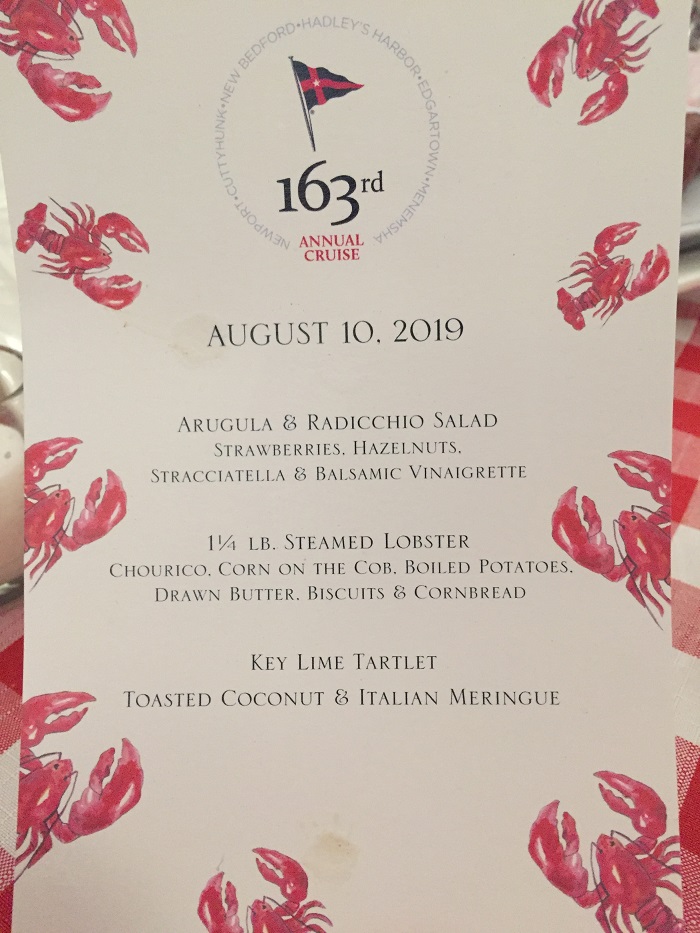
  Of course, each place had a printed menu in the unlikely event that you did not know what you were eating or perhaps forgot why you were there.
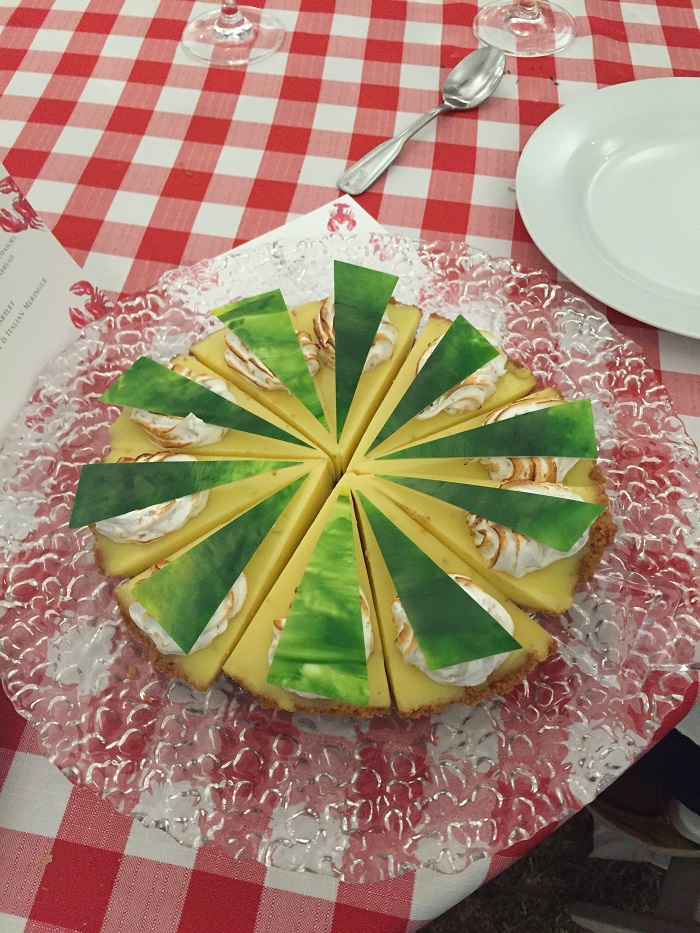
  The Key Lime Tartlet, complete with some sort of crunchy green thing on top, “how dey do dat?” lived up to it’s name. Unfortunately, I was limited to only one piece. Never the less, yum!!!
 So, there you have it a blow by blow, or as my father used to say “perhaps more than you want to know about penguins”, of the 163rd edition of the New York Yacht Club cruise and I was there. There of course, largely due to the generous support of my “sponsor” David, surely helped along by the fact that he and his crew needed a shower. Happy to oblige David. Thanks for having me along.
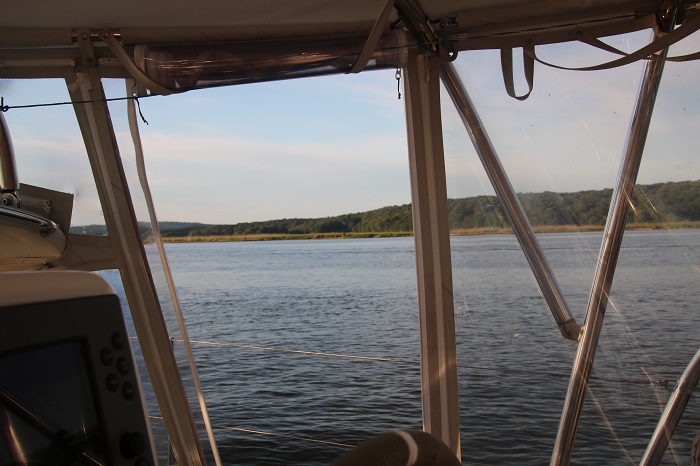 Once moored, Brenda joined me for cocktails as we enjoyed the growing twilight over the marshes.
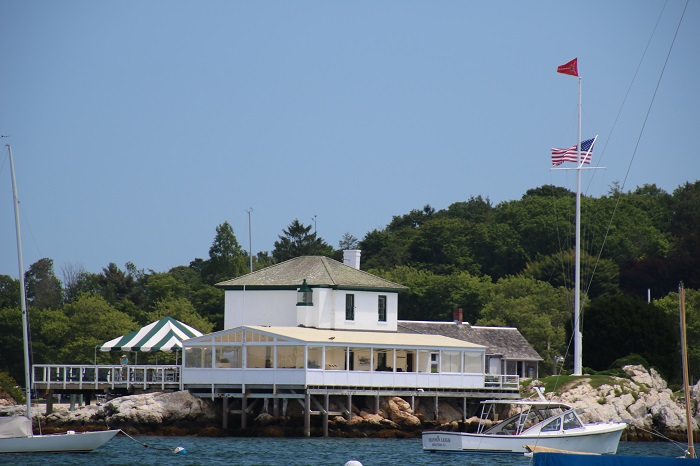 The club is named for a famous lighthouse keeper that manned a lighthouse on the same pile of rocks in Newport Harbor. She was revered for her bravery in rescuing sailors that came to ill in the harbor. She received many awards from the USCG including their highest honor.
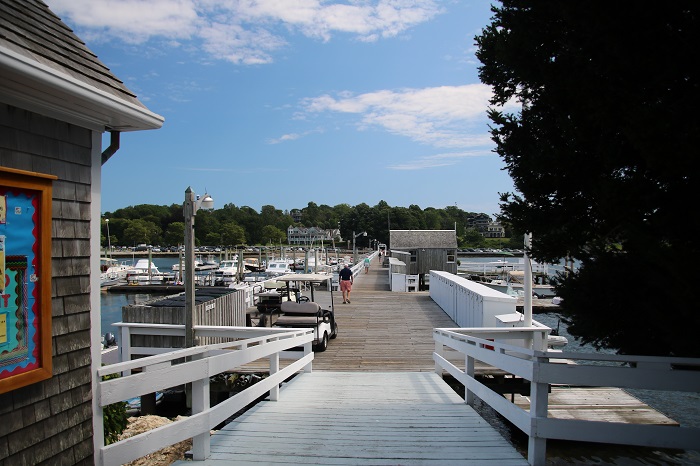
 The clubhouse is approached via a long walkway from shore that seems endless.
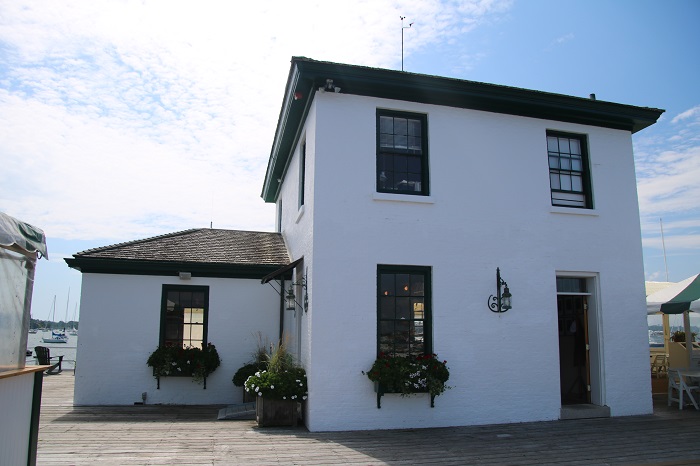
 It is a charming clubhouse and perfectly maintained.
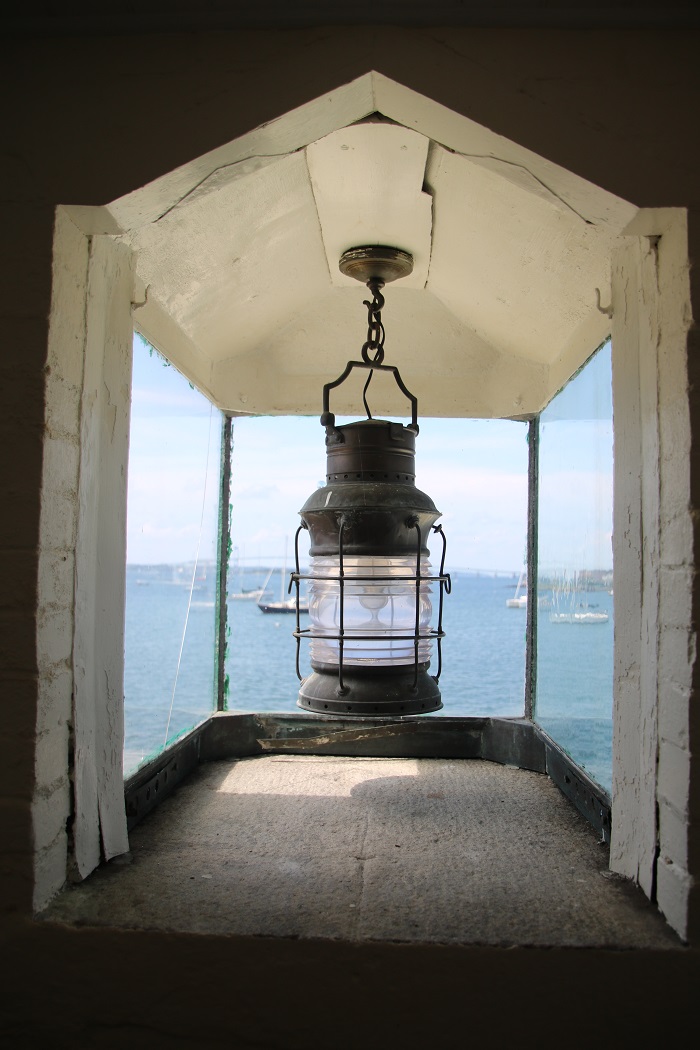
  Brenda would love this image and would probably agree that it would make a great subject for a tapestry.
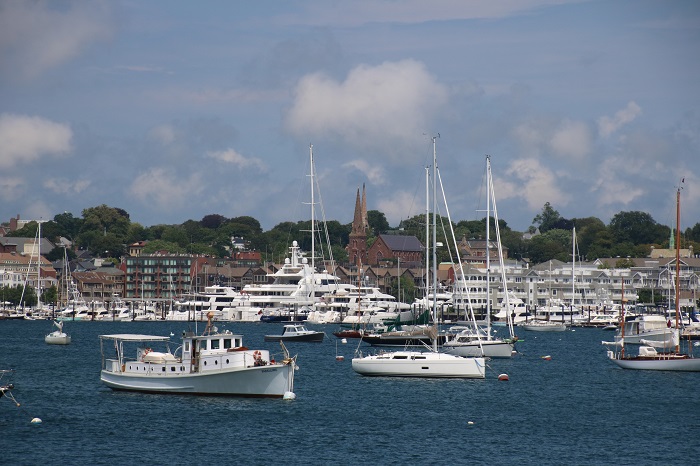
 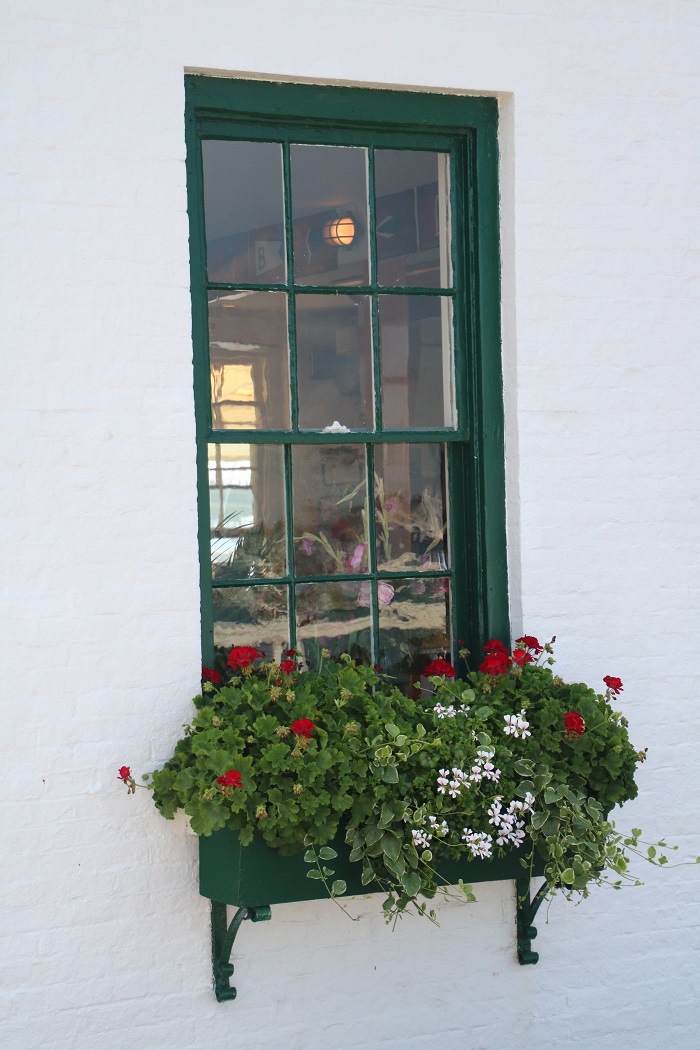 What a view of Newport from their deck.
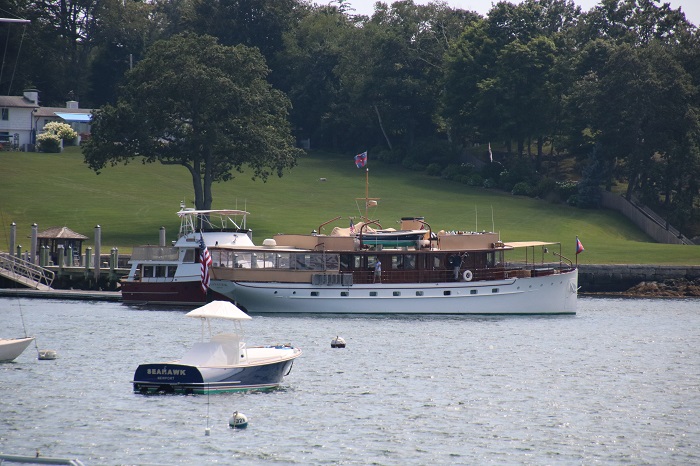
  And what better place to watch all the action from. This Trumpy is Enticer, sistership to the once presidential yacht Sequoia.
  And, of course, a perfect view of Pandora, not far away from the Ida Lewis clubhouse.
 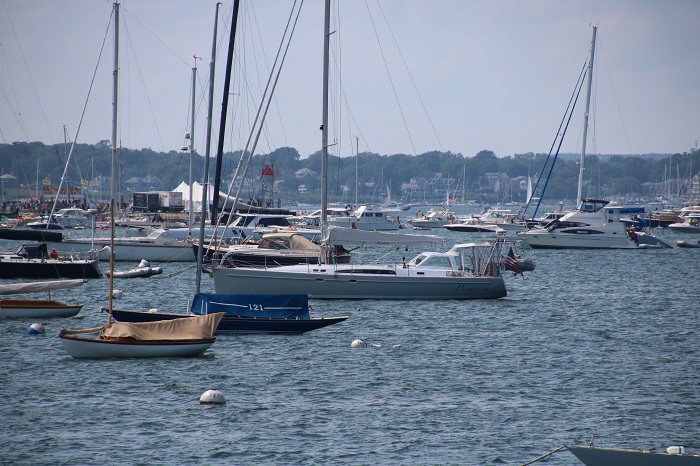 How about this beautiful S boat. She’s perfect.
 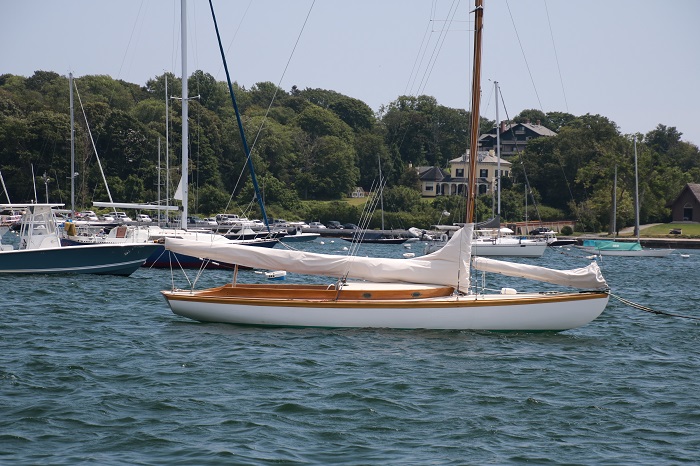 On my way into the harbor I passed this classic 12 meter America’s Cup boat out on a day charter.
 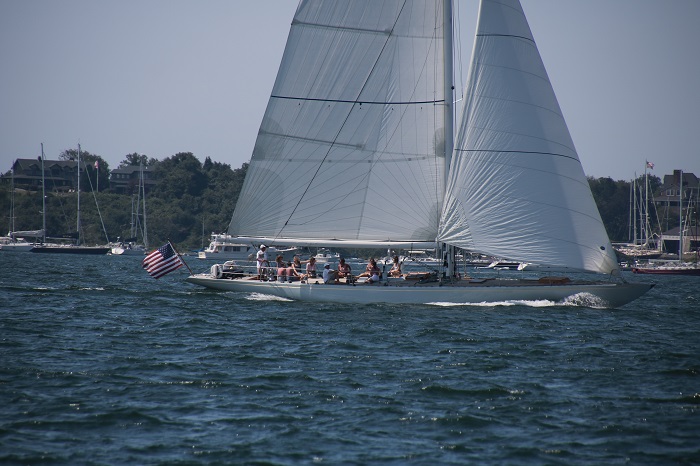 And this super modern cat.
 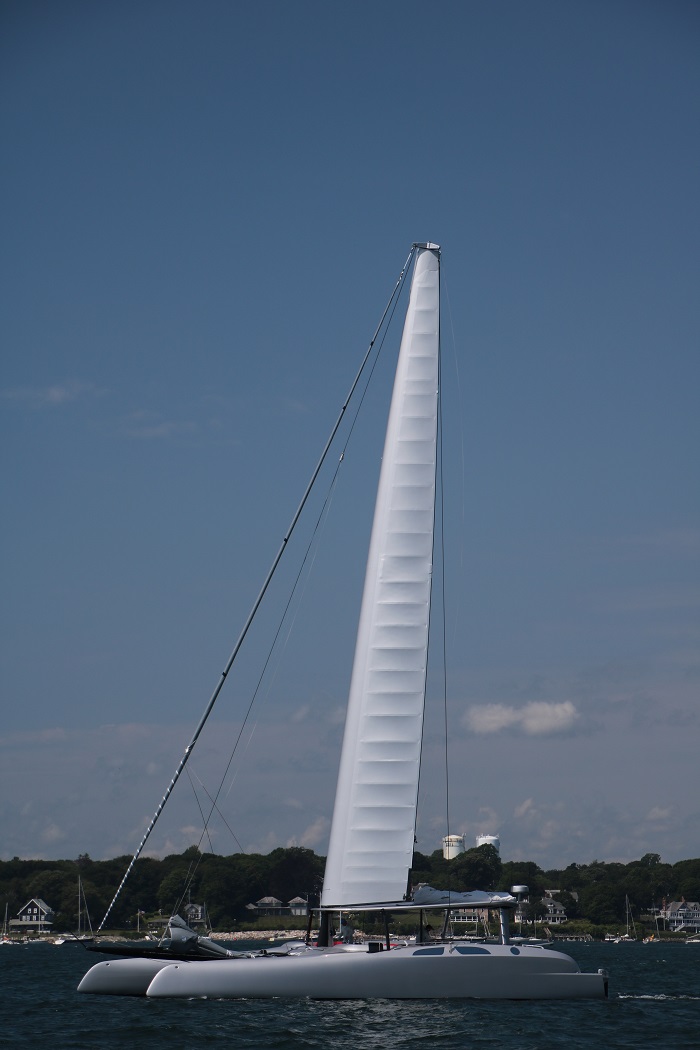 As I left the Newport Harbor yesterday this monster arrived. It’s only two years old and is over 250′ long. She was built in Germany for Joe Lewis, not the boxer and cost $250,000,000. And, she takes 25 crew to run her and take car of up to 16 guests. This yacht is in addition to his private jet, chopper and a few homes, including a huge spread in Argentina. I guess that’s what you can buy if you’ve amassed a fortune of nearly $6,000,000,000.
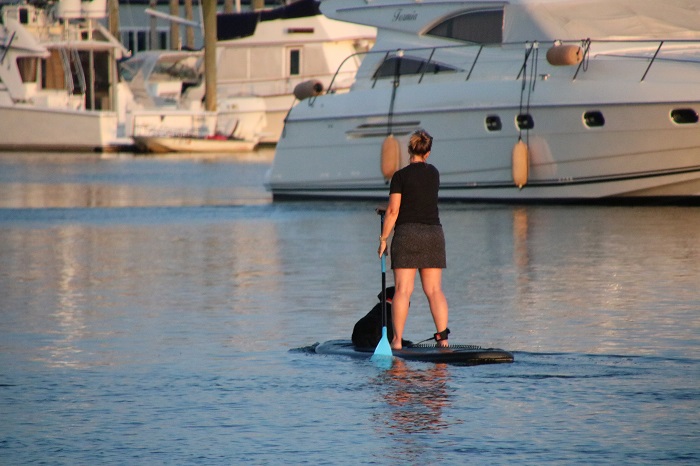
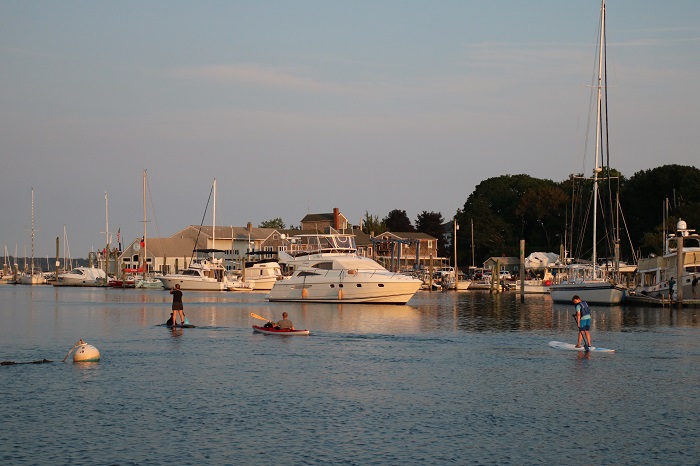 I expect that the Lab on this paddle board feels the same, probably thinking, “this is my BEST DAY EVER!” Well, either that or “I wonder when I’ll get another cookie? that would make today my BEST DAY EVER”
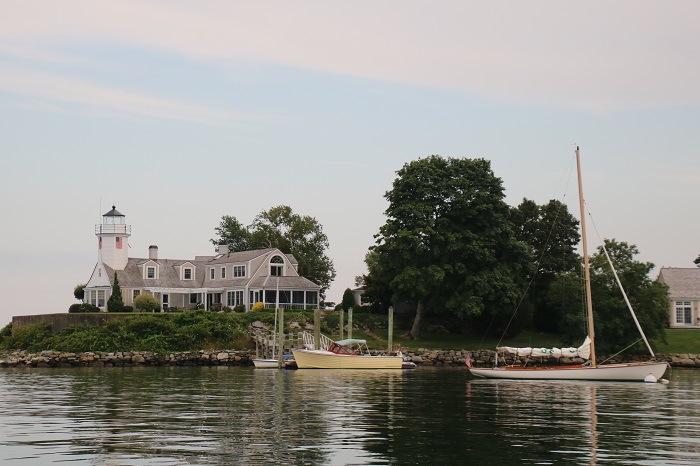
 This home at the entrance of Wickford harbor is particularly charming.
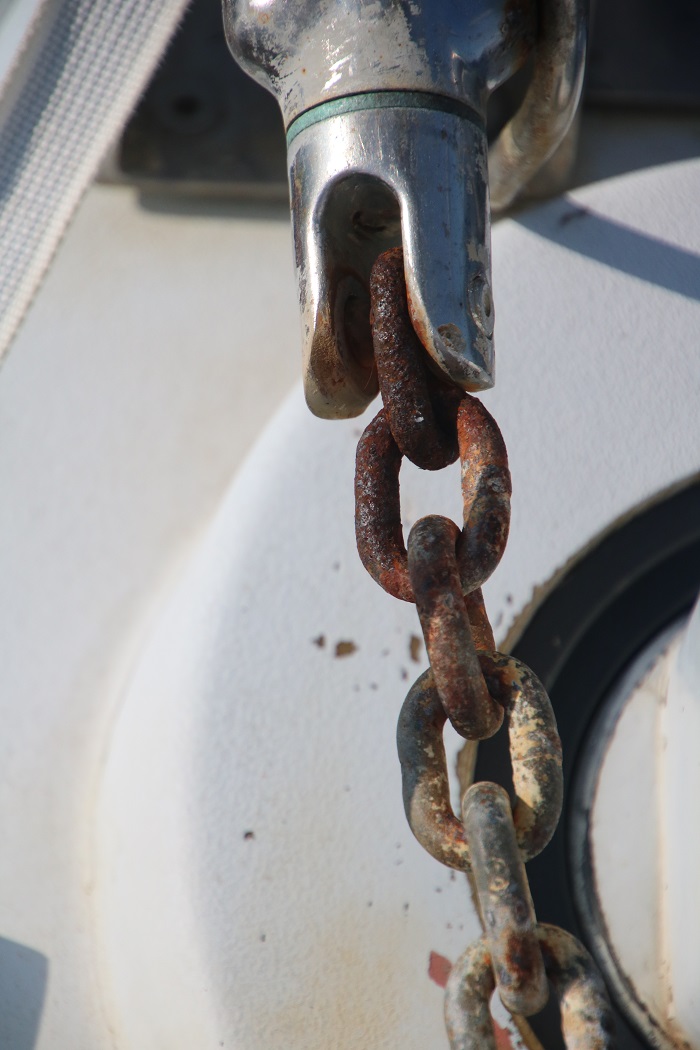
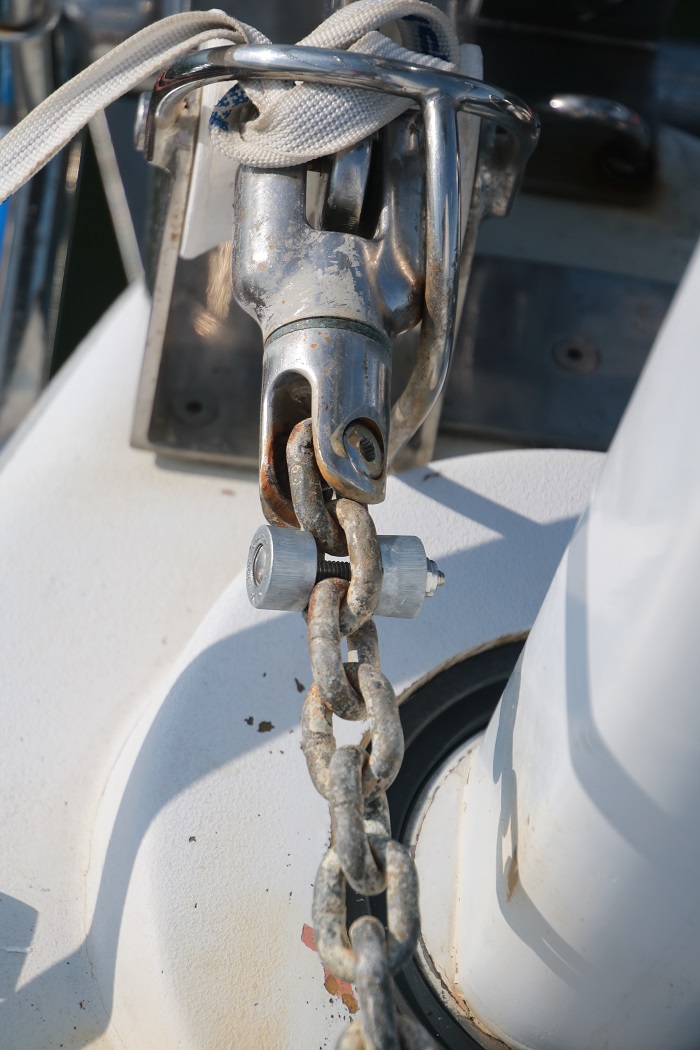
  Before I close, a bit of housekeeping. Pandora sports a stainless steel anchor and a galvanized steel anchor chain. The problem is that when stainless and galvanized chain are linked there is a tendency to have the first few chain links loose their galvanizing due to electrolysis because stainless is a much more “noble” metal. Each year I have to cut off a few links to remove the ones that have become rusted. It’s not hard to see that this isn’t a good thing. What to do?
 I borrowed a bolt cutter from the yard and clipped them off. It was alarmingly easy. What a scary pair of scissors.
 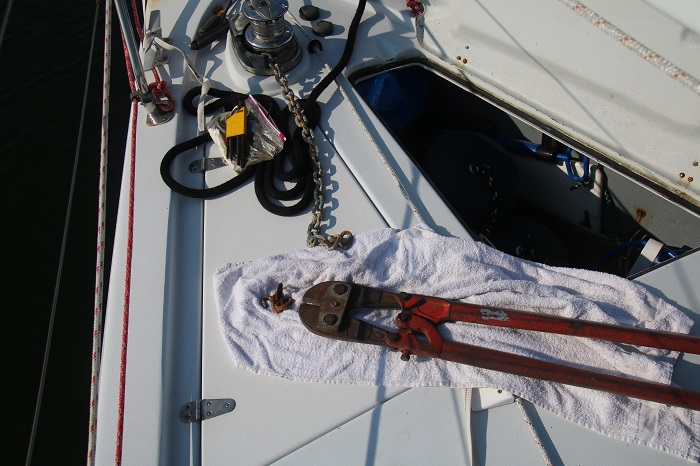 So, an experiment. I secured two small sacrificial zincs, designed to corrode easily and save the more important metals from damage. It’s not a perfect solution but I hope it will help. I’ll report back on that.
 So, here I am getting ready to hang out with the “big boys”, and I wonder how many of them will look at me and say “what are you doing here?”. Not to worry, I know, I am acting as tender and know my place. Wish me luck. Good thing my ego isn’t all that tender.