For the last few years I have known that it would soon be time to replace my aging AGM house battery bank aboard Pandora. In spite of nursing it along with full charges regularly and being certain that I equalized the bank several times a year, the inevitable happened, and the nearly ten year old bank lost meaningful capacity and was no longer serving our power needs.
The bank still worked fairly well when we were living aboard at anchor during the winter season in the Caribbean but I was beginning to see that the resting voltage was lower the next morning than had been the case just a few years earlier and was having to work a lot harder at managing our power consumption than in past years.
The decay was very gradual and I didn’t notice it much for a few years, but the last season the problems were more acute. I particularly noticed it when we were on passage when the voltage dropped sooner than it had in the past and when I was charging the bank, the draw was much higher than had been the norm.
Pandora’s house bank was made up of four Lifeline AGMs rated at a bit over 1,000 AH at 12v, plenty to run our electronics, watermaker and even heat domestic water when we had sufficient sunshine on our 600 watts of solar panels. I plan on adding a wind generator before we head south this fall to increase our ability to charge batteries in the strong Caribbean trades and on passage as I make my way south and back north in the spring.
When considering replacement batteries for our house bank, and lithium in particular, I recalled horror stories of batteries catching fire aboard planes, in cars and on boats. However, as so many parts of our world now rely on high-capacity energy storage and our boat has become ever more energy hungry, I decided to look more closely at lithium electrical system.
I say “electrical system” as converting to a lithium bank is not as simple as pulling out those trusty AGMs, that has been the standard for years, and plunking in lithium. There were also considerations of how Pandora was wired when she was built in Europe in 2006 to European codes, and how that wiring would handle the potentially increased loads and whatever else was needed to ensure that the installation is up to code and safe.
A few years ago I had decided to swap out our aging AGMs and just put in a new set of the same batteries. However, this proved to be easier said than done with two years of pandemic delays making it difficult to even find reasonable source for quality batteries so this spring we finally were able to move forward, and decided to make the change to lithium.
There are some fundamental differences between the basic characteristics of lead acid batteries and lithium and I learned that a switch to Lithium is not as simple as looking on Amazon for the cheapest options, swapping out those old batteries, reprograming the charger and off you go. At first glance it I thought that I could take that approach but was told that unless I optimized the rest of the electrical system, I might not achieve the expected performance out of your new bank. Additionally, a “non-code” installation could very well make it impossible to secure insurance or worse, expose Pandora to a major electrical problem or fire.
The American Boat and Yacht Council will soon issue guidelines for the installation of lithium batteries and a milestone that now makes many more insurers willing to cover boats with lithium aboard when installed properly so getting the new bank assembled to those standards was a must.
Over the last few years Pandora’s insurers changed their rules from “no lithium” to “lithium is ok as long as the installation is done to ABYC standards” an important development that gave me the confidence that move forward.
Finding a trusted source of the batteries was important as cheapest isn’t always best and equally important, I needed an installer that knew how to configure a system that was done right.
Questions include, do the batteries have the type of chemistry that are less prone to overheating and do they have a well-designed BMS (battery management system)? I chose to go with batteries with lithium phosphate chemistry, also called liFeTO batteries, as they are generally considered to be the most stable and safe in a marine installation. Quality batteries come with a bewildering array of safety features, chips to monitor charging and discharging along with aps that will run on your smartphone or tablet to allow you to keep track of exactly what is going on “under the hood”.
The AGM bank was shoehorned under the cabin sole so I didn’t have a lot of room to make adjustments if the new batteries weren’t a similar size. 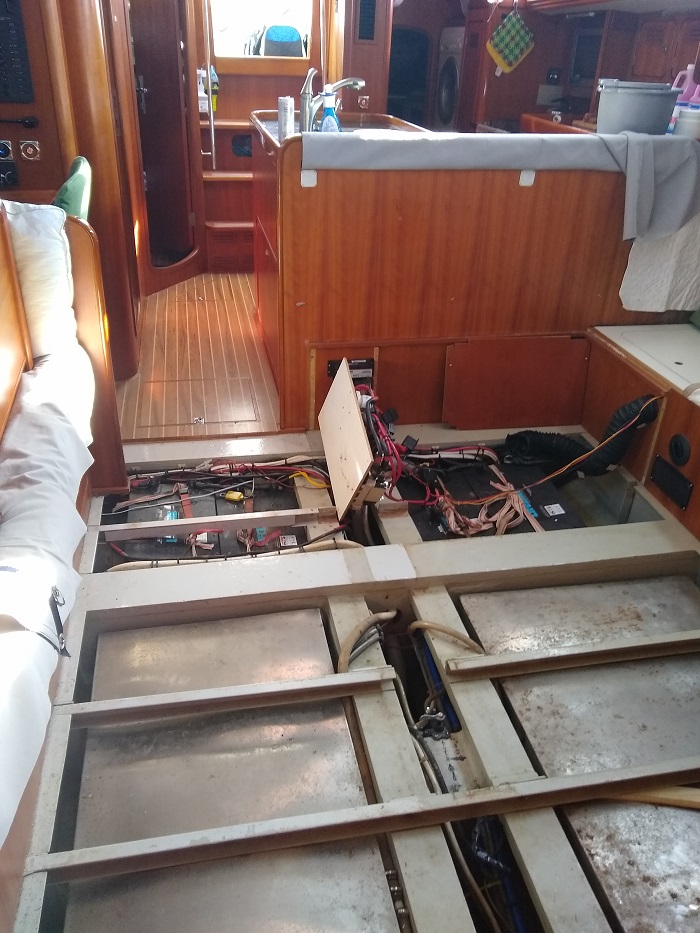 With this in mind, I decided to use four 210Ah, 12v “drop-in” batteries from Blue Heron Battery. They are called “drop-in” but that only means that they are roughly the same physical size as the batteries that they replace, minimizing required changes to the battery box. One of the principles of the company, Hank George, has a deep background in engineering so I trusted him to help design a system that would provide substantially more usable power to handle the growing power needs of Pandora without triggering major changes in Pandora’s wiring or battery containment area.
I had gotten to know Hank when he was my predecessor at Salty Dawg as president. When he “retired” from the SDSA board, he started Blue Heron. I understand that the maker of these batteries is also a supplier for BMW so that sounded good to me.
As a first step before specking out the project, I prepared a full inventory of my electrical system, engine alternators, solar controllers, charger inverter and any components that distributed power to my starter battery, bow thruster bank as well as my house bank to determine which components could be used and reprogramed to be compatible with lithium. Some components needed to be replaced but most proved to be reused, which was good news.
Pandora is equipped with 600w of solar and will soon have a new wind generator and I wanted to increase the usable kw/hrs available from the house bank with this upgrade. As I don’t have a house generator it was important to balance usage with the ability to put power back into the bank every day. As Brenda and I spend the winter cruising season in the Caribbean there is generally ample sun and wind that should keep the bank up and fully charged. On the occasion when mother nature isn’t cooperating, I have a small portable 2kw Honda gas generator that has proven its worth over the years.
An additional consideration in favor of lithium is that they take a charge much faster so I should be able to get more AH out of my panels and wind generator than was the case in the past. And, unlike lead acid, that have increased resistance to input amperage as the batteries get closer to 100% charged, lithium continues to accept charging at a high rate until the batteries are full.
The original bank was comprised of four Lifeline 8DL AGM batteries each with 255AH at 12v, for a total of just over 1000Ah or 500Ah at 24V when new. However, for practical purposes, I rarely used more than 25% of rated capacity as I wanted to extend the life of the bank as long as possible, only allowing about 200 usable amp hours. Some suggest that a quality AGM bank like mine can safely deliver about 50-60% of rated capacity between charging but this does have an impact on lifespan of the batteries so I used less as a rule.
The new lithium bank is comprised of four batteries, each rated at 210AH for a total of 840AH at 12v and as the batteries can be drawn down a full 90% between charges, that is more than 700AH of usable power, more than doubling of our power reserves. Additionally, lithium isn’t damaged by being left partially charged unlike lead acid that can be damaged if left partially discharged for any length of time.
I’d like to say that getting these “drop in” batteries in place was as simple as that but the yard, without much communication with me about what they were doing day to day, ended up making changes that went well beyond what I expected and running up bills that proved to be astonishing. Sadly, much of this was done with minimal warning from the yard or approvals by me.
I mention this, as yes it can be complicated to make the switch to lithium but you have to be certain that you are consulted every step of the way to ensure that the changes being made are “need to have” verses “like to have”, a seemingly subtle point that can make a big difference in the overall cost of a job like this.
To be fair, the yard discovered a number of unexpected areas of corrosion and wiring that I was told was substandard, causing the job cost to balloon alarmingly. While this development and the lack of communication with me was very unwelcomed at least I can now be confident, I hope, that the electrical system, that is so fundamental to safety aboard Pandora, is up to snuff.
I am not the first owner of Pandora, and have no idea what sort of modifications were made to the electrical system prior to our ownership. It was particularly alarming when the yard discovered that when I had a new new inverter/charger installed about 5 years ago that the unit had not been properly grounded along with other issues. I am told that fixing this problem required that the entire nav station be disassembled, a huge job.
I am sure that everyone who owns an older boat has seen terminal corrosion like this.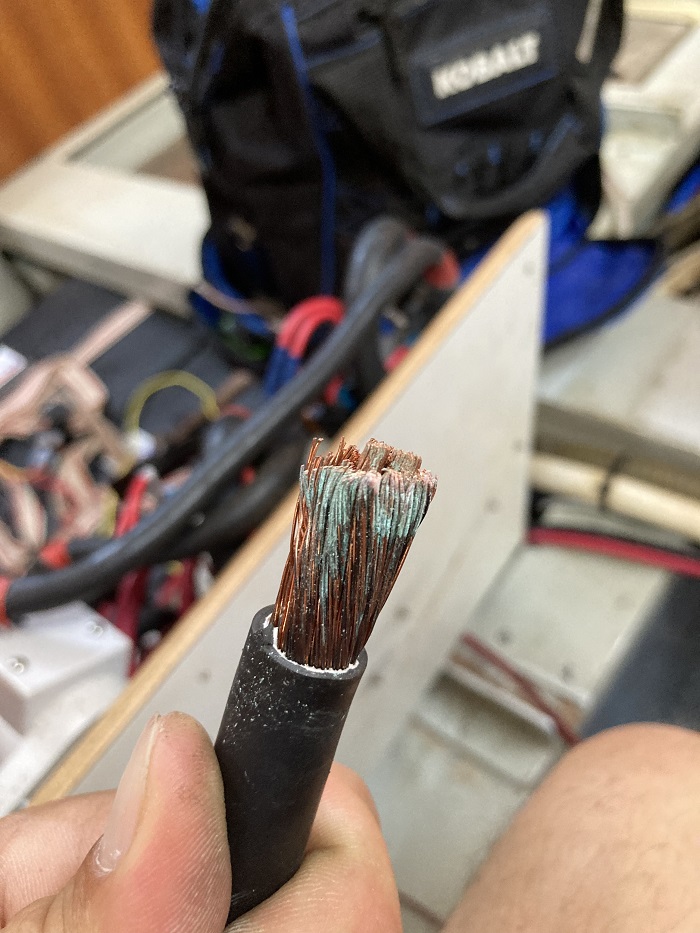 And, the scorching on this wire clearly demonstrates that it overheated at some point.
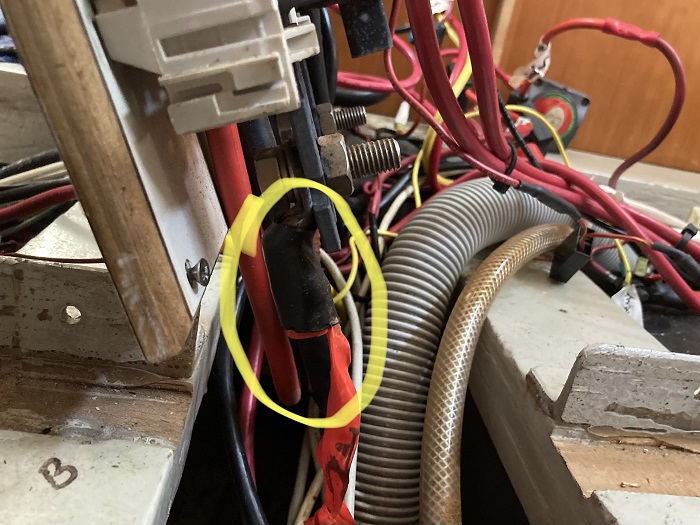 I guess that I’ll rationalize the increased cost as an electrical system “refit” and not just the installation of a new battery bank.
One good thing is that the “drop-in” sort of dropped in after all. 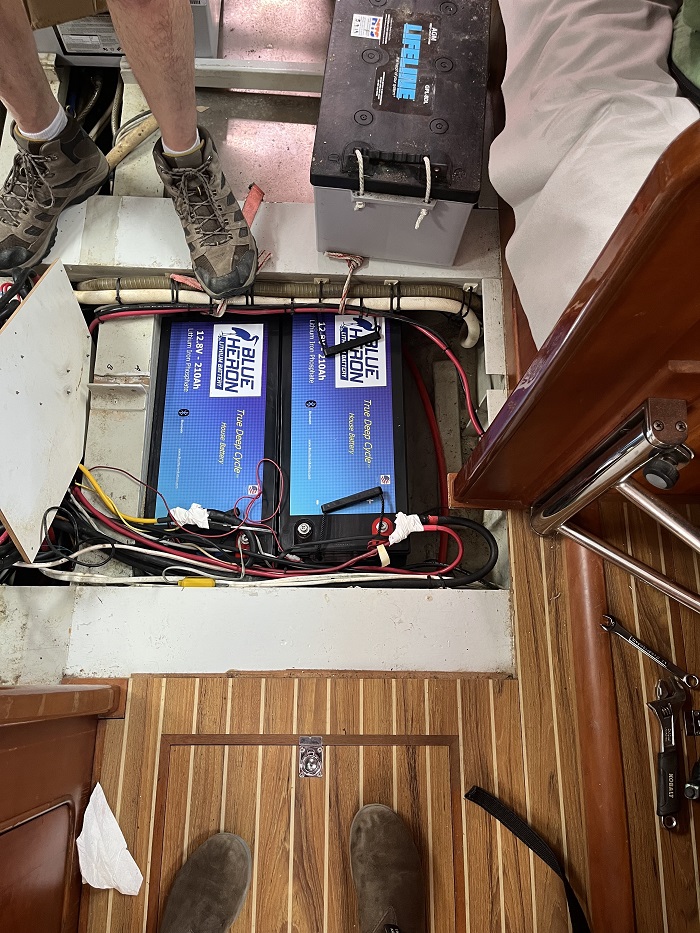 Another big advantage of lithium is weight and as the new bank weighs in at just under 250lbs, a savings of nearly 400 pounds when compared to the old AGM bank. A weight savings of this scale would be particularly valuable for cruising cats that are becoming more popular.
All and all, I am optimistic that the addition of the new lithium bank was a meaningful investment and having the additional power aboard an increasingly power-hungry vessel was an important upgrade that should pay dividends in the coming years.
I will be keeping track of how the bank performs this winter season and plan to do additional posts about how things perform in the “real world”.
If you want to learn more about installing lithium and want to find a tech that is certified to do the job right, ABYC maintains a database of marine electricians that have been credentialed to do what is needed to make for a sound lithium system.
As I finish up this post, I took the unprecedented move of telling the yard that is doing the installation to stop working on the project as the work is not complete and they can’t say with certainty when they will be able to finish, or what it will cost. Considering that I originally thought that the work would be done by mid July, where we are now, nearly to Labor Day and the job is still unfinished, risks risks my ability to get Pandora ready for the run south to Antigua.
I have lined up someone else to finish the remaining work so I can run her from Deltaville VA back to CT to get her hauled so I can finish all of the rest of what needs addressing before heading south in about two months.
When I dropped Pandora at this particular yard in mid-May, I never imagined that I’d be debating how to get the job done, after months of back and forth.
I am hopeful that the process of finishing up the job will prove easier than the process that has ever so S-L-O-W-L-Y and EXPENSIVELY unfolded since May.
I guess I’ll close with a shot of Pandora in Antigua tied up at Nelson’s Dockyard. That’s what I am trying to stay focused on right now.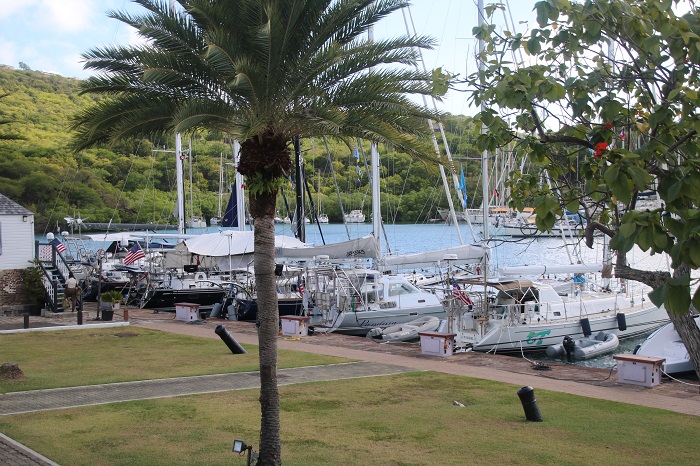 Oh yeah, the rally is shaping up really well and we are now expecting perhaps our largest yet with over 100 boats making the run south, mostly to Antigua.
That’s amazing, actually.
As they say, stay tuned for details.



 Here is what the society had to say about my photo.
 So, there you have it. Not only is there a society for every imaginable interest but you can now rest easy when you are confronted by a “red sky in the morning”. Well at least as long as you are in the tropics.
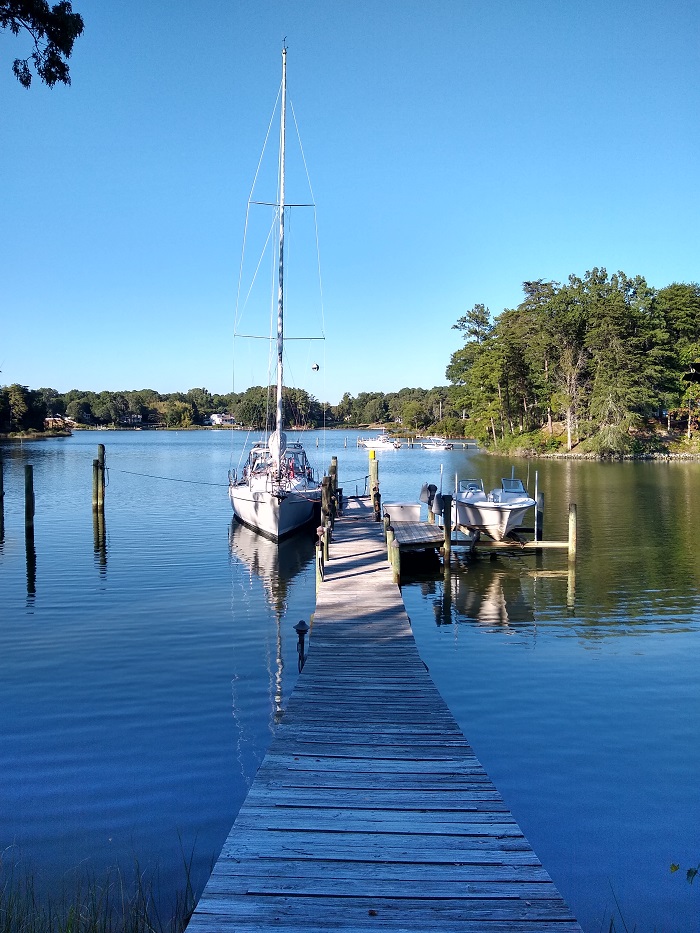 My plan, all along, was to get the work completed and bring her back to CT so I could get other work done before I headed south to Antigua at the end of October. Additionally, the Salty Dawg Rally is now offering a departure from Newport and I wanted to give that a try.
 After I get Pandora ready, I will head down to Hampton to join in the fun leading up to the departure for Antigua and the Salty Dawg Rally to the Caribbean.
 I guess that I have to say that the SAGA continues but hopefully, no more surprises await.
 They will be missed.
 As for Pandora, all I can do is hope…