


Oh boy, will we ever leave?
If perhaps you have been following the tracking map for the rally, you will have seen that Pandora is still in port and nope, I didn’t leave on Monday as planned.
Such is life and the best laid plans. This is what the forecast for a few days from now looks like. Red is REALLY WINDY.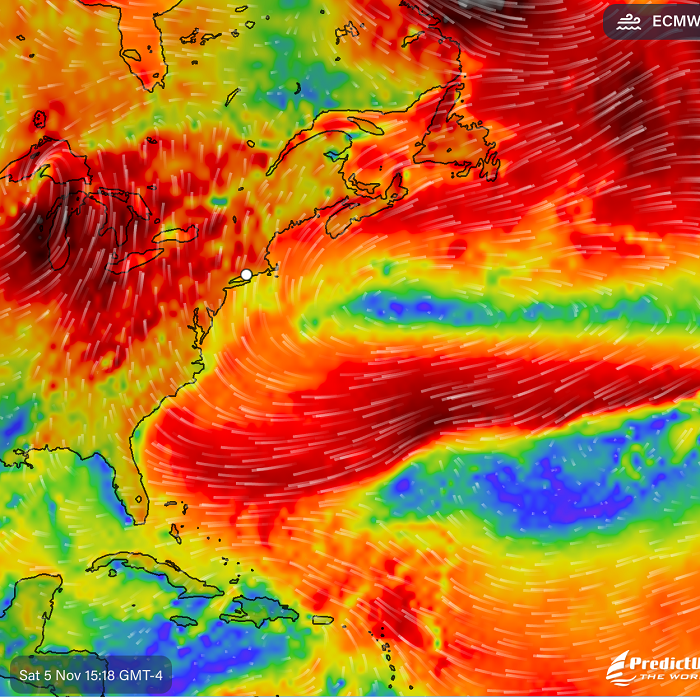 After the months and weeks leading up to the departure of the Caribbean Rally, we were all very disappointed to discover that there wasn’t even a hint of a good weather window to get to Antigua for the foreseeable future.
Over the weekend skippers and crew assembled to hear what Chris Parker, our weather router, had to say about conditions for heading out. 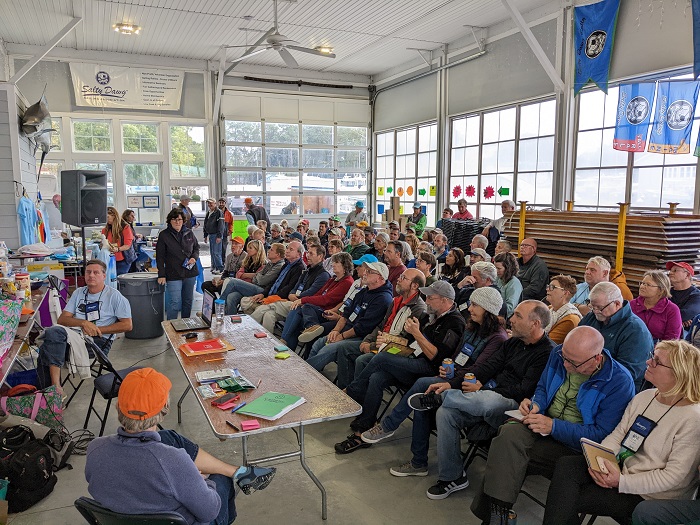 We listened intently as he described conditions that I had never encountered as we saw really strong persistent southerly winds in the eastern Caribbean, a late season hurricane spooling up in the central Caribbean and a huge low crashing toward Bermuda, all at the same time.
As he described the conditions that we’d encounter if we attempted to go out within the next few days as a sort of “you can’t get there from here” and that perhaps the closest we might get to Antigua might be the Dominican Republic or the Bahamas, if we even got that far at all.
I left that meeting feeling a bit shell-shocked, trying hard to prepare myself for what looked like a tough trip and if I’d be able to leave at all.
The next morning I woke up, did my last post about leaving Monday, and set out to make coffee for me and my crew. I hadn’t even put the water on to boil when I blurted out, “I’m not going”. George, who has sailed around the world and publishes Blue Water Sailing Magazine, had also come to the same conclusion and when I called Rick Palm, another Circumnavigator, and fellow board member, told me he was about to call me, having come to the same conclusion.
With 100 boats getting ready to head out, we called a meeting and less than two hours later we had a packed house.
I announced, as president of the group, that I wasn’t leaving and then we talked about our thoughts with the group.
Within an hour nearly everyone in the room had decided to delay their departure. A few ventured out anyway but that’s to be expected as some have a very tough time changing gears once they set their minds to something. Of course, the philosophy of Salty Dawg is that every skipper and crew make their own decision on when and if to head out.
Of the 20 boats that were heading to Bermuda or the Caribbean, all but a handful decided to delay.
However, the window to head to The Bahamas, while not ideal, didn’t look terrible so most of those boats departed as planned.
As you can imagine, such a dramatic about face gave everyone a lot to think about and many are still trying to decide what to do next.
Many have lost their carefully selected crew, some are revaluating their destinations and a few have decided that they will have to skip the season entirely.
After months of planning, and in some cases years, it was a very difficult day while everyone wrestled with what to do next. I for one, scrambled to find a more reasonably priced place to leave Pandora for the next week or two and booked a flight home where I will be standing by until a window begins to emerge and then I’ll hightail it back to Pandora and get ready to depart yet again.
As I write this, I’ll admit that I am not terribly optimistic that things will improve any time soon but one can always hope. With Thanksgiving and Christmas on the horizon that complicates things even more. I have no idea how this will turn out.
Even though we are now in a frustrating state of limbo, the days leading up to “departure” were great fun with seminars, a pig roast and plenty of time to compare notes with one another.
A highlight of the week was a live Search And Rescue, SAR, demonstration by the US Coast Guard with a J Hawk helicopter. If you have never seen something like this in action, it is amazing.
The chopper arrived and began to hover low over the water perhaps 100 yards from the dock. As they dropped low to the water a stunning amount of salt spray was kicked up and soaked the crowd that had assembled to watch. As the chopper came over my brand new Salty Dawg cap was blown from my head into the water, only to sink quickly out of sight.
The downdraft was incredible. The chopper was so low you could easily see the faces of the crew. 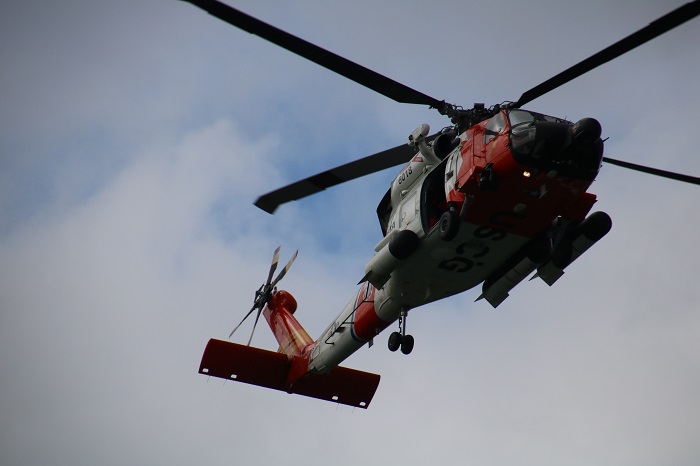 They dropped down low near the water. Salt spray was flying everywhere. This picture doesn’t begin to do justice to the wind that they were kicking up. Every boat in the marina was soon covered with salt. I had to stop shooting several times to clean off the lens of my camera.
 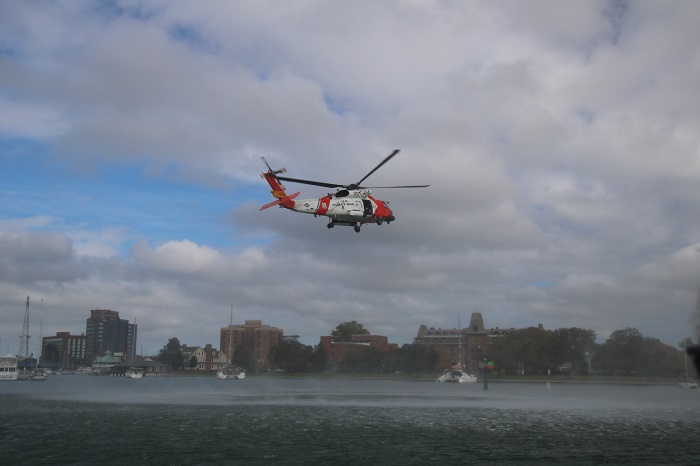 Soon the rescue swimmer was lowered to the water.
 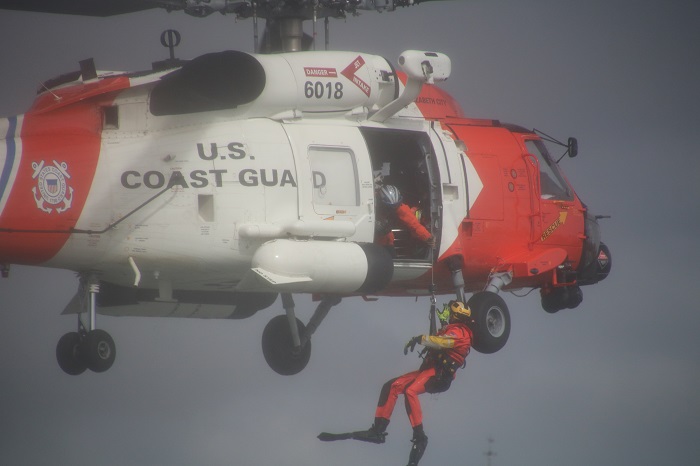 Before he went down they tossed out a “rescue dummy”, something that they use to simulate a real person. It is about the same size and weight of a person.
 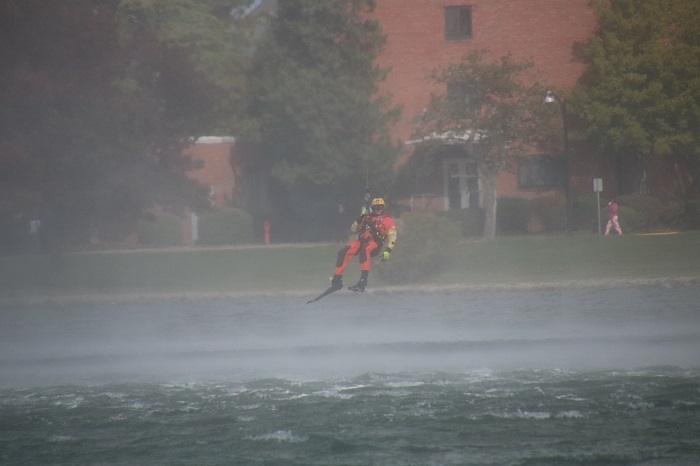 After the swimmer secured the dummy, they showed how they would pull up someone in a wire litter.
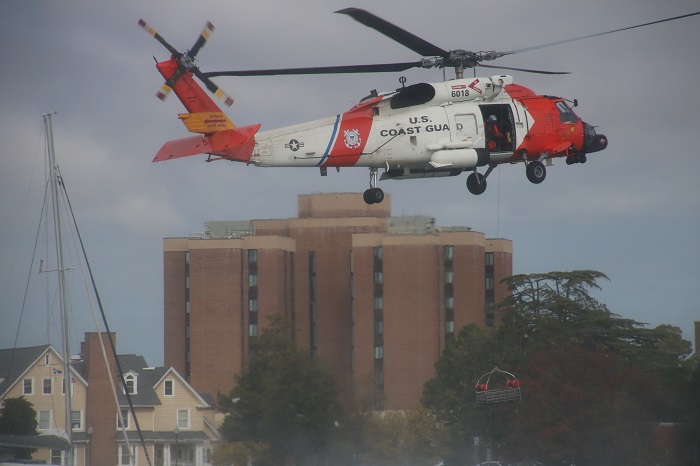 All and all, it was a totally awesome display. It looked plenty hard to do on flat water and I can only imagine what it’s like to rescue someone in 40′ waves and hurricane force winds. Not for the feint of heart.
All I can say is that I really hope that I never witness something like this in the ocean and the idea of someone swimming up to Pandora and announcing “Hi, I’ll be your rescue swimmer today” is a bit frightening.
Having witnessed this demonstration first hand, and not for the first time, the thought of heading out aboard Pandora and questionable conditions just didn’t seem like a good idea.
As my friend Rick likes to say, “don’t rush, the islands will still be there if you don’t leave now”.
So, here I sit in CT, at home, with no idea of when I might return to begin the run to Antigua. With Thanksgiving and Christmas bearing down on us, who knows what this will turn out like.
With all of this uncertainty and the fact that my crew won’t be willing to be at sea for Thanksgiving, I have to ask myself “will we ever leave?”.
I guess that I’ll just have to wait and see.
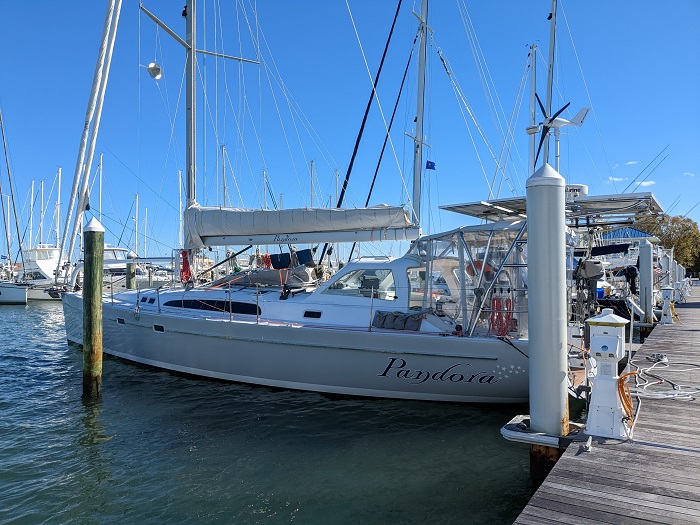
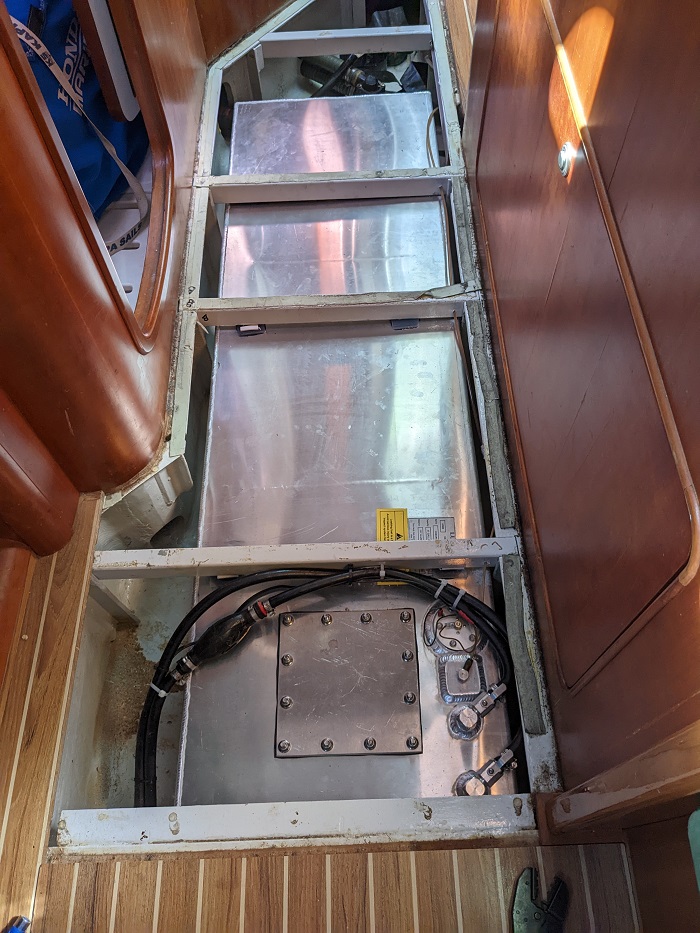
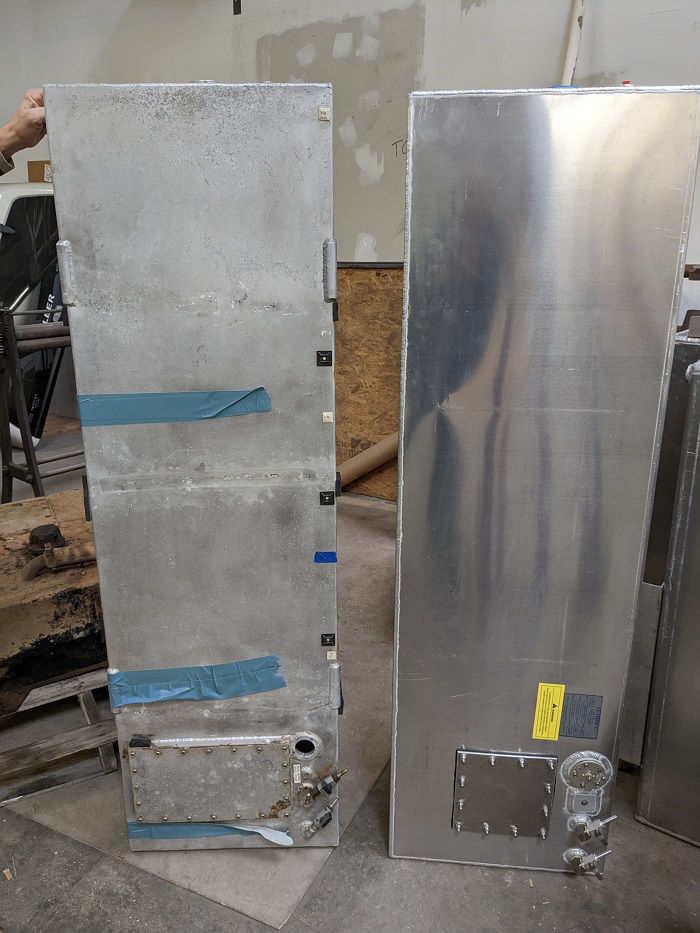 I have now learned a lot about corrosion and what can happen when aluminum lays in the bilge. In such a dank area salt sitting on the metal will raise hell with it over time. The “new” leak was pretty apparent. No wonder that it didn’t take long for all that fuel to leak out. Nasty…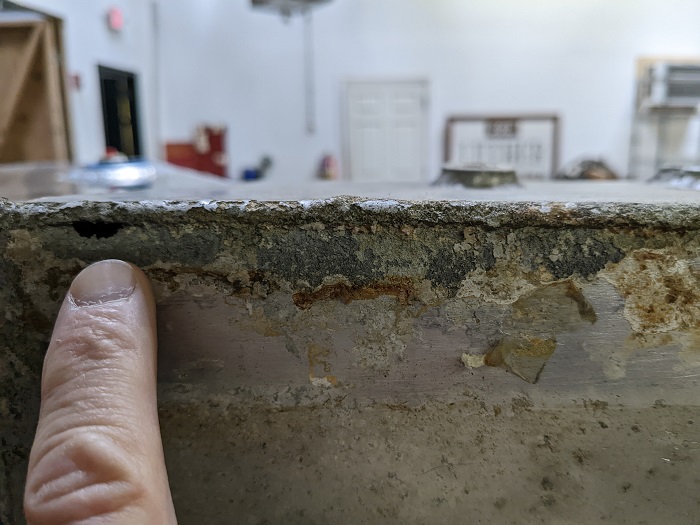
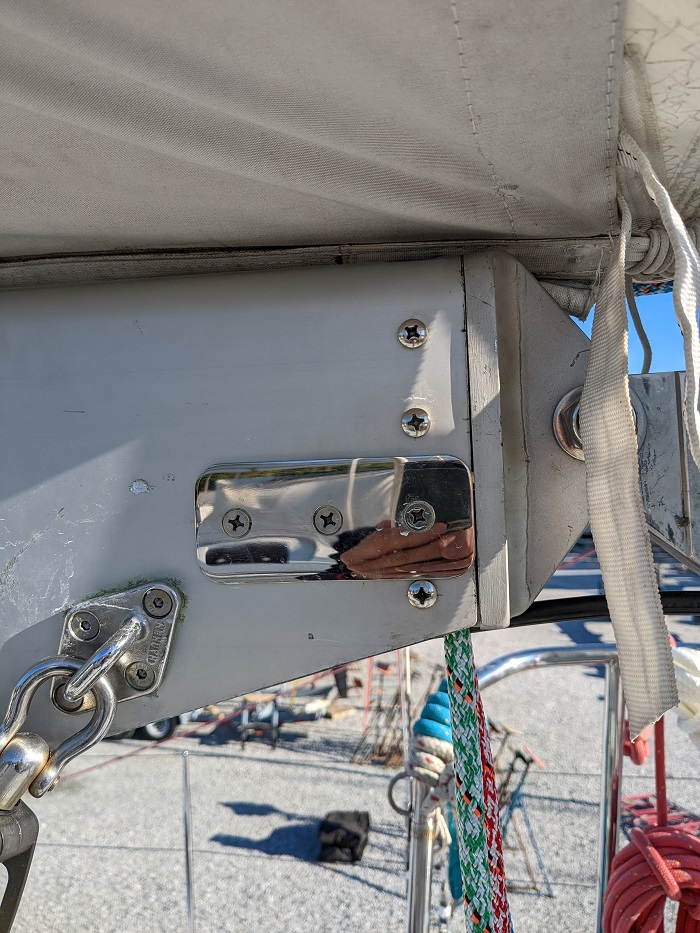
 I was also having difficulty with the boom gooseneck that was working the fittings loose and needed some love. It is generally a bad thing if the boom works itself loose while underway. They removed the boom, did some surgery, and now it’s back in place. It was a pretty big job in spite of there being only a few new screws showing for their efforts. Better now.
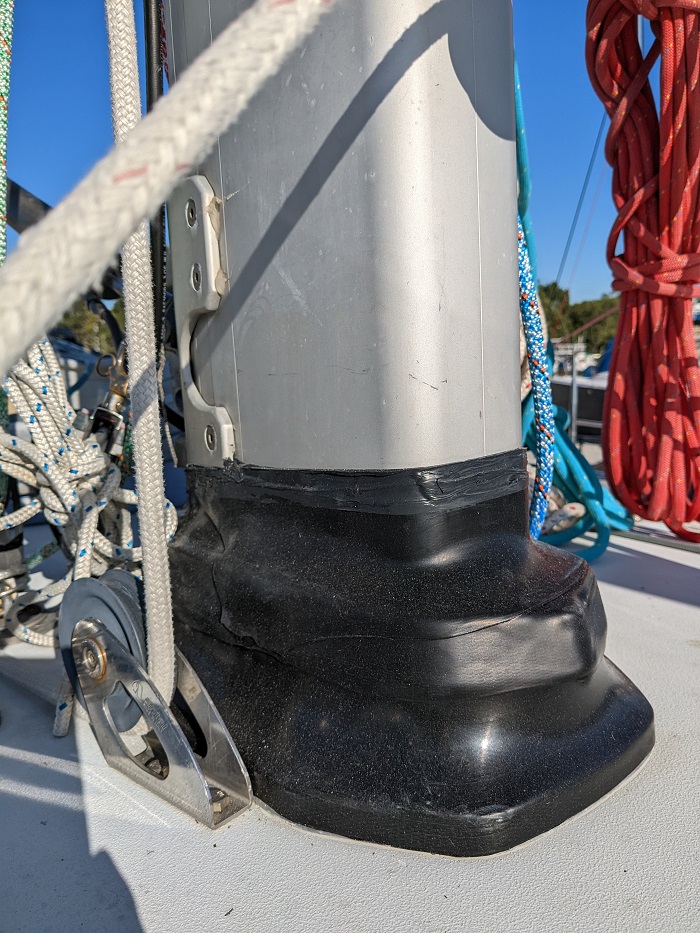
  I also had small but persistent leak around the deck joint for the mast. I had no idea how they would address it but they did. It looks pretty elegant. So much, I hope for the SLOB, Slow Leak Over Bunk.
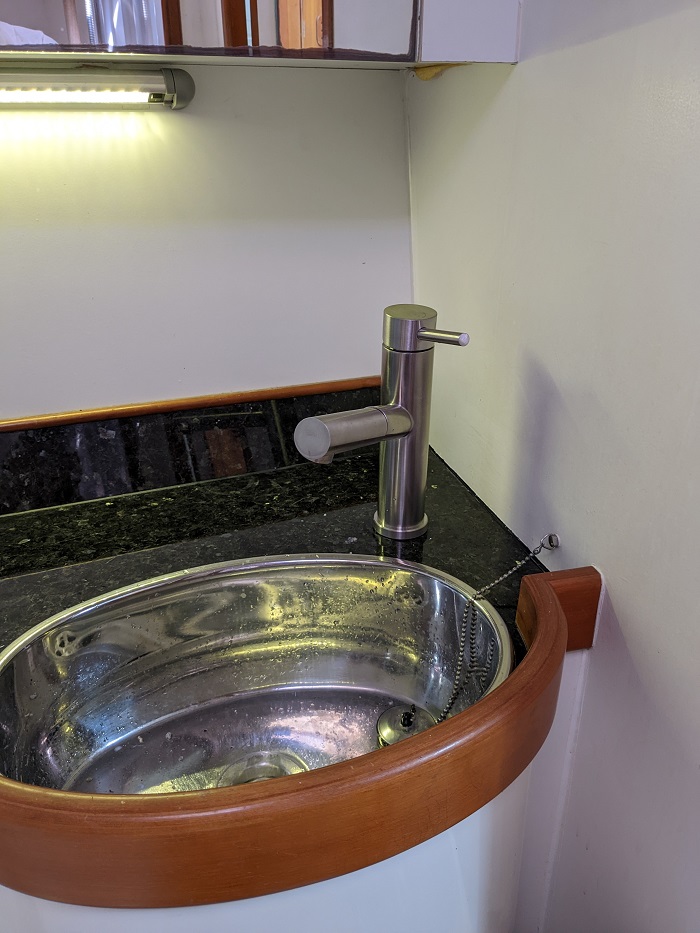
  And under the “so simple, even a child, or Bob, can do it”, I installed two new faucets in the heads. The old ones were pretty corroded. I don’t expect that these will last decades but then, nothing does in the marine environment.
  I am also having the underside of the hard dodger repainted as the old finish was peeling and looked terrible. It’s turning out to be a very difficult job with some adhesion issues that have come up and I am anxious about what the bill will be like and how it will turn out.
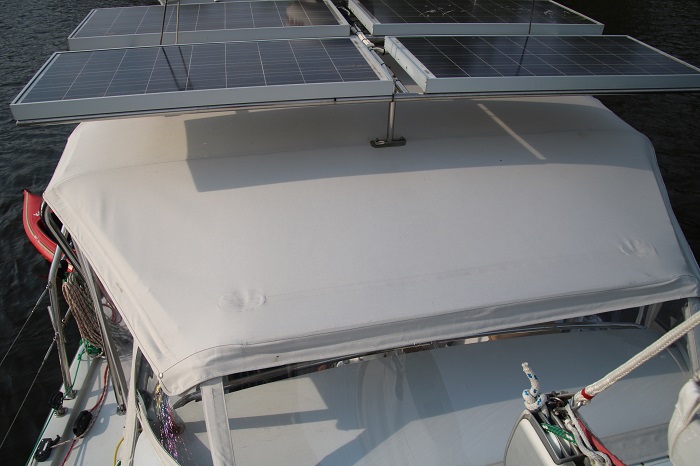
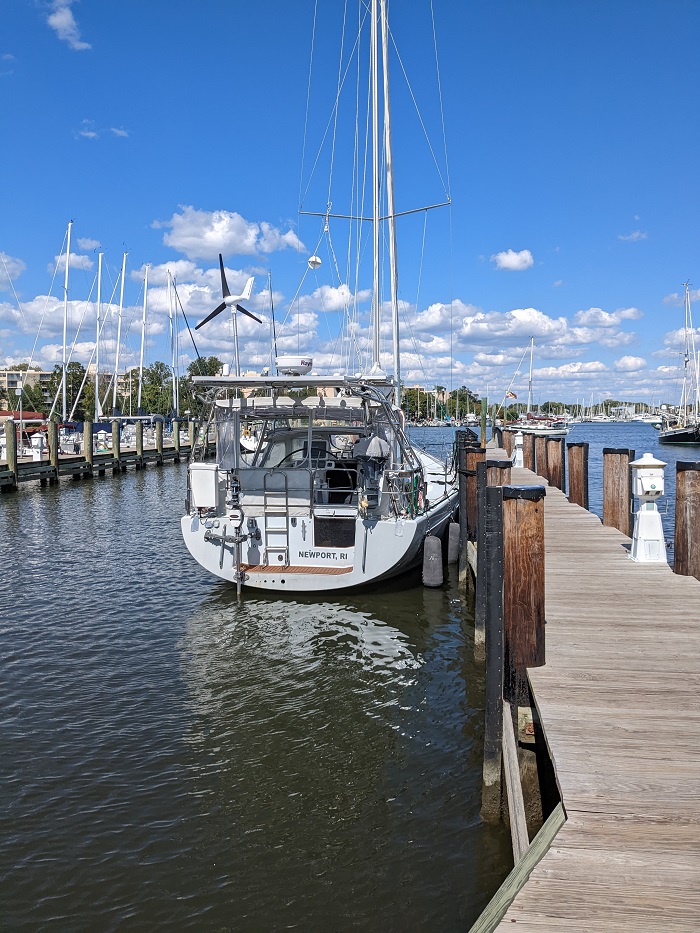 I also installed some new solar panels, four 150 watt units replacing the 80 watt panels that were in the boat when I purchased her. This increase in wattage, combined with the fact that the old panels had lost a lot of efficiency has nearly doubled my output. I am not enough of an expert to wire them up and put in the new regulator so M Yachts is doing that. They do look pretty impressive.
 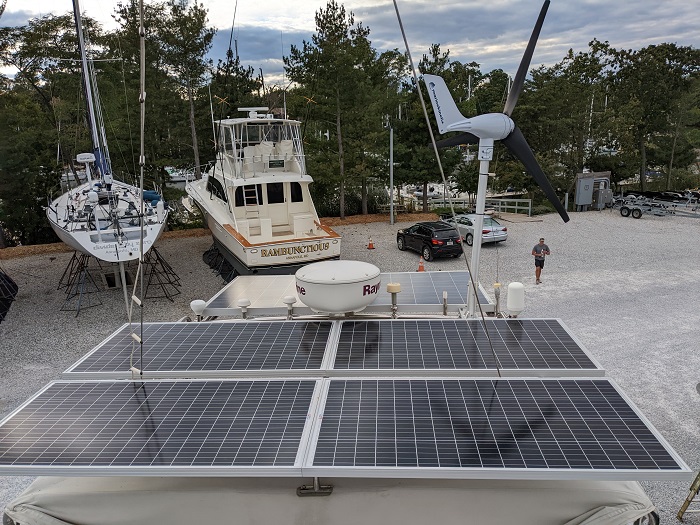 And contrast that to the old panels in the photo below. The new ones do not hang over to the sides of the supports at all and only overhang the front of the supports from the old panels by about 6″. Of course, a big change is that they are each 150 watt, more fully utilize the space available and at $150 each, were a mere “rounding error” in the grand scope of the job.
  And the wind generator. I have no idea how that’s going to work out but based on what I have heard from others that have the same unit, I am optimistic. This photo shows the unit with a slight port list but I will be adding some plastic shims under the mount to deal with that. It’s because the arch itself is sloped outboard and the installer didn’t have shims on hand.
 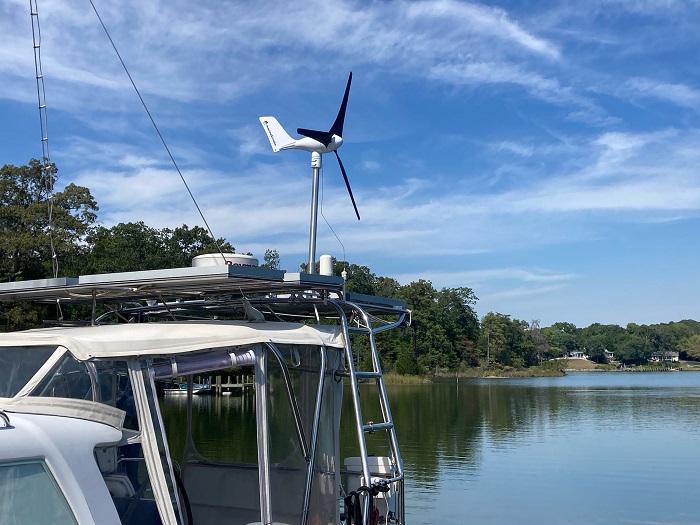 Combine the upgraded solar, the wind generator and a lithium bank and we have more than doubled our charging ability, I hope, and usable power storage for Pandora.
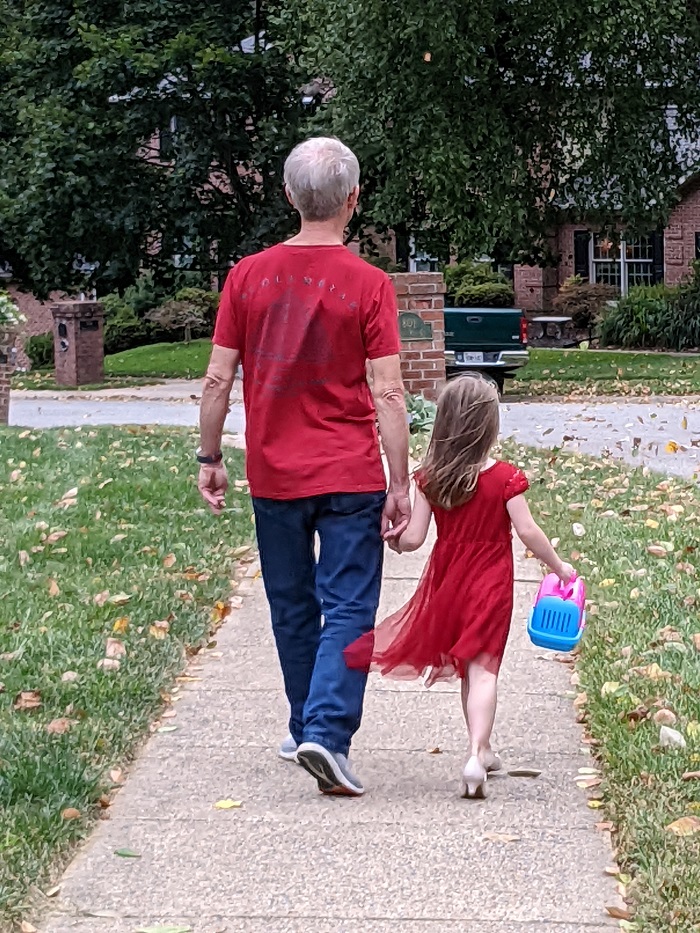 It seems that alive and well in that adorable little body is a tremendous selection of cold viruses, something that she gives me and I bring home with me after nearly every visit. As I write this I am hacking away more than a week since my last visit.
 I think that while a big part of all this is that many have emerged from the pandemic with a renewed belief that life is short and they want to use their remaining time wisely . And, as Salty Dawg has shifted to almost totally online presentations, the material is accessible to many more than could every participate at an occasional live event.
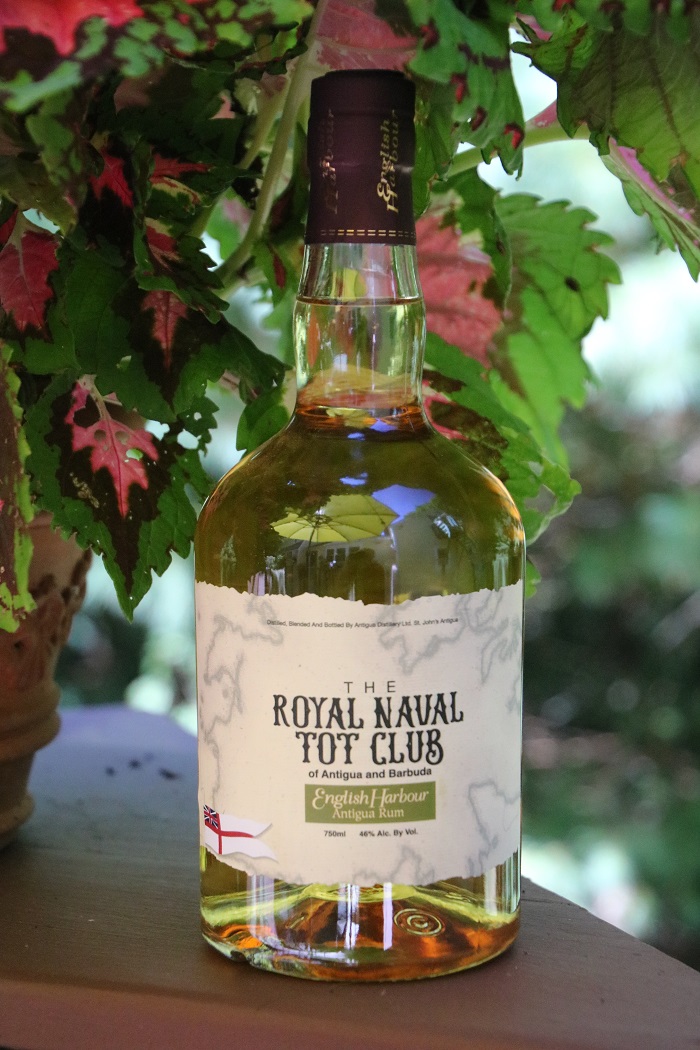 The setup…
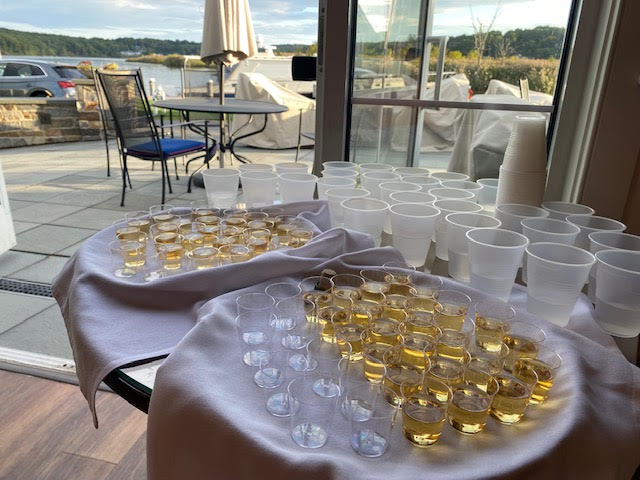 The toast, following a reading of some brief passages from a book covering happenings on “this day in British Navy History”. Interestingly, that night, October was the anniversary of the opening of Nelson’s dockyard in 1725, the destination of the Salty Dawg Rally each year.
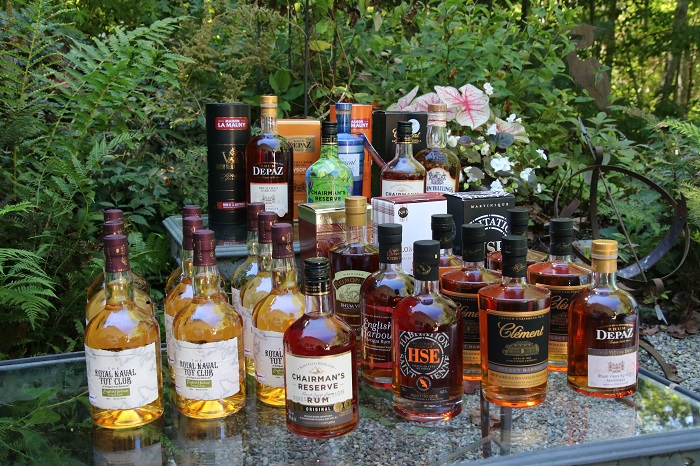
 I supplied the rum for the tot, brought to the US aboard Pandora, of course. And in spite of more than 60 taking part, it didn’t put much of a dent in my supply. I will admit that this is an alarming cache of rum by any standards. Don’t worry, I a plan to give a lot, well some, away.
  It was a wonderful evening and I do wish that I had taped the program as it’s the first one that I have done in a few years that hasn’t been “archived” for others to see.