Sail Pandora

Following Seas and the Wind at our Backs

It’s Friday morning and we are moving along at decent pace, about 6 kts.  I’d like to be going faster but the wind is behind us and not as strong as it was for the first few days.

Our run over the last 24 hours was a bit under 150 miles giving us an average speed of about 6 kts, substantially less than the earlier part of the trip but still acceptable and what the weather forecast suggested would happen.  I expect that this will be the case for the next few days.

We are about half of the way and I still think that we are likely to arrive sometime next Wednesday, giving us a dock-to-dock time of 9 days, considerably less than the near 12 days for my run south last November.

This is not surprising as the run north takes better advantage of prevailing winds and is generally an easier run.   I expect that we may have some days of motoring and perhaps a few days of wind forward of the beam, but it should not be particularly challenging.

Everyone has settled in pretty well, now that the first few days are behind us, which is typical.  It won’t be long until we will have made it more than half way there which is always nice.  And, with the wind continuing to be behind us, it will begin to feel like it’s downhill from here.

Yes, with following seas and the wind at our backs, it’s a pretty good run.

Music to My Ears

Pandora has a way of telling you that she’s moving along nicely.  At just about 7 kts, she begins to hum, a sort of harmonic vibration that you can hear and feel throughout the boat.
I have no idea what the source of this noise is but it is very consistent and depends on the speed of the boat moving through the water, not the speed of the wind.

As 7+ kts is a very nice turn of speed for Pandora, the sound is very much “music to my ears.”

The perennial question that everyone has, including me, when we are on passage, is “when will we get there?”  Of course, as our speed is dependent on the strength and direction of the wind, asking that question is sort of like asking “how much does a car cost.”

Another key question, beyond how fast we are going, is “are we going toward our destination,” which is often not the case at all.

From when we left St Thomas, three days ago, we were basically sailing due north, with the goal of staying east of some nasty thunderstorms that were moving across our path for several days.  A course that wasn’t really toward our destination.

Going the wrong way isn’t great but it’s way better than being stuck in nasty thunderstorms for hours or days.   I will say that getting struck by lightening or being knocked down by 50 MPH winds, makes me very nervous and while a lightening strike is rare, the thought of having all of our electronics fried while far from shore is pretty scary.

Anyway, by heading north for the first few hundred miles, we were able to stay to the east of the storms.  After they passed, we turned a bit farther to the NW and toward our destination.

We still have a long way to go, nearly 1,000 miles, but it is nice to at least be heading in the mostly right direction.  And, we continue to be heading there at a good speed.  I mentioned that we made nearly 190 miles on our first day and I was surprised to see that yesterday’s run was nearly 180 miles.  Very respectable.

So, with about 25% of the run done, and good a good wind forecast for much of the remainder of the trip, it’s beginning to look like we could end up in Deltaville sometime next Wednesday.

Happily, nothing more has broken and the repair on the jib outhaul seems to be holding for now.  With us moving along on a broad reach, the pressures on the rig aren’t all that great, even though the wind speeds are in the low 20s much of the time.

All of this is good as a broad reach is a comfortable point of sail and with the wind in the low 20s, it’s strong enough to keep us moving along nicely.

I guess that the biggest issue for us right now is that we forgot to get cookies so the supply is pretty limited.  I do have a cake mix and as the temperatures seem to be dropping as we get farther north, perhaps I can whip up a cake or cupcakes in the next few days.

Pandora is happy, humming away and that, along with the possibility of cupcakes, is music to Pandora’s crew’s ears.

So far, so good and pointing in the right direction.

Stuff Breaks

One thing that we always worry about when we are offshore is stuff breaking.

Some years ago the headboard at the top of my main tore off, probably because the webbing that attached it to the top of the main decayed in the sun.   Sadly, I didn’t notice that it had any decay until it broke, taking the headboard to the top of the mast and the sail ending up on deck.

Getting that resolved was a harrowing experience that had me going up the mast while far offshort, not an experience that I want to repeat.   It was terrifying, to say the least.

Well, today we had yet another failure but in this case it wasn’t all that bad.  The jib is on a boom and to pull the sail out there is a line that runs from the aft end of the boom up to a block on the back of the jib and out to the end of the boom.   This line takes a tremendous amount of load so the line is a fairly high tech material with a special anti-chafe exterior to help it resist breaking.

Unfortunately, that line failed anyway leaving the jib flapping madly in the wind.

With help from Craig and Alex I was able to rerun the remaining line and tie it back onto the fitting on the boom and after about an hour we were back in business.
I will say that I am not confident that it will hold so I am going to watch the repair carefully.  So far, so good.

One reason that folks opt to leave their boats south for the summer is to avoid the wear and tear on crew and boat and it’s issues like this that are a good example of why that makes sense.

The forces at work as the boat moves through the water at 8-9 kts for days on end are pretty remarkable and it is no wonder that things break.

Speaking of 8-9 kts, we had quite a run for our first 24 hours, a total of just under 190 miles, an average speed of 7.9 kts, an impressive performance.

Chris Parker has had us moving more to the north for a few days to avoid a line of very strong thunderstorms but we should be able to begin heading for the Chesapeake, perhaps Thursday morning.

All and all, the wind should be mostly favorable and behind the beam most of the time.  I am hopeful that we will continue to sail with good wind and hopefully, won’t be hit with any major thunderstorms.

A squall isn’t all that bad but lightning can be a real trial, something that we want to avoid.

So, as of now things have been pretty standard, with the exception of that broken line.

Let’s hope that our luck holds out, along with the favorable winds.
And yes, it’s still hot and sticky.  The good news is as we get farther north things should cool down.

I guess that’s about it for now.  it’s nearly time to think about what to make for dinner.   Simple sounds good.

Underway at Last…Deltaville, Here We Come!

It’s Tuesday afternoon and we have been underway since 10:00 this morning.  After two days in a marina with the AC running, I have to say that it is hot.  Try 90 degrees down below.

As we have to keep Pandora buttoned up to avoid having the occasional wave find it’s way down below, it really doesn’t cool down much in the cabin.  As the engine is under the galley, all the heat from that mass of iron radiates into the cabin for hours after it’s turned off.

Eventually, it cools off a bit but then we have to run the engine again to charge the batteries and the cycle starts all over again.  Hopefully, once I have a new battery bank and a wind generator, I will not have to run the engine quite as much.  Of course, all this assumes that there is wind.

And there is, wind that is, about 15 kts on the beam.  A lovely point of sail. The sea state is reasonable and Pandora is tracking well at about 8 kts, a a respectable turn of speed.

I tried to set up the wind vane steering today and gave up after a while.  I guess I am out of practice.  Perhaps tomorrow.  It is a good way to cut down on electrical consumption compared to using the electronic autopilot, so I don’t have to recharge quite as often.

I am always amazed about how much has to be done to get ready to head offshore.  Moving from island to island means that we have to put everything away that might come loose and break or crash around down below.  However, at sea for days at a time, there are so many unknowns that we have to prepare for just about everything.   Big waves, rough conditions, high winds, you name it…

While I don’t put the dink on deck when we are moving between islands, offshore I deflate it and put it up on deck, securely lashed to the cabin top.  The engine is put in it’s holder on the stern pulpit and the sailcover is securely lashed out of the way to avoid any sort of chafing.

Between that, changing the engine oil and filters along with checking for loose fittings and belts that might be worn, and grocery shopping for two weeks of meals at sea, it takes a full two days to get everything in order.

And, of course, ultimately it’s about the weather. In preparation for the departure of the rally, about 20 boats strong, Chris Parker spent about an hour last night and Sunday going over what we should expect to encounter along the way.

I won’t go into a lot of detail except to say that we are currently heading due north and not directly to the Chesapeake to avoid a very nasty line of thunderstorms that are directly in our path.  By heading north for a few days and then bearing off to the northwest, we will hopefully avoid the front and then have a better angle of wind to head the rest of the way.

That isn’t much out of our way and I am hopeful that we will have a straight shot to the Chesapeake after perhaps Thursday.

With all of this in mind, and if the wind holds for most of the trip, we should arrive at the mouth of the Chesapeake sometime next Wednesday.

That would be a pretty good passage of about 1,400 miles.

So, all is well and soon I’ll begin getting dinner ready.  A rotisserie chicken, chilled, over greens.  A good first-day-at-sea dinner.

More tomorrow about how it’s going.

The best possible weather forecast, I hope…

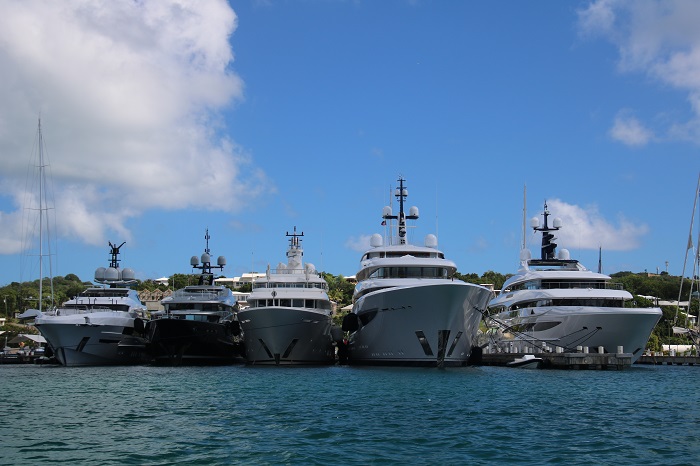
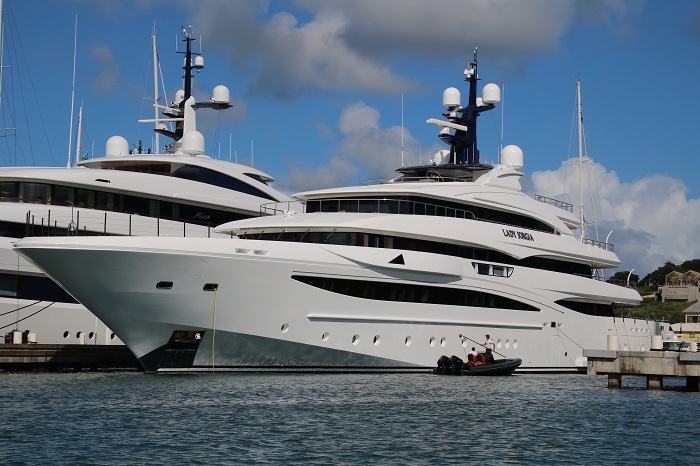
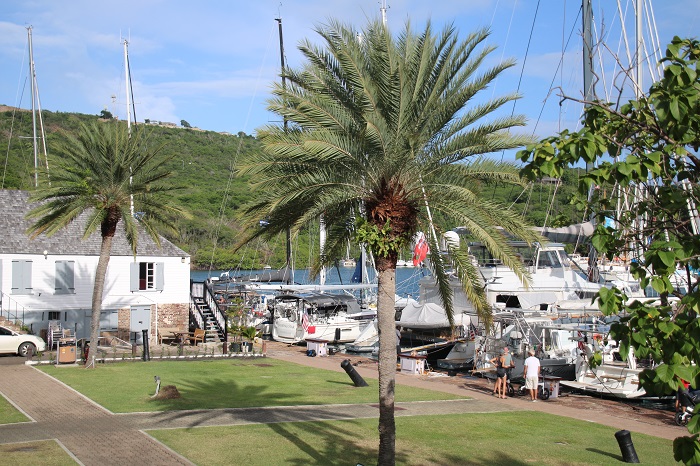
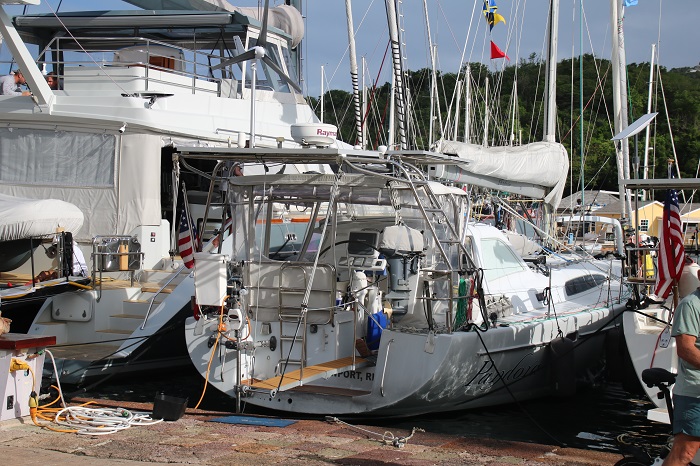
The 120 mile overnight run from St Barts to St John was uneventful and we made good time.  Craig and I took a mooring in the national park, a really nice area, for a few days before Alex arrived.  The water was an amazing blue and there were turtles all over the place.  In preparation for our run north, beginning tomorrow, Tuesday,  we decided to head to a marina in Red Hook, on St Thomas.  It’s a lot easier to prepare, getting the dink up on deck and getting provisions from a marina.  The marina is part of the IGY family of marinas, the same company that runs the one in St Lucia that we stayed at in Rodney Bay.  Their rates tend to be a bit more reasonable than others.  Plenty of services nearby.  The view of nearby St John this morning as the sun came up, was pretty nice. Under the category of “it takes all types” how about this boat near us in the marina.  A great party platform, to be sure. Being in a marina for a few days was a good idea.  A bit of luxury, complete with AC, is a good way to begin a long journey.

So on to the passage north.

I have been wondering, and worrying, about what the weather will be like for our 1,300 mile run to Deltaville VA.  I am heading there instead of home as I will be having a new lithium battery bank installed along with a wind generator before taking her to New England and home.

We have been relying on Chris Parker for weather routing for a decade as do all of the Salty Dawg Rallies.  Chris has a good feel for what sorts of conditions cruisers “of a certain age” look for so he does what he can to help us avoid drama along the way.

Of course, weather is what weather is on a trip of over 3-4 days but he tries to “read the tea leaves” with regards to long range considerations.  This is important for a run like ours, that will take perhaps 8-10 days.  While the weather for early days of the run are pretty clear, after 5 days it is possible that we will encounter conditions that look a lot different than what it looks like when we head out.

As an additional tool to monitor the weather, I also subscribe to Predict Wind and am able to download weather GRIBS twice a day via the Iridium Go satellite unit.  It’s an expensive bit of gear but well worth it for the long passages.  By seeing graphically on my screen what I am hearing from Chris Parker’s forecast, I am able to better visualize what he is talking about.

While the confidence of what the forecast is saying is a lot less certain after the first few days, Chris monitors the weather in Canada and the upper atmosphere thousands of miles away to try and get a feel for what is coming our way perhaps a week from now.

I say this as nearly every time I make a long run, Chris’s comments are always something like “well, that’s a long way off and a lot can change” when it comes to the conditions we may face.   Also, there just about always seems to be something nasty ahead of us to make the run a bit more arduous.

However, when we had our weather briefing yesterday, Chris was uncharacteristically upbeat with how he described the conditions that we were likely to face on our run north.  His comment was something like “I can’t imagine a better forecast”.  That’s good, very good.

Without going into too much detail, this is what the current conditions look like for our departure tomorrow.  It does look quite alarming up north where there are currently gales.  However, by the time we get there the system will have moved out of the area.  You can see the various tracks that the computer has recommended based on a number of different weather models.  See the boat icon, Pandora, at the bottom of the image.

It’s a bit hard to see but the green areas are wind in the mid teens and we will be on a broad reach.  Not ideal, as I’d like a bit more wind when it’s behind us, but pretty good.  As we make our way north, conditions continue to be good with favorable winds, and you can see that the nasty low has moved out of the area.  We will continue to have wind aft of the beam, and hopefully it will be strong enough to keep us moving at a good speed. Finally, as we approach the US east coast, there is a bit of uncertainty with a weak low forecasted to exit the coast.  Again, Chris feels a high degree of confidence that it will not amount to much.   Fingers crossed that it will be long gone by the time we cross the gulf stream off of Cape Hatteras and arrive at the mouth of the Chesapeake Bay. All and all, it looks like the wind will be favorable for the entire trip if perhaps a bit light at times.  Light wind isn’t a huge problem as I have plenty of fuel, so bring it on.

Over the years of working with Chris and getting his forecasts, there always seems to have been something on the horizon that is particularly worrisome but this time I am encouraged by Chris’s upbeat assessment of what lies ahead.

Just for fun, if you want to follow the fleet for the run home, check out this link to the Salty Dawg Homeward Bound rally page and see where we are relative to the rest of the fleet.   There is a list of the participating boats to the right and you can click on Pandora to see where we are at any given time.  If you don’t see the list of boats on that page follow this link to my own dedicated predict wind page. which is a bit easier to use but leaves out the other boats.  The tracker will update our position every few hours as we make our way north.

Let’s hope that when we arrive in Deltaville that we will look back and say “that was the best forecast ever!”

I’m counting on it, I hope…


Scroll to Top