As I sit down to write this post, it’s two days before Christmas and Brenda and I are in the midst of a whirlwind family holiday visit tour. Unbelievably, a week from today we will fly to Antigua just in time to celebrate New Year’s Eve in English Harbor. If you haven’t celebrated from the bow of your boat in the tropics… 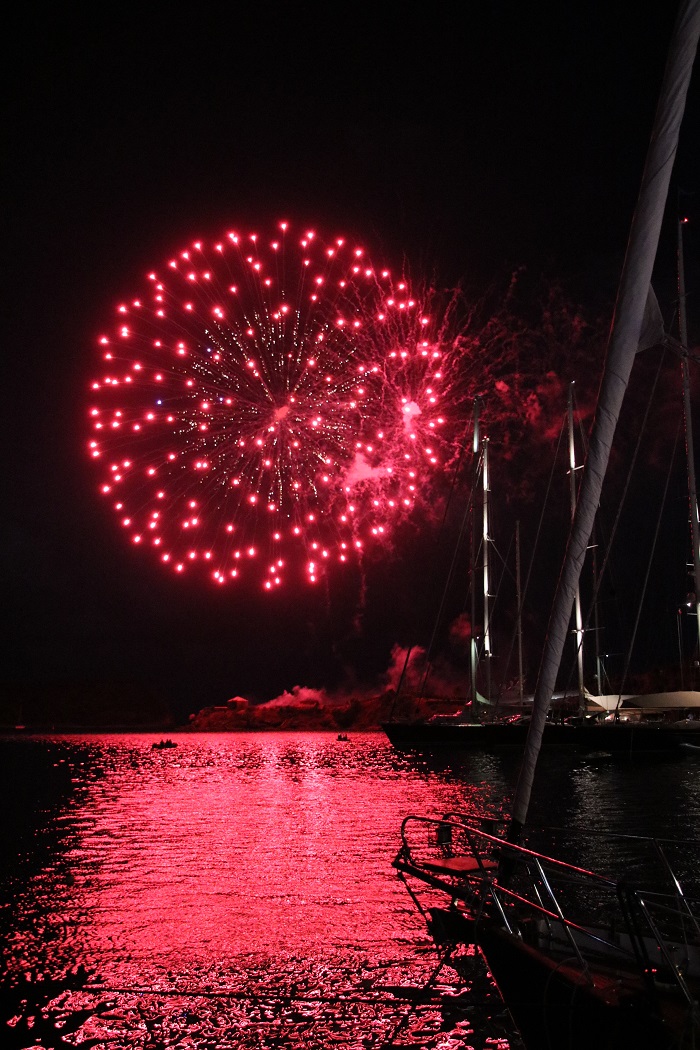 Timing is good for us to be on “tour” as there is no power at our home in CT, compliments of the winter storm that is sweeping much of the country. Tonight will be the coldest of the year in the mid teens.
We drove into NYC yesterday, loaded to the brim with presents and holiday food, to stay with Chris and Melody for a few days and then on to MD and Rob’s family on Christmas day. After that, home in CT for less than two days before we winterize our home, head to the airport and fly back to Antigua to begin our winter season afloat. Whew! No rest for retired boomers.
I was reminded just how different life in The Big City is, both from our home in CT and winters aboard Pandora when my alarm went off this morning telling me to head outside to move our car to the other side of the street. I wasn’t alone in my quest for another parking spot, but competing with just about everybody else in town. We had to move in time to accommodate the street cleaners, with everyone jockeying for a spot after the sweeper came by. Of course, after the sweeper came by a bit after 09:00, I still had to sit in the car until 10:00 when it was “legal” to park again. Such is life for those too cheap to pay for parking.
Anyway, here in the “big apple”, life is just so different than when we are onboard Pandora.
As a seemingly random segue, when I was in Antigua at one of our arrival events, a Salty Dawg member who had organized our Hampton departure activities, Kathy on Island Time, presented me with a rally flag that had been signed by most of the boats that had sailed to Antigua. I was very touched.
I mention this as Zelensky, president of Ukraine, when he addressed a joint session of Congress the other night presented a Ukraine flag signed by soldiers at the font line in the battle with Russia, to Nancy Pelosi, speaker of the house, at the conclusion of his speech. It was a moving moment.
When I told Kathy that Zelensky had stolen her idea, she said “who’s Zelensky?”, thinking that I was talking about someone in the rally, not knowing who that was. Being in Antigua and on Island Time, in more ways than one, she was, for the moment at least, oblivious of what was going on in the US. Good for her!
I get it. When I told her who I was referring to, she said, “Of course, that Zelensky!” Such is the life of the cruiser. It’s so easy to become detached, often in a good way, from all the troubles of the world.
When I am on passage I do wonder what’s going on in the “real world” but am generally focused on the boat, weather and of course, the proverbial question of “when will we get there”.
I was reminded of this disconnect at 07:30 today when my alarm went off, reminding me to move the car to the other side of the street or get a ticket. The thought was just so far from my consciousness that had no idea what the alarm was for and just rolled over. Thankfully, a short while later, Brenda said “when are you going to move the car”. I bolted up, pulled on my pants, jacket and ran, hoping that I wasn’t too late. The traffic cops were ticketing cars but hadn’t reached mine yet. Whew! I sat and waited nearly an hour for another spot to open up.
A friend told me that when he lived in the city, drivers would take parking spots that opened up all day long, “giving” them up to anyone willing to pay $10 instead of having to wait themselves. Then they would wait for yet another spot to open up and sell that one for $10. Park, repeat, park repeat…
I suppose that there is a parallel to this in the cruising community when we wait for a prime anchoring spot or mooring to open up and then race over in our dink to claim the spot. “Hey buddy, for ten bucks this mooring is yours!” Beer money! An idea?
To the point of how different life is aboard, especially on passage. I tried to capture the feeling excepted from a recent piece that I wrote for a recent club newsletter, that follows about my most recent run from Hampton VA to Antigua.
I wrote…with some heavy edits, I’ll admit.
It’s 04:00 and I’ve emerged from down below to begin my watch and relive Bob, who’s been up since midnight. He updates me on what’s going on: nothing sighted for the last few hours, little change from the last few days when we never saw another boat or much else for that matter. I generally do the 04:00 to 08:00 watch as I really enjoy seeing the sun rise over the eastern horizon. It’s very peaceful, well peaceful most of the time anyway. 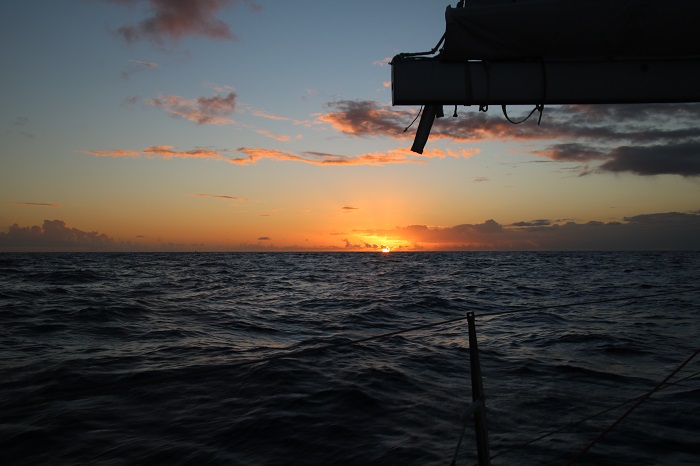 We are more than half of the way to Antigua, with 600 miles to go, on the final third of what will be my fastest southbound run yet, 9.5 days.
Pandora has been moving along nicely, reeling off the miles for what turned out to be one of the four days when we covered about 200nm, pretty fast for a cruising boat where that many miles in 24 hours is generally beyond most boats of her size. Fore days now, I have been focused on the boat, our progress and little else. My time, when I am not on watch is consumed by chores, keeping things clean, cooking and hours spent reading each day. I generally read an entire book every day when on passage.
The wind is ESE at 20kts and we are on a close reach with gusts that often brings the apparent wind into the low 30kts and even higher during frequent squalls. Fortunately, tropical squalls are rarely convective so lightning hasn’t been much of a concern. The idea of losing my electronics, 500 miles from land, is a sobering thought. 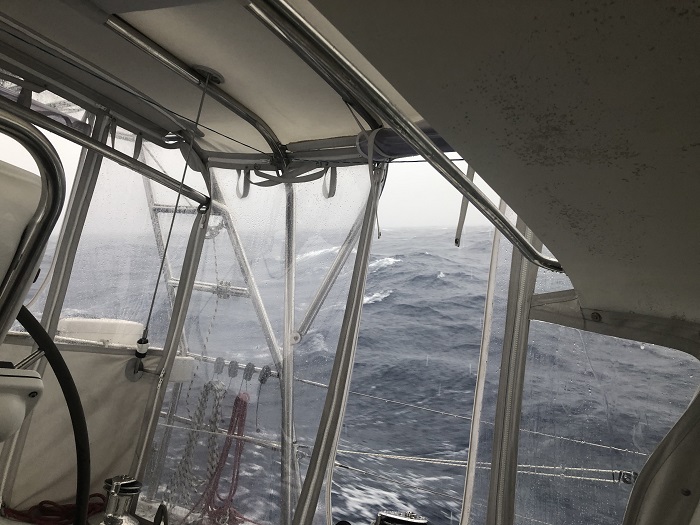 We are double reefed with a 100% jib. With frequent squalls over the last 24 hours, we have done plenty of reefing, requiring at least two of us on deck. A rigger had recently adjusted my slab reefing system with new leads and lines that are considerably slipperier than their predecessors so this process is as smooth as could be.
At speed, Pandora is a wet boat and we are taking plenty of water over the bow with beam seas in the 10’ range. Occasionally, we ship a good amount of water, especially when her fine bow plows into the back of a particularly large wave, but with her generous hard dodger and full cockpit enclosure we stay fairly dry, save for occasional water that washes across the back of the cockpit after sluicing under the enclosure panels.
The run has been fairly uneventful for the nearly a week that we have been underway as part of the Salty Dawg Sailing Association, Rally to the Caribbean. I serve as president of the group and after a few smaller “pandemic” rallies this year’s run was a record for the group with a capacity crowd of 120 boats. About 30% of the fleet went to the Bahamas with the rest heading to Caribbean, and the bulk of those planning landfall in English Harbor Antigua, the official Caribbean home of the rally.
Our planned departure date of November 1st came and went with unfavorable weather, and while the Bahamas bound boats were able to leave as planned, they later endured a direct hit from Nicole, huddled in Marsh Harbor, Abacos.
It wasn’t until 11 days later than the Bahamas bound boats left that the remainder of the fleet, including Pandora, patiently waiting in Hampton for the go-ahead from our weather router Chris Parker, departed.
While participants in the rally can opt to leave from anywhere they choose, the vast majority of the fleet staged in Hampton, VA, as this port offers good services and a simpler run to cross the Gulf Stream. It is also far enough south to avoid most of the late fall gales that plague New England. We had a Newport start for the first time this year and a handful of boats opted to leave from there. The run from Newport is farther east than Hampton, with a more direct route to Antigua passing about 150 miles west of Bermuda.
However, unless you have a particularly fast boat you are unlikely to make it to the south side of the Gulf Stream without encountering at least one gale. As it turned out, this year the wind was unusually favorable from Newport, a welcome surprise.
The run south in the fall always feels a lot like “threading the needle” as we try to find a decent weather window between lows, with the hope of being far enough south and east to avoid unpleasant conditions, and this year was no different.
As we waited for good conditions to carry us south, one low after another exited the coast, keeping everyone in port. I won’t go into detail but it’s always best to “stay out of the red stuff”.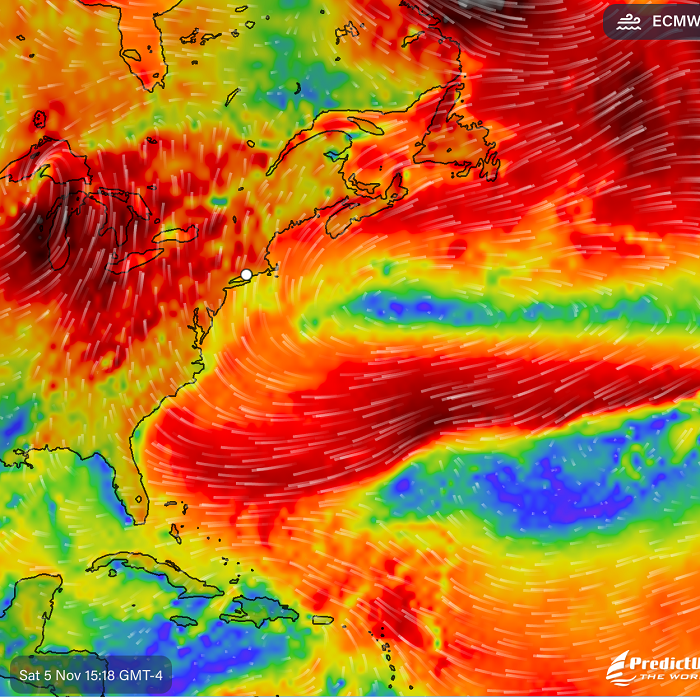 For the last 5 years the rally has been heading to Antigua, a destination that I championed after visiting there on our first run to the Caribbean in 2017. It is a remarkable place with the government and so many businesses enthusiastically welcoming our fleet.
The arrival of the “Dawgs” signals the beginning of their yachting season and to see Nelson’s Dockyard full to capacity with our boats was a rewarding sight. As we are the first to arrive, normally in mid-November, nearly all of the local businesses celebrate the Dawgs with parties and special events too numerous to outline here.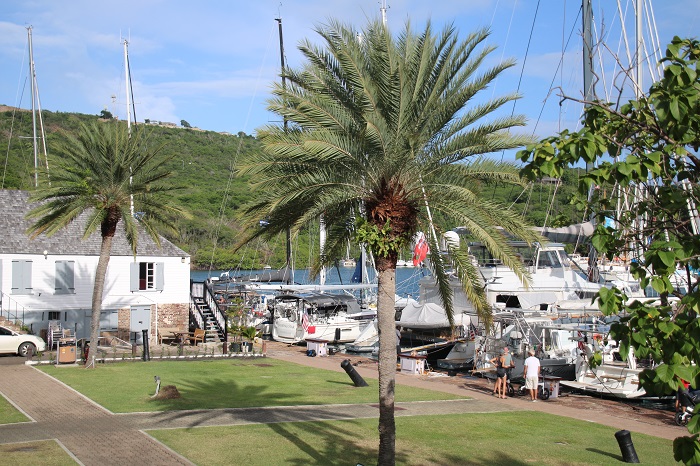 In spite of the nearly two-week delay we were still able to have 9 events in a little over a week, capped off with an amazing welcome in Nelson’s Dockyard attended by the director of The National Parks, Ann-Marie Martin and Minister of Tourism, Charles Fernandez. It’s worth noting that both, huge supporters, have welcomed us personally every year except during the height of the pandemic when social distancing made that impractical.
Antigua, the self-styled “sailing capital of the Caribbean” is very focused on the cruising community at every level as they know we will arrive thirsty, ready to party and with a lot broken stuff that will need to be fixed after a long 1,500nm run.
This year Pandora came through with minimal “issues” which was a first, and yet I still ended up with a rigger, canvas maker and electrician aboard upon arrival. And, with nearly 100 boats arriving within a few weeks that’s a lot of broken stuff…
Over the last decade Brenda and I have sailed the full US East Coast from eastern Maine to Key west, thousands of miles in the Bahamas, Cuba, and nearly every island from the USVI south to Grenada. I can say with confidence that making landfall in Antigua is my favorite. Once you arrive you have made all of your “easting” so everywhere else you might go to from there is a reach. During a season of exploring the islands of the Eastern Caribbean, you need never do a run of more than 75 miles as the islands are all so close together.
Located solidly in the easterly trade winds that, with rare exception, are from the east, perhaps slightly north or south of east but always from the east, sailing there is a treat for anyone who has sailed in the NE where wind direction changes daily. While heading east for a cruise in the NE is fairly simple, returning home means, more often than not, beating against the prevailing SW winds that are prevalent during the summer.
For many doing the rally, the 1,500nm to Antigua is their longest run to date. And while most boats are crewed by couples, nearly everyone takes on at least two additional crew for the run. Sure, some do the trip themselves but with gear breakage always a risk, having extra hands aboard is prudent.
Since the pandemic, many have taken stock of their lives and have decided to focus more on their “bucket list.” For many this involves heading south and SDSA and the rally is the perfect way to gain needed skills. And crewing on a rally boat is often a first step for many and with more than 100 boats, there are plenty of berths.
Since I retired over ten years ago, our lives have certainly changed. And as a long time member, and now the reluctant president of Salty Dawg, I can say with confidence that I would not have ever made the leap to sail the 1,500 miles to Antigua had it not been for what I learned through the group.
Heck, I can still recall how I felt as I exited the Cape Cod Canal for an overnight run, my first, way back in the early 90s, on my way to Maine. At the time, I was pretty confident that I had no business being out there. Little did I know that in years hence, I would be on yet another 1,500 mile run to the Caribbean, this time in the company of more than 100 boats, myself having accumulated nearly 20,000 miles at sea since that first run to Maine.
After living through the pandemic, I can say with confidence that “life is short and you will never be any younger or healthier,” so don’t wait! Cast off the dock lines and head south. After making a long voyage in the company of dozens of other boats you will be a part of a rarified group of sailors, those who have successfully completed a major blue water passage. Estimates are that only about 1,000 boats head south in any given year so that is indeed a very select “club.”
As I woke up to that jarring alarm this morning, unsure of where I was, I was again reminded how different things are ashore, especially here in Manhattan, than when I am aboard Pandora.
I am so excited about the next week, visiting family and seeing the excitement about Christmas from our three grandchildren. And their Dad, our Rob, is whipping them into quite a frenzy over the whole Santa thing, using their own personal “Elf on a Shelf” to help things along.
A very creative dad who never seems to run out of things for Elf, or for the kids to do, here Elf ziplining in the den. Love the tutu. Looks like Elf is in touch with his/her feminine side. Of course, these days Elf is able to identify with whatever… 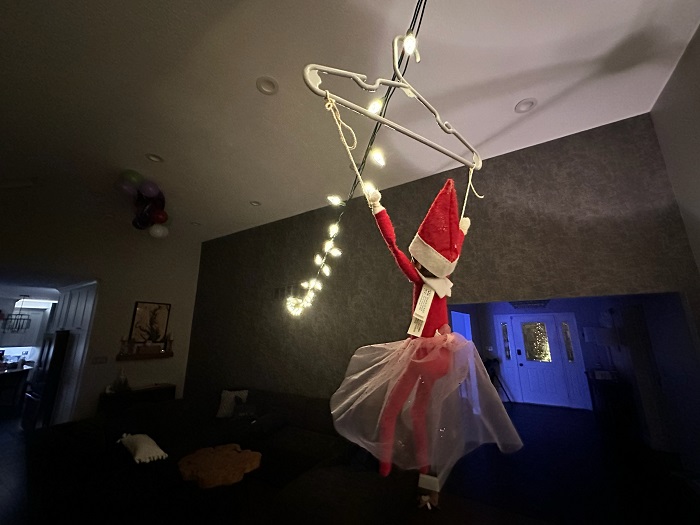 For me, it’s wonderful to move between the many “worlds” that make up our lives. But for sure, confused or not, I am very happy to wake up, unsure where I am from time to time, today bolting out to move the car and I hope to continue to do all this as long as I can keep up the pace.
A few more days with Chris and Melody, then off to see the kiddies, home to winterize our “land home” and on to Antigua.
Indeed, it often feels like a “collision of worlds” but USUALLY in a good way.
Oh yeah, and all this happening in the midst of a “polar bomb” that’s impacting much of the lower 48. Yes, plenty of variety for us these days.
I have to say that given the choice, as we head into the teeth of the northern winter season, I am all about those sunny beaches of the Caribbean. Besides, I won’t have to worry about moving the car…



 A closeup of the unit. It’s crazy as when you turn it on, it rotates and automatically points to the optimal source of signal. As the boat moves around in the very light winds that we have right now, it follows the satellites by rotating to compensate for the boat’s movement.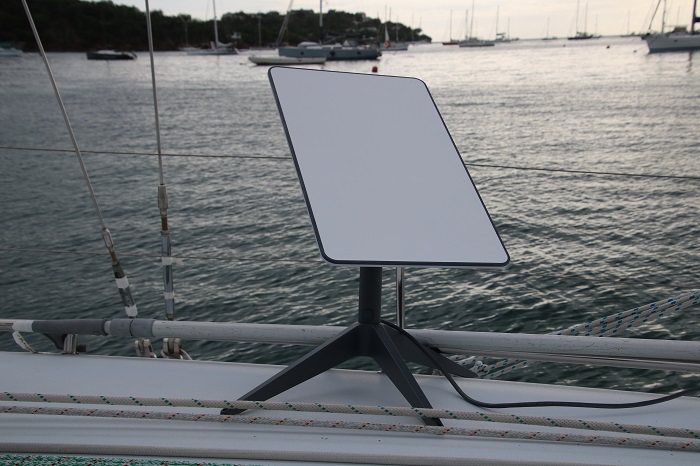
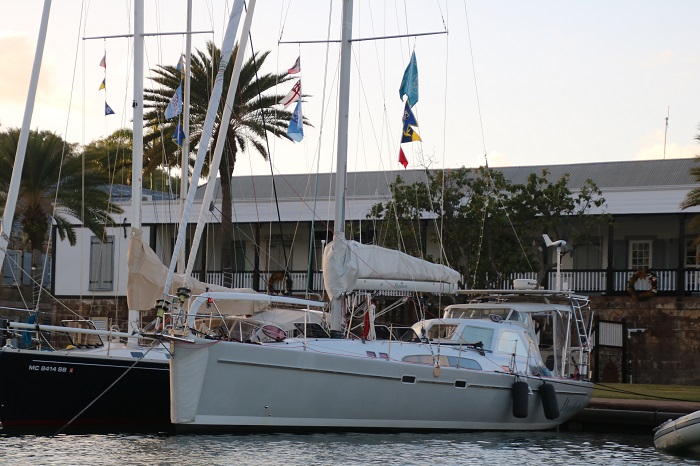
 For the first few days we moved over to historic Nelson’s Dockyard and tied up to the quay. This involved Mediterranean mooring where we dropped our anchor out in the harbor and backed up to the marina wall, using the anchor to hold ourselves off and safe from hitting the dock. It’s a tricky process but after you get the hang of it, not too bad. When we moor this way, Brenda is up forward dropping the anchor. I power backwards, using the bow thruster to steer the boat. I say not too hard but my heart is racing the whole time as we always have to do this between a few other boats with feet on each side and of course there is always a nasty cross wind. And, to add a bit of fun, this is a very popular spectator sport, as is all docking. Sometimes it feels more like Nascar with the excitement of crashes always a moment away.
 We had some canvas repairs done while we have been in Antigua and that included a new mast boot, to keep the water out of the boat. Actually, this “fix” included an inner boot of rubber covered by the canvas. That part was done in Annapolis.
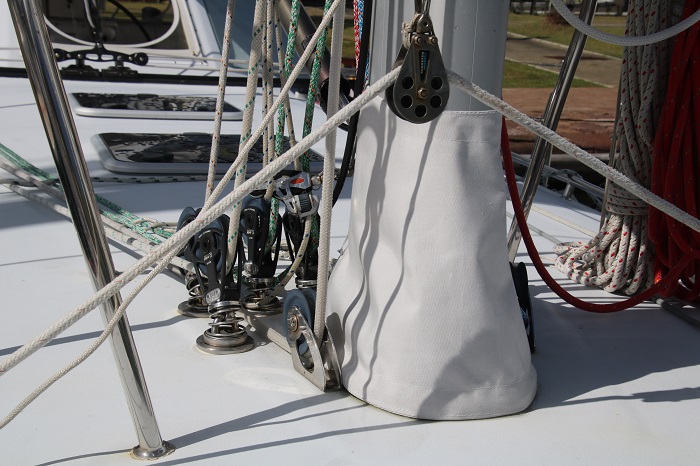 Even more impressive from the back as it’s pretty intricate with multiple Velcro flaps to keep it affixed. . It’s a bit hard to see but there is a lot going on including fittings for the boom vang and lots of other stuff to work around.
 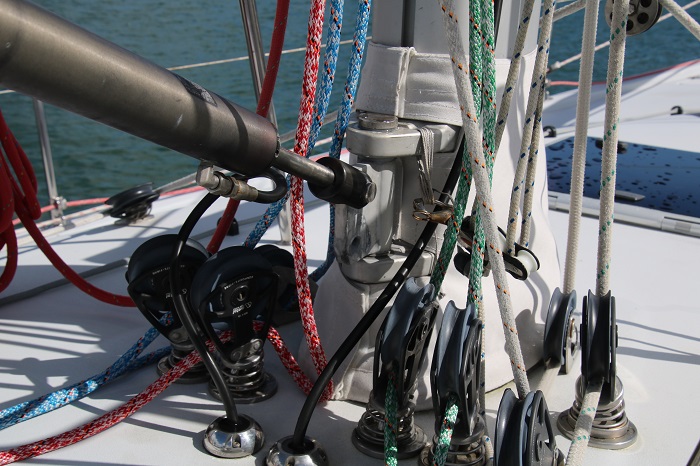 This is what’s under the new canvas boot.
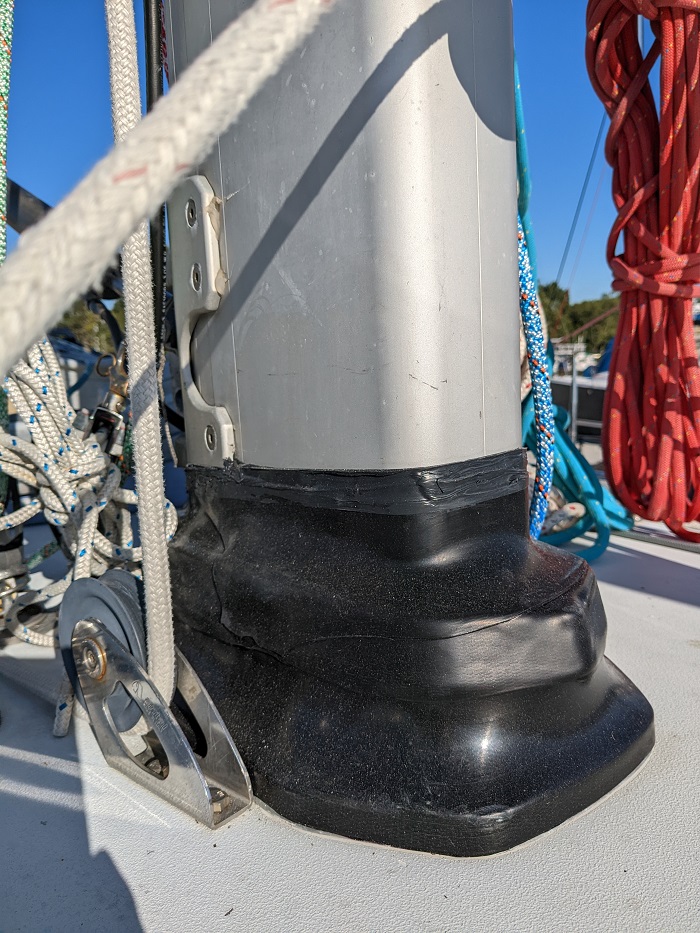 This has been a major source of leaking down below, especially on this last passage so I hope that things are finally solved. Fingers crossed.
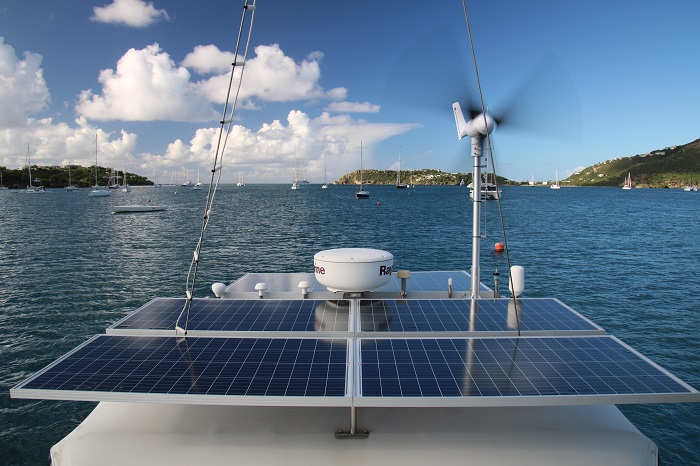
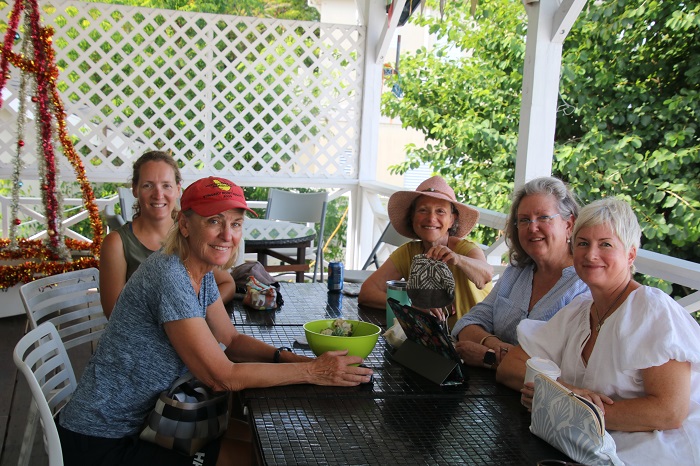 All that electrical upgrades we had done on Pandora over the summer are paying off with plenty of excess electricity to power the boat. Lots of hot water and I am thinking of having a change done on my electrical panel that will allow us to run our washing machine off of the batteries as well. We have a very powerful inverter to run appliances and it seems pretty clear that we can use a lot more power with the wind generator, new solar panels and those power hungry lithium batteries to suck all that juice up.
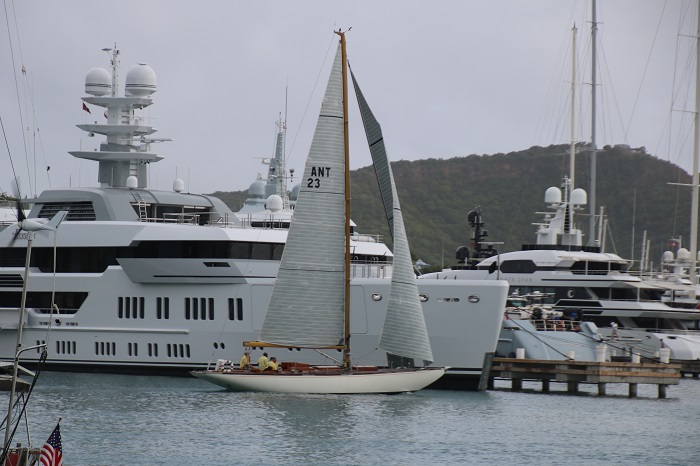
 Of course, it’s Saturday afternoon and it’s time for club racing. This lovely classic sloop tacked back and forth before heading out for the races. What a contrast to all the huge mega yachts lined up cheek to jowl in the Antigua Yacht Club marina.
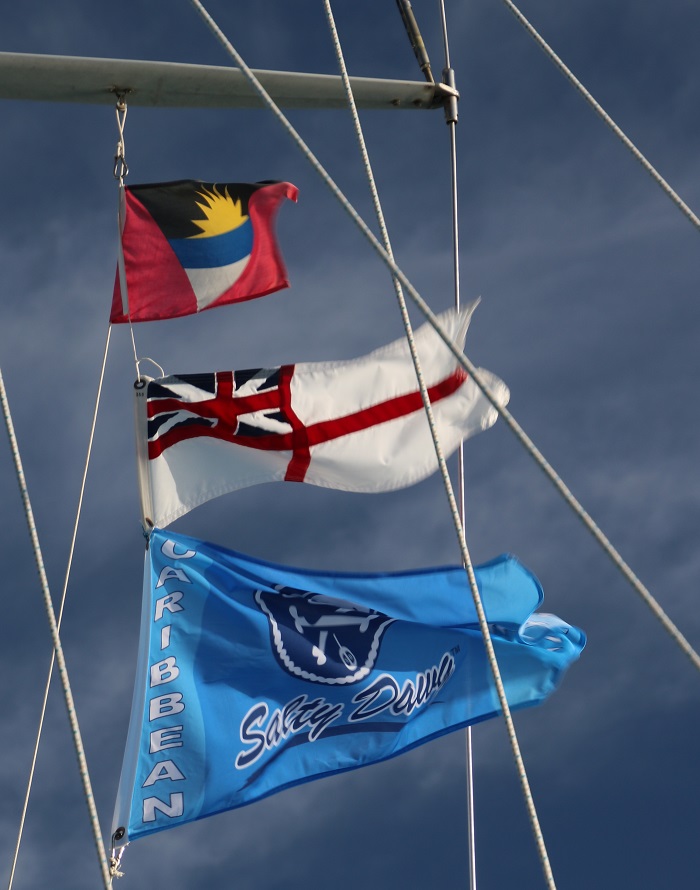
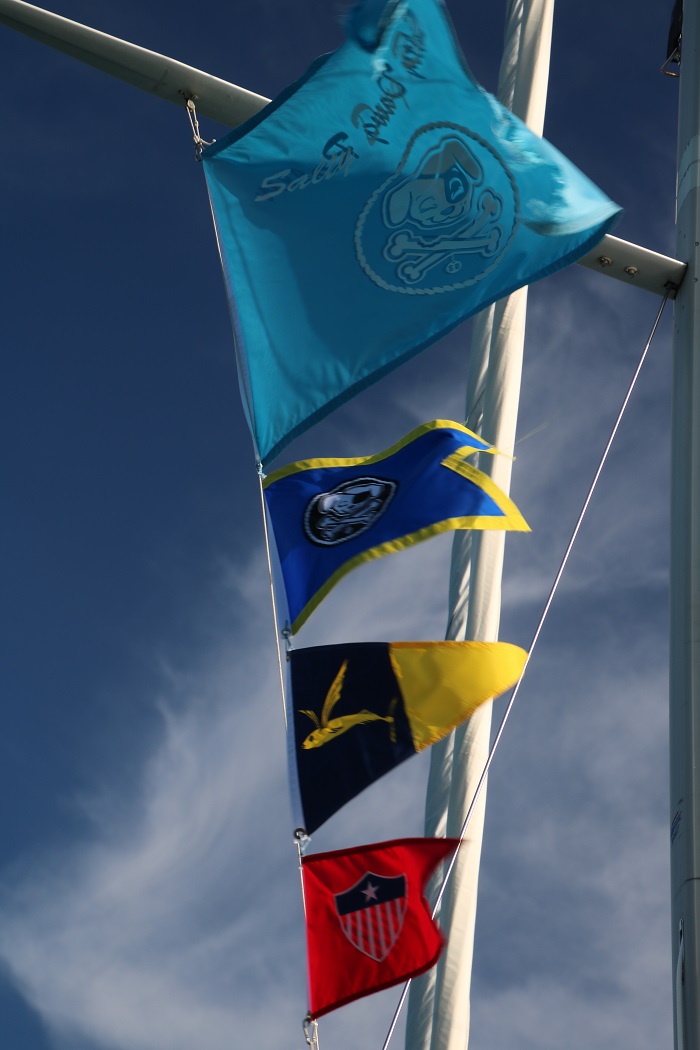
  And, speaking of clubs. I belong to plenty and enjoy flying the flags. Of course, the Antigua courtesy flag followed by the “white penant” of the Royal Naval Tot Club of Antigua and Barbuda. Of course, I am a card carrying member of this terrific group. Below that, a big Salty Dawg rally flag.
  And speaking of the White Pennant. This beautiful classic yacht, Shemara, built in 1938, pulled in today flying a White Ensign, which is very similar to the Tot Club flag. This version signifies that someone aboard is a member of the Royal Yacht Squadron. I have seen this yacht before and
 Beyond that, not a lot to talk about. Brenda’s birthday is coming up on the 15th and she’s none too happy about being away from family so I will have to work hard to make it up to her.
 It’s amazing that this year is a full decade as a retired person. If you haven’t tried it, being retired is easier than working, most of the time, anyway.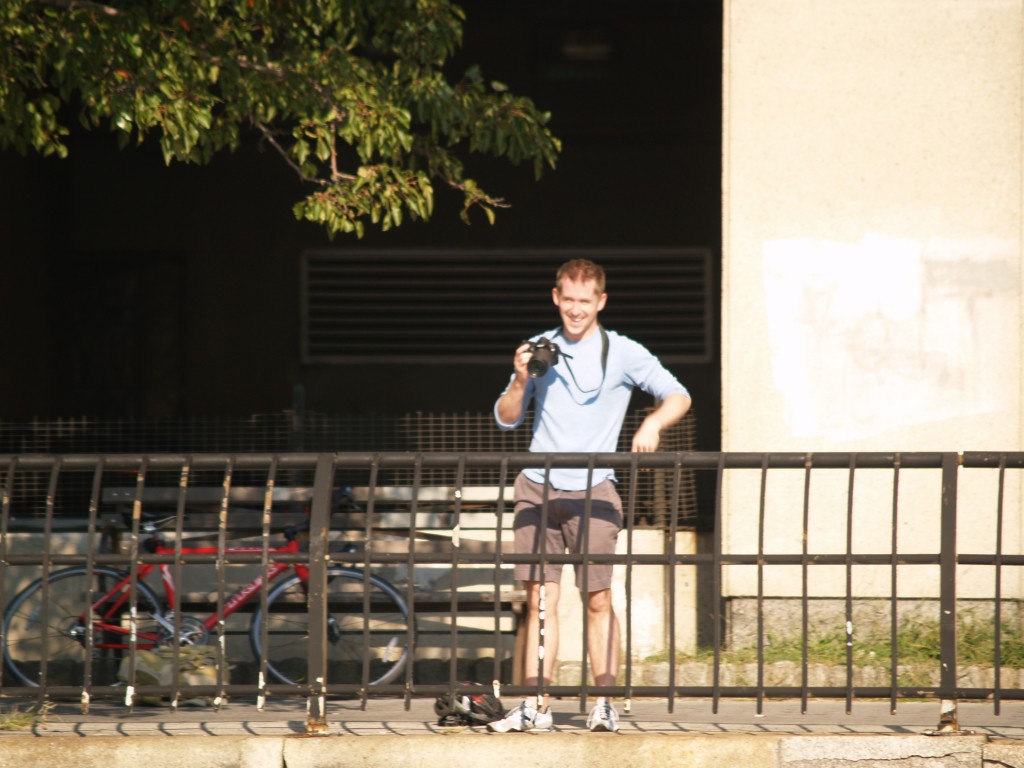
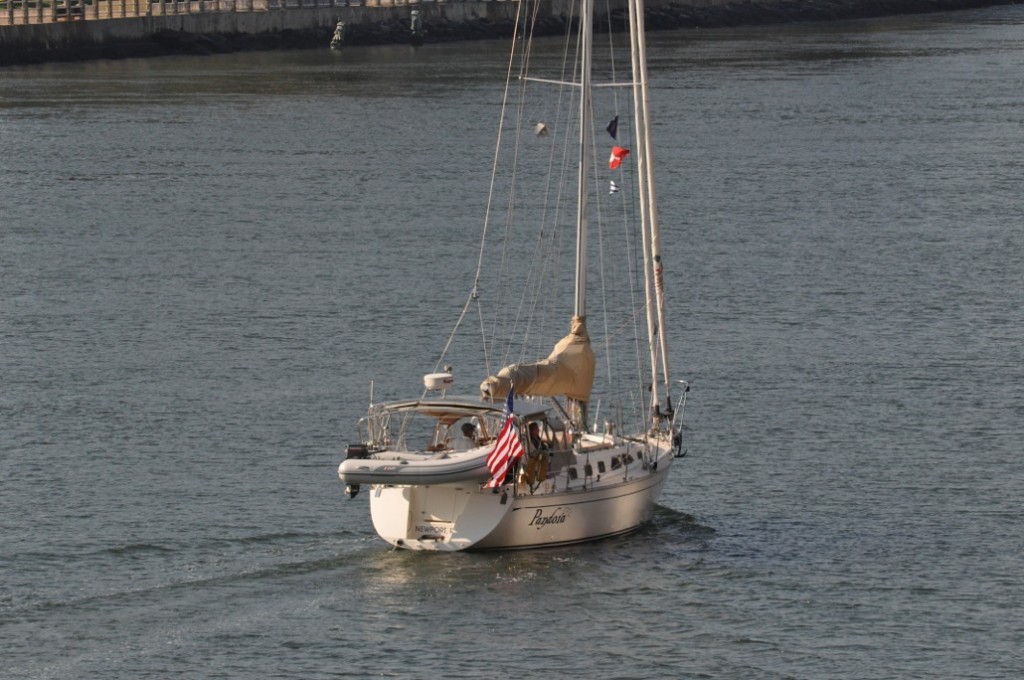 He then jumped on his bike and raced us downtown and waved us bon voyage from Battery Park. That moment was so long ago and yet it seems like yesterday. Christopher was at Columbia University for grad school where he would ultimately earn is PhD in Physics. Brenda cried alligator tears as we made our way down the harbor, Christopher fading into the distance.
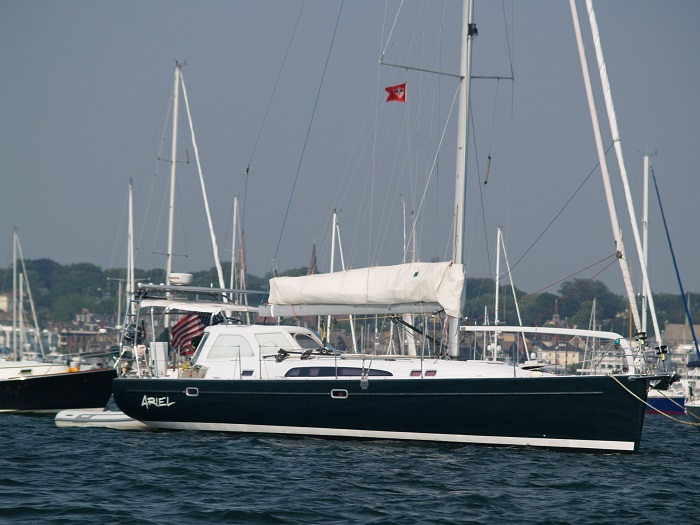 Now she’s a light grey, a lot cooler in the tropical sun. Here she is in English Harbor, Antigua. She’s in better shape than ever and really tricked out for long distance cruising, sitting in a place that we could not have imagined all those years ago.
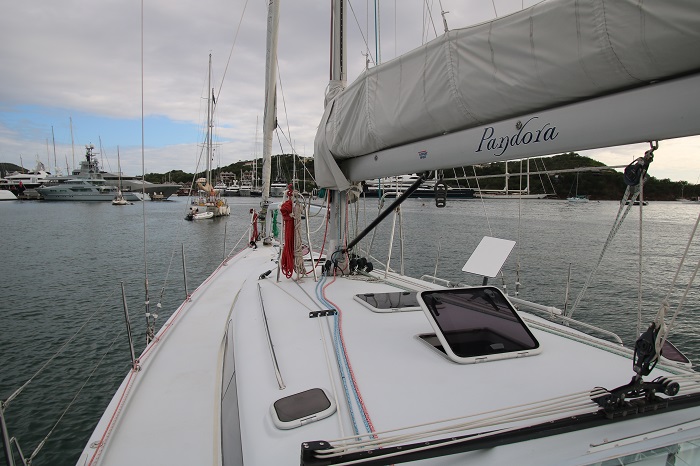
 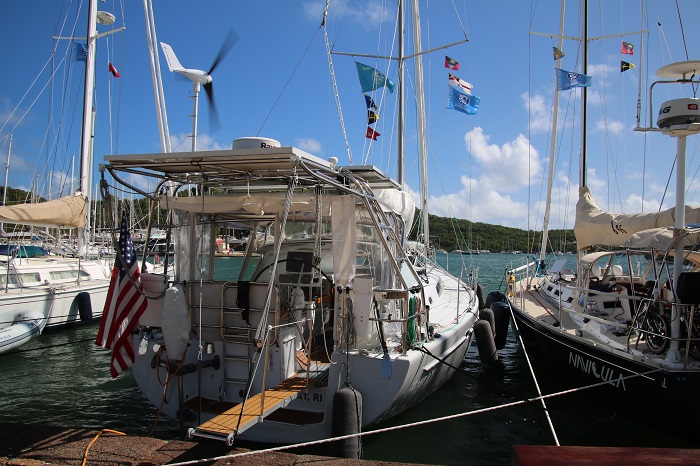 What a view from her bow, tropical breezes blowing while it’s cold and rainy up in CT. A week ago at home it was in the low teens, a lot different, that’s for sure.
 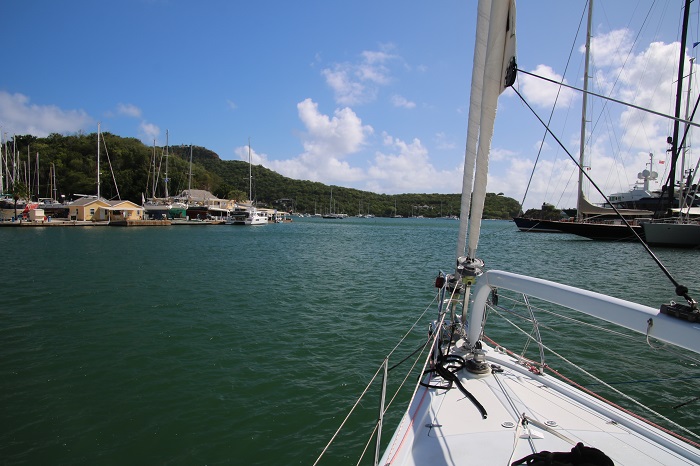 And the boats in the neighborhood are a lot bigger these days.
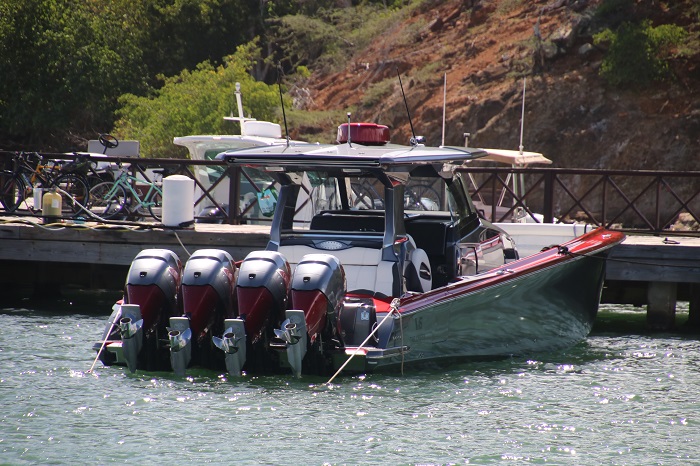
 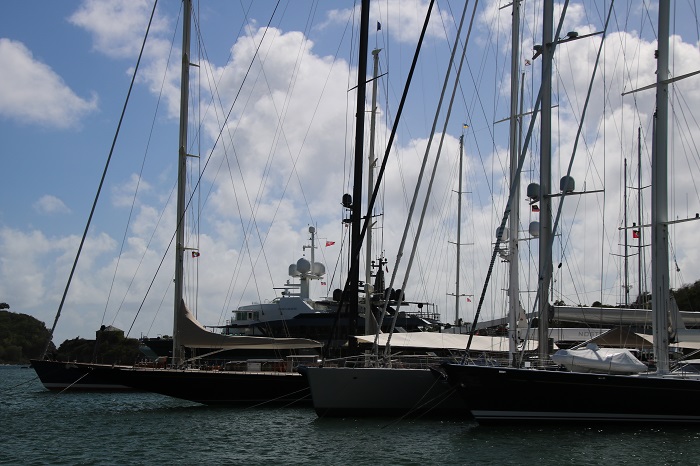 The show of wealth here in the Caribbean, especially Antigua, is remarkable. How many outboards does it take to push your dink?
 Happily we haven’t been home for too many winters since that first run to the Bahamas and during that time, our travels have taken us the entire length of the US east coast, the Bahamas, Cuba and most of the islands of the eastern Caribbean.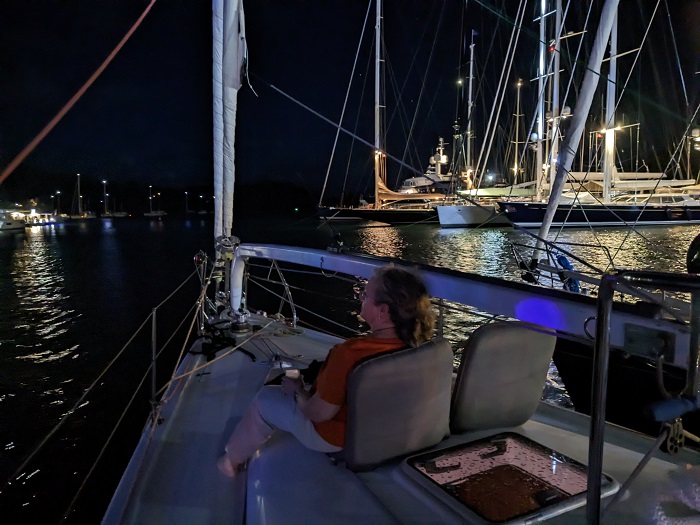
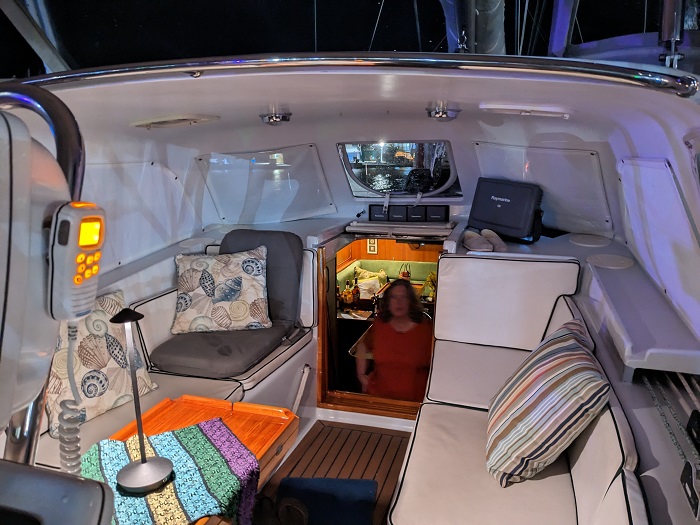 And speaking of here, you should have seen the fireworks on New Year’s Eve.
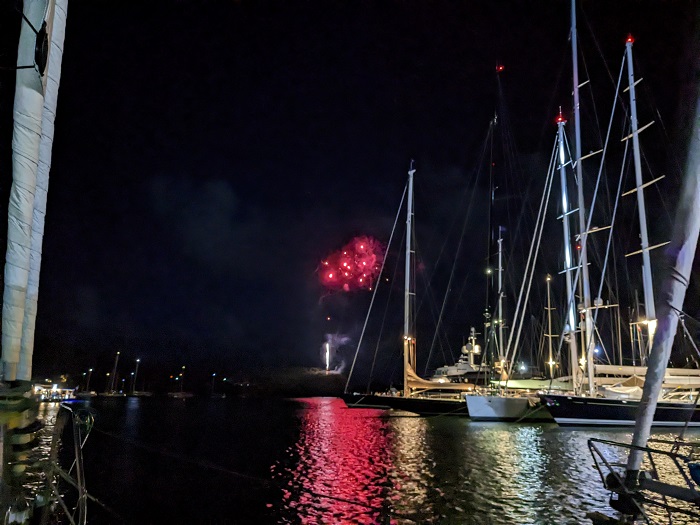 A short but remarkable display.
 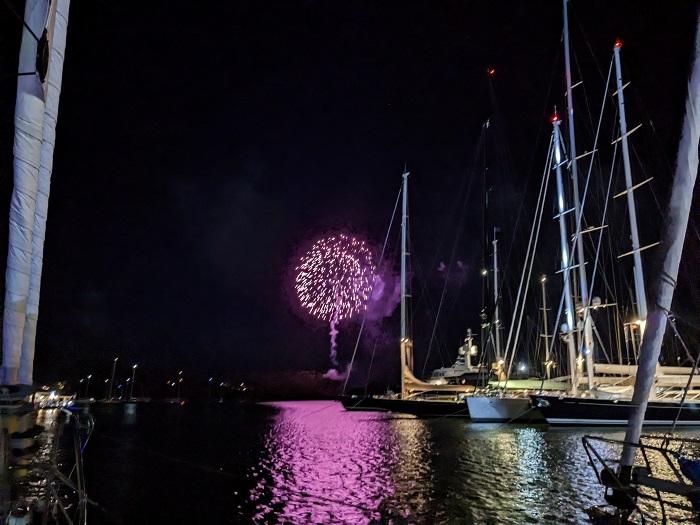 There is nothing like tropical fireworks and we actually stayed up till midnight when the show began.
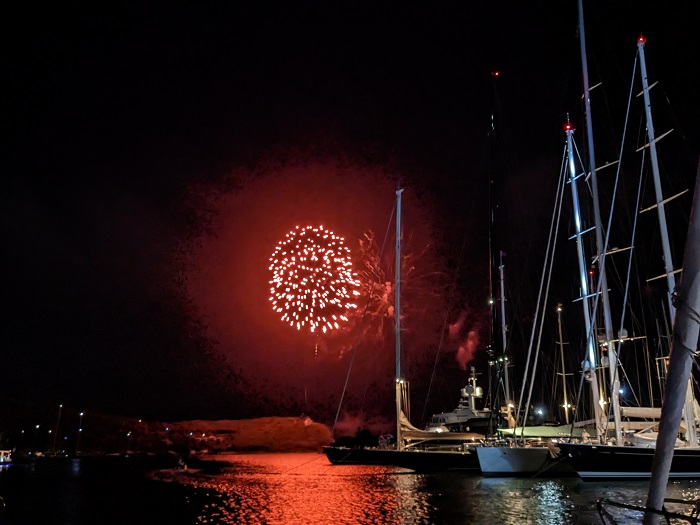 We were not alone with a big crowd in the Dockyard, thumping music and all that ran until 02:00.
 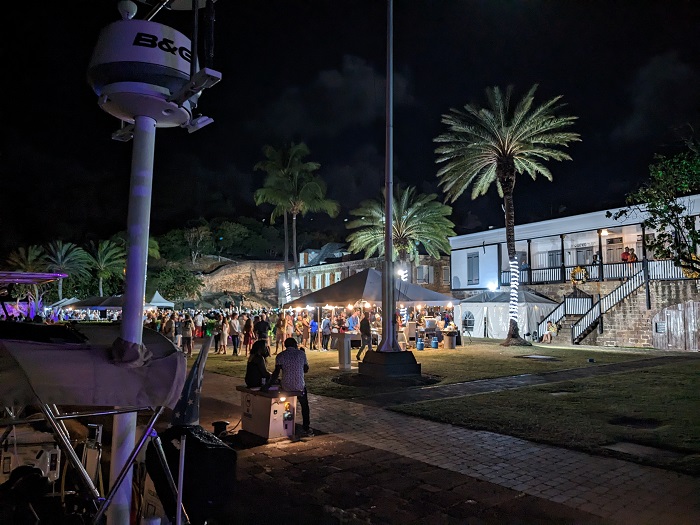 We had no trouble “tuning” out the revelers out with the hatches closed and AC humming…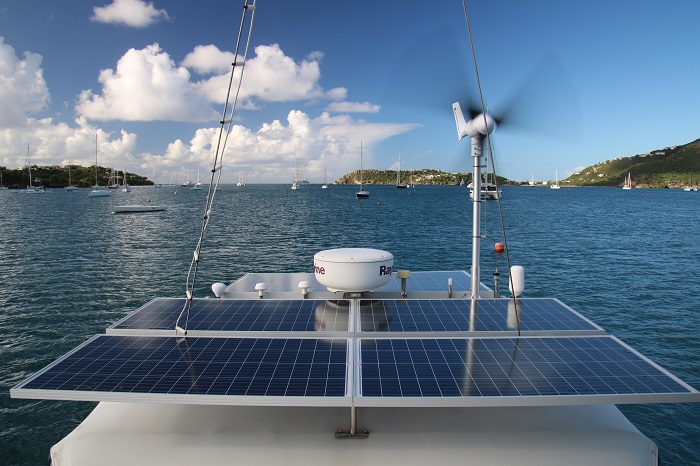
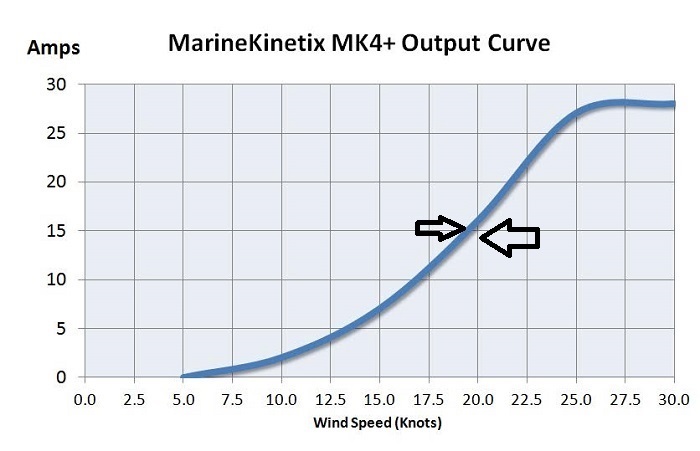 As the generator output matches exactly what the power curve of the unit is rated at, suggests that the new batteries will take power as fast as you can give them with virtually no resistance.
 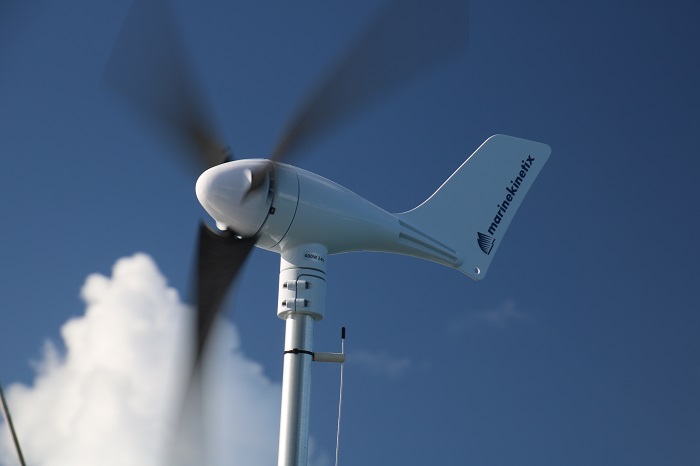 I chose the