


Only 18 days till spring… Yahoo!
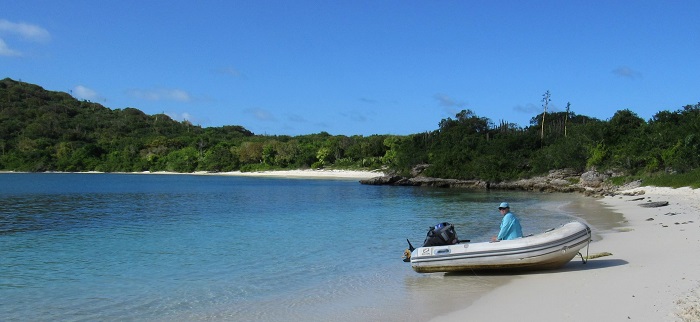
It’s been a long COVID winter but as I sit here watching the snow, that has been carpeting the ground for the last month, finally melt, I am encouraged that we have left January and February in the rear view mirror. With multiple snowfalls, my snow blower has had more use this winter than it has for many years. I am very hopeful that it will be along in “cold storage” for all next winter, snow or not…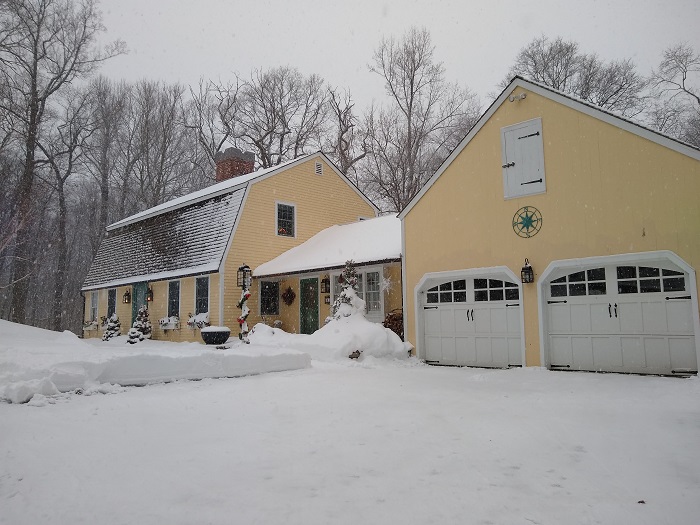 Next winter I am looking forward to tropical sun warmed “white”, the type you get on a sandy beach. That’s our friend Maureen enjoying the warm weather in Antigua back in January, a big contrast to our frozen time up north.
  Here, a glimmer of hope as the spring flower catalogues have begun piling up in our mailbox, knowing that we are all desperate to see something new and green poking up from the ground, bringing the promise of warmer weather.
Brenda and I received our first Moderna vaccination two weeks ago and will soon return for our second. Hopefully, after that, we will be able to begin resuming something resembling a normal life. Fingers crossed that research will show that we won’t be at risk of asymptomatically passing the virus to Chris and Melody before they get their vaccinations in mid April.
Once the “coast is clear” we are totally going out for dinner. I can not wait for that and to hear the words “Welcome. What can I get you this evening?”
Yes, it’s been a long winter but having our son Christopher and his partner Melody with us, along with their Husky Mila, has done a lot to keep us from going completely stir crazy. As of this week, they have been with us for 6 months and I can not imagine this winter would have been like without them in our “bubble”.
Here’s my buddy Mila with her own new baby husky. After a few days of “love” the “baby” is headless and somewhat worse for wear. “What are you looking at? I didn’t do anything, nothing… If you’d only take me for a walk. Now?” And speaking of afternoon walks, Mila always seeks me out around 3:00 knowing that it’s time to head into the woods for a walk.
Yes, it’s been great to have the three of them with us so the next order of business will be to convince them not to return to San Francisco any time soon. Hopefully, they will decide to set up house, not that we are trying to get rid of them, somewhere within a reasonable distance. “I hear that you need to have someone watch Mila. We’re on it…”
Just how isolated have we been? Today, I cleaned out old receipts from my wallet and discovered a few from my trip back to Florida in June to bring Pandora north. With these forlorn slips of paper, I was able to follow my progress up the East Coast, Fort Pierce Florid, a stop in Hampton VA, and on to Annapolis.
Aside from trips to the grocery, and an endless number of Amazon charges on our card, there have been precious few trips out since the weather turned cold. Totally depressing. And, I expect that the few $20 bills accompanying those old receipts are probably from an ATM months ago. Remember cash? How quaint.
I’ll admit that I am really f0cused on next summer and the coming cruising season and am praying that we will be able to go out in public without too many restrictions. There’s been a lot of discussion about how masks are here to say that I am not all that unhappy about that possibility as I have become quite used to wearing one. In particular, with masks, the wildly coughing people on planes and other public places will seem a lot less intimidating. Remember the flu? That seems like such a long time ago.
And, speaking of summer cruising, I’ll be leading a rally to Maine from Newport in July for the Salty Dawgs, which should be fun. This summer will mark by 16th trip “Down East” and I am really looking forward to the trip. I really don’t need a rally for the one day over-night to Maine but really want to support those who are doing their very first run in the dark.
My friend Bill recently quipped “sailing at night is exactly like sailing during the day except that you can’t see anything”. Yes Bill, that’s correct but to many it sounds a lot like “So Mrs. Lincoln, other than that, what did you think of the play?”
It is widely recognized that anxiety about doing “overnights” is one of the top issues with first timers. Personally, I can attest to that as I vividly recall the first time I headed out of the Cape Cod Canal for my first overnight run to Maine. It was about 20:00 and I thought “I have no right to be out here in the dark”. But I made it and over the years I have spent countless nights at sea.
Our friends Tom and Sarah, who sailed around the world as part of the Oyster Around the World Rally, shared that when Sarah first began sailing with Tom said that she WOULD NOT sail overnight and yet went on to sail some 25,000 miles, including many-many overnights. You never know until you give it a try.
Anyway, sailing in the dark isn’t for everyone but it’s a hurdle that must be overcome in order to do anything other than short local hops. I am hopeful that we will have good participation in the Maine rally this summer so more can take the important step from coastal to extended cruising.
And, speaking of learning new skills, I have been hosting a series of nearly weekly Zoom meetings since January with some cruisers who want to head out and away, mostly this fall, probably down the ICW and onto the Bahamas.
Brenda and I have enjoyed these sessions and it will be fun to have Tom and Sara as special guests tomorrow evening to provide insight from their own experiences, about what it takes to “cast off the docklines”.
While most of our sessions have been more of a Q&A format, I did a presentation recently about crossing from FL to the Bahamas, strategies for crossing the Stream and the Banks along with some highlights of Bahamas cruising. Check out the recording here.I am also kicking around the idea of preparing a recorded talk about the plans for the Down East Rally and if that works, I’ll do the same about planned highlights for the upcoming Caribbean Rally to Antigua, yet another opportunity to take advantage of what Zoom Culture has brought to us. The ability to easily share stories and “see” others, when we can’t, is one positive to come out of the Pandemic.
It is bringing me some solace to be able to think about the coming cruising season but it’s still too cold to begin projects on Pandora to get her ready and in proper cruising shape.
In the meantime, I am trying to build good will with Brenda by building a new kitchen table out of cherry. I still have a long way to go but I am confident that a new table that will replace the one we purchased when we were first married over 40 years ago, will be a welcome addition to our home.
I began with rough lumber and yesterday joined the boards together for the top. They were really rough and you can see that much will have to happen to make them “ready for prime time”. ‘
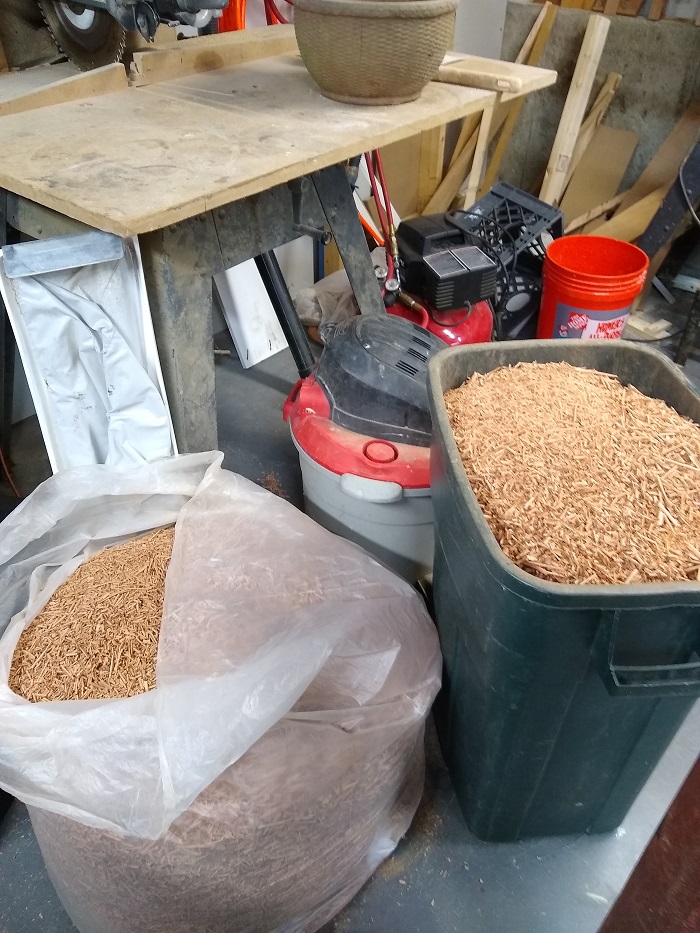
Partially planed rough boards. They were completely grey when I received them, compliments of a friend who had them in her garden shed for years. 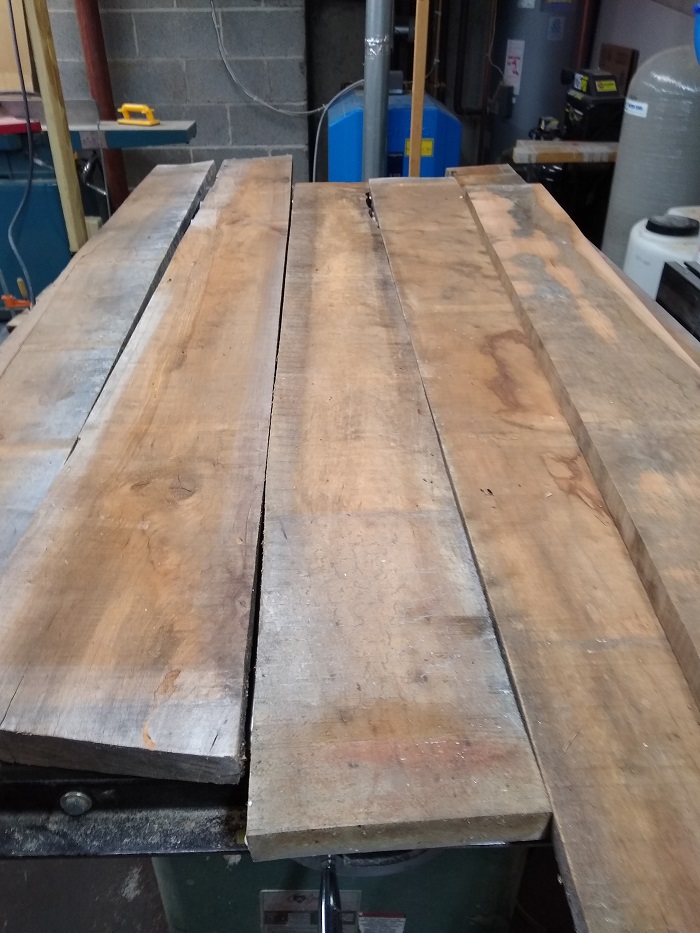 I thought that they were walnut but was thrilled to learn that they were cherry, my favorite, when they emerged from the planer.
 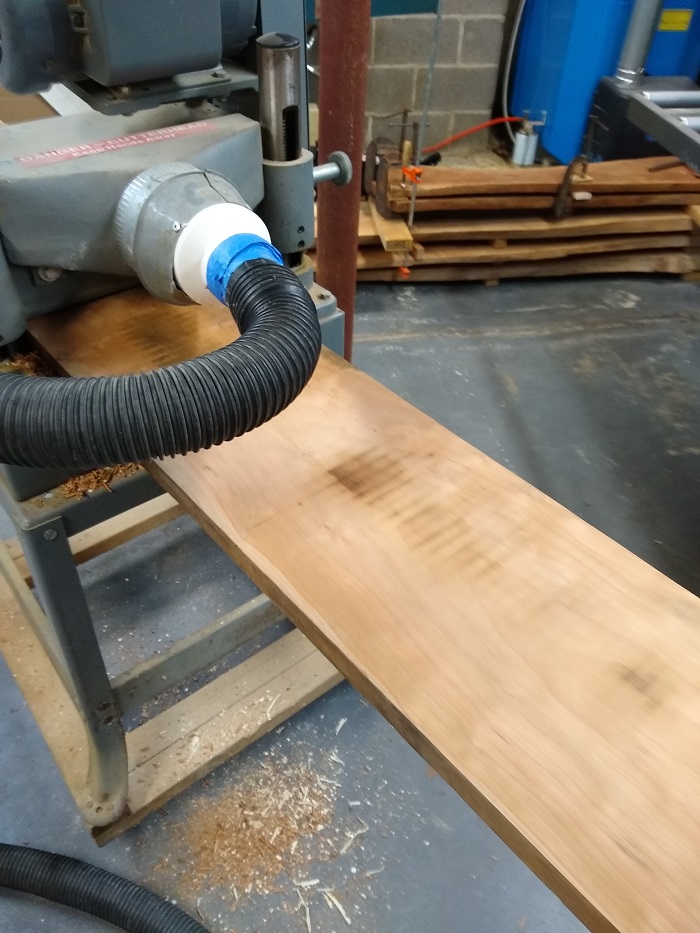 Some of the board were fairly irregular so it took a number of passes through the planer and I ended up with tons of shavings. This is only half…
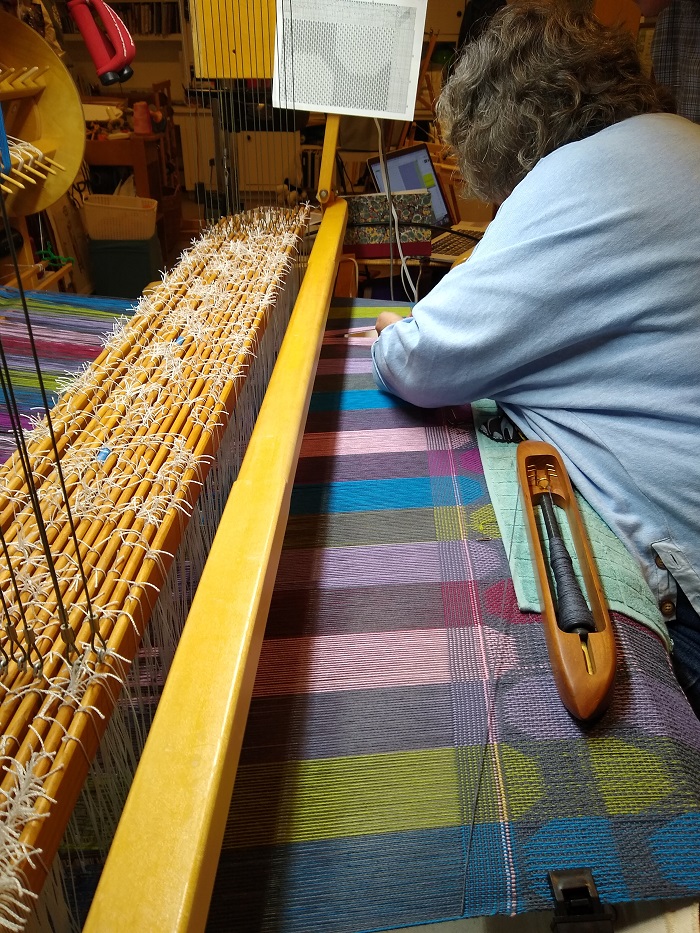
 Meanwhile, Brenda is weaving away. This project, her first on a 16 harness loom that we purchased recently, is very complicated and involves 1,000 threads in the warp, a major undertaking to set up. Now that all the bugs are worked out, and there was a “bug swarm”, she’s a very happy camper/weaver.
 So, that’s about it. Our world has been pretty narrow for the last 6 months, made better with our “brood” here with us.
Soon, very soon, we will be able to once again sit outside and enjoy the springtime weather.
“Did I hear someone say OUTSIDE? Is it TIME FOR A WALK?”, says Mila.
Oh boy, I sure hope so, and without a jacket…
So much to look forward to and only 18 days till spring. Yahoo! Yahoo!
YAHOO!
 Clouds bring the sky alive. Without them, the sky is just a Pantone color sample, I’m going with “Etherial Blue #15-4323, yes that’s the color.
  Pedestrian, unless a tropical long-tail happens by. Then it gets a bit more interesting.
 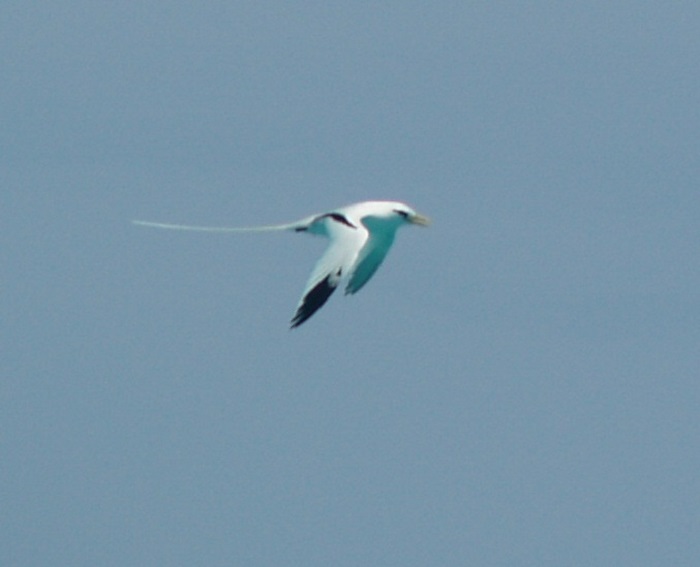 Enter an interesting cloud and then you really have something.
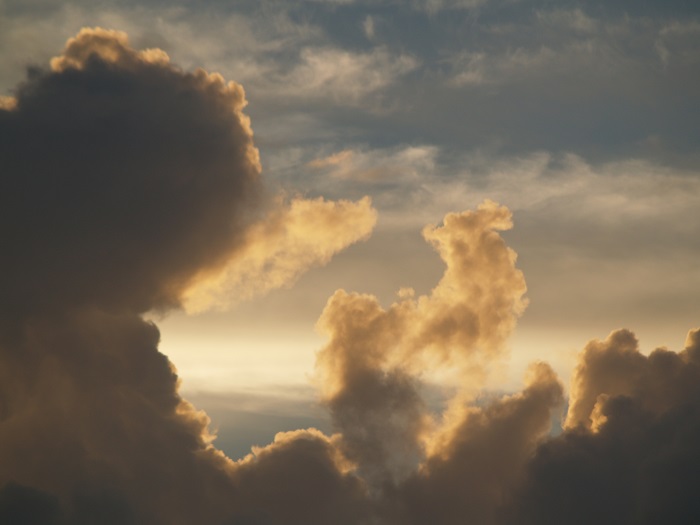
  If you have followed this blog over the years you know that I just love sunsets and have posted photos of them more often than I can ever justify. Perhaps my love of sunsets is equal to how I feel about clouds. Particularly the big puffy kind that always make me think of those times laying in a field trying to decipher what they are trying to tell me. I can’t admit what this one reminds me of. You decide…
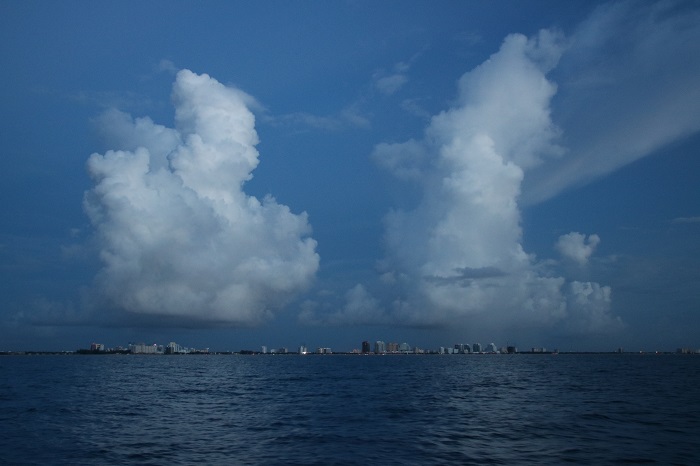
 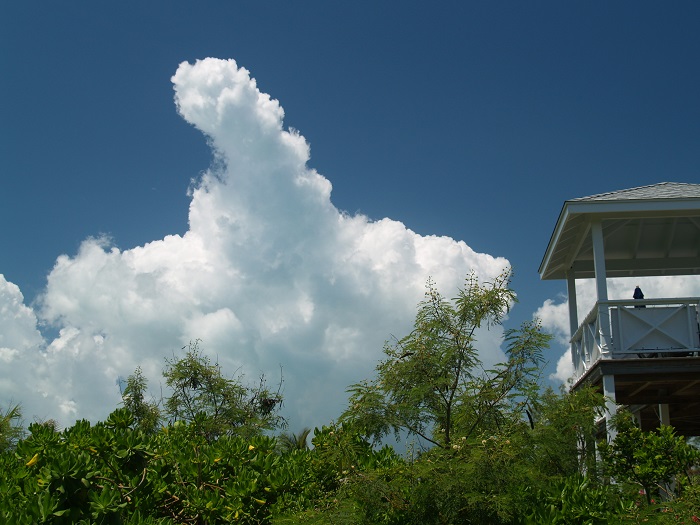 Or this one taken off of Miami. The sheer magnitude and so often, gone in a moment.
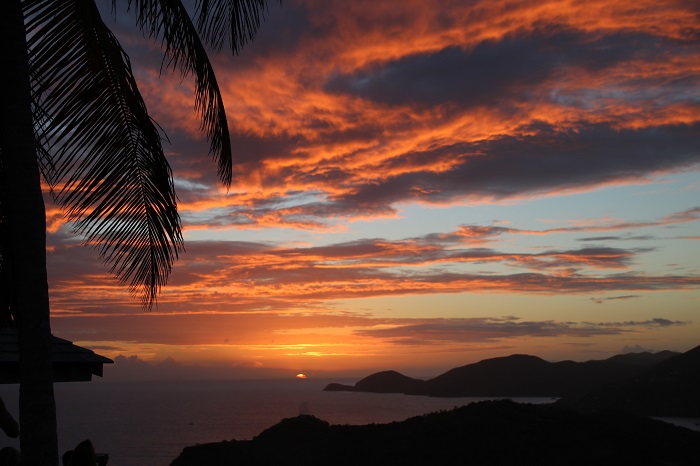
  What’s not to love about clouds and how they affect a sunset like this one on Eggemoggin Reach in Maine.
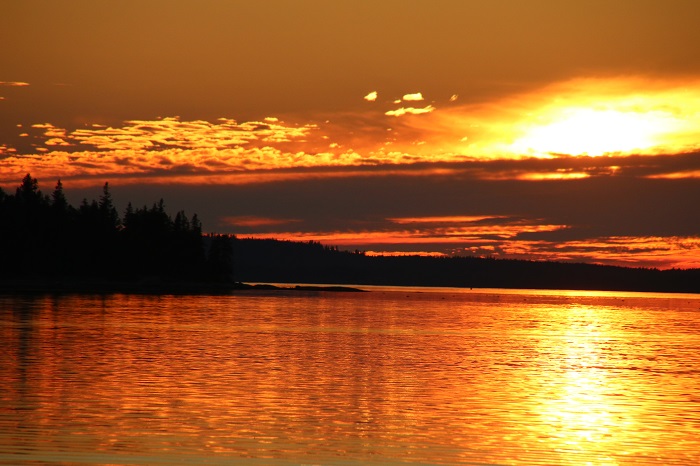 The “picture” changes from moment to moment in ways that defy words.
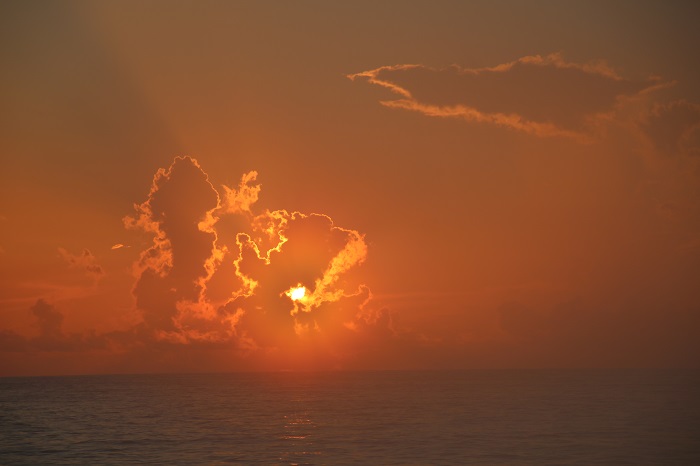
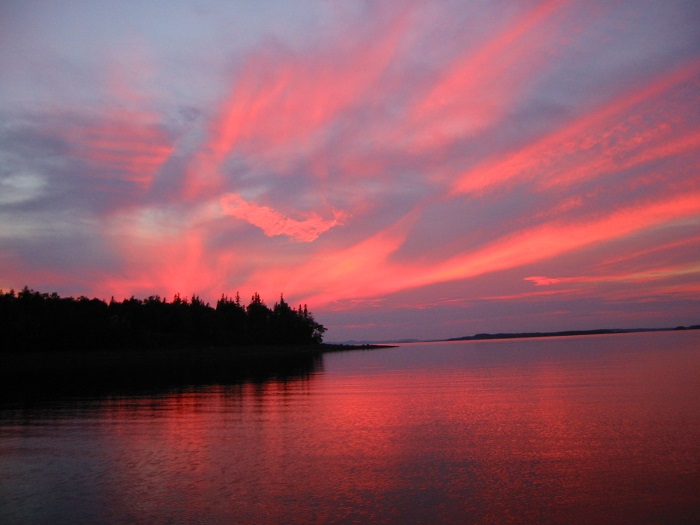 I find sunrises and their interplay with clouds endlessly entertaining and is why I always choose the “dog watch” from 04:00 to 08:00. This shot taken on an offshore passage to Antigua.
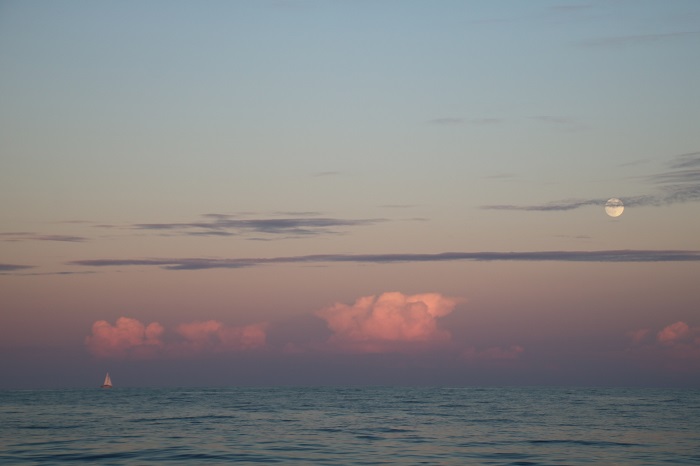
  Who can resist the thrill of a full moon rising through the clouds on the first day at sea. This was taken as we approached the Gulf Stream on another passage to Antigua. Look hard to see the sailboat in the distance, the last sighting we had of another boat for the rest of the trip.
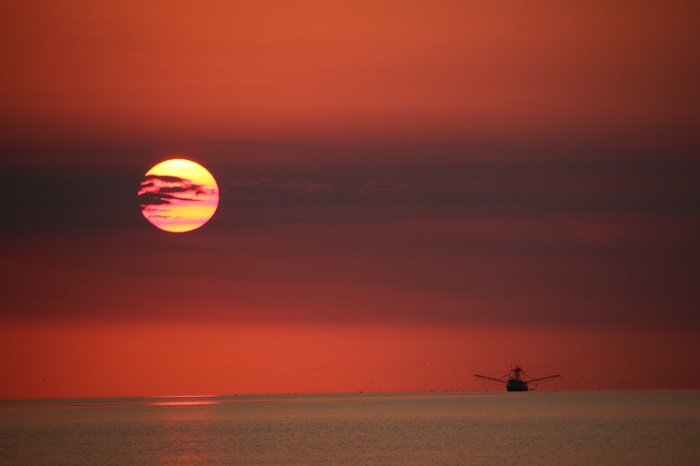
  Without clouds, this sunset shot with a shrimp boat on Albermarle sound near Ocracoke on the ICW would not be nearly as interesting.
 There is no end to the shear majesty of clouds offshore. And that’s a good thing as there’s just not a whole lot to look at when you are 500 miles from terra firma.
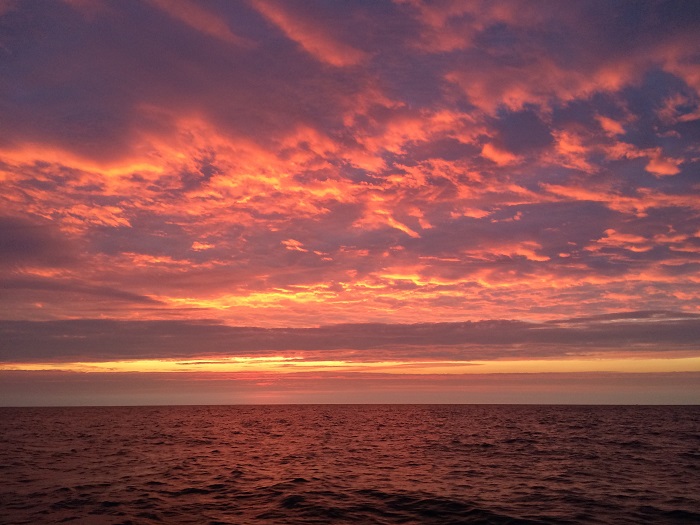 Amazing from one moment to the next.
 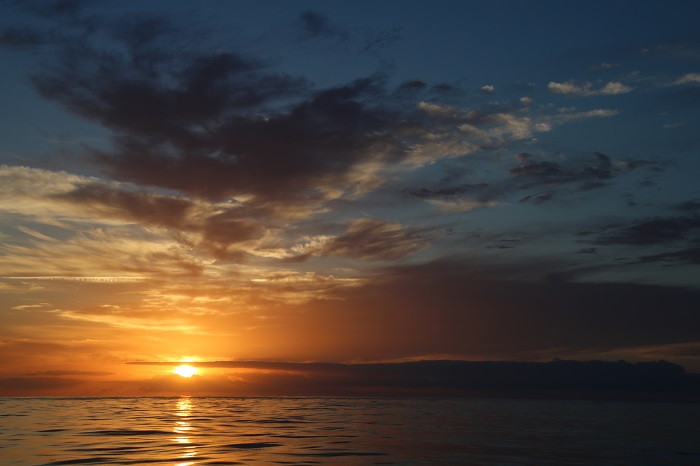 A view like this makes you wonder about majesty of forces behind everything in our world.
 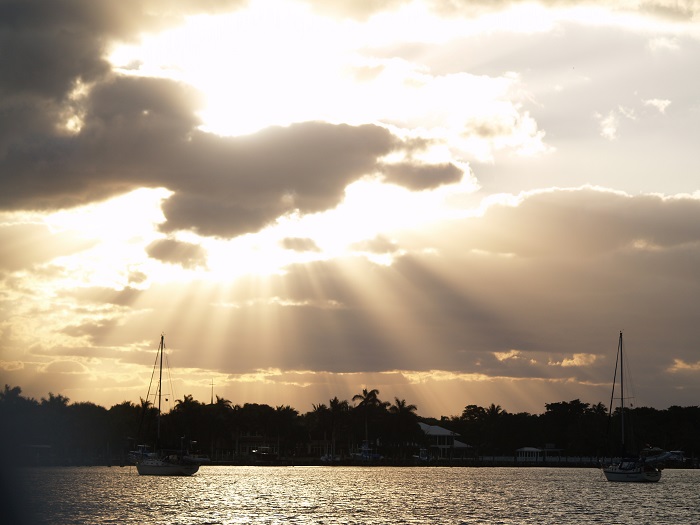 Seeing a moment when rays shoot toward the heavens from behind a cloud always reminds me of that iconic moment when God speaks to Arthur in Monty Python’s Holy Grail movie. Arthur!…Clouds are not always so dramatic. Take these “clouds”, early morning fog shrouding islands in Maine. Fog is clouds or is it “fog are clouds”? Hmm…
 I joined, of course, and my membership number? 54,749. Who knew that there could be so many that loved clouds.
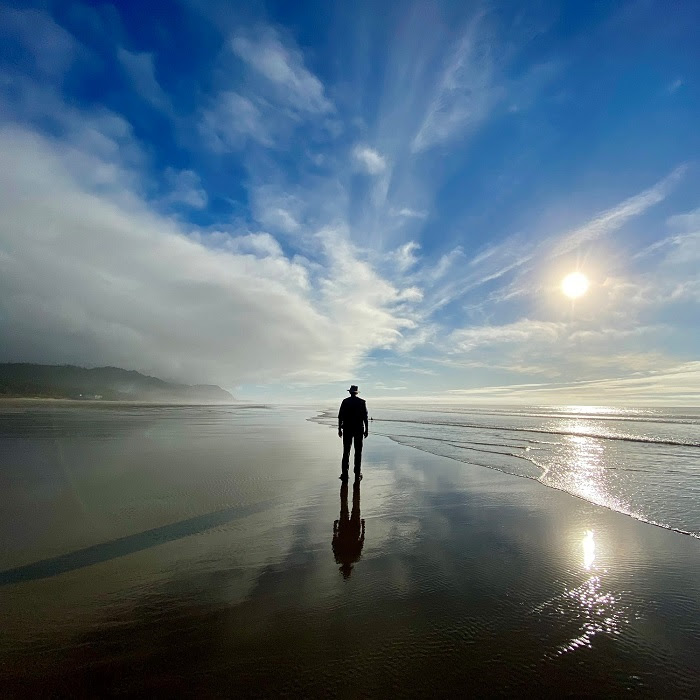 So, there you have it, another rambling post but hey, I got to use a bunch of cloud photos and it proves that I’m not only about sunsets.
 We enjoyed the events along with a number of other Dawgs but I’ll admit that it really feels like a thousand years ago. After nearly a year in the clutches of the pandemic it feels like a different lifetime. And, as I look back on our days in Martinique during Carnival, and think of all the crowds, it’s a bit frightening to consider what might have been.
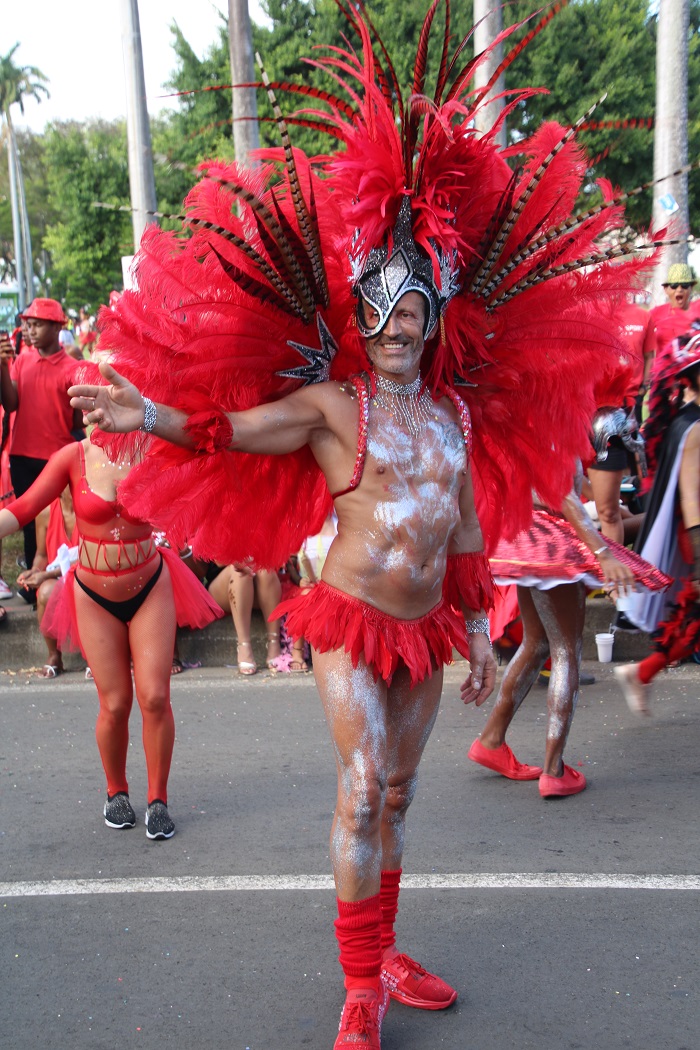 Another day, another costume. By the second day, dare I say, we developed a bond. No, perhaps not.
 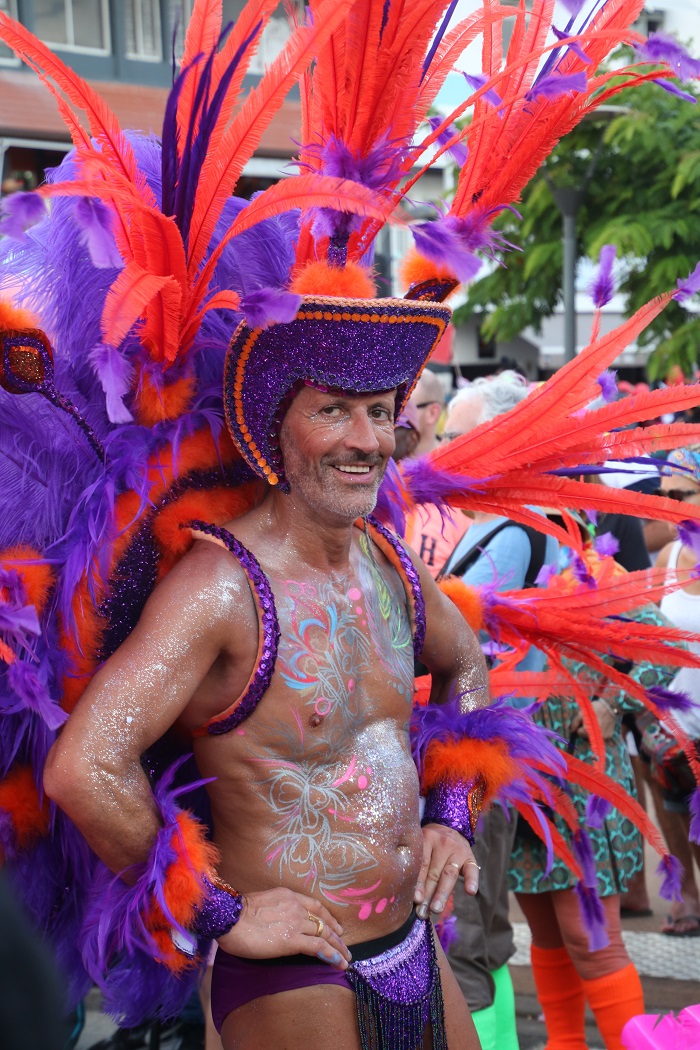 Brenda and I had a funny moment when we saw him, out of costume, sipping a cup of espresso early one morning. He looked, well, different. I so wish we had said hello and I had aske him to pose for a photo with Brenda. Perhaps next year.
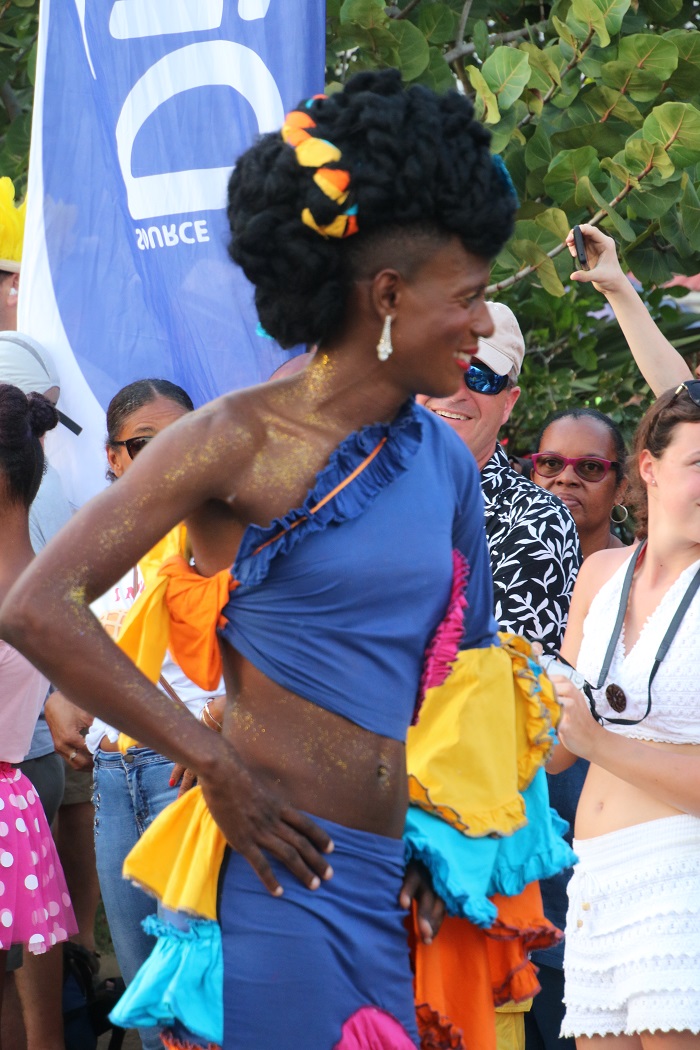 Some, well a little less so. No, yes, no… Last time I saw such high heels, was the First Lady.
 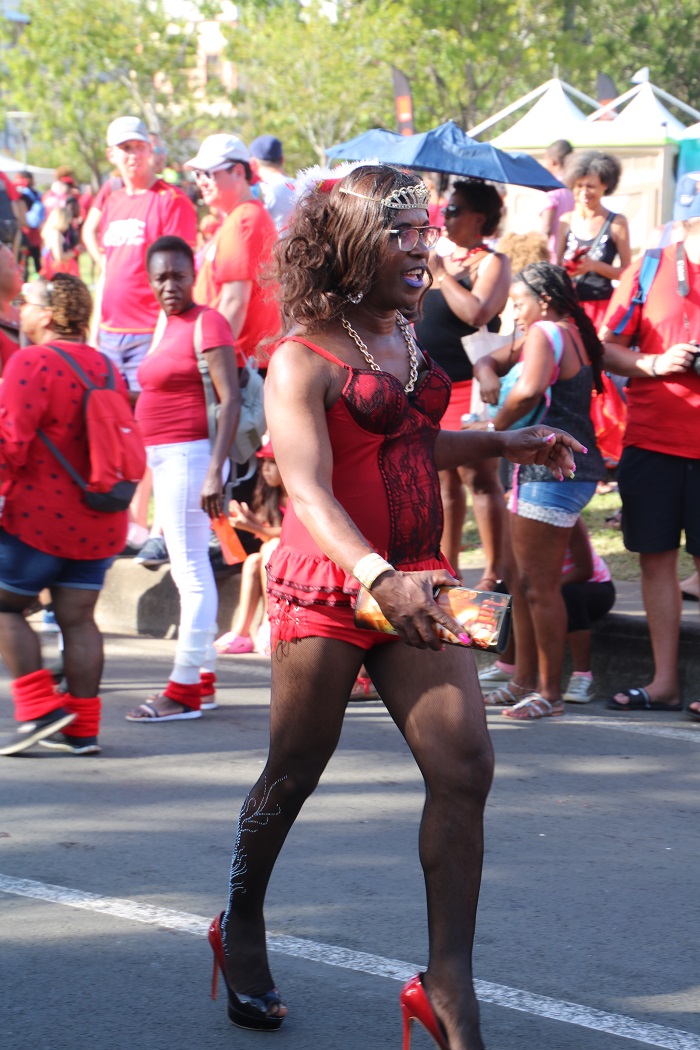 And, some not quite so convincing. Perhaps that’s the point after all. .
 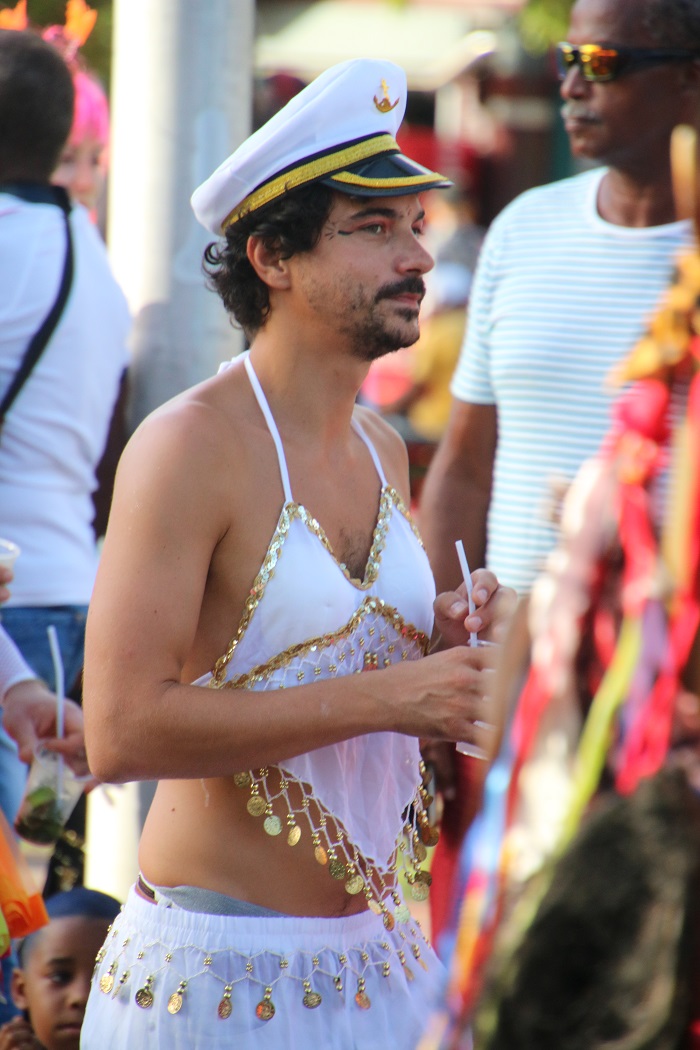 Perhaps it was the week long stubble that gave it away. Seems a bit heavy on the testosterone.
 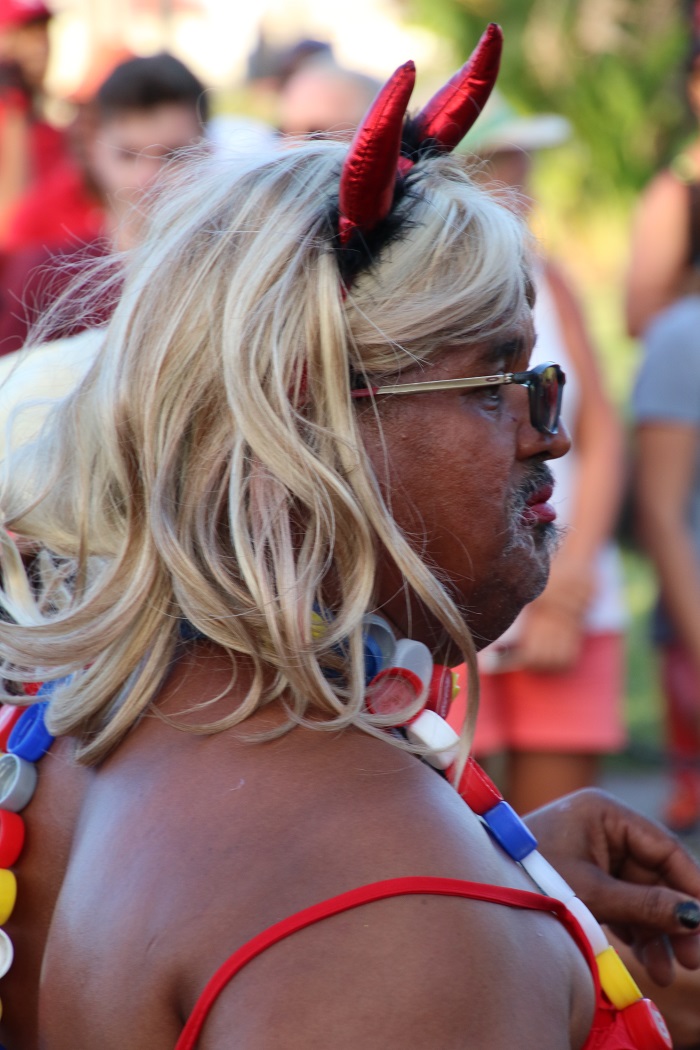 And the cross-dressing wasn’t limited to those in the parades. Bystanders totally got into the moment.
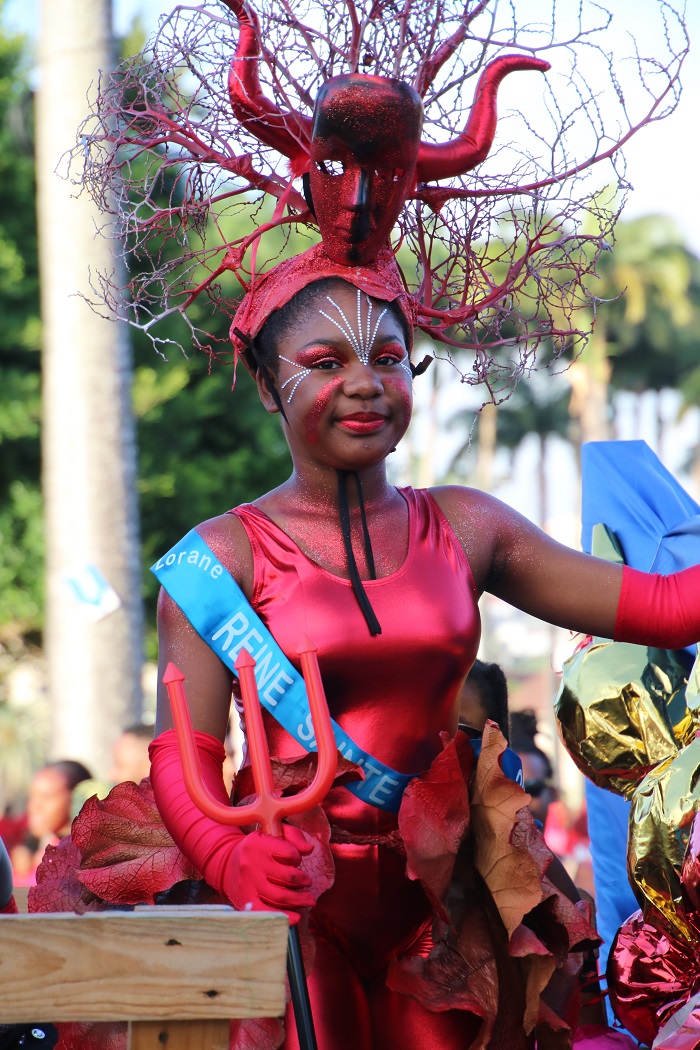
  Tuesday is the day of the devil with everyone dressed as the devil, in red and black.
 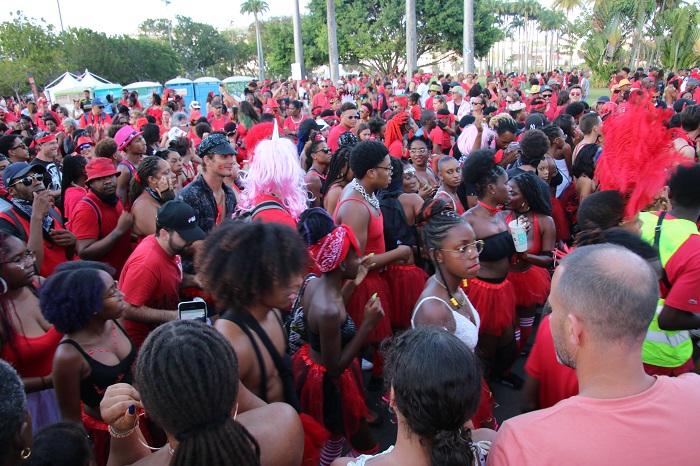 Remarkably elaborate “devils” paraded by for hours.
 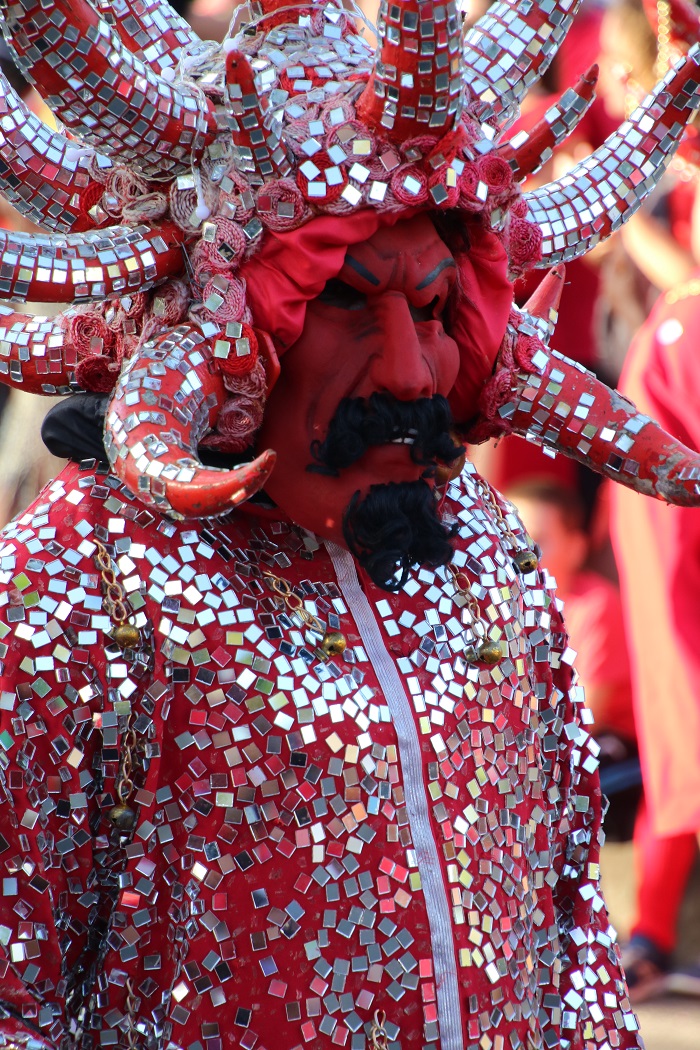 Everyone working hard to outdo…
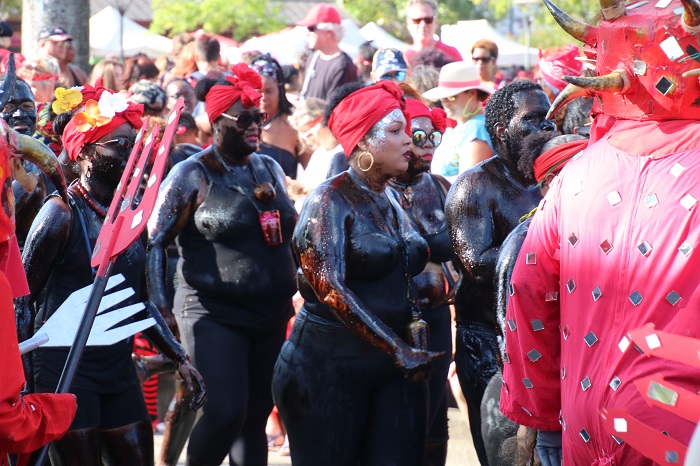
 I’ll admit that I am still a bit fuzzy on this theme, with everyone slathering themselves from head to toe with molasses, mixed with ashes. The smell of sweet sugar fully enveloped the downtown area. Imagine what the tropical heat mixed with sticky sugar felt like. Good thing that the beach, and a bottle of beer, or two, or three, were only a few steps away.
 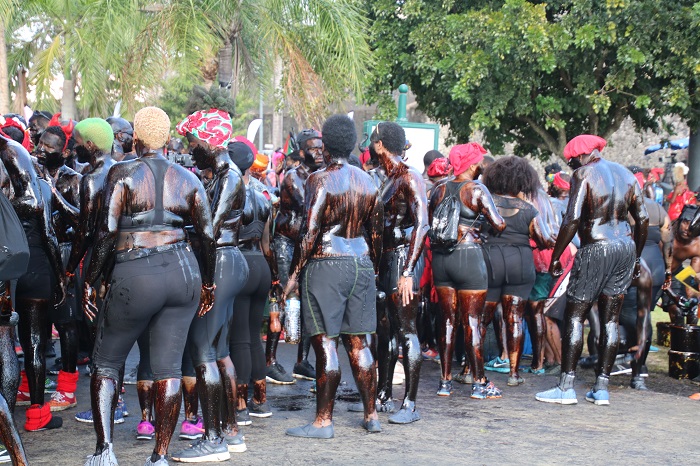 No rush to get cleaned up. They didn’t rinse off until after hours of parading through the city.
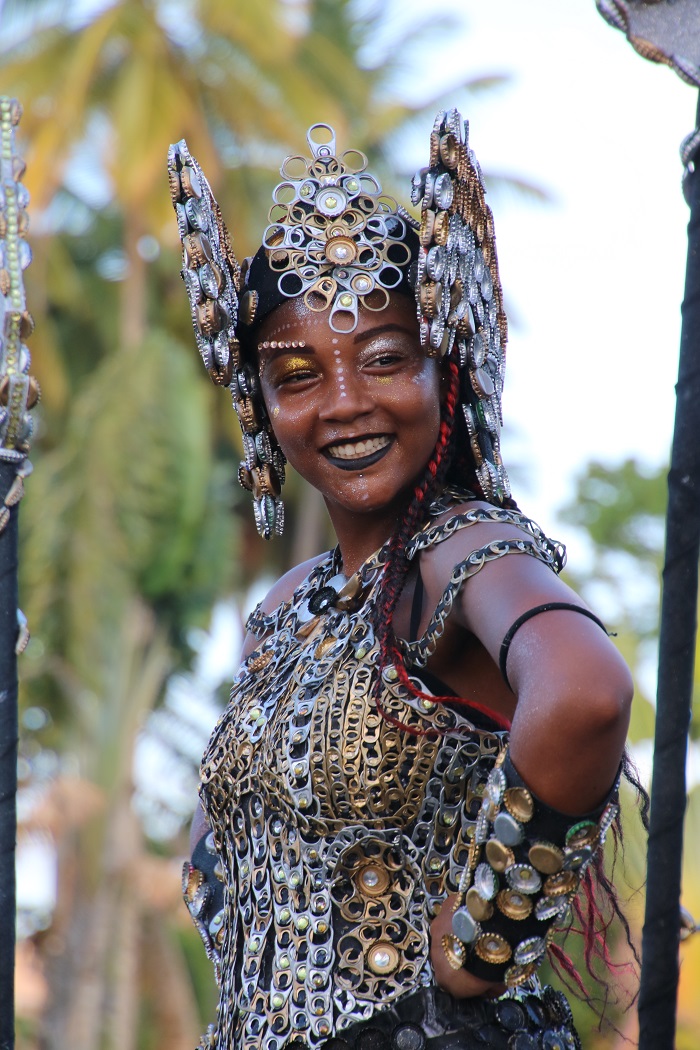
  And devil or not, my favorite… If it’s not obvious, her costume is made up almost entirely of beer can pulls and caps. Forget a glass of chardonnay. She makes me want to drink more beer.
  The celebration ends at the beginning of Lent, leading up to Easter, marking a period of fasting and abstinence. Tradition dictates that one does not dance or listen to music and all weddings are postponed during the period. After experiencing Carnival myself, I’ll bet that it takes that much time, and more, for many of them to fully recover.
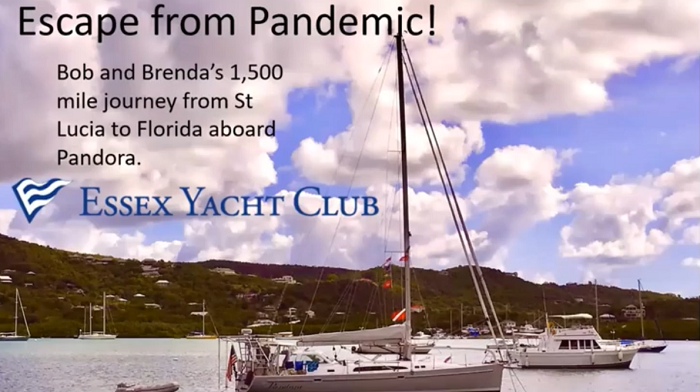 So there we were, in St Lucia and day by day, our crew options were evaporating, leaving us no option but to sail Pandora home alone. Brenda is not a blue water sailor and while we have been sailing together since the 70s, she had never done an ocean passage beyond a few hundred miles and the realization that 1,500 miles of ocean lay between us and the US was a daunting prospect for her.
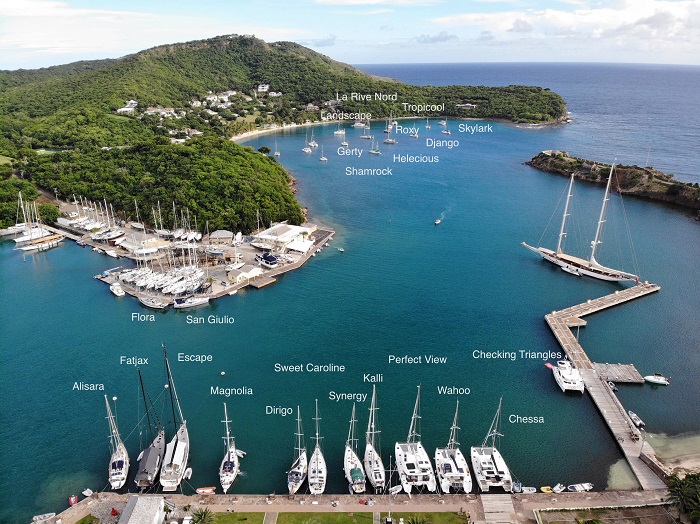 Over the years, I have put on many events and given talks about the areas that we have cruised and have often been asked if these events were recorded. Until now, with the widespread use of Zoom, this was not practical. Now it is and I am able to share our experiences more broadly.