Sail Pandora

Ya Ya bar and a bottle of rum.

It’s been a week since my mishap with the wind generator and I am feeling much better, thankyou.   The cuts are beginning to itch and I am very much looking forward to getting the stiches out, supposedly on Tuesday.

The last few days have been uncharacteristically still with almost no wind to keep things cool.  Happily, it does cool down quite a bit at night so sleeping isn’t a problem.

We moved into La Marin to be closer to shopping and less exposed to the small chop in St Anne,  There are also a good number of places to eat out and renting a car there is also quite easy.

To that point, we took a day to drive around the island and visit some distilleries with our friends Lynn and Mark on Roxy on Wednesday.   I have been on the hunt for some interesting rums for some friends and our travels did not disappoint.

In particular, I enjoy Clement, a great place to visit.  This short video, also featured on their website, captures the spirit, pun intended, of Martinique.Since the pandemic, like so many businesses that had to close, they took advantage of the shutdown to remodel their tasting room.   Unlike similar businesses in the US that charge for tastings, at most distilleries in the islands, you can try as many as you wish.  And, because taxation on spirits in the islands is so much different than in the US, prices at the liquor store are considerably less here.  For about $25-$50 you can get a very nice bottle of 10 year old rum and a very decent rum is in the teens.

You can tell from the face of the building that this place is something special.  Stainless cladding. The tasting room at Clement is impressive with their product dramatically displayed. This selection is just their basic product.   Pretty good anyway and about $15 a bottle. And the better stuff.  Want to spend $1,000 a bottle, that’s possible but probably not necessary.  This was a particularly dramatic display in a tall stairwell. Upon closer inspection, reflected in mirrors on the bottom of each shelf. These bottles show off the various colors of their rums.If you want to purchase product, and everyone does, they will store your purchases while you tour the sculpture gardens.  We’ve been here before but it’s always worth another look.  Quite dramatic and huge sculptures.And a reminder that this place has been in business for a long time.  Very tropical.And now onto another topic.

Many of us, should I say “of a certain age” struggle to get in and out of the dink, even when we haven’t had much rum to drink.  At the junction of water and land, there are generally docks, often questionable.  Some have high ladders and others are just plain sketchy with splintered boards that we have to crawl onto.

This has been a source of great frustration for Brenda who in addition to hating the whole “spectator sport” of watching her navigate from dink to dock and back again judges a town by the quality of the docks.  And, she is not alone as so many of us aren’t quite as spry as we once were.

Enter the Ya Ya bar.

Last week we were climbing, not all that gracefully, out onto yet another dock and as Brenda got up onto her feet, a woman nearby said, “you should get one of these for your dink” pointing to a bar that has been installed on theirs.   Her husband, who had a bad stroke a while back, needed a way to steady himself in the dink so they had a bar installed to help him get in and out.  She then pointed to a nearby shop, Inoxalu.  The business is owned by a very nice German couple.  The husband Kai, is soft spoken and extremely precise in his work.  It was clear that he thinks hard to make sure that form follows function.  He took time with Brenda in the dink to make measurements so it was the right height to help her and also to find a way to secure the structure to the dink without needing to drill any holes through the hull.

I think that he did a masterful job of putting it all together.

We had the bar installed on the starboard side of the dink as that’s the side that we always pull up to our transom when entering the dink from Pandora. It straddles the seat so it’s a good backrest to help Brenda feel more secure when we are blasting along over the choppy water in the harbor. As we did not want him to bolt the bar directly through the bottom of the boat so  he fabricated some very nice fittings for the pipe to go into.   This is the aft fitting and the pipe can easily be unbolted and removed. The forward outboard fitting is also bolted into a ridge running down the bottom of the dink.And there is a third leg that bolts onto a ridge aft of the forward fuel tank to give the whole structure rigidity.  The bar is very sold and does not wiggle at all.   It works exactly as advertised and Brenda is already finding that it makes getting in and out of the dink much easier.

She even has a name of it and christened it “My Ya Ya Bar”.  And for those of  you that are not aware the names of such things, this is her takeoff of “Granny Bar” the braces that stand on either side of a mast for you to lean up against when it’s rough.  Oh yeah, to be clear, Ya Ya is what our grandchildren call her if you are wondering were in the world that came from.

So there you have it, in one day we became the proud recipients of “A Ya Ya bar and a bottle of rum…” with apologies to pirates everywhere. as we toured the island and waited for the work on our dink to be completed.

And to make things even better, Brenda likes it.   And that’s good.

The absolute worst boat bite of all time.

It’s a beautiful day here in St Ann Martinique.  It’s one of the largest anchorages in the Caribbean and it’s nice to be somewhere where there is plenty of room to anchor.  And, it’s not rolly!

This is a wide open and lovely spot and I can’t help but begin this post with a view of the full moon setting early this morning when I was sitting in the cockpit reading a book at O-dark-30, a few hours before dawn.   It was a beautiful sight.Even better close up. Somehow one of the best parts of cruising is watching the sky and trying to see interesting shapes in the clouds.   I think that this one looks a lot like a dragon on patrol. And speaking of setting full moons.  How about this sunset?  It’s hard to beat a view like this as the sun drops to the horizon. And the illusive green flash which isn’t all that uncommon here in the Caribbean when the horizon is clear. As I have mentioned in an earlier post, we badly bent our anchor trying to Anchor in Fort de France but here it’s easy with plenty of room all around us.  Happily, the shank has been straightened and the anchor is as good as new.

Tomorrow we will be leaving our dink in nearby La Marin to have a “granny bar” or in this case a “YaYa bar” installed to make it easier for Brenda, AKA, YaYa, to get in and out of the dink.   When we were at a dock in La Marin last week a women watched Brenda as she crawled out of the dink, like everyone of a certain age does including yours truly.  She pointed out that her husband, who had a severe stroke, now had a terrific handhold in their dink that made it possible for him to get in and out fairly easily in spite of being partially paralyzed on the left half of his body.

As luck would have it, the shop that made the bar 0n their dink was nearby and was actually the same one that fixed our anchor, so YaYa bar, here we come!  Tomorrow!

As we have to leave the dink for the day we have rented a car to tour the island.  Can you say Rum Distilleries?

Martinique is home to some great distilleries and it’s great fun to visit them and do a bit of tasting.   I’ll report on what I learn.

And, speaking of learning.  As of today, after three months aboard we have finally completed the “mostly permanent” installation of our Starlink satellite antenna.

Since January we had it perched on deck while we were at anchor and then dwon below when we were underway.  Deciding where to mount it was a real challenge but I finally figured it out.

It actually took me an entire sweaty day to snake the cable from the navigation station down below, all the way to the stern.  And, it wasn’t until I was able to source a robust fishing rod holder and install it on the back of the davits, that I had a spot to put the antenna.

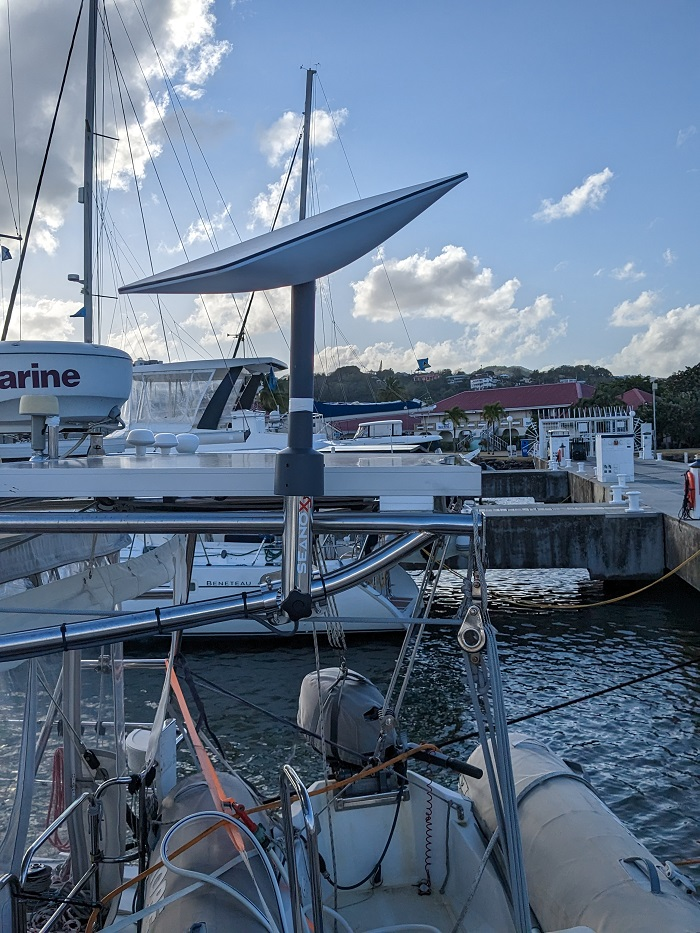
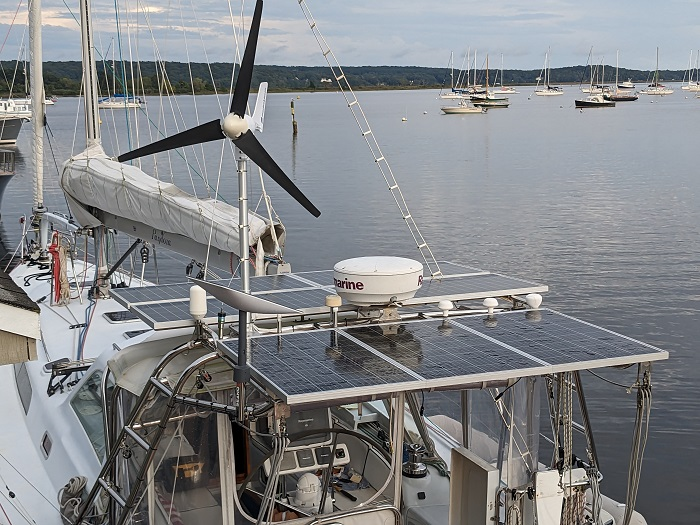
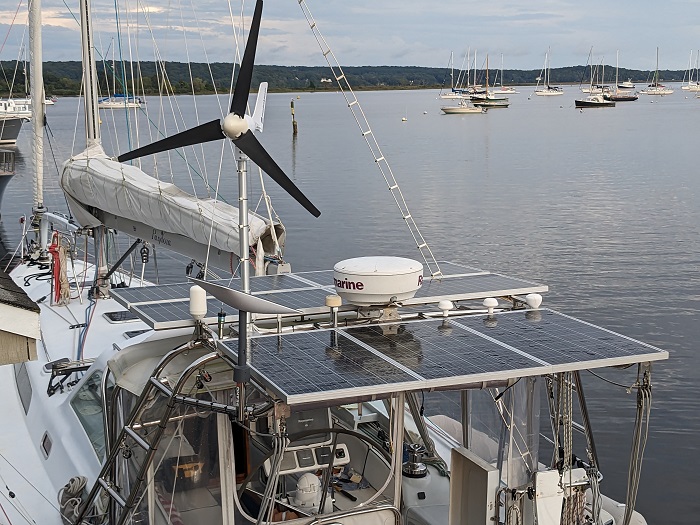
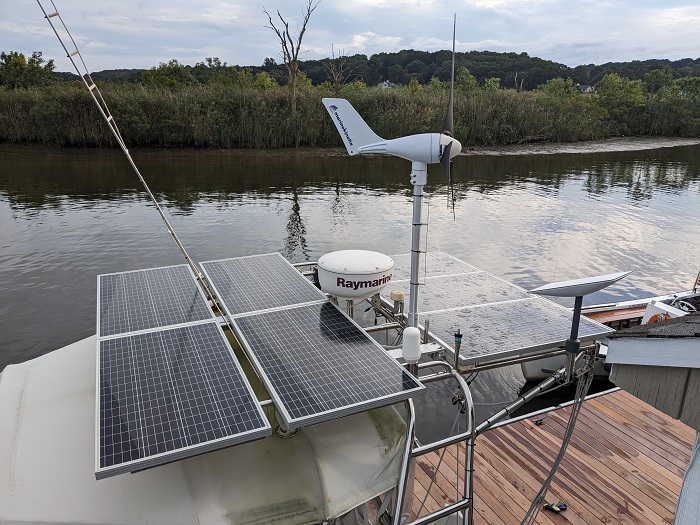
Here’s how it looks.  Pretty spiffy and it should stay fairly high above the salt spray on passage.  We’ll see how that goes.   It is an “RV” unit but not necessarily marine.  But, there are plenty of these installed on boats now so fingers crossed. Note that it is installed on the port side of the arch.  That’s important as the prevailing winds are from the east and that means that the sun generally tracks on the starboard, south, side of the boat which means that the antenna doesn’t shade the solar panel below it.

Note that the antenna is mounted behind the wind generator. That’s an important distinction and I learned the hard way that carbon fiber wind generator blades do not mix well with flesh.

A few days ago when I was installing the bracket for the antenna on the arch I had turned off the wind generator while I was working up on the arch installing the bracket.   However, and it’s a BIG HOWEVER, I turned it back on when I was working below and forgot to engage the break again before going back up on the arch to work.

I have mentioned that the unit is pretty quiet and while it was whirring away, spinning REALLY F*****G FAST, I lifted my hand and in a fraction of a second the blades sliced open my hand, splattering blood everywhere including in my dink that was trailing 10′ behind the boat.

In a fraction of a second, my hand was mangled and bleeding like nothing like I have ever seen.  Thick, alarmingly red blood splattered everywhere.  It looked terrible.   Oh boy, did it hurt!

I was able to climb down from the arch and count my fingers.  All accounted for…

I called out to Brenda and we applied pressure on the “wounds” and did our best to stop the bleeding.    A LOT OF BLOOD!  It’s amazing how much a cut, no make that multiple cuts, can bleed.

Anyway, we cleaned up a bit and applied a pressure bandage, and headed ashore in the dink.  After trying to find a cab with no luck, we ended up taking a bus to the hospital in a nearby town and after waiting about an hour a doctor showed up.  Two or three hours later I was finally in the examining room.

She was very competent and spent an hour cleaning me up and stitching my wounds.  Let me tell you, it wasn’t fun but she did a very good job.

If you have a weak stomach, stop here….

This may look nasty but it’s downright beautiful compared to what I arrived at the hospital looking like.  The blades hit me so hard that even my palm is bruised from the force of impact on the back of my hand.  No swimming for me for the next ten days.  I’ll tell you that I feel like I have a guardian angel watching over me as it could have been a lot worse,  WAY LOT WORSE!  At least I still have all my fingers, no numb spots and everything still works just fine if a bit puffy.  And, in the dark of night my mind wanders and I imagine just HOW BAD it could have been.

I have written a lot about my wind generator and solar panels and let me tell you, I still like looking at them but from now on, it’s look but don’t touch, even by accident.

Well, a few days later it still hurts but not nearly as much and I am more than a little thankful that it wasn’t a lot worse.

I can say with confidence that this is without question the absolute worst “boat bite” I have ever had and way worse than the recent one on my left shin and my big toe but that’s another story.

But, it was still a lovely sunrise today after the moon went down. Oh yeah, and about all that spilling blood thing…

Brenda was not amused…


The Martinique Yole, not a flash in the pan.

We are anchored in Grande Anse a lovely and large cove on the western side of Martinique.  We expect to be here for a few days before heading over to St Anne, the southern most harbor in Martinique.

The mile long sandy beach is lined with many beach bars to choose from.There is a very nice promenade along the water behind the bars. Of course, Pandora at anchor.  Yes, you do have to look hard to see her in the center. When we were near Fort de France, we were treated to a number of races by these amazing traditional sailing boats that I have learned are known as Yoles.  These narrow, unballasted open boats are decedents of traditional fishing boats and are unique to Martinique.

This link gives an excellent overview of the history of these fascinating craft.   These races are hotly contested and a major source of pride for the locals.

The races begin with the boats all lined up on a beach.  And then they are off.  When the gun goes off, everyone scrambles to get the boats going.   I took this short video while waiting for a ferry to take us to Fort de France to go to Carnival for the day.These narrow boats are heavily canvased and with no ballast, they rely on crew hiking out on bamboo poles to steady them.   To watch these boats go by, and they are fast, is an impressive sight.  Crew hike out on the bamboo poles to keep the boat from tipping over and sinking.    In and out on the poles to balance the boat as the wind gusts or shifts. Sometimes they are just holding on trying not to fall into the water. And sometimes it doesn’t go well. No need to stop, just don’t run over the swimmers. It takes a lot of big guys to keep the boats upright. Sailing these tippy boats is very athletic.  I am told that this is THE sport of Martinique.There are a lot of close encounters.  As the boats are so fast, they complete the races in less than 3o minutes.
This is a short professionally edited video from a few years ago.  Well done and pretty well captures the intensity of the competition.It was great to see these boats and their hard working crews make their way around the course.

With the designation as a UNESCO world heritage fleet, and the enthusiasm of the racers and everyone in Martinique, the future of this class is surely secure.

I guess I will close with a few photos that sort of captured a green flash last night, I think our third of the season here in the Caribbean.   What a beautiful way to end the day, rum punch in hand.  Actually, we were drinking Mai Tais.  Details, details…

Just before the sun set below the horizon. Getting closer. And, the brief flash of green.  Don’t see it?  Trust me.  I guess you had to be there or perhaps it was the rum…Hmm…Forgive me for what will surely seem like an awkward segue but here goes.

Yolos endure, unlike a green flash-in-the-pan…

Not my best ending, I’ll admit.

Time to jump on a zoom call.  Just love that Starlink.

Starlink. Too good to be true?

In mid January I wrote about my first exposure to Starlink as a source of affordable broadband internet on a boat.

At the time, we had just installed it aboard and were getting to know the unit.  It was an amazing realization to have access to internet speeds that were higher than we get at home with fiber optic cables.  In some ways the speed, price and ease of use seemed too good to be true.  Follow this link to my first reaction. 

So, here we are a month later and I have learned a lot about the system and what we might expect in the coming months.

As a refresher, there are three versions of Starlink, residential, mobile and maritime.

Residential is designed to be mounted on a home or other stationary object.   The cost, in addition to the purchase of the dish, is a bit more than cable at $110 a month on an annual plan.  In spite of being a little more expensive than traditional cable services, there is a waiting list for shipping because of such high interest.

The RV unit is what I ordered for Pandora, a system designed to use on a camper, for example, but not necessarily from a moving object.   The unit itself cost $700 plus a service at $135 a month and you can cancel or restart the plan a month at a time.   It’s really designed to be used in the country where you purchase it but we and many others have taken delivery in the US and are now using it on our boats here in the Caribbean.  As a point of interest, there has been a lot of talk about what happens if you take delivery of a unit in the US and use it in the Caribbean as that is a totally different area and we are supposed to use it in the same continent where it is delivered.  Well, I found out last night when I received a notice that my monthly fee was going to go up to $150/month.  Still reasonable if a bit pricy.  The reason for the price increase wasn’t clear and didn’t specifically note my location.  I guess, details to come.

It’s worth noting that the “fine print” states that our access may be limited if we stray too far from home for too long.  Fingers crossed on that point.

The third version and the most expensive is their Maritime version, designed for use on commercial vessels, mega yachts and cruise ships.    The hardware costs several thousand and carries a monthly service plan of about $5,000.

I understand that the maritime version has advertised speeds of between 300 and 400 baud, hugely fast.   Even on Pandora we have seen speeds upwards of 100 baud in an area that they identify as having modest coverage.   Where we are, near the yellow arrow, shows as limited coverage.  This is a visual representation of what will be a galaxy of satellites to be launched in the coming years, in the thousands, many more than are up there now.   It’s pretty amazing.There are loads of YouTube videos on Starlink but this one is an excellent overview of the program and how it works.  It also goes into other types of communication but if you want to see Starlink alone, go to about 9 minutes and 30 seconds in the video and start there. This video is an excellent explanation of what is “behind the curtain”.  It’s remarkable that a private company, Musk, has accomplished something of this magnitude.    After years of chasing wifi and dealing with crappy cell connections, Starlink just feels like a miracle.

And, sometimes miracles aren’t what they seem and when I ordered the RV version, designed to be used in the US from a van, and had it brought down to Antigua, I was fearful that Starlink would catch on and say “whoa!, that’s not what we sent you the unit for!”,  and cut me off.

I still fear that will happen as they have a maritime version for marine use, even if it costs WAY more than I could ever afford.  And, in the fine print that explains the terms of service for RV, it’s clear that we are not following the rules and I have been wondering if they might cut me off.

However, last night I received an email that alerted me to a price increase to $150/month, and thanking me for my support.  I’ll admit that when I saw the email I was expecting something much worse.

So, is Starlink too good to be true?  Time will tell if they restrict the RV version but for now it seems pretty awesome and I’ll keep my fingers crossed that the good times will continue to roll.

For the moment I still have the antenna mounted on the deck but when we are in a marina in St Lucia in March I’ll move it up onto the radar arch in a semi-permanent install and reconsider the best options when I get Pandora home next summer.

If beauty is as beauty does, than this is indeed a beautiful antenna.Internet speeds on a boat faster than home?  It’s here.  Well, at least until Musk changes his mind…

Into every life a little rain must fall

In spite of all the experience we have, or perhaps because of that, we seem to be destined to repeat some of the same problems again and again when we are cruising.

Back in 2014, during our second winter in the Bahamas, we became solidly stuck on the bottom when we tried to pull up our anchor.  I pulled and pulled and finally gave up on retrieving my anchor only to go swimming to pull it out from under the limestone ledge where it had become wedged.  It looked terrible and ultimately, I had to toss it and get another anchor.   This is what it looked like at the time when I finally got it aboard.   Pretty mangled.Well, a few days ago when we tried to anchor in the harbor off of Fort de France to visit for Carnival, we were having a terrible time anchoring and after about 5 tries, accompanied by advice for perhaps a half dozen other cruisers, we finally were firmly hooked.    However, in spite of our best efforts, we decided that we were just too close to another boat and decided to leave.

Unfortunately, as we began to retrieve our anchor, we realized that it wasn’t coming up.  I pulled and pulled on it and we moved the boat to different angles with no results.  The way that the boat came up short when the chain went taught, was really alarming.

However, finally we were able to get it back except that they shank was badly mangled, bent perhaps 30 degrees.  Deja vous all over again.  Only, this time our anchor is a stainless steel anchor that would cost about $2,500 to replace, a lot more than the one we damaged years ago.

Anyway, I shipped tthe anchor and we hightailed out of Fort de France and headed across the bay to lick our wounds.  I am hopeful that when we are in La Marin next week that there will be a shop that can address this and bend the shank back into place.  Fingers crossed.

The good news is that we were able to pull it up finally, if damaged as it was way too deep for me to dive on it and to get a diver on short notice wasn’t going to work out particularly well, I expect.

However, we moved across the harbor to a little village and took a ferry over to Ft de France yesterday to enjoy some of the festivities.  I understand from some friends that are still over there, that it’s been crazy with boat after boat coming in and trying to anchor in impossibly tight conditions.  Glad we moved.

This season has been rainier than normal and two days ago it rained just about all day.  At home when the weather calls for say, 30% chance of showers, this generally means that perhaps a third of the area will see rain.  Here it seems to mean that it will rain a third of the time.  And that day, it was more like rain hard for 10 minutes, sunny for 20 and rain again.  It’s hard to plan activities outdoors in those conditions.

Rain or shine, the view off of our stern, and it’s fairly calm here, is quite beautiful.  A golf course.   Notice the perfectly manicured mangrove hedge at the water.  They even cut little pass-throughs to allow them to get to the waterside to trim that too.   The town nearby is quaint if a bit deserted.  We went ashore to have lunch and look around a bit.  About the only action in town was a farmer’s market but there were not many places to eat.

A very pretty church, something that just about every village has here.And some very nice French Colonial architecture. Before we headed here we were in St Pierre, one of our favorite spots where we planned to spend a few days.   Unfortunately, after the first night the anchorage became very rolly (what’s new?) and we all decided to head to Fort de France.

Before we left, we did visit the Depaz distillery.    This link is interesting and gives a good feel for what it’s about.

A grand entrance to the estate.They have a very nice tasting room that has finally reopened after being closed for a few years because of the pandemic. When our friends Peter and Jane join us in March, I expect that we will be visiting it again as it’s one of my favorite and not far from the harbor.   If you are curious about this place and the history of the island and sugar, take a look at this post I did a few years ago.  I also talked a book, The Sugar Barrons, a very interesting book that’s well worth reading.

San Pierre also has a very interesting history as the once capital of Martinique and the “Paris of the Caribbean” until it was leveled by the explosion of Mt Pele that overlooks the city in 1902.    The explosion killed everyone in the vicinity as super-heated gas and volcanic ash blanketed the city, with some 30,000 dead in moments.   You can still see much of the ruins that have been preserved near the waterfront.  Nowadays, the capital is Fort de France to the south.

I did a more detailed post last season when we visited St Pierre including a discussion about the explosion that destroyed the city.

There’s been plenty going on for the last few weeks but one constant has been rolly anchorages with the exception of where we are now and Dominica.

That harbor in Dominica is huge but more of a roadstead than harbor as it’s completely open to the west.   Because of the large harbor and the popularity of Dominca with cruisers who enjoy hiking on the island, we decided to hold a special rendezvous with the Salty Dawgs and more than 25 boats showing up.  It was nearly a week of fun, barbecue parties, tours and hiking.

Dominica is one of the poorest countries in the Caribbean and the locals really appreciate it when we arrive en-mass.

Along with a number of rum punch soaked barbecues,  a group of of us spent a day planting seedling palm trees down the side of a road, about 200 of them at 20′ intervals.  They took us to a local nursery to pick them up. It seemed like there were as many of us as plants to load so we formed a bucket brigade to get them on the truck. Off we went.  It was hot work but nice to help out.  On another day, three couples hired a driver to take us around the island.   We visited a small local chocolate factory.   These are the chocolate pods all piled up on the ground.  Each pod contains many coco beans, each about the size of a large almond.  The pod, when mature, are about 8″ long.  It’s amazing how tiny these pods begin, sprouting along a branch.  They are solo and only about 1/8″ long. Then they get big but aren’t harvested until they are ripe and yellow. After the pods are opened and seeds removed, they are put in a box and covered with banana leaves to ferment for almost a week.  Then they are cleaned and spread to dry under cover.There are a bunch of other steps that include roasting in special ovens. Then they are crushed and the “hull” is separated from the good parts using air that blows off the hull and lets the heavier parts drop into a hopper. Ultimately they are ground into a smooth paste over a period of days before being melted and poured into molds. As you can imagine, this whole process smells fabulous so who can leave without buying some to take home?

Nearby, also on the estate, were many beautiful flowers.   This one looked a lot like a version of milkweed.  And, a more native version of poinsettia, n0t the highly hybridized versions that we see in the US.  And no tropical garden is complete without orchids.   This one looks like a phalaenopsis but I believe is a native orchid, perhaps oncidium. Very showy flowers on a large bush. So often looking like house plants that escaped. And breadfruit.  It is said that all the breadfruit trees in the new world are descended from those brought on the Bounty by Captain Cook. The rest of the day was spent driving around with beautiful vistas around every bend in the road. This gorge looked a bit intimidating with the gnarly roots of the trees snaking everywhere. A must-stop place in Dominica is known as Red Rock.  It’s an exposed outcropping of red sandstone, weathered over the years into something that looks more like dunes than rocks. A pretty amazing place. Just to prove were there. We visited a place where the mostly dormant volcano vents gasses through the ground.   The place, nestled in the jungle, stands out as a small area with nothing growing and a very strong smell of Sulphur.  Leading down into the crater was lush with tree ferns, some 30′ tall all around. They are just beautiful and only grow above a certain altitude. The hills were carpeted with them.Well, I guess I’ll leave it there for now and follow up with a post soon about Carnival but there is just so much that I can cram into a single post.

All and all, it’s been interesting if a bit challenging with strong winds, unsettled anchorages and, most fun of all, a damaged anchor. Hope that gets fixed soon.  At least it’s still usable if a bit gnarly to look at.

They say that cruising is generally boat repair in exotic places.   Yes, into every life a little rain must fall.  For me, I prefer the wet kind.

Sometimes it’s the other kind and I have a bent anchor to prove it.

Scroll to Top