


After only a few months cruising the western Mediterranean, I realized I was learning the weather, all over again. It was a bit of a shock.
By the time Pandora passed through the Strait of Gibraltar, I’d logged nearly 30,000 offshore miles. Brenda and I had cruised the U.S. East Coast, the Bahamas, Cuba, the Eastern Caribbean, and crossed the Atlantic. I thought I had a pretty good handle on weather.
The Mediterranean quickly convinced me otherwise. Every part seemed to have its own weather.
Along the U.S. East Coast, summer weather follows a familiar rhythm. Cold fronts roll down from Canada every few days, the wind clocks around, blows hard for a while, and then settles back into the prevailing southwest breeze.
The Bahamas are different. A regular series of cold fronts sends cruisers scrambling for one of the few protected anchorages. Ignore the forecast and you may find yourself in an anchorage that was perfectly safe yesterday but has become untenable today.
The eastern Caribbean is different again. The trade winds are wonderfully dependable, but wraparound swell can turn a peaceful anchorage into a rolly mess—and chasing your wine glass around the cockpit loses its charm pretty quickly. Broadly speaking, though, tomorrow usually looks a lot like today.
Even an Atlantic crossing is fairly predictable if you leave at the right time of year.
Then we arrived in the Mediterranean.
Within weeks I felt like a beginner again.
Since Brenda and I first headed south on the Intracoastal Waterway in 2012, we’ve relied on weather router Chris Parker.
Before leaving for Europe, everyone seemed to have an opinion about Mediterranean weather.
“There’s either too much wind or not enough.”
I’d become comfortable comparing the European and U.S. weather models. They didn’t always agree, but they usually painted the same general picture.
The Mediterranean was different.
Even forecasts for the same day sometimes looked like they were describing completely different places. One model predicted calm conditions while another suggested strong winds.
It made no sense to me.
Eventually I realized the forecasts weren’t the biggest challenge.
I’d been thinking of the Mediterranean as though it were one body of water, and it isn’t.
One thing Brenda and I have learned over the years is to spend time with people who’ve already sailed where we’re planning to go.
We first discovered the value of that in 2012 when we met Bill and Maureen aboard Kalunamoo. They became our mentors as we worked our way down the ICW, crossed to the Bahamas, and eventually cruised parts of the eastern Caribbean together.
More than a decade later, we’re still comparing notes and learning from each other.
Since then, talking with sailors who’ve “been there” has become part of every major cruising plan.
So, before heading to the Mediterranean, we did exactly that.
We spoke with friends who had spent years cruising there.
Their advice was helpful.
But after several months exploring Spain, the Balearics, and Sardinia, I still felt I was missing something.
I knew what we were experiencing.
I didn’t understand why.
I needed some context, so I set up a call with Chris Parker.
By then Pandora had crossed the Atlantic, entered the Mediterranean, worked her way along the Spanish coast, visited the Balearics, and continued on to Sardinia.
One of the first things Chris said now seems obvious.
The Caribbean is essentially one large body of water dotted with relatively small islands.
The Mediterranean is a collection of smaller seas surrounded by continents, mountain ranges, and islands large enough to create their own weather with many names.
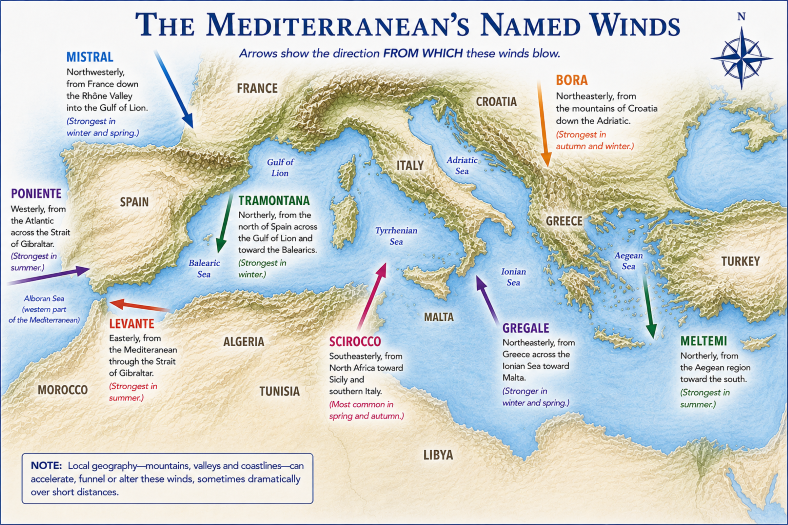
That simple observation explained a great deal.
Like many first-time Mediterranean cruisers, I arrived with charts, guidebooks, weather-routing software, GRIB files, and websites.
What I didn’t have was experience.
I didn’t yet know which parts of the forecast mattered most—or just how dramatically local geography could change what we’d actually experience on the water.
That realization changed the way I began looking at Mediterranean weather.
And it was only the beginning.
The Mediterranean Isn’t One Sea
One of the biggest mistakes I made before arriving in Europe was thinking of the Mediterranean, like the Caribbean where we’d spent more than a decade, as a single cruising ground, which I now understand it is not…
We talk about “crossing the Atlantic” or “cruising the Caribbean” because, despite their differences, each has a recognizable personality. The Mediterranean is different. It’s really a collection of neighboring seas, each shaped by its own geography, prevailing winds, and seasonal weather patterns.
I didn’t really appreciate that until we started cruising in the Med. My conversations with fellow cruisers helped, but it didn’t really sink in until we began moving from one area to another.
Now that we have worked our way east from Almerimar, where Pandora had spent the winter, to Sardinia that one of Chris’s comments clicked for me. A weather discussion about the western Mediterranean might have almost nothing to do with what another sailor was experiencing in the Adriatic or the Aegean. Even within the western Mediterranean, conditions along the Spanish mainland could be completely different from those only a day’s sail away in the Balearics.
That realization meant that I didn’t have to (yet) understand the entire Mediterranean.
I only had to understand the part I was sailing.
That probably explains why experienced Mediterranean cruisers smile when newcomers ask, “What’s the weather like in the Med?”
Now I realize that’s the wrong question.
The real question is, “Where are you?”
One surprise for us was fog.
During more than a decade in the Bahamas and Caribbean, we could go months without seeing visibility reduced by anything more than a passing rain squall. As we traversed the Balearics, however, we found ourselves navigating in dense fog that reminded me much more of Maine than the Mediterranean.
On one passage visibility dropped to less than a quarter mile as we approached the fog bank in the distance.
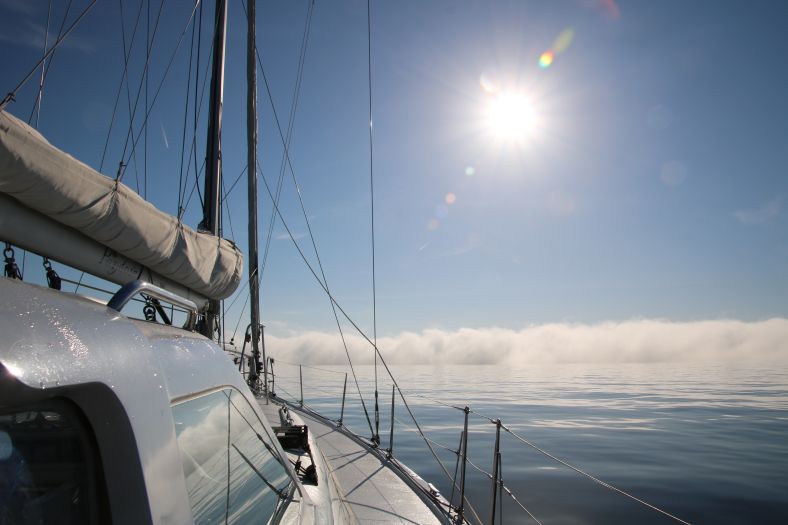
Once we entered the bank it was like being in Maine but with warmer water.
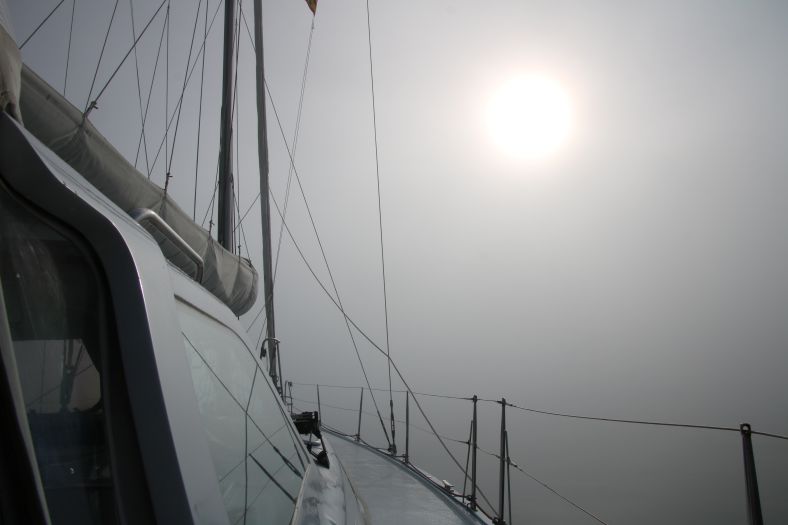
It wasn’t something I had ever associated with Mediterranean cruising.
Later I learned it wasn’t unusual during the spring.
Like so many things we were discovering, it was another reminder that “Mediterranean weather” isn’t just one thing.
Our first season is limited to the western Mediterranean, but even there the weather kept changing character.
Southern Spain introduced us to the Levante and Poniente—the easterly and westerly winds that dominate the Strait of Gibraltar. Those winds aren’t simply created by passing weather systems. The geography of the Strait funnels and accelerates them, and they can remain strong for many miles beyond Gibraltar itself.
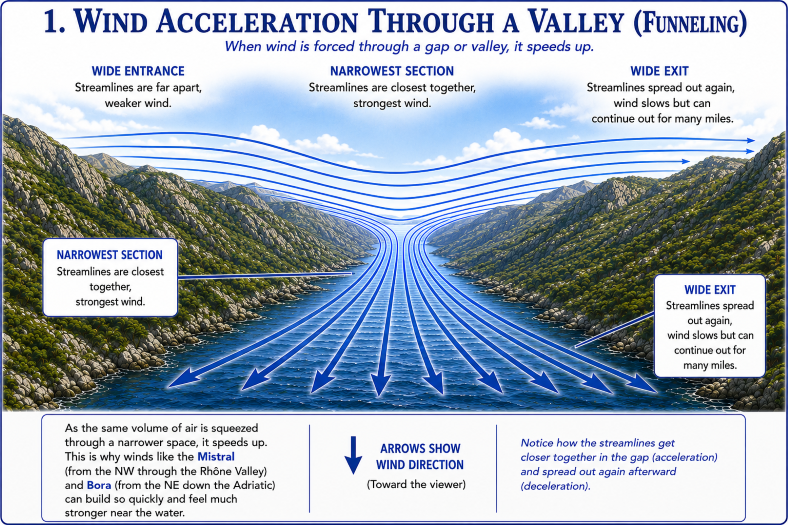
Farther east, another familiar Mediterranean name (familiar to me now anyway) appears—the Tramontana spilling out of the Gulf of Lion.
And then there’s the Mistral.
Long before we ever sailed there, I’d heard stories about it from other cruisers.
Chris explained that what makes the Mistral remarkable isn’t simply that it blows hard. It’s what happens when ordinary weather encounters extraordinary geography.
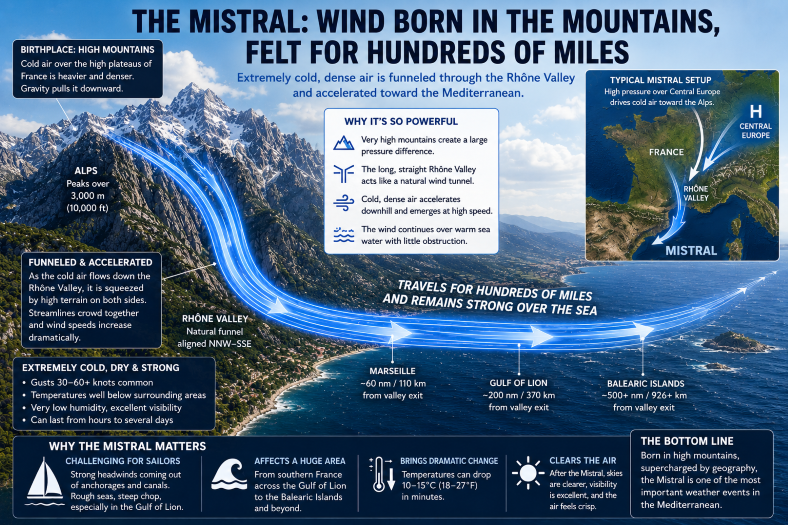
A cold front crossing Europe isn’t unusual.
What happens after that cold air is squeezed through mountain valleys and spills out over the sea—that’s what makes the Mistral the Mistral.
That made sense to me.
After years offshore, I’d gotten into the habit of thinking mostly about wind strength.
Twenty knots is twenty knots.
If the wind shifts ten degrees, you trim the sails, alter course a little, and keep going. When your destination is hundreds of miles away, small course or wind changes usually don’t matter very much.
The Mediterranean is very different.
Here, a ten-degree change in wind direction can be far more important than another ten knots of wind.
Most Mediterranean passages are relatively short. You don’t have distance to adjust your landfall as the wind direction is always changing. You’re trying to reach a specific harbor or anchor in a cove that’s protected from only certain wind directions.
Many anchorages are only protected from a fairly narrow range of wind directions, so even a modest wind shift can turn a comfortable anchorage into one you’d rather not be in.
That reminded me of our early sailing on Long Island Sound, moving from harbor to harbor where we had to maintain a certain course to make it to the harbor without a lot of tacking.
As the weeks passed, I noticed another change.
I spent less time studying the anchorage itself and much more time looking at everything around it—the headlands, mountain valleys, gaps between islands, and other features that have a big effect on the wind.
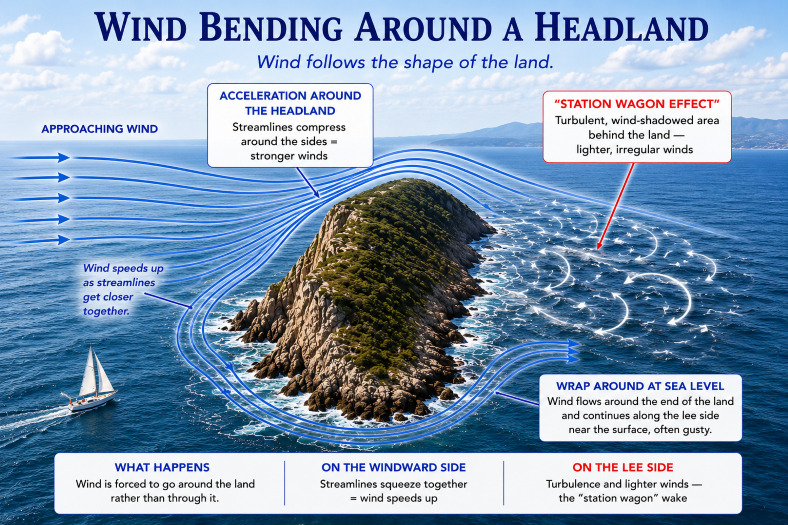
I’d certainly seen local effects elsewhere. In the Caribbean, for example, the trade winds often accelerate as you approach a mountainous island before dying away in its wind shadow. Or, in Deshais, Guadeloupe where the wind funnels through the mountains gusting in the harbor at alarming speeds.
But in the Mediterranean those local, Deshais-like, effects seemed to be everywhere.
Once I started looking at the coastline that way, many of the forecasts that had puzzled me suddenly made much more sense.
It wasn’t that the weather models were necessarily wrong.
They simply couldn’t tell the whole story.
The last few miles into an anchorage often depended just as much on the surrounding landscape as on the larger weather system.
In many ways, the land itself had become just as important as the wind
Planning Around Tomorrow
After years cruising the Caribbean, life aboard Pandora had settled into a comfortable routine.
We often joked that nothing happened before noon aboard Pandora with plenty of time to enjoy another cup of coffee and catch up on the news.
There was rarely any reason to rush. The trade winds were remarkably dependable and, unless we were preparing for a longer offshore passage, tomorrow usually looked a lot like today. The biggest question wasn’t whether we could sail—it was whether we’d have a close reach, a beam reach, or a broad reach and if it would be easy sailing, sort of sporty or super salty but the wind was generally from the same direction, if at different speeds.
We’d check the forecast, chat with neighboring cruisers on the morning VHF net, and decide whether today—or maybe tomorrow—felt like a good, or best, day to move.
It was a wonderfully relaxed way to cruise.
The Mediterranean isn’t like that.
Instead of asking,
“Should we leave tomorrow?”
The question is…
“When is the next good weather window…and what happens after that?”
That was a completely different way of thinking.
I remember sitting in Cartagena.
There were still museums we wanted to visit, markets we hadn’t wandered through, and restaurants we hadn’t yet tried. We certainly weren’t anxious to leave.
But the forecast suggested that three days later we’d have an excellent crossing to the Balearics, followed by several days of fresh winds from exactly the wrong direction.
Suddenly the decision wasn’t just about making the passage.
It was about what would happen after we got there.
Would our anchorage still be comfortable?
Would we be looking for another harbor?
Would we wish we’d waited another day?
And the models were not in agreement at all…
Those weren’t questions I’d spent much time asking in the Caribbean.
Chris pointed out that many Mediterranean passages are short enough that you often have several possible departure days.
The challenge isn’t finding weather that’s acceptable.
It’s choosing the weather window that leaves you in the best place for whatever comes next.
And “next” could very well be tomorrow, or not.
That idea completely changed the way I looked at forecasts.
Instead of planning tomorrow’s sail, I gradually found myself planning the coming week—which often meant not moving at all.
If the forecast suggested conditions would deteriorate before we were ready to leave again, we’d often spend a few nights in a marina instead of an anchorage.
It cost more, but it also bought peace of mind—and sometimes that’s worth every euro.
One of the unexpected pleasures of Mediterranean cruising is discovering just how easy it is to stay put.
The history has a way of slowing you down.
There always seemed to be another castle to explore, another museum, another market, or another café where we could linger over lunch before wandering back to Pandora.
But even while we were enjoying ourselves ashore, there was usually a little voice in the back of my mind asking,
“If we don’t leave tomorrow…when’s the next opportunity?”
Of course, another factor influenced our decisions.
The calendar.
Cruisers like to say,
“The most dangerous thing aboard is a calendar.”
There’s a lot of truth in that.
Maybe it’s a haul-out reservation.
Maybe it’s family flying in.
Maybe it’s a flight home that will cost a fortune to change.
For those of us on non-EU boats, there are also Schengen limits and the need to occasionally leave the European Union to avoid triggering VAT issues.
Whatever the reason, flexibility is one of the most valuable things you can carry aboard.
Another surprise was how often we used the engine.
I’d heard sailors jokingly refer to the Mediterranean as the “Motorterranean,” and now I understand why.
For years I’d unconsciously measured a successful cruising season by how many miles we’d sailed and how few hours we put on the engine.
The Caribbean makes that easy.
The Mediterranean…well…it’s different.
Some mornings the sea looked like Long Island Sound on a hot August afternoon.
By afternoon a pleasant thermal breeze might appear for a few hours before disappearing again by sunset.
Other days there was plenty of wind.
Unfortunately, it was blowing from exactly the direction we wanted to go.
So we waited.
Or we motored.
When I mentioned our unexpectedly high engine hours to Chris, he laughed.
“Have you ever wondered why the ancient Greeks had tiny sails and lots of oars?”
That one sentence probably changed my attitude more than anything else.
There was so much to explore and so much history to discover.
What was the rush?
Sure, we’d rather sail than motor, but the real goal wasn’t to maximize sailing.
It was to enjoy the places we’d come so far to see.
Brenda has always been willing to let me know when I’m making good cruising decisions…or not.
When we first started talking about spending several seasons in the Mediterranean, she looked at me one day and said,
“I’m not sure I want to sail somewhere the Greeks had dozens of words for wind.”
I laughed.
Sort of.
After a few months in the Mediterranean, I realized she may have understood the place better than I did.
Learning Never Ends
Spend an evening in almost any marina or anchorage, and sooner or later the conversation turns to weather.
Sailors have always been storytellers, but the stories they tell are rarely about perfect days reaching across a sparkling blue sea.
Instead, they’re about the gale that arrived a day early, the anchor that dragged at three in the morning, or the harbor entrance they found just before dark.
There’s an old saying that cruising is “days of wonder punctuated by moments of sheer terror.”
Like most sailing sayings, there’s enough truth in it to make every cruiser smile.
I certainly have my own collection of stories.
The seas breaking over Pandora off Portugal while I was sailing from the Azores toward Gibraltar will stay with me for a long time.
But if someone now asks me the scariest moment I’ve experienced in nearly 30,000 offshore miles, I don’t hesitate.
Orcas.
As we approached Gibraltar last summer, Pandora was attacked by a pod of orcas.
Watching—and feeling—several tons of highly intelligent animals repeatedly slam into your rudder is something I hope never to experience again.
It was terrifying.
Looking back, though, I’ve come to realize that many of the stories sailors tell aren’t really about weather.
They’re about decisions.
A crew leaves because they have a marina reservation.
Or friends waiting at the next port.
Or airline tickets that can’t easily be changed.
Or maybe they simply convince themselves that the forecast “doesn’t look too bad.”
Every skipper has made one of those decisions.
I certainly have.
My encounter with the orcas happened largely because I was trying to keep to a schedule.
With the benefit of hindsight, I would have made a different choice.
That’s one of the reasons I wanted to have Chris Parker help me understand.
I wasn’t looking for better forecasts.
I was trying to become better at making decisions.
What had I missed?
What did I know before leaving that I either ignored—or simply didn’t understand?
Those are the questions that really matter.
Before arriving in Europe I’d heard countless stories about the Mistral, the Bora, the Meltemi, and the other named Mediterranean winds.
Somehow I’d come away thinking they appeared almost without warning.
Chris surprised me.
“Most of the time, they’re quite predictable.”
That wasn’t the answer I expected.
He explained that these winds are usually associated with recognizable weather patterns.
The difficult part isn’t forecasting them.
The difficult part is understanding what those forecasts actually mean once mountains, valleys, islands, and coastlines begin reshaping the wind.
That’s the part experienced Mediterranean sailors understand almost instinctively.
They know which anchorages become uncomfortable with only a modest shift in wind direction.
They know when today’s peaceful harbor becomes tomorrow’s lee shore.
They know when to leave one day early instead of one day too late.
You won’t get that from a weather model.
It comes from experience.
Fortunately, Mediterranean cruisers are just as willing to share that experience as the sailors who helped Brenda and me when we first headed south more than a decade ago.
Guidebooks tell you where to go.
Charts tell you what’s under the keel.
Weather forecasts tell you about the wind and waves.
But conversations with sailors who’ve already been there explain how all three fit together.
I’ve really come to appreciate how valuable those conversations are.
As our first Mediterranean season came to an end and Pandora settled into her berth in Sardinia before we flew home, I realized something had changed.
I wasn’t thinking so much about the weather anymore.
I was thinking about how I thought about the weather.
That may sound like the same thing, but it isn’t.
I’d stopped trying to understand the Mediterranean as one enormous cruising ground.
Instead, I was beginning to appreciate that every region has its own personality.
The trick wasn’t understanding the entire Mediterranean.
It was understanding the place where we happened to be.
That realization made the whole thing feel a lot less intimidating.
Instead of trying to “figure out the Med,” I could just focus on the next cruising area.
That seemed a lot more manageable.
And, in the end, the weather wasn’t what impressed us most.
It was what waited for us at the end of each passage.
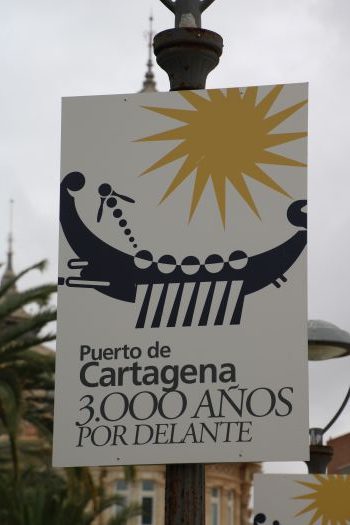
One week we were wandering the Roman streets of Cartagena, where three thousand years of history somehow felt perfectly ordinary.
Another day we were shopping in markets overflowing with fresh bread, seafood, fruit, and vegetables before lingering over a late-afternoon sundowner and eventually wandering back to Pandora for dinner beneath the walls of a medieval castle.
In the Balearics we found quiet anchorages and impossibly clear water.
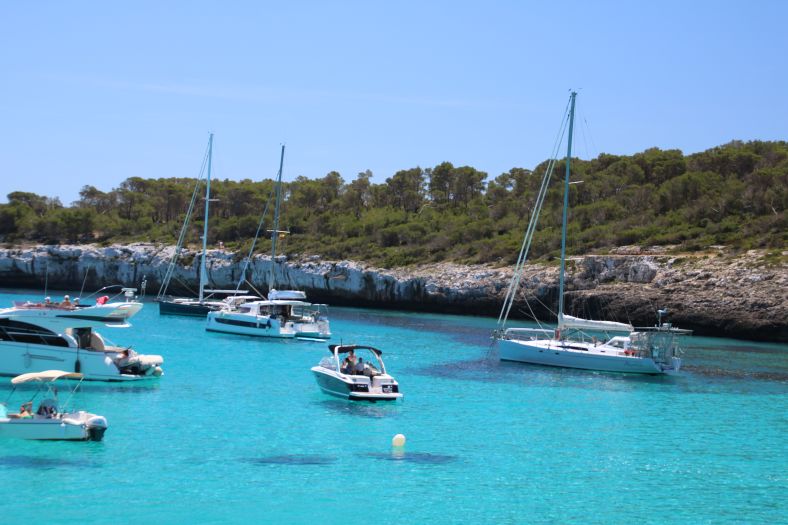
In Sardinia we discovered hill towns and harbors whose histories stretched back centuries before the United States even existed.
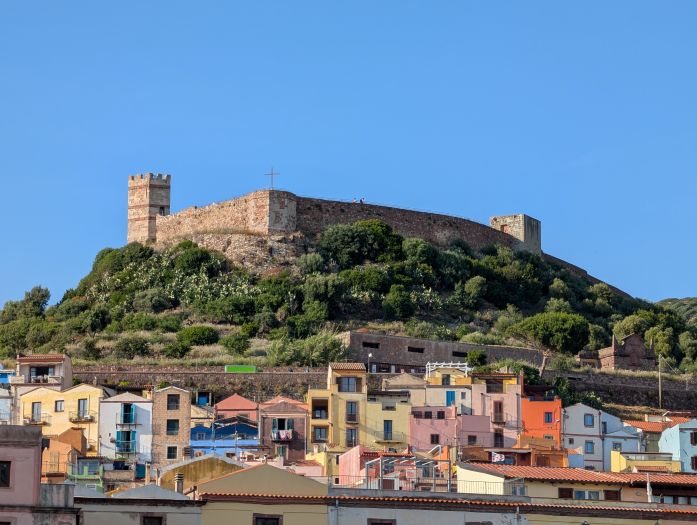
The weather determines when you move.
Places like these remind you why you moved in the first place.
For Brenda and me, that’s become one of the great rewards of cruising the Mediterranean.
As Americans celebrating our nation’s 250th birthday, it was hard not to be impressed by places where history is measured in thousands of years instead of hundreds.
As I write this, we’re only a few weeks away from returning to Pandora.
Our first season has given us just enough experience to appreciate how much we still have to learn.
Oddly enough, I find that encouraging.
After nearly 30,000 offshore miles, I wasn’t looking for another place to prove what I already knew.
I was looking for somewhere that would continue teaching me—and be a place that Brenda would enjoy.
The Mediterranean has proven to be exactly that.
I’ve always believed that good seamanship isn’t measured by how much we know, but by our willingness to keep learning—from the weather, from our mistakes, and, most importantly, from those who’ve sailed these waters before us.
For me, this first season in the Mediterranean has really been about learning the weather all over again.
Bob, this is the best post ever! Very thoughtful and informative. How did you do the excellent graphics?
Hi Bob,
Interesting descriptions of various wind phenomena. An additional one that we often see in Maine is called the descending southwester. An island on a sunny day will heat up and the SW sea breeze will be deflected upward by the warm air as it approaches the island and will accelerate as it descends on the leeward side. This creates less wind on the windward side and more wind on the leeward side. A meteorological oxymoron!
Best,
Tom Babbitt,
Tom: All and all, “sailing” in the Med isn’t for anyone in a hurry. Good to hear from you.
Bob