Sail Pandora

At thirteen degrees north, a long way from home.

We are now in Bequia, south of St Vincent and the furthest south we have ever been aboard Pandora.  The island is part of the Grenadines, a number of small islands between St Vincent and Grenada.  It’s a beautiful area and only a few hundred miles from Venezuela.   Many of the folks we have met along the way keep their boats in Grenada or Trinidad, a bit further south from here, but storage there will have to wait another year for Pandora.  As I have mentioned in past posts, leaving Pandora from May to December just doesn’t sit well with me.  That’s a really long time to leave her unattended.

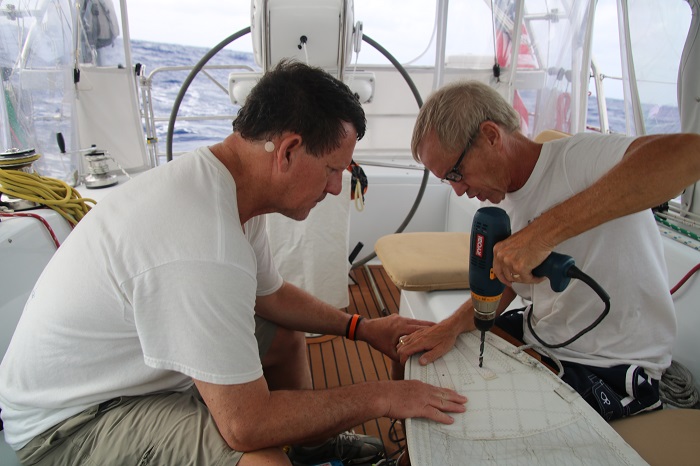
One of the benefits of keeping boats in the Caribbean is that labor rates are low by US standards.   Fortunately, here are excellent crafts people in many of the islands, Bequia for one.   We had heard good things about one of the canvas shops here, in particular, and decided to have canvas chaps made for our dink.  Covers will keep the blazing tropical sun off of the dink and should greatly extend it’s life.

Yesterday the guy from the canvas shop spent three hours making templates for the dink and the finished work will be put on the dink later today.  I’ll let you know how it goes.  We are pretty excited to have matching chaps, seat and engine cover, all in medium grey.

We have also hired a guy to do some varnishing down below on Pandora, the companionway, galley fiddle, navigation station and woodwork in the forward head.  I checked the work that he did for a friend and it looked beautiful.  He says he will be done with the job in a few days so I’ll let you know how it goes.

We were thinking about a new sail cover too but after having the canvas guy look at things today, he thinks it would be OK to put it off until next winter.

We were later arriving in Bequia than expected because we have had so much trouble prying ourselves loose from just about everywhere we have visited, Marigot, our last port, included.   The last day we were in Marigot a beautiful ketch showed up.  She’s Elfje and is owned by a woman, unusual for a superyacht.  I say that it’s “unusual” as that’s how it was described in one of the  magazines that wrote about her and her yacht.  It seems that mega-yacht ownership is overwhelming a male.  So, the owner is Wendy Schmidt, wife, perhaps ex-wife of Eric Schmidt, co-founder of Google.  Ever wonder who owns these spectacular yachts?  Now you know.  She has spectacular lines, the boat that is. And, speaking of varnish, which I was, she has plenty along with a large enough crew to keep up with it.   I love the color of the boat, Columbia Grey, I am told.  Pandora’s dark green is very hot in the tropical sun and we are considering having her repainted in Antigua, perhaps a medium grey.  Changing her color is complicated and more expensive than just going with the same color again, so we’ll have to see what comes of that.   I have lined up someone to do it when I get to Antigua in mid April but it’s unclear if there will be time to get the job done before I leave to head to New England in early May.
She looks enormous on the dock compared with Pandora out in the harbor. Just about everywhere you go in the southeast Caribbean, “boat boys” approach you selling something.  This guy was selling bananas.  We bought some and paid too much.  He reminded us of the Grinch, in looks, not temperament.  Across the harbor was a trail that led up to the top of the hill.   I climbed up the impossibly steep trail, complete with installed ropes to hold as you pulled yourself up.   I didn’t think I’d make it.  Later I was told that many 20 somethings turn back because it’s so steep.   Go me!  Trust me, it was way, way steeper than it looks in this photo.
At the top, after many stops to catch my breath along the way, I was told to look for the “meditation platform”.   By the time I got there it looked more like a “recovery platform” to me, a place to lay down to listen to my pounding heart as it slowed to normal.   Most of the time really steep paths have many switchbacks to make the climb easier.  Not here.

However, once up top, the view was spectacular and worth it. There’s little Pandora way down below. And the view south toward the Pitons, the short run to where we were headed the next day. The Pitons, one of the most photographed sites in the Caribbean, are two 1,000′ tall cones from long extinct volcanoes.   They are impossibly steep and the ocean drops off quickly to more than a mile deep very close to the shore.   We took a mooring in 140′ because of the dropoff.  I have never taken a mooring in that much water.   The gusty winds swirled around us we swung one way or the other by 100′ or more because of the impossibly long scope on the mooring.  It was gusty there, so close to the rising mountains so we had to get help from one of the local “boat boys” to tie up.    As high as the “hill” looks, its actually a lot higher.  As they say, “you had to be there”.  We headed ashore to a very fancy resort on the beach and enjoyed the setting sun from our table under the palms.  It was a “million dollar view” and the bar tab was right in line.  How about $100 for two glasses of wine each and a single appetizer?  The next day we dropped the mooring first thing and headed south to Bequia.    As we rounded the southern tip of St Lucia the seas were very confused with a strong western setting current pushing against us.  That combined with the wind funneling around the headlands made for some pretty “sporty” conditions for the first hour.    In spite of my having carefully secured the dink I was concerned about how much it was moving around in the davits.   Fortunately, no damage.

Following a torrential downpour we were treated to a spectacular view of the Pitons receding in the distance.  It was a long day, nearly 60 miles, as we could not stop in St Vincent, a large island just north of here as it’s not safe.   Too bad that some bad actors have scared off all the cruisers.    All and all, a beautiful sail in moderate winds and all on a beam reach.  It was the best sail yet for the season. 
Bequia is truly an island of boaters and there is a very active junior sailing program with some really nice boats.    They sailed right by us through the turquoise waters. Heading back up wind, they looked like they were having a wonderful time.  To me, this picture just speaks to the exuberance of kids out sailing for an afternoon as they tacked through the anchored boats. The customs house is right near the dinghy dock.  Very Caribbean.  True to form, with it’s English heritage, clearing in was much more complicated than the French islands.
Main street in the village is tree lined and very quaint. I liked this scruffy building framed in flowers.  Everything here is very colorful, even the ferry boats lined up at the dock. Well, I guess that’s about it for today.  The WiFi is really slow and doing this post has taken me FOR EVER.

Yes, we are a long way from home but it’s so beautiful we will surely come back next season.  Perhaps we will even be further south than thirteen degrees.

Did someone say “crossing the equator?”  Not Brenda, that’s for sure.

Ok, ok, one more day…

It’s Wednesday and we are STILL here in Marigot bay and yes, and continue to think about leaving for The Pitons and Bequia.   Hold on though, it’s just so nice here and we hate to rush off.

Besides, another afternoon at the pool sounds pretty good to us and that Indian restaurant up above the marina is still on our list.

Earlier this morning very nice basket weaver came up to Pandora to show us his work, baskets.  We bought one.   You have to admire his entrepreneurial spirit along with his brightly colored skiff.  And speaking of hustle, there are plenty of day boats taking large groups of tourists out for a day of snorkeling and sightseeing.   A parade of these jam packed boats come through the harbor every day.   I wonder if the USCG would approve of their safety equipment?  Perhaps better not to ask.
Ok, how about some boat watching?  I love this little Lyle Hess Bristol Channel Cutter.  She’s one of a long production run for this petite 24′ “go anywhere design.  Tiny and very popular with a cult like following since her introduction in the 80s.  Perhaps something with a bit more creature comfort is what you’re looking for.   RH3 is a beautiful explorer yacht that went through a major refit just a few years ago.  She’s rugged and looks the part of a world cruiser, which she is.  Check out this article about what she’s all about.    Her tenders are impressive and this one, that I guess they must tow around, would fit right in a James Bond movie.   And, that doesn’t even count the two smaller equally sinister looking ones parked on the upper deck.  His and hers?I am particularly struck by this Lefite 44.   She is an 80s vintage and yet doesn’t look it as her owner has lovingly maintained her, along with some excellent craftsmen in Trinidad where she has been stored for a number of summer seasons.    She must be the best of her breed and I understand that she’s for sale.  Bob Perry, perhaps the leading designer of cruising boats, designed her back in 1978.   Read about this iconic design here.   Her recent paint job and fresh canvas really make her shine.  Nice boat.And speaking of nice boats.  How about Pandora sitting pretty in this tiny charming harbor?Well, it’s almost lunchtime and, as usual, not a lot has happened aboard Pandroa so I’d better, as my father used to say, “get the lead out”.   Actually, I have to clear out today so we can leave in the morning for the Pitons and then on to Bequia.   That is, of course, unless we decide to spend one more day here. 

 And, we just have to carve out some time to curl up with a book near the infinity pool.  Right?     

Marigot St Lucia. Why leave?

Well, yesterday we finally left Rodney Bay to sail down to the Pitons but as we passed the tiny harbor of Marigot we decided to check it out.  It’s so tiny on the map that you could easily miss it and we are really glad that we didn’t.   The harbor is completely protected and there are lovely homes scattered on the nearby hillsides as well as a few really nice resorts.   It’s nice to be here for a few days.

We enjoyed our time in Rodney Bay and were pleased that we didn’t encounter any of the reported crime, such as loosing a dink, that we’ve heard happens on  a fairly regular basis.  Actually, had we not heard about these incidents, we would not have had a second thought as we didn’t feel threatened while we were there.  We’d also heard that there were “boat boys” that harassed cruisers but we didn’t see that either.  However, we did make and extra effort of locking the dink at night in addition to pulling it out of the water, which we do, as a rule, wherever we are.  The sunset was beautiful that last evening framing the boat that was anchored behind us. We left shortly after sunrise to make the run down the coast.  We had a short, less than 10 mile run before turning into Marigot.   The western coast of St Lucia is very green and lush. The outer harbor of Marigot is quite narrow and mostly too deep to anchor, however, you can anchor along the side near shore in less than 20′.   There is a beautiful stand of palms along the spit that protects the inner harbor.   They framed the view that greeted me this morning in the early light.  The wind and water were uncharacteristically still.   Those palms really make the place look remote and plenty tropical, like a south seas village.    However, it’s not remote at all with the really lux, Capella Marigot Bay Resort along the inner harbor shore .   While we could have easily anchored in the outer harbor, we opted to take a mooring at $30/day as it comes with WIFI and access to the resort facilities.    Not bad as staying in one of the resort rooms will set you back $400 or more.  Here’s Pandora framed in a view from one of the restaurants. There are actually a number of restaurants to choose from, some alongside infinity pools and many of the rooms have their own mini-pool just outside the room.One cascades into the other. Love the chairs.  George Jetson would have been all about sitting in these. 
If all this isn’t in your budget, you can always go next door and get your hair cut.  Want to rent a small boat yourself.  There’s plenty to choose from on the waterfront.  However, most of the residents, and some of them are particularly well heeled, probably keep their own barber on board.  Tommy Hilfiger’s yacht, Flag pulled in yesterday.  It was amazing to see such a huge yacht navigate in this tiny teacup harbor and pull up to the dock.  They do advertise as being able to handle yachts up to 250′ long and Flag is nearly that big.  I realized that it was Hilfiger’s yacht because his “corporate” flag logo was on the side of the superstructure.  After a bit of digging, I confirmed it.  It’s amazing what you can find on the Internet.  Feel like chartering her?  She’s available for 400,000 Euros a week, plus expenses.   The sailboat next to her is nearly 200′ long.  Tells you how bi Hilfiger’s boat is.  That ketch is a mere 200′ long.  Not too shabby.
Atlante, another resident here when we arrived yesterday, is much smaller at only a tad over 100 feet and is only a few years old.  She’s spectacular.  Check out her site. Beautiful lines.  Love the traditional stern.
Yes, this is a pretty rarefied neighborhood and it’s going to be tough to pry ourselves away.  It’s supposed to get fairly windy for a few days so perhaps we will just have to hang out here for a bit and then move further south.

Oh yeah, when Brenda flies out in April and my friend Craig joins me for the run to Antigua we’ve decided that Marigot is where we make the switch.   That’s good as we haven’t even left and we are looking forward to 0ur next visit which won’t be a long way off.

Tonite we’ve been invited to join a couple on a nearby boat for cocktails.  They leave their boat in Trinidad for the summer each year and it will be interesting to hear what they have to say about the experience.  His boat looks like it’s kept to a pretty high standard so I’ll be interested in what he has to say.

St Lucia, on our way south.

We are anchored in Rodney Bay, St Lucia, the main harbor on the island.  It’s nice to be back in a country where English is the main language but the trade off is that cheese, baguettes and good inexpensive French wine are nowhere to be found.  When we were in St Anne there were plenty to choose from in a village that was “oh so French” with quaint shops and restaurants as well as a busy bakery that churned out a dizzying selection of pastries and breads from sunrise to sunset.

And, speaking of sunset, last evening’s was beautiful, complete with a three masted schooner in the distance. A square rigger ablaze with lights in the twilight.  We’ve been here for two days and plan to leave in the morning to head down-island to the Pitons, perhaps one of the most photographed places in the Caribbean.   After that, we will head to Bequia to rejoin a few of our cruising friends for a few days relaxing in what some say is their favorite island in the chain.

This morning Brenda and I took a hike up to an old British fort, overlooking the harbor.   The view of the harbor down below was impressive. The view south toward the Pitons and a schooner heading out. This harbor was an important stronghold for the British during the 17th and 18th centuries.   Nearby Martinique, which is easily seen from the fort lookout,  was an important port for the French so keeping watch afforded a good view of any impending attack.

Downhill from the fort, ruins of troop housing, still impressive after so many years. When we returned from our hike a fruit and vegetable vendor came to visit in his “eclectic” store.    We bought a variety of produce including this huge and very lumpy lemon.  The produce looked pretty rough compared to what we see in US markets but I expect that what it lacks in good looks will be made up by great taste.   In the US we sometimes forget what local is supposed to look like.  As I headed in to do some errands and this post, I passed a lovely gaff rigged sloop plying the blue waters of the harbor.Well, it’s taken a lot longer to do this post than it should have thanks to really, really SLOOOOW Wifi.   I had to try two different spots until I found a spot where the speed was, sort of, OK.   It seems that mid day is just too busy with lots of folks competing for time on the server and everything just slows to a crawl.

However, I am finally done so I can head back to Pandora to fix, finally, Brenda’s potty.  Fingers crossed that the new parts, specially shipped from the US, do the trick.


Sugar riches of Martinique.

Tomorrow, after a month in Martinique for Pandora, we head off to St Lucia.  We have heard about problems for cruisers visiting the island as theft and petty crime can be a problem with outboard motors stolen on an alarmingly regular basis.  It’s unfortunate but we have been told that with reasonable precautions, like pulling the dink up into the davits at night, which we do, every night, that the thieves will likely choose someone else’s and leave ours alone.

However, St Lucia it will be as we have parts for Brenda’s toilet waiting for us there and we are excited about getting things back in order.  Well, I can tell you that Brenda’s excited and if it keeps her happy, I am totally game.

After St Lucia we hope to head a somewhat farther south to Bequia and perhaps the Grenadines where we will turn north again so Brenda can fly out of St Lucia for home in April, Friday the 13th, actually, not to put too fine a point on it.  Hmm…

In preparation for leaving tomorrow, I checked out with customs today and we will leave first thing to make the short 22 mile run to Rodney Bay, on the north west corner of the island.  I expect that it will be a “sporty” sail, with 20+kts on the beam and ocean waves of 7-10′.  However, with Pandora’s now clean bottom, we should make the trip in good form.

In my last post I alluded to our visit to a rum distillery and a visit to St Pierre on the northern end of Martinique and I thought that I’d share some of that experience.

There are many distilleries in Martinique and sugarcane is still a major crop.  Sugarcane is a large tropical grass, introduced to the America’s by Columbus, you know “in 1492 Columbus sailed the ocean blue…with sugarcane…”?  It grows well in the local warm and wet climate here.  The industry in the Caribbean began in Barbados in the 1600s and spread through many of the other islands.  Producing and refining sugar has been big business in the islands for hundreds of years now and while cane sugar from the Caribbean has been largely replaced by cheaper sources elsewhere, today’s crop is still important but generally consumed in the production of rum and there is plenty being made here in the islands.

Broadly speaking, there are two types of rum produced in the caribbean, Rhum Agricole made from freshly pressed cane juice, primarily in the French islands, and that made from molasses, a byproduct of cane sugar production.   The latter type is generally associated with British Islands.  Don’t ask me to describe the differences but the link above provides a good overview.  However, it’s safe to say that they both go down easily, especially after the first round.

Brenda and I visited a number of other distilleries a few weeks ago when we rented a car with some friends.  I wrote about our great day in this post.

During our last outing a few days ago we visited the home of Rum Depaz, where they have been making fine rums since 1651.  These grand plantations once used many African slaves to tend to every aspect of the growing and harvesting of sugarcane and the making of rum.  Slavery in the islands was a brutal time but fortunately, modern equipment has made it possible to continue and improve production at much less of a human cost.  There are many excellent books about this dark history and if you’d like to learn more I recommend the book The Sugar Barons,  a well written history of the industry in the islands and it’s brutal past. It is hard to overstate the importance of the Caribbean sugar industry in the 17th and 18th centuries.  During this period, the tiny island of Barbados had exports of sugar that were more valuable than the entire export income of North America.  Great fortunes were made and lost along with a great human toll on both blacks and whites that died in great numbers in these islands.

Plantation owners generally made their homes on the same property where the cane was grown and processed.  Many of the modern operations in Martinique have restored these old homes and now offer tours.  Unfortunately, Brenda and I were too late for a tour here but enjoyed walking the grounds.

It’s pretty clear that the owners of Depaz did pretty well for themselves.  Bougainvillea climb each corner of the massive home. The gardens would have been the envy of any European aristocrat.  No wait, these were European aristocrats.  Nice view. Immediately adjacent to the home is the modern production facility. There are many buildings in the complex. Including the reception center and tasting room.   Unfortunately, they closed before we got there.   However, I was able to beg them to let me in so I could buy a bottle to have my own tasting. While the modern equipment is powered by electricity, water was once the primary driver of the machinery that processed the cane which had to be cut and crushed quickly to avoid premature fermenting in the tropical heat. There are still remnants of the aqueducts that moved water to the factory.   As Martinique is a very wet country, there is usually plenty of water and this spillway was designed to carry away excess water beyond what the factory needed to power the crushing machinery.   The day we were there plenty of water was flowing over the spillway and onto the parking lot. Modern equipment now does the backbreaking work that once took hundreds of slaves. This is the business end of the combine.  The boom at the top employs two massive circular blades to cut the cane and feed it into the steel “maws”.  inside the machine the cane is chopped up and separated from the leaves that are spit out the back to help rebuild the soil.  This is not a machine to be trifled with. After visiting Depaz, we headed to the coast and St Pierre.  Today the city is a popular tourist stop and no longer the capitol of the island.  The local beaches are black volcanic sand and provide an gentle arc along the coast to the north. And south…Main street is lined with small shops and restaurants. Remnants of the once capitol buildings are preserved as a reminder of the power of the volcano.   Unlike Montserrat, Pelee is currently dormant and scientists constantly monitor it for activity. Today’s buildings still retain the charm of what might be called simpler times. Unfortunately, we were late and many of the businesses were closed but it was nice to visit.  Many boats were anchored off of the beach, including Ishtar, sister ship to our last Pandora, our SAGA 43.  Perhaps we will visit aboard Pandora on a future trip through the islands.

It’s fascinating to visit Martinique and learn about the history that shaped this colorful island nation and the effect that sugar has had on every aspect of the island for hundreds of years.

Scroll to Top