Well, it’s nearly the end of August and Pandora will be heading toward home next week. As I write this I am in Rockland, counting down the days and not in a good way.
Brenda spent much of yesterday with an artist’s, artist friend who lives in Maine full time and enjoyed her time with her. Me, I just sat for hours in a coffee shop, wifi and all.
Somehow doing bills, working on some details next steps with Pandora and some Salty Dawg stuff ate up the entire morning. When Brenda returned after lunch, her response was, “you’re still here?”. Yup, still here and no blog post to show for myself.
So, it’s another beautiful day here in Rockland. Last night a cold front came through and instead of the mid 80s humidity that we have endured for days not, today’s high is a more Maine Like mid 60s. It will be lovely.
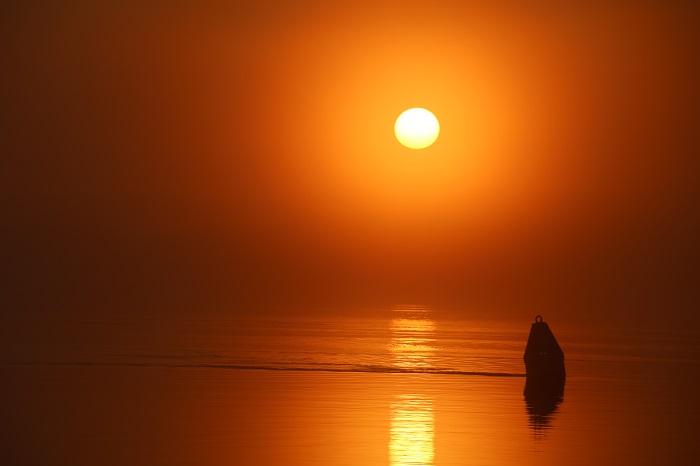
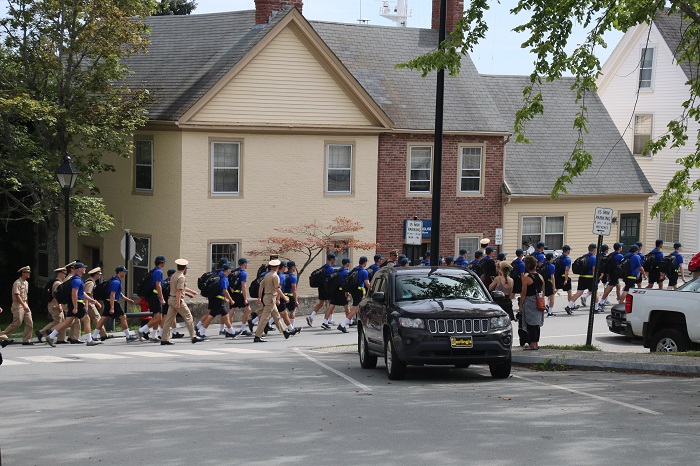
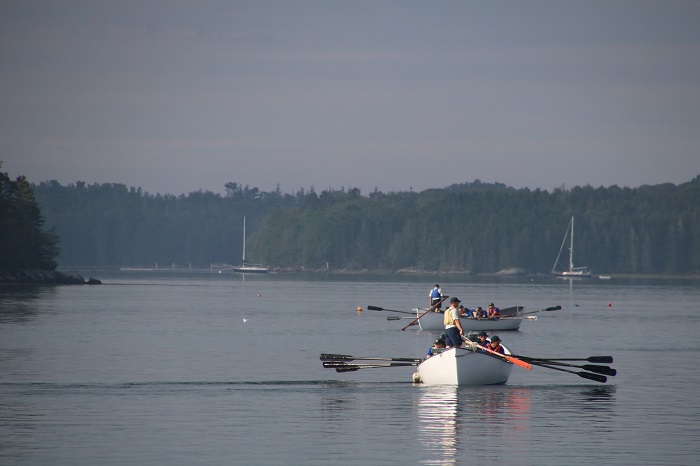
Before I go into some of the fun details of what the last two weeks here in Maine have been like, I’ll share yesterday’s sunrise, framed by a huge ketch anchored far out in the harbor. What a perfect way to begin the day. Those of you that sleep late miss moments like this. And, speaking of memorable sunrises, when we were in Castine, before hurricane Henri passed up the east coast. The currents are swift in the river there and the sunrise made for a beautiful moment with the current pulling hard on a channel marker.Castine is the home of the Maine Maritime Academy and it was fun to see the cadets out marching through town. Lots of “hup, hup” stuff going on and plenty of loud chants by the officers, dutifully repeated by the cadets. They also were out for training on their lifeboats, learning to row in perfect time. Back and forth across the river they went with the bosun keeping time. Their “boat”, the State of Maine was in town. At one point the cadets filed one at a time up the gangway to board the ship. It was unclear to me if that’s where they live or if there are dorms. Castine is a charming little town with loads of history. There are a number of very nice independent book stores, something that seems to be fairly thriving in the small towns in Maine. Perhaps their trade is driven by tourists that want to curl up with a good book when it’s foggy, cold and rainy. Melody, an artist herself, saw a tiny kiosk mounted on a sidewalk post outside of one shop where artists can swap out their work. Put in a piece of art and take one. I love the idea. Perhaps we need one in our home town. We also spent time in Buck’s Harbor where we had a lobster bake. I wanted Chris and Melody to experience eating lobster outside on a picnic table overlooking a quintessential Maine harbor. While we were there a schooner full of vacationers pulled in and dropped her hook. There are many schooners in Maine that take out vacationers for week long cruises, stopping in one quaint spot after the next. Buck’s is home to a beautifully maintained Concordia yawl, a well regarded design coveted by those that love wooden classics. Her owner also has a Pulsifer Hampton, another charming design. I’ve never seen two of them together and with matching canvas, no less. From Buck’s we headed back up to Castine to wait out the hurricane. Fortunately, it turned out to be a non-event and we never saw winds much more than a brief period in the high teens. There were many boats in the harbor tucked down near shore including the 1030s vintage Ranger, one of a number of restored America’s Cup boats making the rounds of the classic racing regattas. She is an impressive sight and huge at over 130′ long. She draws more than a dozen feet, which she needs to, in order to balance her impossibly tall mast. I was taken by this tug boat converted into a yacht. I don’t know anything about her but our paths have crossed a number of times this season. It’s not always sunny and to see a schooner drifting by in the fog is an impressive and ageless sight. Sun, threats of hurricanes, fog, rain, the weather is always changing in Maine and is one of the reasons that I love being here.
So, as I finish up this post, we are planning to head to Allen Island, the site of the family summer home for Andrew and Betsy Wyeth, now diseased, the famous artist and his wife. I’ll have more to say about that perhaps in a few days. From there we hope to go to Booth Bay where my friend George will meet us and help me bring Pandora to Fall River MA where I am having some work done on her electronics. Conveniently, Brenda will drive his car back home for him. Very convenient.
Our time in Maine is nearing a close but I am optimistic that our cruising season is not and that we will soon be back in the Caribbean for a winter of cruising. However, I will say that the details of that are still up in the air due to the lasting threats of Covid-19 and the Delta variant. Life is never simple, even for the vaccinated.
It’s a beautiful day here in Castine where we moved yesterday after a few days in Belfast. The sunrise was spectacular. However, you know what the say about “red sky in the morning”. Rain this afternoon. Castine is a wonderful place but that will have to wait on that point as I have scintillating news in the life of the giant rubber ducky Joy.
On our last night in Belfast I was still wondering if I was about to be arrested for illegal transport of the giant rubber duckie when I moved her from another area of the harbor. All day long we watched a parade of boats, large and small, passing by Joy to pay her tribute.
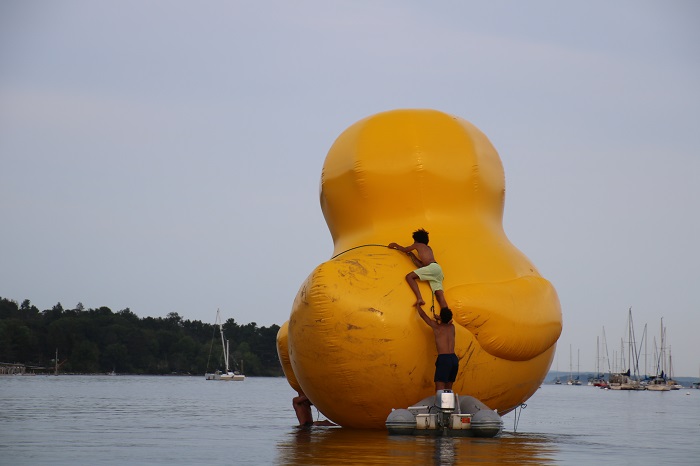
Late in the afternoon, three boys showed up in their dink, looking very determined to do something as they strung a rope over her back. I could not imagine what they had in mind and we took our dink over to inqure about what they were planning. “we want to climb up on her back”, they said.
Ok, AWESOME, go for it! I just HAD to record this and stood by, but I will admit, I was wondering if such a feat was even possible. Actually, I was thinking NO WAY!
After perhaps a half hour of prep, here they are, getting ready to scale to the summit. Note the drone, upper right, capturing the moment. I have no idea who was the “driver” of the drone. It wasn’t the trio. The would-be climbers had things pretty well thought out, I guess, and they proceeded to string a rope over her back so they had something to hold onto. As everyone knows, rubber duckies are notoriously slippery. To keep her from rolling over, one guy got into the water (very cold water) to balance things out.
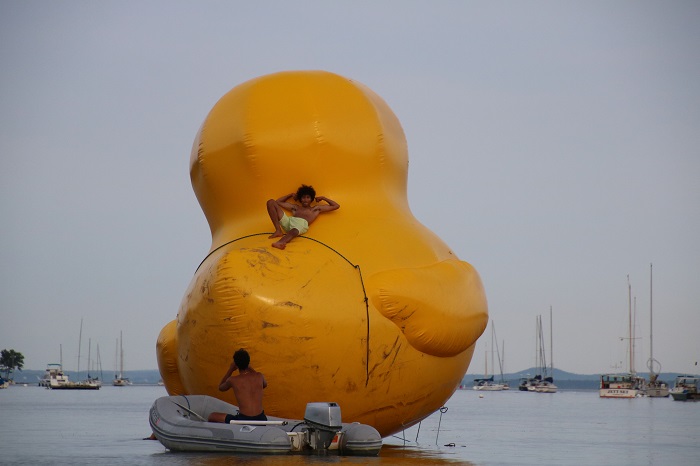
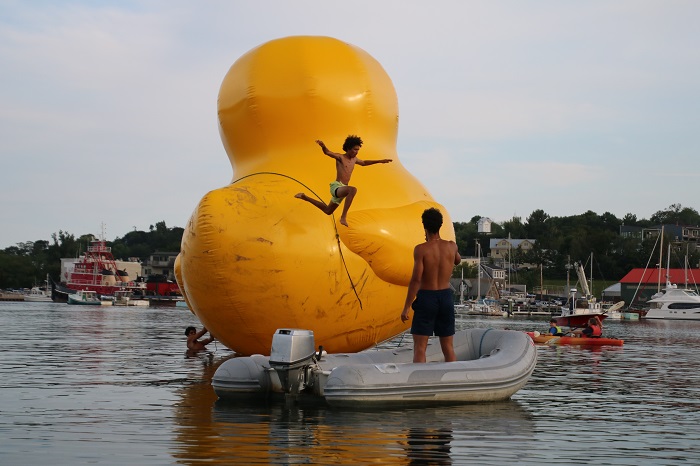
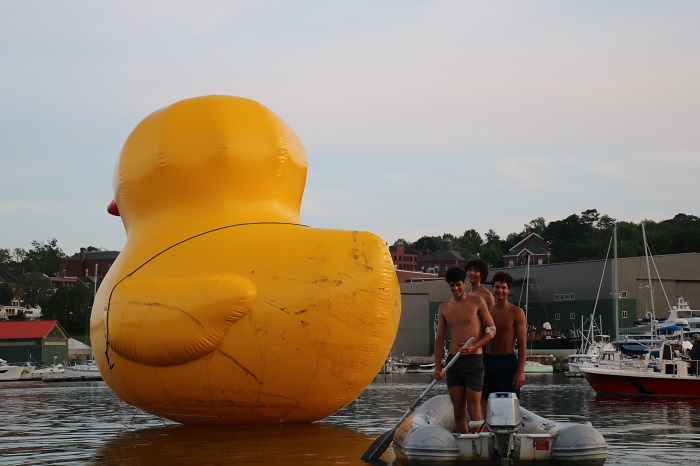
Getting a boost. Still not looking very promising. OMG! Up he went…What would you do when you finally summit a giant rubber ducky? What anyone would do. Strike a pose!And how do you top that? Jump off, of course, and be quick about it as, as their friend in the water was probably about to succumb to hypothermia. The three of them were pretty proud of their feat and willingly posed for a photo. I wonder how they chose who would would be the climber? The one to conquer the biggest rubber duckie in Maine?
Perhaps their planning discussions were about who would be THE ONE to summit. Perhaps the same talk that Neil Armstrong must have had with fellow crew Buzz Aldrin and Michael Collins as to who was going to be the first to walk on the moon.
Who would take that “first to find the joy of being the first to summit Joy for all mankind”?
Ok, ok, I’ll admit that I am beating this to death but hey, the story was picked up in USA Today, so it must have been big news. Don’t believe me? Check out this link.
Surely the Joy of conquering Joy is worth something. At least when you are a kid you should take your wins when you can.
I thought it was awesome! Oh, to be young.
Me? All I would be thinking about is how cold the water is.
But perhaps more importantly, where else will we find Joy?
Well, I am finally back in Belfast and aboard Pandora after three weeks back home. Since returning from the Down East Rally, I’ve been hugely busy with Salty Dawg stuff and have been spending a lot of time interviewing applicants that are flagged to me as possibly having limited blue water experience. I want to be sure that they have a good feel for what they might face and plan to invite crew aboard that know what sailing hundreds of miles from land is all about.
There was also considerable discussion about how we were going to handle the question of vaccine requirement for those making the run south. After months of factfinding the Board decided that the most prudent approach to insure the safety of all at sea, was to require vaccination for everyone. Additionally, the islands that we plan to visit are really having a tough time with the virus and with sometimes small numbers of their people unvaccinated, it would not be fair to bring yet another unvaccinated person to their homes. Additionally, most islands are taking a very hard line with those that are unvaccinated visiting and they are requiring testing and quarantine until they are certain that all is well.
I do expect that event the vaccinated will also continue to be tested before visiting or moving to other but, as of now, if their test is negative, they are free to go. With breakthrough infections popping up among the vaccinated, it’s hard to say how this will all play out in the coming months.
As of today, Biden has announced that boosters are recommended and, Brenda and I will be lining up to do just that as soon as we are given the all clear.
Given how polarizing and political this issue has become here in the US, I had no idea what sort of blowback we might encounter. Personally, I felt that most, if not all, cruisers were probably comfortable with the “jab”, but did wonder what might happen when the announcement was made.
Happily, there has been virtually no complaints about the plan, very good news.
We are getting a lot of applications for the rally and the recent webinars on Antigua and the Bahamas were very well attended. It looks like we are on course to have a larger rally than has been the case in recent memory. Fingers crossed that there will not be any surprises as we get closer to departure in early November.
So, here we are in Belfast for a few days with our son Christopher and his partner Melody. Brenda and I are focused on giving them a good feel for what cruising Maine is like. Wish us luck.
Our arrival in Belfast coincided with the mysterious appearance of a huge rubber duckie named Joy. She? He? Im going with She and she, has been making a tour of the harbor in recent days. Many have been taking her photo. Me too. It seems that she recently made her mysterious appearance at the head of the harbor, where we are, and then drifted down and tangled with some of the moored boats.
This morning, under the influence of coffee, I decided that Joy needed to “return to her roots” at the head of the harbor. The fact that we wanted to have her closer to Pandora had nothing to do with the decision to “rescue” her at all, I assure you.
I approached cautiously so as not to alarm her, lifted her moorings and off we went. In spite of the fact that Joy has been moving around, it turns out that she has not one but two moorings to keep her in position. They proved too heavy for me to hoist into the dink so I suspended both of them below the dink as best I could to prepare for Joy’s voyage.
Taking her home.The going was slow, as I did not want to alarm her.
Joy proved to be a willing, if not enthusiastic traveler as she followed obediently behind Hope. Hope you say? Hope is the name of our dink.A dink named Hope? Remember the story of Pandora’s box? When Pandora opened the box and all the evils went out into the world? Well, after that, she looked into the box and all that was left was Hope.
Get it? Pandora’s dink called Hope?
So there you have it, as long as there is Hope, there’s Joy. Well, at least there’s joy going for a ride. As she arrives at her new home, Joy continues to pursue Hope as we all do. So, Joy is now among us, as it should be. Guarding over us in the “hope” that we will enjoy Maine. It’s a beautiful day here in May and I am happy that I was able to bring a bit of Joy, no, she’s HUGE so she’s brought a LOT of Joy into our lives.
I guess that it is safe to say that where there is Hope, Joy will follow.
The last stop on the “mini-cruise” that I organized for the Salty Dawg Down East Rally was Belfast Maine, home to Front Street Shipyard and some remarkable boats.
I can still recall when we first started visiting Maine with our Tartan 37 Electra back in the 80s, Belfast was a place that had been best known for it’s smelly chicken and sardine processing factories and not really as a place to stop on a cruise. Last time Brenda and I visited Belfast was in 2011, ten years ago and by that time the chickens were long gone and it was actually a nice place to visit.
Checking a decade old post about that last visit brought back some nice memories. Check it out. To that point, I can’t believe that I began keeping this blog in 2007, 14 years ago. And, even crazier, once I push the “publish” button, this will be my 989th post. I guess I should think of something to do to celebrate my 1,000th post as that’s only a handful of posts away.
Anyway, back to Belfast. Ten years later the town is still charming and the harbor, exposed to the south, still acts like a funnel when it pipes up from the south, not so great. To that point, I was on the phone with Jonathan, the dockmaster at Front Street Shipyard yesterday and he told me that it’s pretty bumpy out in the harbor today. Yup, wind’s out of the south. Glad I’m not aboard with Brenda. She would not like that at all.
A lot has changed in Belfast over the last decade with perhaps the most notable being the emergence of the Front Street Shipyard that rose up quickly on the grounds of an abandoned sardine factory. They are now a major employer, known for their expert craftsmanship on all manner of boats, perhaps most notably the “big kids”.
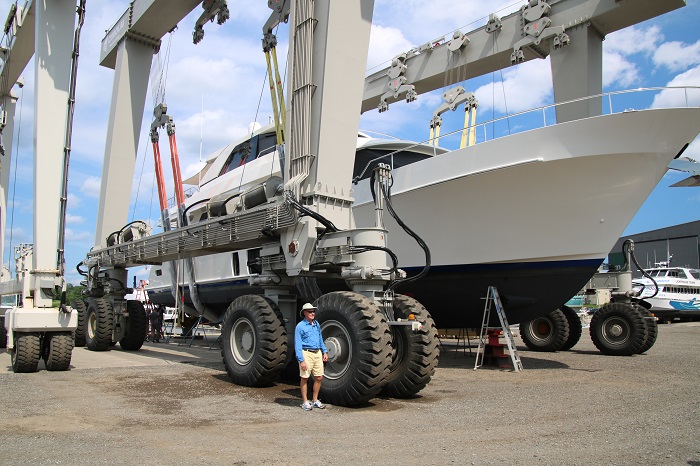
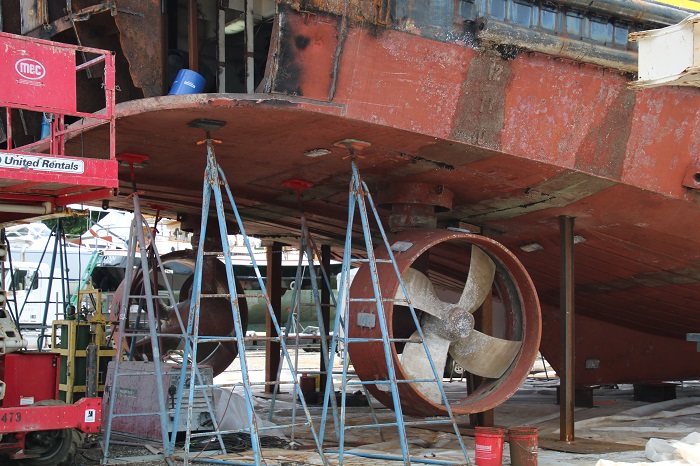
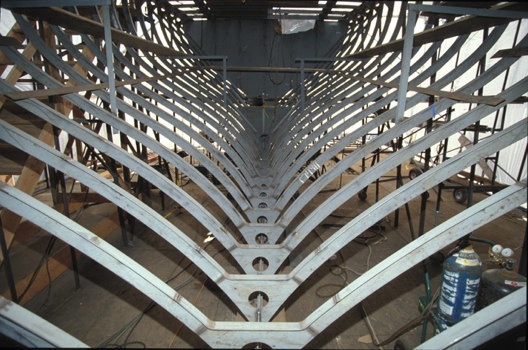
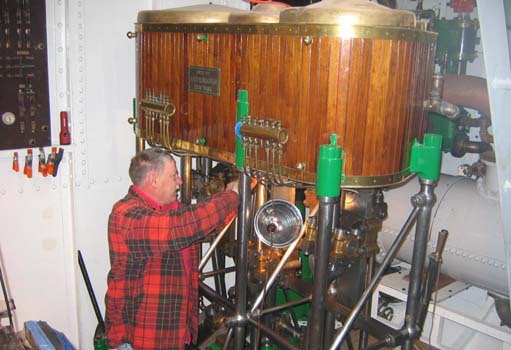
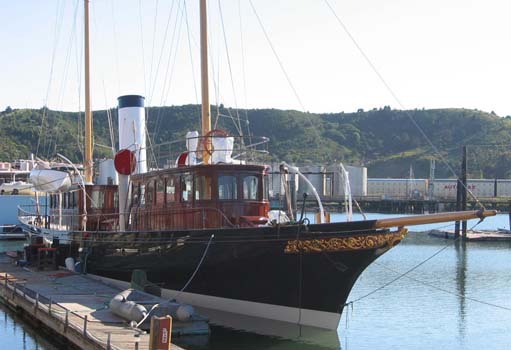
For this last stop on our mini-cruise, I was lucky to arrange a tour of the Ship Yard for the group. It was fascinating. Big group of Dawgs. The yard’s largest lift can handle nearly one million pounds. It is one of the largest on the East Coast with 16 wheels. It had better be strong to pick up this tug. Her props are huge, about 8′ in diameter. Each of them can rotate 180 degrees so she can move in any direction and is steered with a joy stick, not a wheel. We were told that she had failed a recent survey and needed to have her stern re-plated. Hold that thought about how they fabricate the plates for a moment.Big is the theme at the Shipyard. The door to one of the buildings and they are all plenty big, is over 80′ tall. That door is tall enough and the shed big enough, to fit this 126′ steam yacht with room to spare. She is Cangarda, the last surviving steam powered yacht in the US and one of only three surviving worldwide. Built in Wilmington DE in 1901, she eventually fell into disrepair and in the early 1980s a restoration was attempted but eventually abandoned for a lack of funds, and she sunk in Boston Harbor. I’m not sure how she got there, but she ended up on the West Coast and received a full restoration at Rutherford Boats that began in 2004 and was completed in 2010. She was in pretty rough shape when they began the project. Like, no kidding, totally rough… It’s hard to imagine all that went into such a detailed restoration when you consider what they had to work with. Most of the materials in the boat are new now. However, she still has her original steam engines that were shipped to Europe to be completely rebuilt. Really impressive work. While she is still true to her heritage as a lone survivor from the Victorian age, having hosted many world famous dignitaries, she is modern in ways that count with stabilizers and touch screen displays for her complex systems. I can’t imagine how much it costs to keep a yacht like this in prime condition. It is reported that it took a crew of 30 8 years to complete the restoration at a cost estimated at $12 million. It seems that her new owner, Robert McNeil, a venture capitalist, was able to look beyond her state of disrepair and had a vision of what she could become.
When the restoration was completed after 8 long years, what a transformation. I believe that she returned to New England waters on her own bottom, via the Panama canal, and since returning she has been cruising the North East and often wintering at Mystic Seaport where I saw her on a number of visits. Originally she was coal fired but was converted to a diesel boiler during the restoration. In addition to her primary steam engine, she has other smaller steam engines, I think a total of 5, that run her many systems.
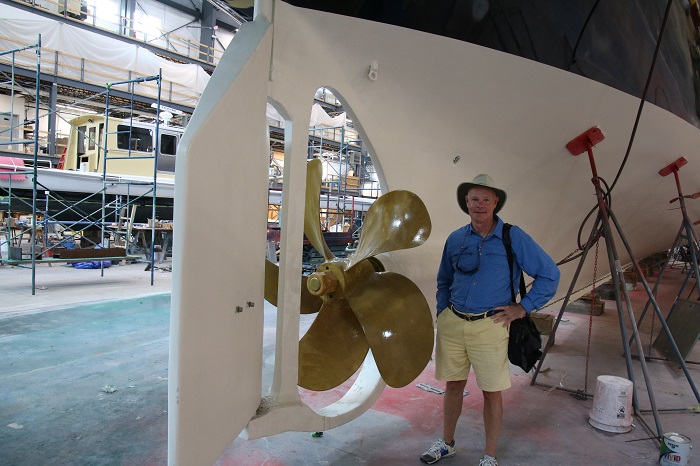
What a magnificent vessel. She still looks like new a decade following her restoration. I so wish that I was able to get a tour inside her. Interestingly, her spotless white bottom is nearly unmarred by thru-hulls. She is as narrow as she is long. Her slow turning prop is huge. Craig gives some sense of scale. Cangarda’s future is now in doubt as Robert McNeil passed away on July 23rd the day after our group saw his boat in Belfast. It will take a very special owner, with really deep pockets, to see what he saw in this remarkable yacht.
Feel like a steam yacht of your very own? Hang around to see if she comes up for sale.
Clearly, Front Street has the knowhow to fix and maintain just about anything. Along with huge lifts and some amazing stuff like huge table saws and all sorts of tools, they have perhaps the coolest machine of all. A CNC pressure water cutter.
It seems that water can actually cut steel. And Front Street has a machine that will smoothly cut through 9″ of stainless steel. Water cutting steel? Who knew? It is an amazing machine and I was lucky enough to see it in action.
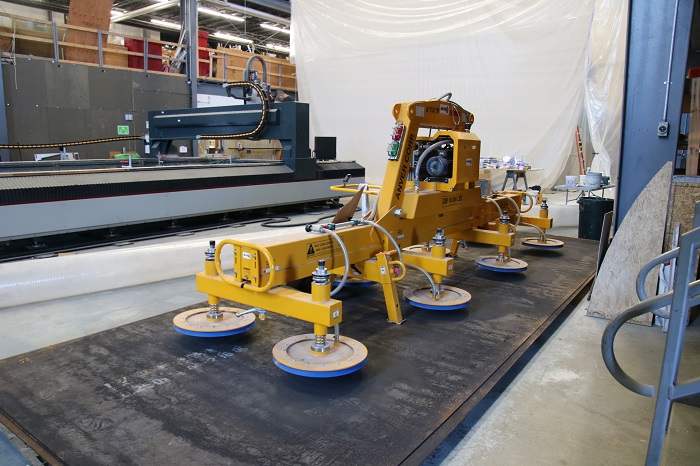
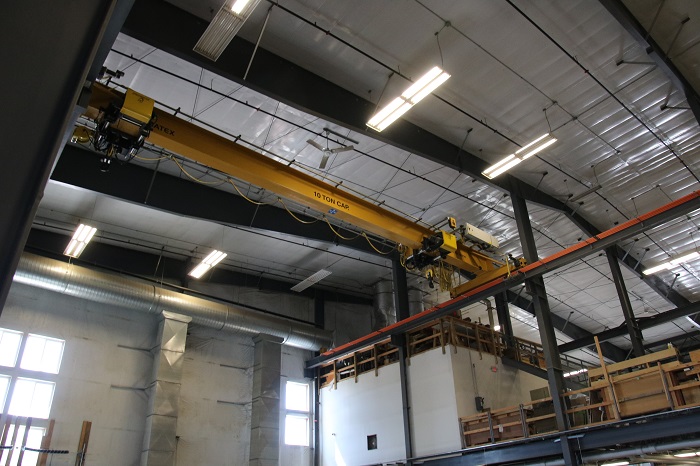
Note the operator on the right for scale. I was told that he is the only guy at Front Street that even knows how to operate it.Back to that tug boat with the gimpy stern plates. It looks like they have some steel near the cutter ready to cut into the exact shape. The yellow machine on top of the pile has suction cups so it can be picked up and deposited in the “pool”. This suction thingy is attached to a 10 ton crane suspended from the celling. Heavy plate steel or not, this would be a delicate operation, I expect. The shape of the final object to be cut is put into a computer so that the cutter head can be programed to move in precise ways and make the cuts.
The unit can do some very intricate cuts and fortunately it was operating when I visited. When everything is ready to go, the operator steps aside. Good move as I expect that a sneaker would a lot easier to cut than 9″ of stainless. That said, steel toed safety shoes. Hmm…
The actual cutting operation doesn’t look like much and is pretty quiet. At the end of the process, the cutting head puts out an impressive burst of vapor, about the only evidence that anything important has actually happened. I can only imagine what it must cost to have them make a “special something” with that machine. It’s so cool I almost want something to break on Pandora. No, never mind but it is awesome. I wonder if I could at least have them make me a paperweight?
I won’t bore you with an endless litany of awesome yachts that they have in their care except to show a few. I was taken by this lovely trawler. She’s actually wood but you have to get really close to see anything wood-like to give that away.She has really lovely lines.And, tied up on the city dock was this beautiful steel trawler. She’s for sale. Ten years later, Main Street is still lovely with beautiful brick buildings lining the way down to the waterfront. There’s something for everyone and even a knitting store and some nice book shops that I am sure will interest Brenda when we rejoin Pandora next week.
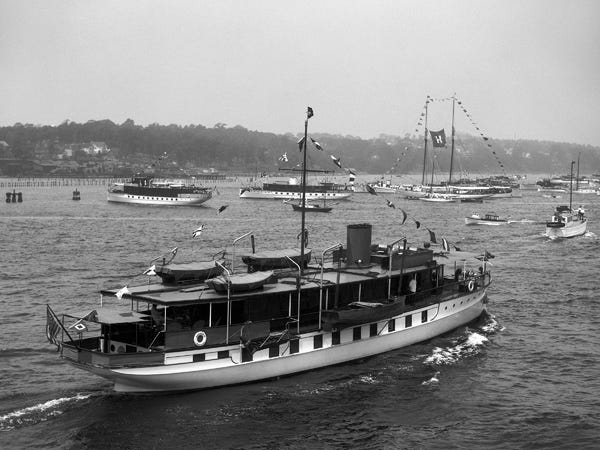
And in the spirit of the Salty Dawg Rally, there is even the Salty Dog Pet Grooming salon. Belfast really does have EVERYTHING!But wait, there’s more and, in particular, the city is currently home to a very special yacht, another legendary vessel, the ex-presidential yacht Sequoia. She too has a remarkable history having served 8 presidents.
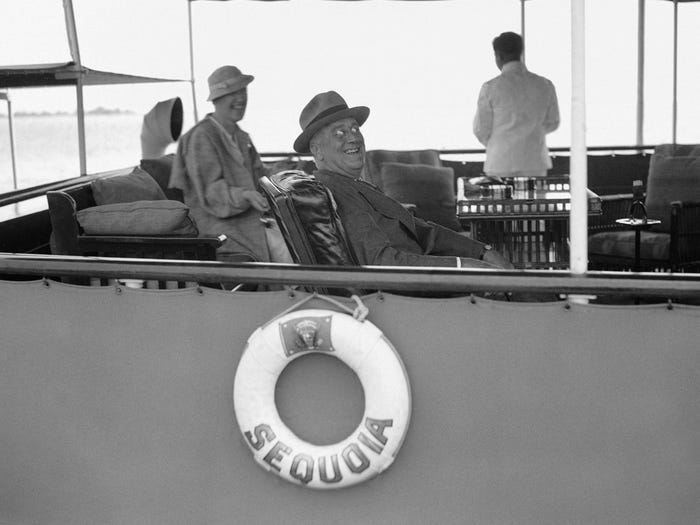
In her glory days.With FDR aboard… It seems he was having a good day. He even had an elevator installed to accommodate his wheel chair. Johnson had it removed when he used the yacht. JFK celebrated what would be his last birthday aboard in 1963. Sequoia was built in 1925, was acquired by the US Government in 1931 and converted for use as the presidential yacht in 1933. She was sold in 1977 as part of an austerity move by Jimmy Carter.
Sadly, Sequoia’s story has been checkered since she was sold passing through some 8 different owners. I recall hearing about her sale by Carter who didn’t see that it was right to spend taxpayers dollars on such a luxury item. In recent years she sat badly neglected in Virginia, nearly her final resting place. This video shows how far she had fallen including becoming a home to a growing family of racoons. After years of legal wrangling, last fall Sequoia was finally loaded aboard a barge for her journey from Virginia to Belfast. She is now housed, under cover, at the French and Webb yard where she is being restored. It’s hard to even tell that this is the once regal Sequoia under her cover.But a view of her distinctive stern clearly gives away her Trumpy heritage. She is now being funded by a group of investors through Equator Capital who’s mission is rescuing and preserving assets that are significant to US history. I guess that would suggest Sequoia is in good hands. While there’s a long way to go, we should be optimistic that Sequoia will sail again. I wonder if they might be interested in Cangarda? No restoration required. Just a thought…
This short video of her moving to her new “home” in Belfast from VA and has some impressive moments, especially as she is towed past the Statue of Liberty. Well, I guess that’s about enough for now. Belfast, a place worth visiting and if stuff breaks along the way, and it will as IT’s A BOAT after all, I know just where you can have her fixed.
Having your boat worked on in Belfast, perhaps at Front Street Shipyard, would make sense as it’s already the sometime home of some really amazing boats.
Heck, maybe they will even use their totally cool water cutting machine to make some parts for you. If they do, I’ll bet that they would let you watch.
And as they say, “if you have to say How Much, you can’t afford it.”
Well, it’s over. After months of preparation and my moving from “sure, I’ll do the Down East Rally” to becoming Rally Director and all the details that that position suggests. Months of preparation and endless discussions with local businesses as I tried to find a way to arrange events at a time when the virus was raging and nobody was comfortable in committing to anything. When I was doing all of the planning, the vaccine wasn’t even available and every social interaction was viewed as far to risky to even consider. In spite of my assurance to everyone that any plans we made were tentative it wasn’t until literally days into the rally, that many of the events finally came together.
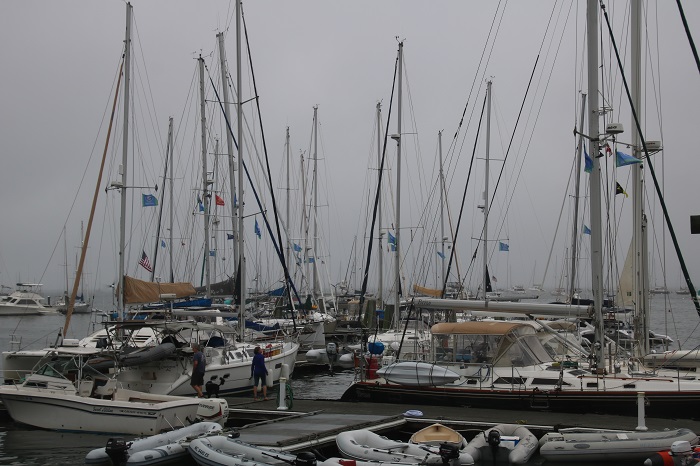
For months I had worked closely with Ryan the harbor master in Rockland on the idea of applying to the Harbor Commission and City Council to consider our arrival in Rockland as an “event” verses a marina visit. This seemingly minor distinction changed things a lot and allowed us to cram 22 boats on the city docks at a rate of approximately $100 per boat, regardless of size, for the full three days. I doubt that the city had ever seen that many boats packed into one place and they were shocked when they realized that our average boat was nearly 50′ long. As a result of our being able to be viewed as an “event” the rate to dock was reduced substantially from $2.50/ft/day to less than the cost of a mooring.
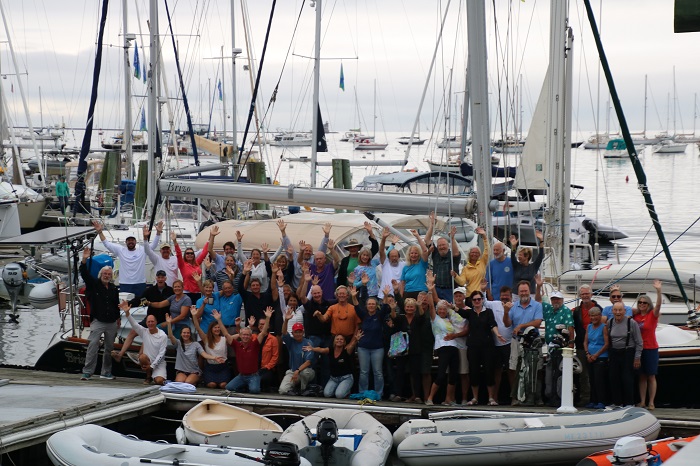
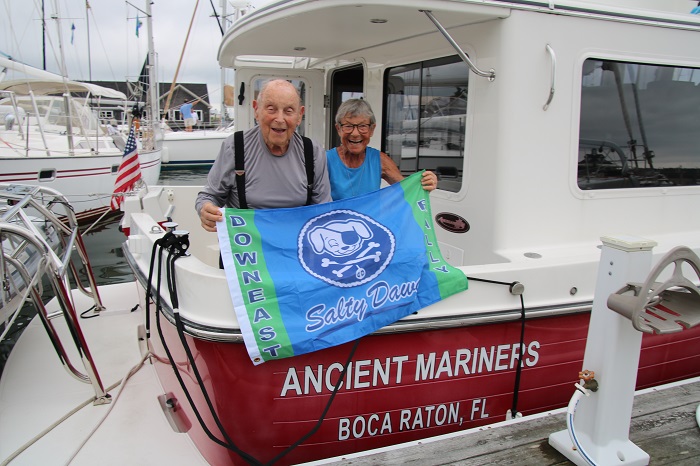
The view of the full docks was impressive and this view only captures about half of the fleet. All of the captains and crew were thrilled as you can see from this group shot. To see so many enjoying the result of the work that went into the rally by so many was very rewarding. Note the couple on the far right, front row. That’s Ruth and Herb of MV Ancient Mariners who visited us to join in the fun. They were not a part of the rally but made a point of coming to Rockland to be with us. Here they are together on their boat aptly named Ancient Mariners. Ruth is the “younger woman” at 95 and Herb is a very impressive 102. To be out and about in Maine aboard their boat is a testament to the importance of staying active and I expect good genes helped as well. Lucky them.
By the power (sort of) invested in me as a board member of SDSA and Rally Director, I gave them a rally flag and declared them “honorary Salty Dawgs”. When my friend George of SV Peace and Plenty, and I were doing our events in Essex a few years back, Ruth and Herb, both VERY long term cruisers, showed up aboard their boat to the delight of everyone. And here they are, years later, still going strong.
These days they keep their boat in Maine year round and winter at their home in Boca Raton, FL. Good for them. And good for us to have them with the fleet in Rockland where they had booked space for several weeks. Craig and I had a lovely visit aboard their boat for a glass of wine. Sadly, we had to cut our visit short as “duty called” and we had to rush off to yet another event.
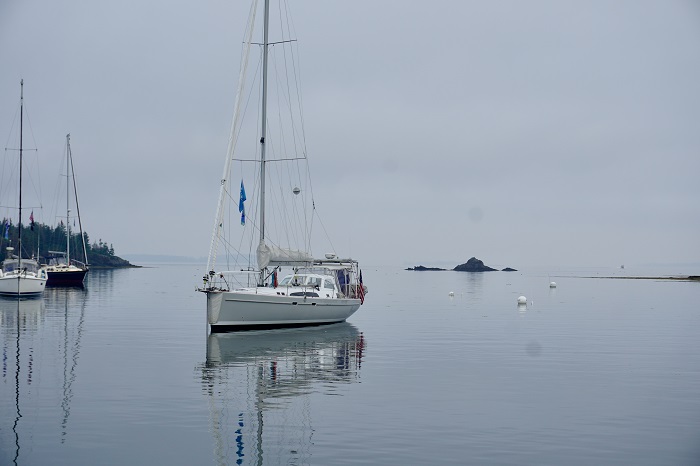
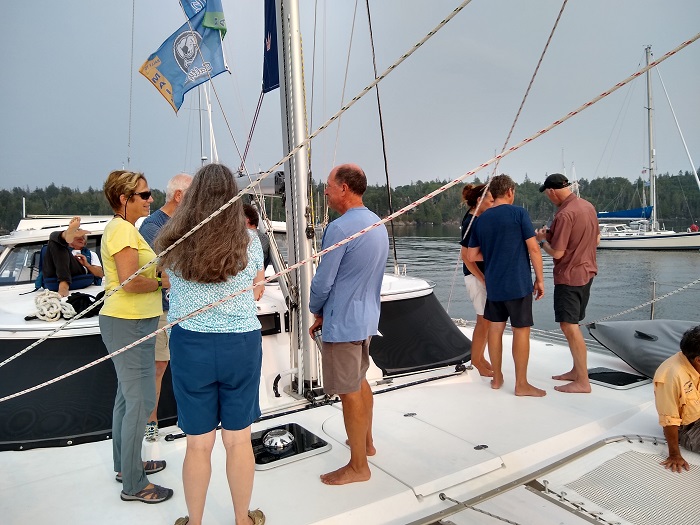
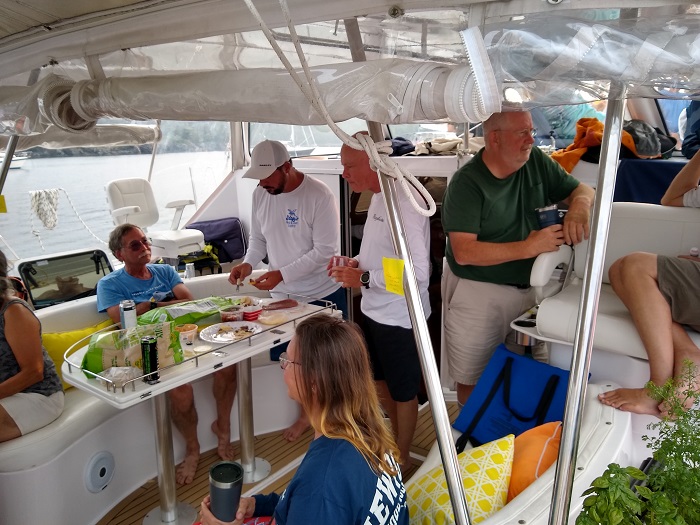
After three days on the docks in Rockland and lots of fun, the fleet headed to nearby Pulpit Harbor, a favorite of mine. It was nice to see the fleet filling the harbor. At least a few of the locals, seeing their harbor jammed with boats, must have wondered who we were. One of the other captains took this lovely shot of Pandora with the harbor’s namesake, the Pulpit, in the distance. That evening one couple on the trip opened up their boat for a cocktail party. No wonder cruising cats have become so popular. Loads of room up on the bow. And in the cockpit. I was told that there were 35 aboard. And it wasn’t all that crowded. From there we headed to Buck’s Harbor and the marina run by John Buck (no relation) and his wife Jessica along with their three children. John, it seems, purchased the marina so he could have his family in Maine for the summers. In his “real life” he owns a successful medical supply company. Nicely done John.
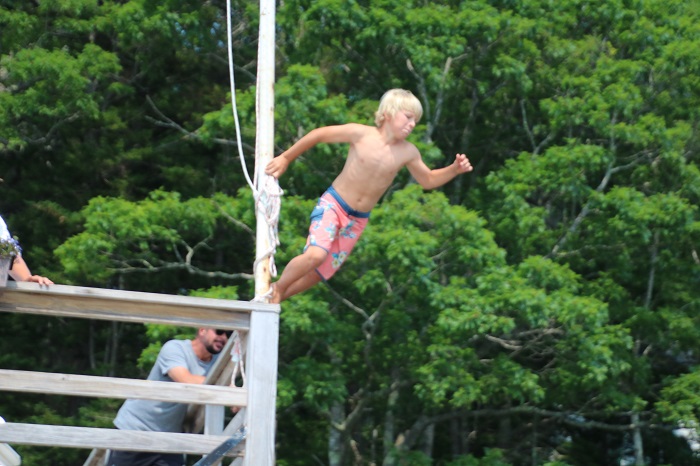
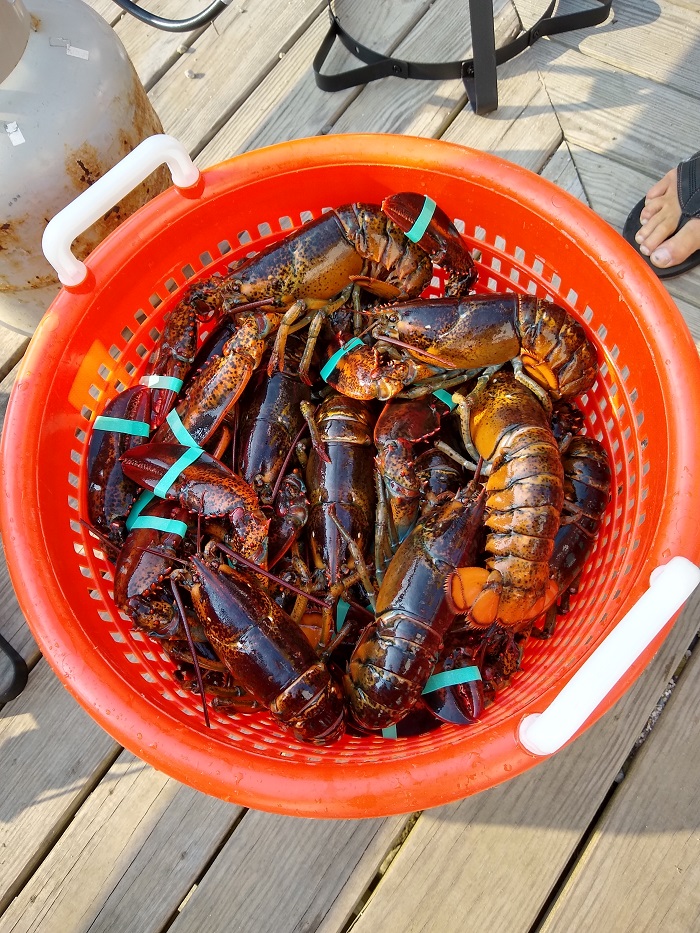
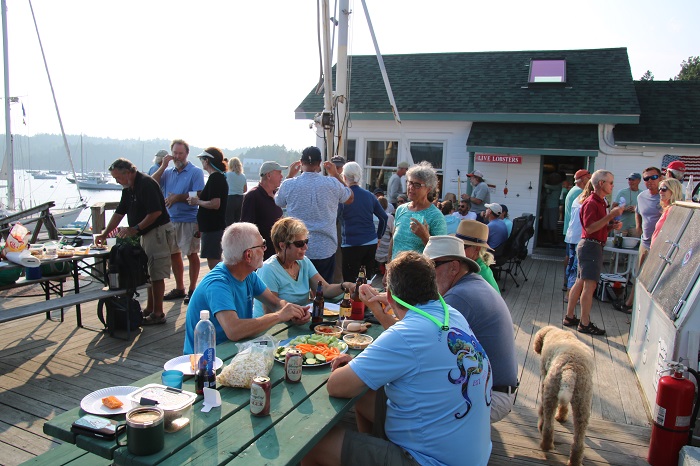
Their children seem to be pretty happy to be there with the older ones helping out in the marina and the youngest having a grand old time, repeatedly jumping into the water, unconcerned about the cold waters. At the marina we had a “DYI lobster boil”. John “boiled” and everyone brought along their own potatoes, corn and whatever else they wanted to include.
I had mentioned to the fleet that they should visit Hamilton Marine in Rockland and purchase bait bags to cook their potatoes and corn in. I later learned that once the fleet descended on Hamilton the manager quickly set up a display of bibs, towels, crackers and of course bait bags. It’s nice to know that the local merchants noticed an uptick in business with the Dawgs in town.
Lobsters are selling at an all time high this summer and yet, John offered them at a very reasonable price of $18 so everyone was able to get a generous 1.5lb lobster, cooked and ready to eat. Interestingly, John carefully removed all of the rubber bands, before cooking them, declaring that if you left them on they would leach into the water and give the lobsters a funny taste. Also, he recommends steaming them but not submerging them into boiling water. Who knew? The group seemed to have a great time. When the heavens opened up with a late evening cloudburst, everyone just strolled into the office until things let up. If you ever have an opportunity to visit Buck’s Harbor, do it. It’s a wonderful spot. However, be prepared to live a bit more “off the grid” as the cell reception is very weak. Actually, that’s probably a good thing given our obsession with being connected all the time, present company included. Oh yeah, they have outdoor showers. I generally shower aboard Pandora but could not resist doing so in the great outdoors with a view of the harbor. It was in the high 50s and I can say that the experience of being out in the chilly air and under a steaming shower was singular. After Buck’s we all headed to Belfast for a final event, a tour of Front Street Shipyard followed by a happy hour on their deck overlooking the harbor.
The Shipyard is a very impressive spot and while there’s lots to tell, I think that I will stop here and reserve all that for my next post in a few days. It’s sufficient to say that the Shipyard and all of the huge yachts that they service was an amazing spot. Perhaps I’ll tease you with this. They have a machine that using nothing but high pressure water, can cut through 9″ of stainless steel.
I saw that in action. Amazing and that was only one stop along the way.
Being in Maine again was such a treat and I can’t wait to head back up with Brenda, Chris and Melody in a few weeks for some more cruising.
Wow, that’s about all I can say about the experience of being in Maine again and it was great fun to do the rally with so many others that were as enthusiastic about being there as I was. I can’t wait to go back.
With the Down East Rally history, I can now turn my attention to the Salty Dawg Rally to Antigua. No rest for the weary…



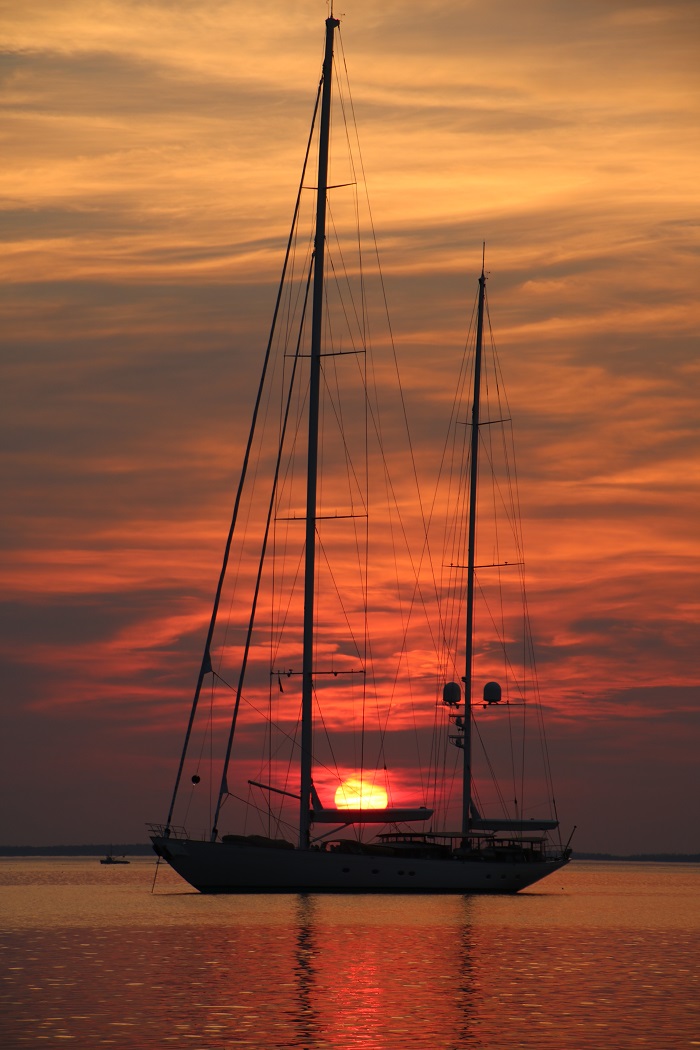 Those of you that sleep late miss moments like this. And, speaking of memorable sunrises, when we were in Castine, before hurricane Henri passed up the east coast. The currents are swift in the river there and the sunrise made for a beautiful moment with the current pulling hard on a channel marker.
 Castine is the home of the Maine Maritime Academy and it was fun to see the cadets out marching through town. Lots of “hup, hup” stuff going on and plenty of loud chants by the officers, dutifully repeated by the cadets.
  They also were out for training on their lifeboats, learning to row in perfect time. Back and forth across the river they went with the bosun keeping time.
  Their “boat”, the State of Maine was in town. At one point the cadets filed one at a time up the gangway to board the ship. It was unclear to me if that’s where they live or if there are dorms.
 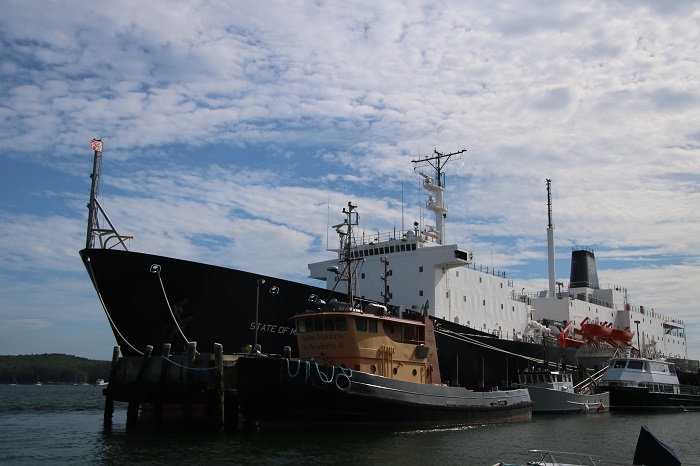 Castine is a charming little town with loads of history.
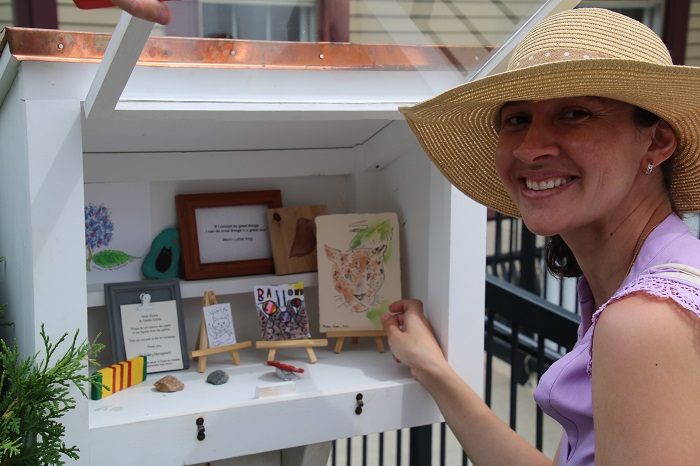
 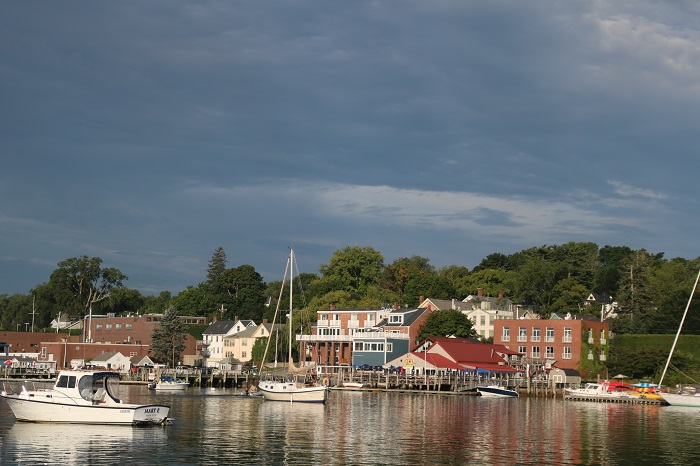 There are a number of very nice independent book stores, something that seems to be fairly thriving in the small towns in Maine. Perhaps their trade is driven by tourists that want to curl up with a good book when it’s foggy, cold and rainy. Melody, an artist herself, saw a tiny kiosk mounted on a sidewalk post outside of one shop where artists can swap out their work. Put in a piece of art and take one. I love the idea. Perhaps we need one in our home town.
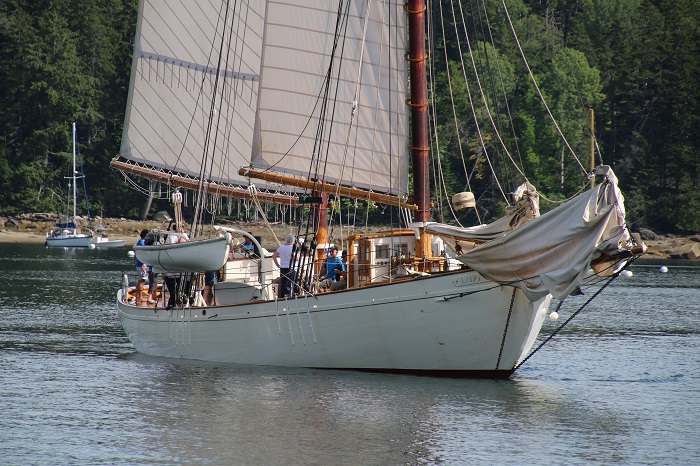
  We also spent time in Buck’s Harbor where we had a lobster bake. I wanted Chris and Melody to experience eating lobster outside on a picnic table overlooking a quintessential Maine harbor. While we were there a schooner full of vacationers pulled in and dropped her hook. There are many schooners in Maine that take out vacationers for week long cruises, stopping in one quaint spot after the next.
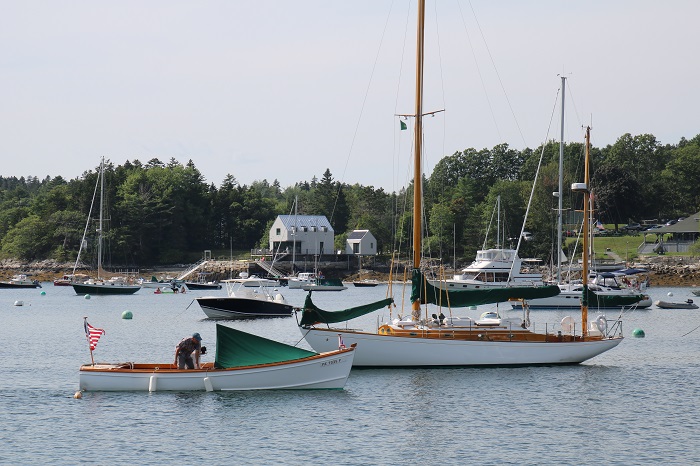
  Buck’s is home to a beautifully maintained Concordia yawl, a well regarded design coveted by those that love wooden classics. Her owner also has a Pulsifer Hampton, another charming design. I’ve never seen two of them together and with matching canvas, no less.
  From Buck’s we headed back up to Castine to wait out the hurricane. Fortunately, it turned out to be a non-event and we never saw winds much more than a brief period in the high teens. There were many boats in the harbor tucked down near shore including the 1030s vintage Ranger, one of a number of restored America’s Cup boats making the rounds of the classic racing regattas. She is an impressive sight and huge at over 130′ long.
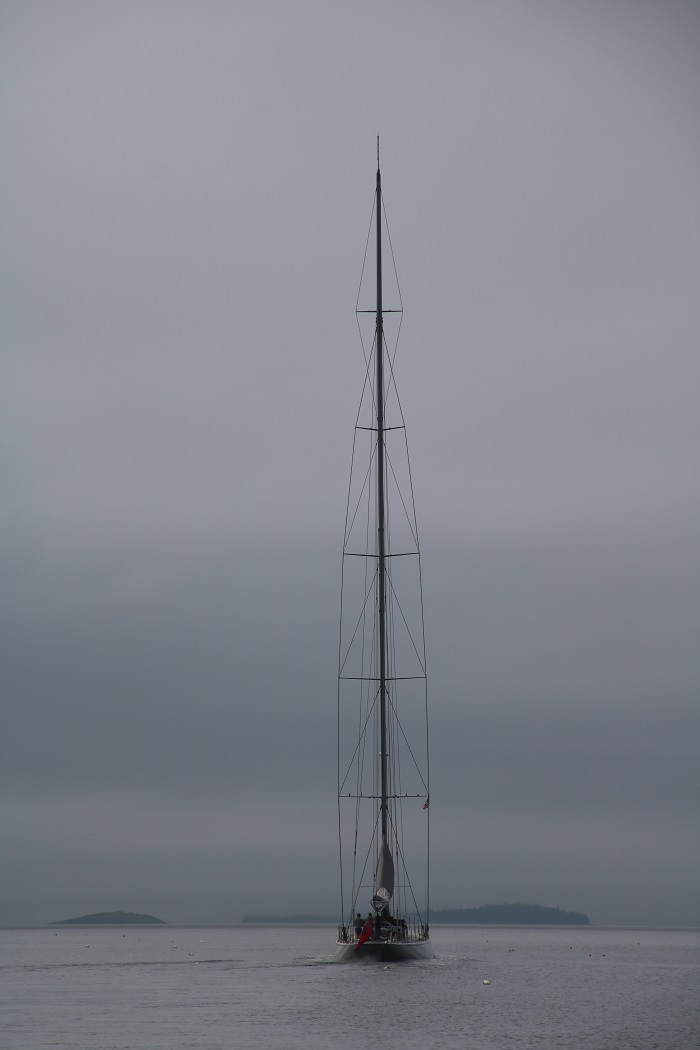
 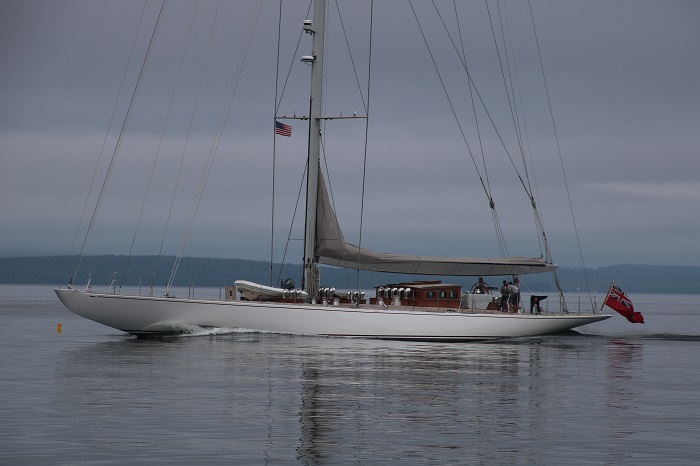 She draws more than a dozen feet, which she needs to, in order to balance her impossibly tall mast.
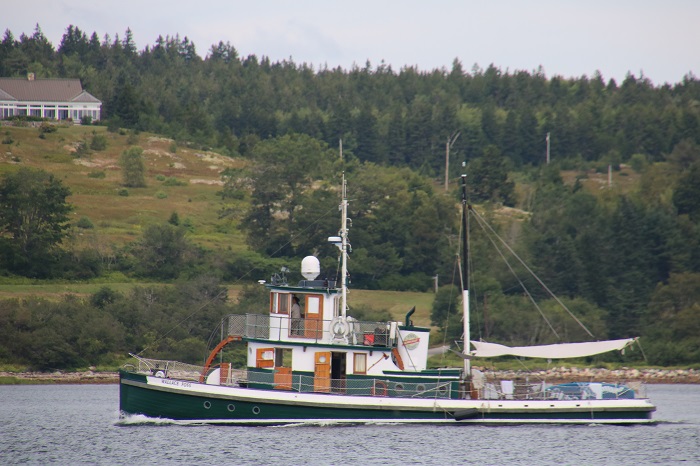
  I was taken by this tug boat converted into a yacht. I don’t know anything about her but our paths have crossed a number of times this season.
  It’s not always sunny and to see a schooner drifting by in the fog is an impressive and ageless sight.
 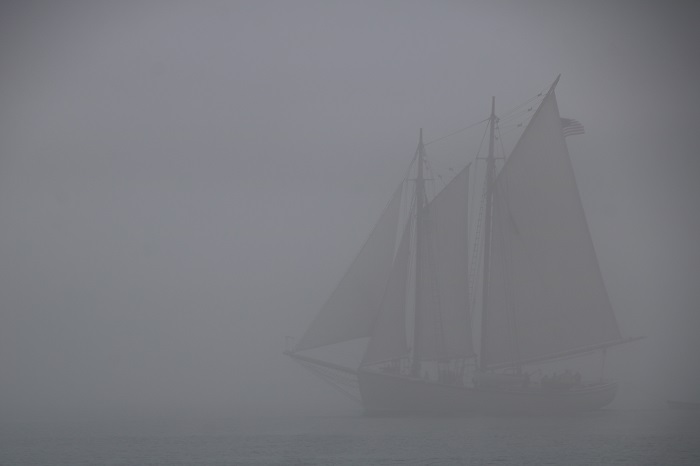 Sun, threats of hurricanes, fog, rain, the weather is always changing in Maine and is one of the reasons that I love being here.
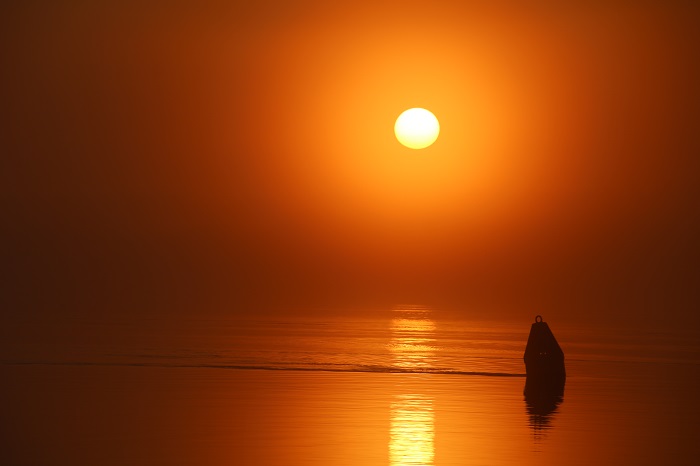 Castine is a wonderful place but that will have to wait on that point as I have scintillating news in the life of the giant rubber ducky Joy.
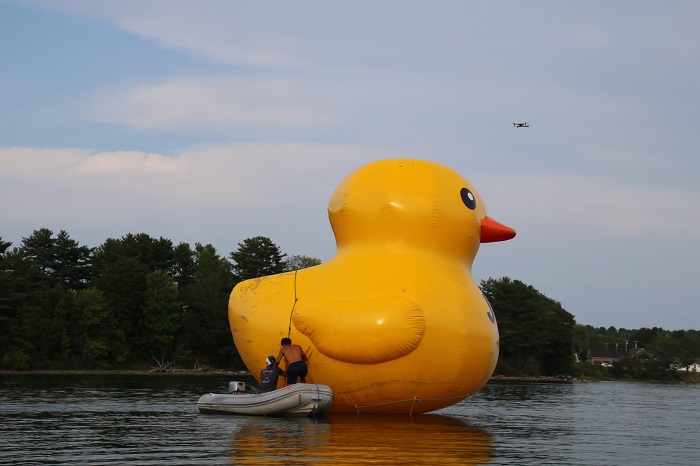 The would-be climbers had things pretty well thought out, I guess, and they proceeded to string a rope over her back so they had something to hold onto. As everyone knows, rubber duckies are notoriously slippery. To keep her from rolling over, one guy got into the water (very cold water) to balance things out.
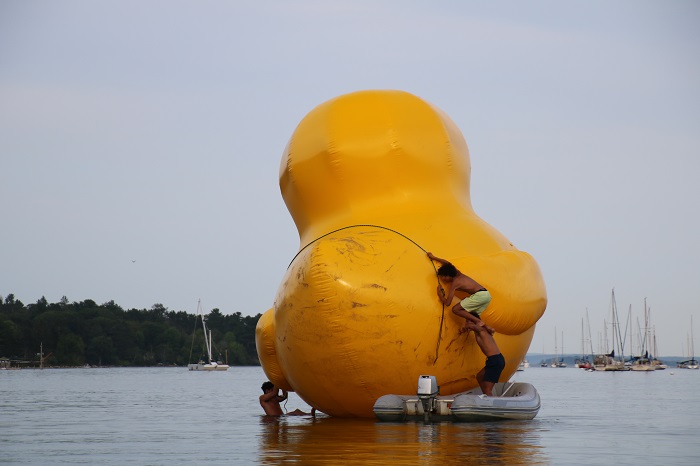 OMG! Up he went…
 What would you do when you finally summit a giant rubber ducky? What anyone would do. Strike a pose!
 And how do you top that? Jump off, of course, and be quick about it as, as their friend in the water was probably about to succumb to hypothermia.
  The three of them were pretty proud of their feat and willingly posed for a photo.
  I wonder how they chose who would would be the climber? The one to conquer the biggest rubber duckie in Maine?
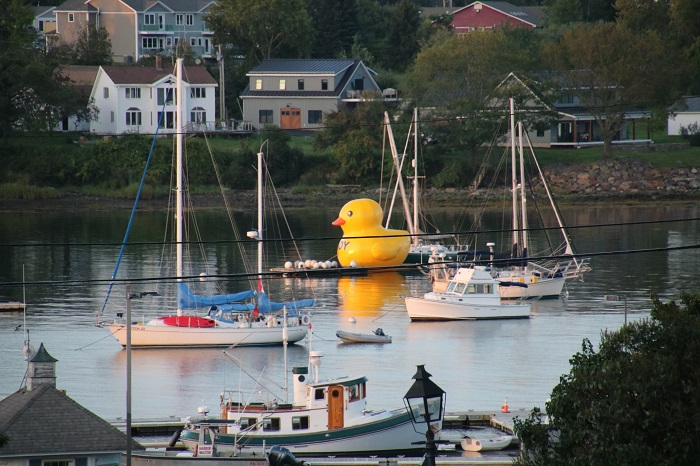 It seems that she recently made her mysterious appearance at the head of the harbor, where we are, and then drifted down and tangled with some of the moored boats.
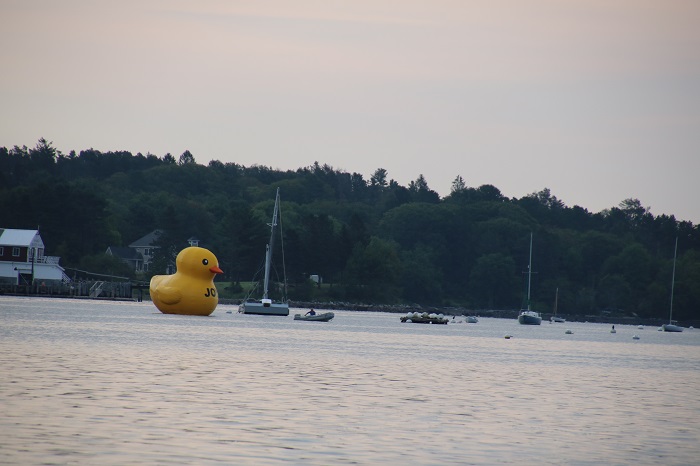 In spite of the fact that Joy has been moving around, it turns out that she has not one but two moorings to keep her in position. They proved too heavy for me to hoist into the dink so I suspended both of them below the dink as best I could to prepare for Joy’s voyage.
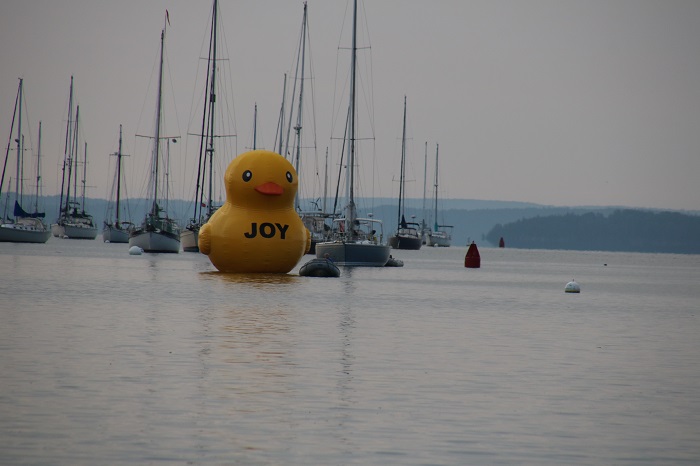 The going was slow, as I did not want to alarm her.
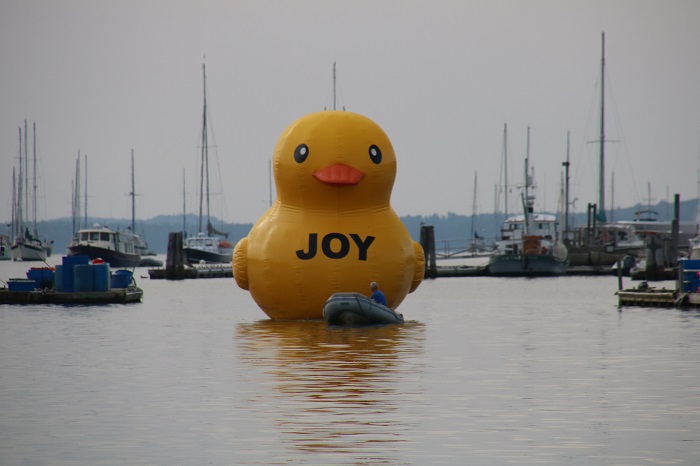 A dink named Hope? Remember the story of Pandora’s box? When Pandora opened the box and all the evils went out into the world? Well, after that, she looked into the box and all that was left was Hope.
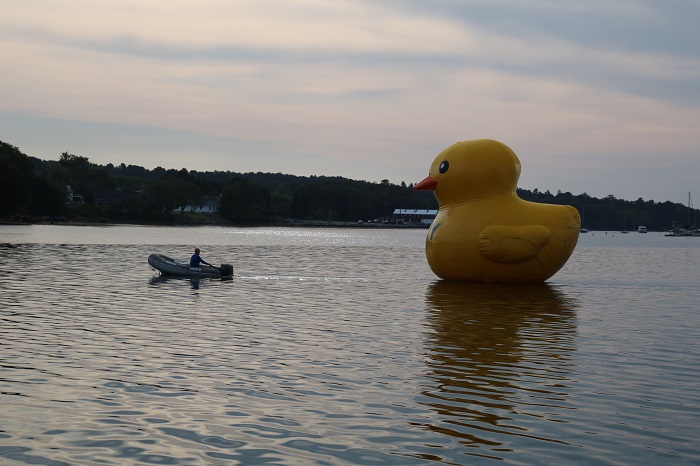 As she arrives at her new home, Joy continues to pursue Hope as we all do.
 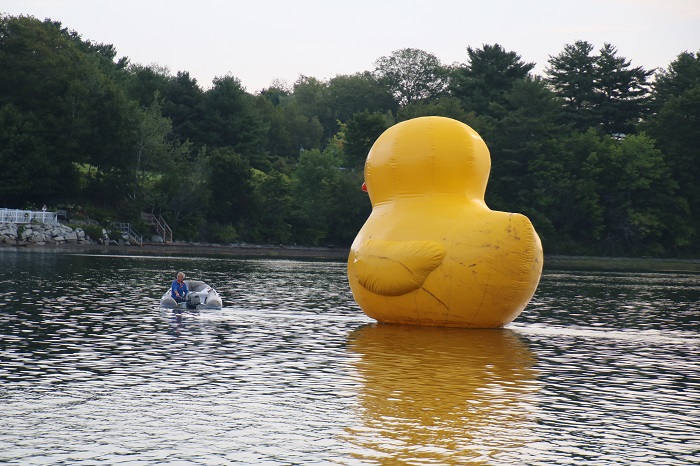 So, Joy is now among us, as it should be.
 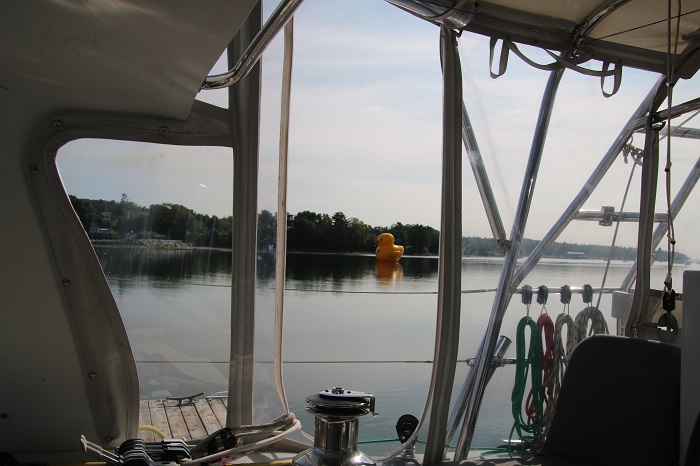 Guarding over us in the “hope” that we will enjoy Maine.
 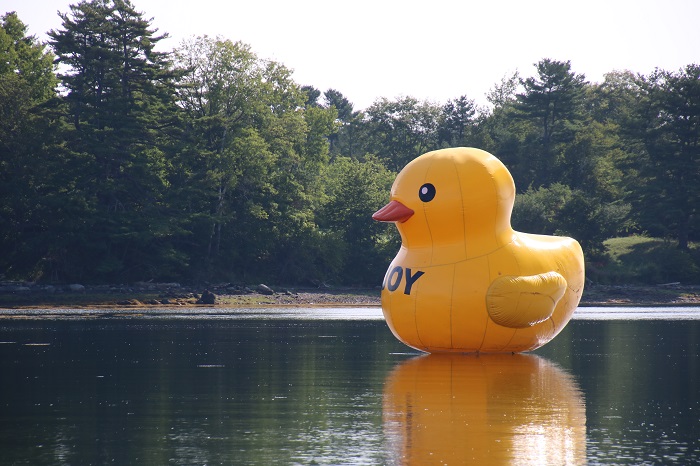 It’s a beautiful day here in May and I am happy that I was able to bring a bit of Joy, no, she’s HUGE so she’s brought a LOT of Joy into our lives.
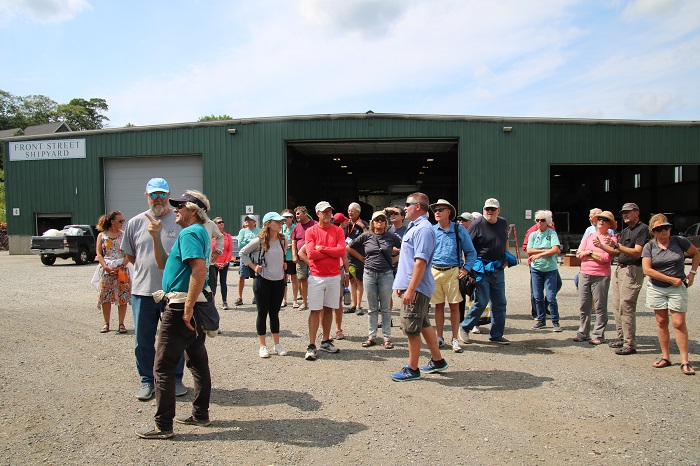 The yard’s largest lift can handle nearly one million pounds. It is one of the largest on the East Coast with 16 wheels.
  It had better be strong to pick up this tug. Her props are huge, about 8′ in diameter. Each of them can rotate 180 degrees so she can move in any direction and is steered with a joy stick, not a wheel. We were told that she had failed a recent survey and needed to have her stern re-plated. Hold that thought about how they fabricate the plates for a moment.
 Big is the theme at the Shipyard. The door to one of the buildings and they are all plenty big, is over 80′ tall.
 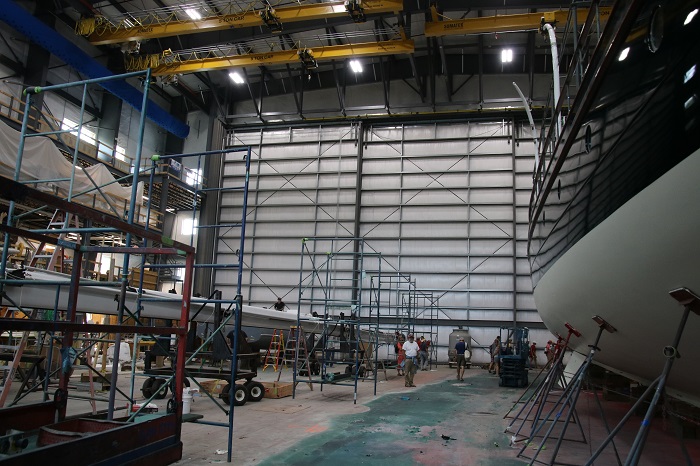 That door is tall enough and the shed big enough, to fit this 126′ steam yacht with room to spare.
 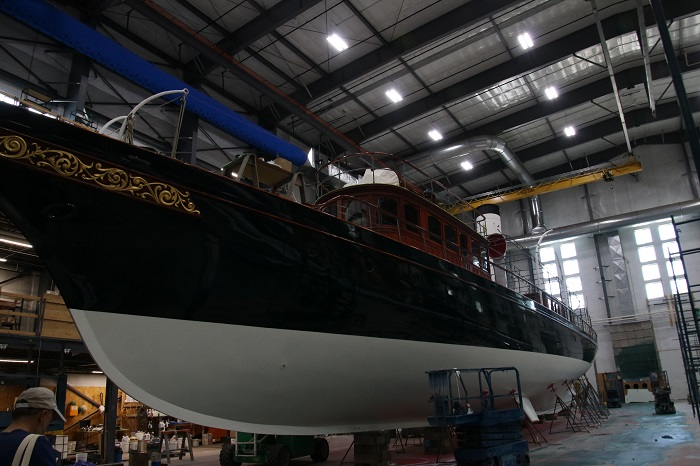 She is
 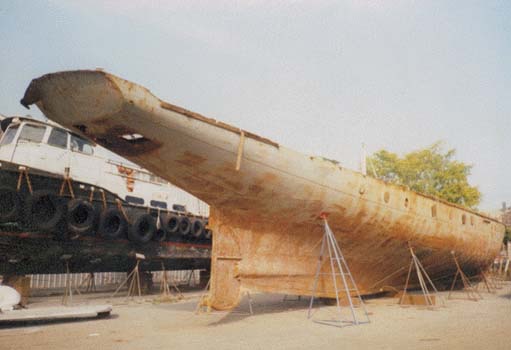 It’s hard to imagine all that went into such a detailed restoration when you consider what they had to work with. Most of the materials in the boat are new now.
  However, she still has her original steam engines that were shipped to Europe to be completely rebuilt. Really impressive work.
  While she is still true to her heritage as a lone survivor from the Victorian age, having hosted many world famous dignitaries, she is modern in ways that count with stabilizers and touch screen displays for her complex systems.
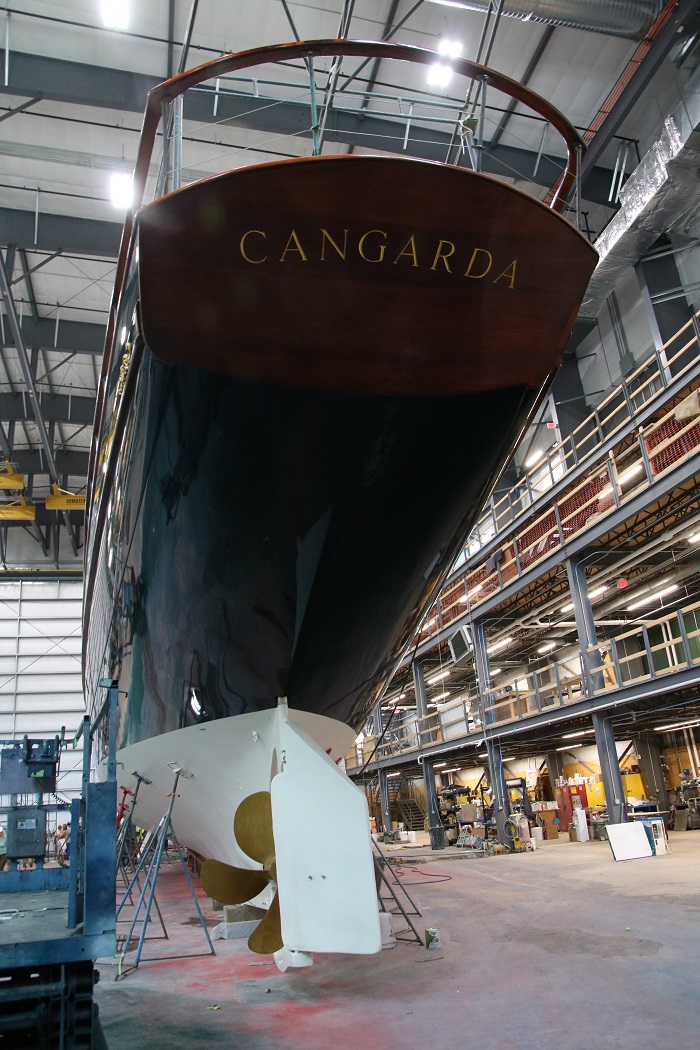 Her slow turning prop is huge. Craig gives some sense of scale.
  Cangarda’s future is now in doubt as
 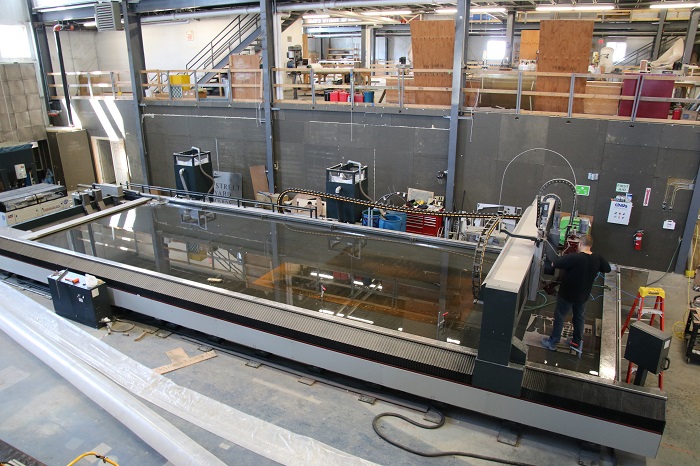 Back to that tug boat with the gimpy stern plates. It looks like they have some steel near the cutter ready to cut into the exact shape. The yellow machine on top of the pile has suction cups so it can be picked up and deposited in the “pool”.
  This suction thingy is attached to a 10 ton crane suspended from the celling. Heavy plate steel or not, this would be a delicate operation, I expect.
  The shape of the final object to be cut is put into a computer so that the cutter head can be programed to move in precise ways and make the cuts.
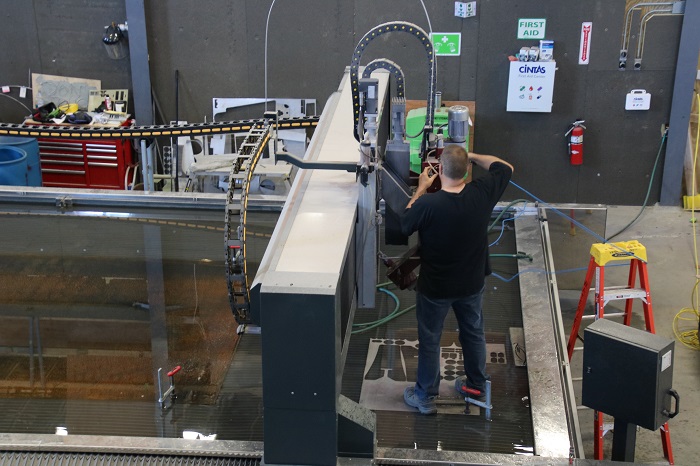 When everything is ready to go, the operator steps aside. Good move as I expect that a sneaker would a lot easier to cut than 9″ of stainless. That said, steel toed safety shoes. Hmm…
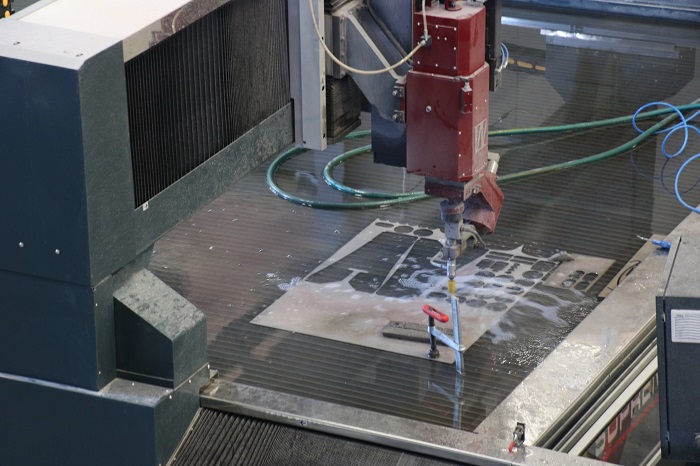 At the end of the process, the cutting head puts out an impressive burst of vapor, about the only evidence that anything important has actually happened.
 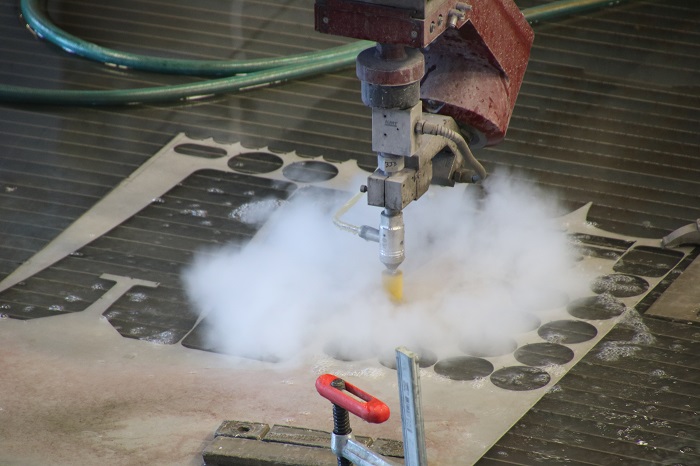 I can only imagine what it must cost to have them make a “special something” with that machine. It’s so cool I almost want something to break on Pandora. No, never mind but it is awesome. I wonder if I could at least have them make me a paperweight?
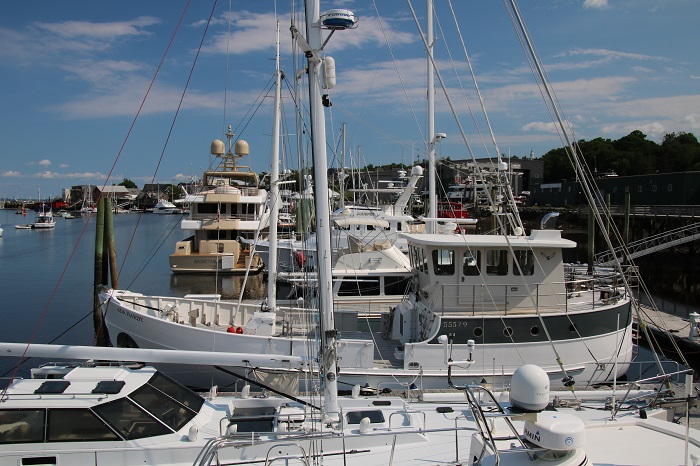 She has really lovely lines.
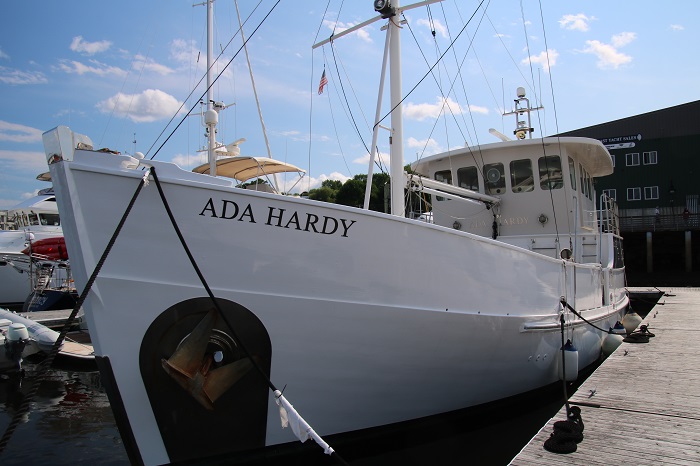 And, tied up on the city dock was this beautiful steel trawler. She’s for sale.
 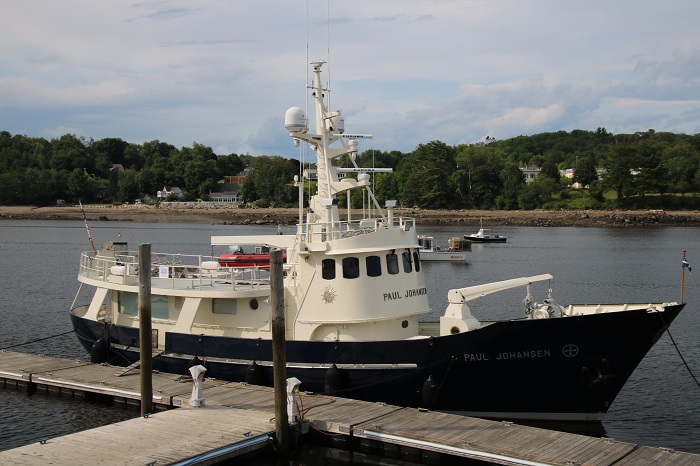 Ten years later, Main Street is still lovely with beautiful brick buildings lining the way down to the waterfront.
 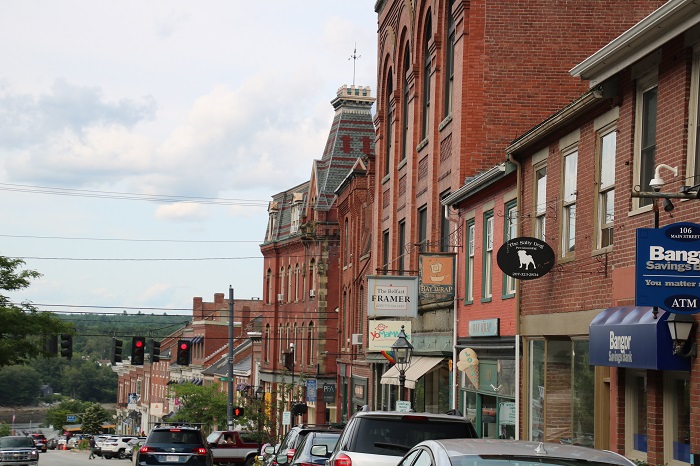 There’s something for everyone and even a knitting store and some nice book shops that I am sure will interest Brenda when we rejoin Pandora next week.
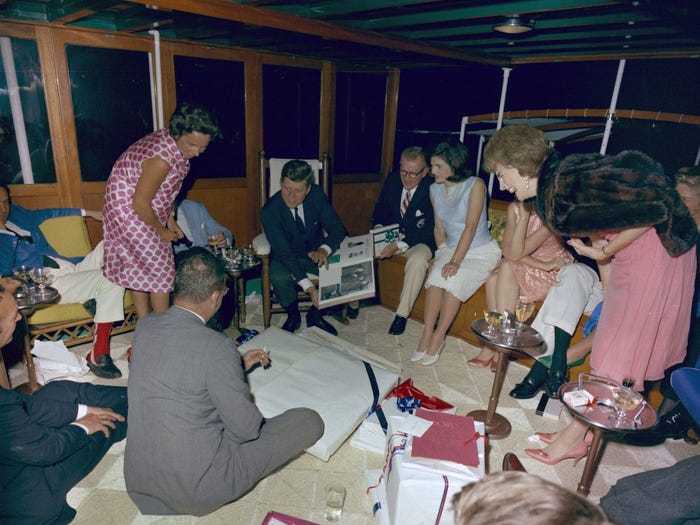 Sequoia was built in 1925, was acquired by the US Government in 1931 and converted for use as the presidential yacht in 1933. She was sold in 1977 as part of an austerity move by Jimmy Carter.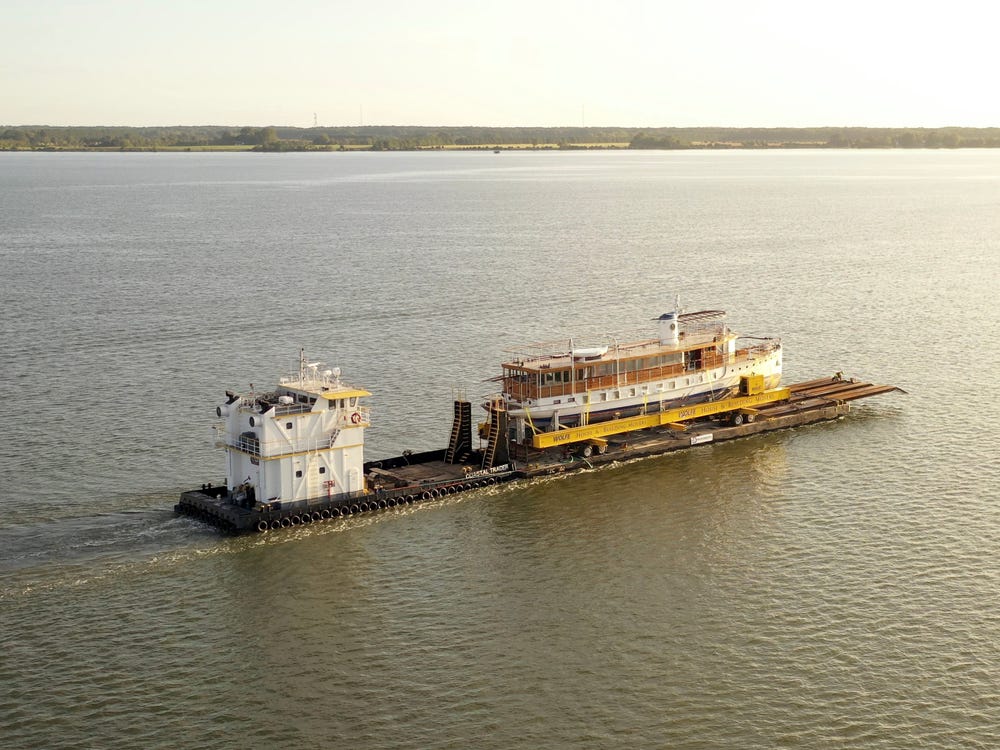
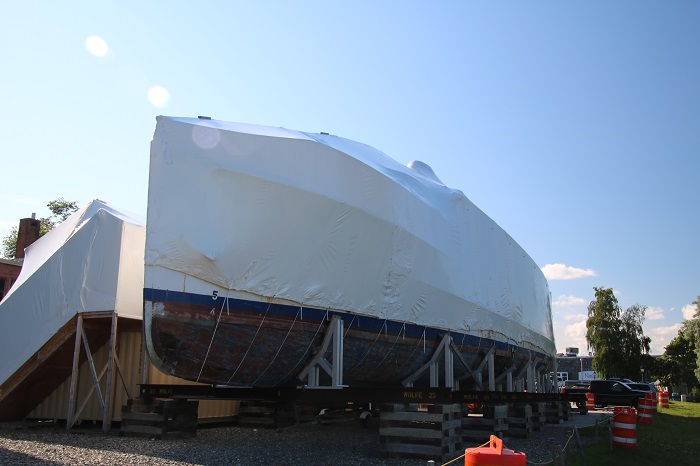 But a view of her distinctive stern clearly gives away her Trumpy heritage.
 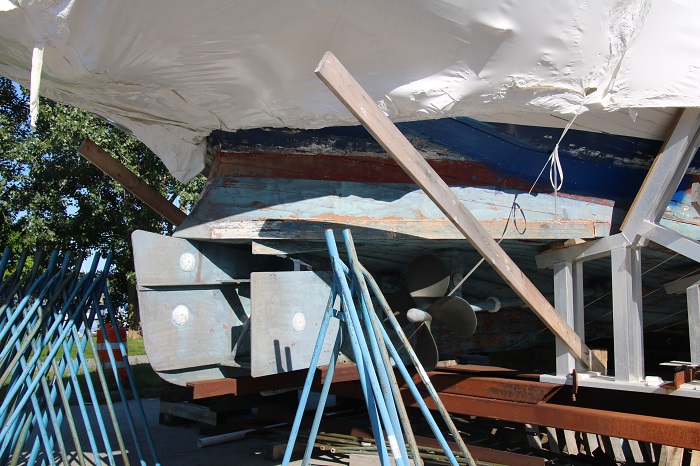 She is now being funded by a group of investors through
  All of the captains and crew were thrilled as you can see from this group shot. To see so many enjoying the result of the work that went into the rally by so many was very rewarding. Note the couple on the far right, front row. That’s Ruth and Herb of MV Ancient Mariners who visited us to join in the fun. They were not a part of the rally but made a point of coming to Rockland to be with us.
  Here they are together on their boat aptly named Ancient Mariners. Ruth is the “younger woman” at 95 and Herb is a very impressive 102. To be out and about in Maine aboard their boat is a testament to the importance of staying active and I expect good genes helped as well. Lucky them.
 When my friend George of SV Peace and Plenty, and I were doing our events in Essex a few years back, Ruth and Herb, both VERY long term cruisers, showed up aboard their boat to the delight of everyone. And here they are, years later, still going strong.
 That evening one couple on the trip opened up their boat for a cocktail party. No wonder cruising cats have become so popular. Loads of room up on the bow.
  And in the cockpit. I was told that there were 35 aboard. And it wasn’t all that crowded.
  From there we headed to Buck’s Harbor and the marina run by John Buck (no relation) and his wife Jessica along with their three children. John, it seems, purchased the marina so he could have his family in Maine for the summers. In his “real life” he owns a successful medical supply company. Nicely done John.
 At the marina we had a “DYI lobster boil”. John “boiled” and everyone brought along their own potatoes, corn and whatever else they wanted to include.
 The group seemed to have a great time.
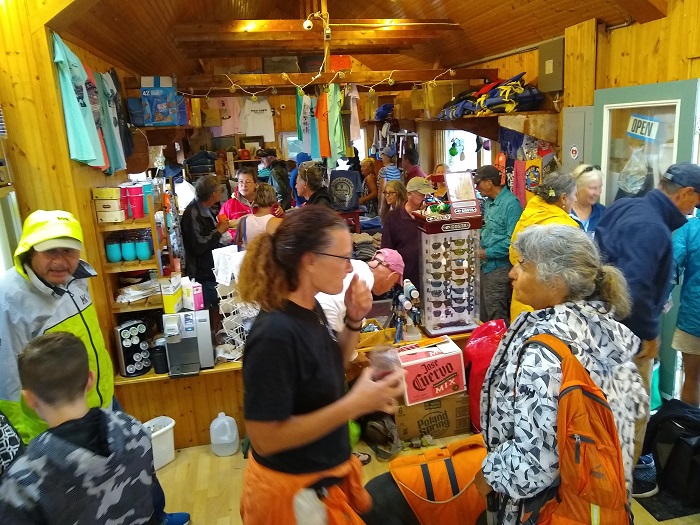
  When the heavens opened up with a late evening cloudburst, everyone just strolled into the office until things let up.
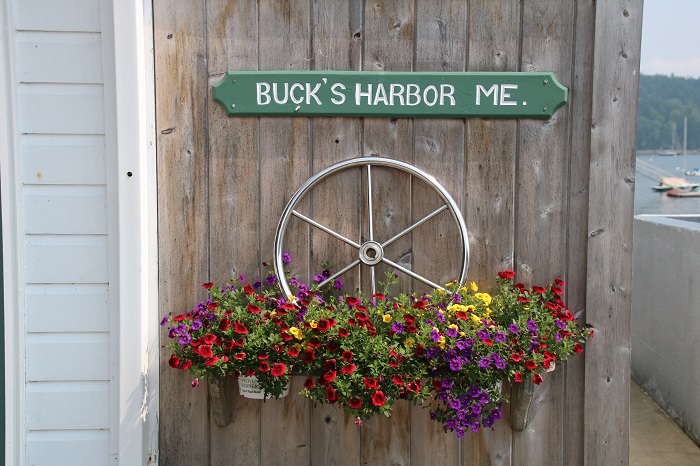
  If you ever have an opportunity to visit Buck’s Harbor, do it. It’s a wonderful spot. However, be prepared to live a bit more “off the grid” as the cell reception is very weak. Actually, that’s probably a good thing given our obsession with being connected all the time, present company included. Oh yeah, they have outdoor showers. I generally shower aboard Pandora but could not resist doing so in the great outdoors with a view of the harbor. It was in the high 50s and I can say that the experience of being out in the chilly air and under a steaming shower was singular.
  After Buck’s we all headed to Belfast for a final event, a tour of Front Street Shipyard followed by a happy hour on their deck overlooking the harbor.