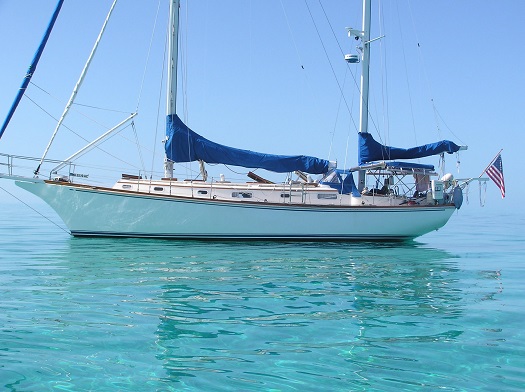
Sail Pandora

After 25,000 miles…

It’s hard to believe that I head to Trinidad in about two weeks, October 25th to be exact, to prepare Pandora for the run north to Antigua and the arrival of the Salty Dawg rally fleet.

Soon many will be following the track of the fleet as they depart from Hampton, VA and Newport RI with most heading to Antigua, where I will be joining them. The link doesn’t look like much now but it will be updated as we get closer to departure.

It seems like just yesterday, May actually, that I arrived in Trinidad with Pandora, a place that I had never visited, to leave Pandora for a major refit. To commit to such a big job, over 2,000 miles from home was quite a leap of faith for me. I was full of questions. Could I be confident that work was being done at all? Would It be done properly? How would I know what was going on from so far away?

Given the scope of the work, I realized that there was no way that I could afford to have it done in the US where labor rates are so high so I had to take her to Trinidad as the only realistic option. With the recommendation of a number of friends, I settled on a vendor last summer and agreed to the scope of work and costs even before I headed to Trinidad. Happily, there have been no major surprises and the job has progressed according to plan.

Amos, of Perfect Finish, who is overseeing the work, has been keeping me informed every step of the way, sending over 100 photos as the job progressed and has also been giving me near weekly video tours of the work on WhatsApp. In spite of the distance, I actually feel better about the communication than I have felt on jobs done in the US over the years.

Amos has a crew of nine that work on his jobs with him and I understand that this season he was fully booked with three major jobs and lots of little projects when he began work on Pandora. These are three of his crew plus Amos on the left. Four of his crew worked on Pandora nearly every day from mid May to August with every detail chronicled in photos and videos sent to me. I detailed much of the work in excruciating detail in past posts if you are curious.

The bulk of the work is now complete and they are now putting things back together again.

The four tempered glass windows in the hard dodger going back in.

Now that things are nearly completed, my only regret is that I did not leave Pandora there in past years as that would have saved a lot of wear and tear on me and the boat as I slogged thousands of miles north and south, time and time again.

As I get ready to head back to Trinidad, I am also reflecting on my soon-to-change role as president of The Salty Dawg Sailing Association (SDSA). My time has been nearly fully consumed by my role of president, as well as, Rally Director and Port Officer for Antigua.

And, busy I have been…

We have a huge number of boats in the rally this year with over 110 heading south in early November. And more than 25 of those needed a lot of extra handholding for the last few months as they aren’t all that experienced. In those cases, I spent hours on the phone with skippers answering questions and helping them navigate all of the details needed to prepare for what would be, for most, their longest run to date.

I advised them, along with support of others in Salty Dawg, on changes to make to their boats, how to evaluate crew, and in a number of cases, required them to do one or more “qualifying passages” so that they would get more overnight experience before they headed offshore with the rally.

And, timing offshore is always an issue and to “practice” during the mild summer months is a good way to prepare for the more challenging weather of late fall.

As the Bahamas is only about half of the 1,500 mile distance to Antigua, I nudged some to head there until they had more experience to make the longer run to Antigua. This advice was generally willingly accepted, perhaps because I often added that “I did not want their first run to be their last…”

Getting a boat set up for a long run, equipment upgrades and arranging for qualified crew, is no simple task and Salty Dawg prides ourselves in helping skippers find their way.

It is very rewarding to have skippers so appreciative of the advice and nearly all that I talked to were very willing to do whatever is needed to prepare for a safe voyage.

later this week I will head to Annapolis for the Sailboat show and the SDSA annual dinner. This event is always popular and will surely have more than 200 attending.

It will be fun to see old friends and to meet many of the skippers that I have spoken to over the last few months as they prepared for their big offshore run.

Going to the Annapolis dinner will be bittersweet for me as I will be giving up my position of President, a major change given how much of my time has been consumed by this position for the last three years.

My successor, fellow board member Mike of SV Exodus, a great guy, will take over as president for at least the next two years and while I will miss being in that role, I am looking forward to having a bit more time on my hands. One thing that has really suffered has been my attention to this blog.

However, I will still have my hooks into SDSA, or them into me as is were, because I will be continuing on as Rally Director, a position that I have had for the last five years. I am very pleased as that is the part of my work with SDSA that I have enjoyed the most. To spend time with so many who are working to fulfill what is for many a lifelong dream has been one of the most rewarding things that I have ever been involved with.

I will also continue as Port Officer for Antigua, which is good as I don’t feel like I have completed my work there.

Happily, we will have the largest number of boats making landfall in Antigua this season. I’m not certain of the exact number as there are always last minute destination changes and in addition to the boats from the US, other boats will be heading north from Grenada and Trinidad. One way or the other, this year we will have a record number, likely in the mid 90s.

My current focus is on getting Pandora to Antigua but that’s actually just the beginning as by the end of the season I will be heading to the Azores from Bermuda.

This short piece only two minutes, gives a feel for the beauty of the Azores.

When I look back to 2012 when Brenda and I first headed down the ICW, I never imagined that I’d be planning a trans-Atlantic run. Here we are, full of hope when we visited the Fayerweather Yacht Club in Bridgeport, where we kept our very first boat, TAO, a 20′ Cape Cod catboat.

And, as we headed down the East River in NYC, we had absolutely no idea where all of this would lead. At that time we had “old Pandora” our SAGA 43 that carried us to the Bahamas for several seasons until we upgraded to “new Pandora” in 2015.

My dad would certainly find this whole thing interesting as I still remember him saying to me, a few years before he passed away, and that was over 10 years ago, “Bob, wouldn’t it be great to take Pandora through the Straits of Gibraltar?” Indeed, Dad, that’s the plan.

After more than 25,000 blue water miles, a dozen winters afloat, time cruising the US East coast, Bahamas and much of the eastern Caribbean, I guess there is still a long way to go.

Perhaps I’ll close with a short video by the travel writer Rick Steves, about visiting the place that I dreamed about with Dad.

I’m excited…

Pandora’s most excellent adventure continues

As I write this I am less than a month from giving up my position as president of the Salty Dawg Sailing Association at our annual rendezvous at the Annapolis Sailboat Show.

My role as president was not quite typical as it was a position that I did not seek. As they say “if called upon I will serve” and I was… There was a bit of a vacuum in succession when my predecessor Hank decided to step down and no takers in the wings. In spite of my best efforts, I was unable to convince anyone on the board to step up so it was me…

It has been a big job for the last three years and I can still remember the first board meeting when I became “official” and how totally out of my depth I felt in front of the others. Over the last three years they have given me the opportunity to shape the position in a way I wanted, taking on jobs that I really enjoyed and letting others take the parts that I was not suited for. And, it’s been a great experience that I will miss.

One of the nice things about a volunteer position is that you can choose to shape it in a way that suits, and I did. I chose to focus a good deal of my energy on the core activity of Salty Dawg, rallies, and that meant continuing my role as rally director. Historically, that position was stand alone from the office of president but I was able to readjust who did what and continued to work with our executive director Tatja to vet boats that applied to participate in our rallies. While there isn’t much to do to manage the more experienced skippers, I have focused a lot of my effort on those skippers that don’t have a lot of experience. As I often say, “I want to be sure that your first big run isn’t your last” and to be sure that they have plans in place for boat and crew that, hopefully, will keep them safe.

When I say “last” I am generally talking about the differences between a miserable run and one that is fun. Is the crew experienced? You fairly sure that they aren’t going to get sick? We often have boats that must stop in Bermuda to drop off a crew member that just can’t recover from seasickness.

Our boys, now men, have often reminded me not to engage in what they call CLMs. As in don’t subject Mom to “Career Limiting Moves”. Meaning that I should avoid making her miserable…

This year, more than ever before, we have a lot of skippers for whom this run will be their longest to date, more than 25 out of more than 100 boats. And, in a few cases, they have never been out of the Chesapeake Bay, much less sailed 1,500 miles to Antigua. This calls for additional preparation for the boat, crew and skipper. In these cases, we offered “provisional” approval to participate. This meant that we were recommending that they think about certain issues such as having experienced crew on board and sometimes professional captains as well as a plan to complete a “qualifying voyage” of several overnights offshore in the time leading up to departure.

For those who have not been out of sheltered waters, they “don’t know what they don’t know”.

The ocean can be a lot of things. From dead calm. Sort of like The Chesapeake or Long Island Sound.

And the wonder of seeing a whale like this Sperm Whale that we encountered off of Dominica last winter.

Or, well not so calm.

In a few cases, I received pushback but mostly my recommendations were met with appreciation as they understood that being properly prepared was important. Those that put up a fuss generally fade away and decide not to participate in the rally.

And, as I have done so many webinars and talks over the years, my contact information is posted in many places so hardly a week goes by that I don’t get a call or two from someone asking questions about blue water prep or Salty Dawg.

While I will be stepping down as president, I will retain the role of rally director as it gives me regular contact with those wishing to make the transition from coastal sailing to ocean voyaging. It is rewarding to spend time working with those that are getting ready for their first big voyage and to hear their enthusiasm and offering what help in some way is something that I really enjoy.

Often success is a matter of good timing and a lot of luck and that has certainly been the case for me. Hank, my predecessor, did a masterful job of bringing SDSA through the worst of the pandemic, guiding us through the wrenching process of deciding to require vaccination to participate. That process cost us two board members, one who was vehemently opposed to the requirement and the other who was exhausted by the back and forth for months that lead up to the controversial decision to require all participants to show proof of vaccination.

While the pandemic was devastating to so many lives, both in the US and around the world, an argument could be made that Covid 19 “made” Salty Dawg the vibrant organization that it is today.

I still remember when Brenda and I were aboard Pandora in Rodney Bay, St Lucia when the whole world suddenly came to a screeching halt, with businesses closed down and everyone tried to figure out what was going to happen next. I wrote a post at that time about how I thought that things would unfold. I was so wrong. When everything shut down, we were at a marina in St Lucia and I wrote about our dilemma in this post. I had no idea how badly it would go.

The world came to a screeching halt, even in “paradise”. Facemask? None available so we made do with a bilge diaper and ribbon. Lots of making due…

Stories were shared on Facebook and as everyone was “locked down”, some wondered what was so bad about being “locked down in paradise”. We, and other cruisers didn’t see it quite that way as somehow being stuck aboard a boat about the same size as a large bathroom, potentially for months, didn’t seem all that appealing.

Additionally, we had no intention of staying in the Caribbean over the summer and yet getting crew for the run home was impossible.

As all of that soaked in, I spoke with Frank and we agreed that perhaps the best option was to expand our spring rally into what we ended up calling the “homeward bound flotilla”. In past years we had always offered a rally home to the US and generally had about a dozen or so boats participating.

However, with everyone struggling to find a way home, suddenly our “flotilla” became a lifeline and ended up helping nearly 200 boats make their way back to the US.

In order to make the decision to join us easy, so we could help as many cruisers as possible, we decided to make the rally free and to give boats the opportunity to make a donation to SDSA, a decision that proved to be a good one as most everyone was very generous.

Board members and volunteers really stepped up and worked with officials in the Bahamas, a country that had closed their boarders and locked down everyone, to accept our rally boats who needed to rest on the long run north with very limited crew. In many cases, like me and Brenda, often with partners that had never taken a long voyage with little options to stop along the way.

Sadly, that was the case for me and Brenda who has never been an “offshore sort of girl” for the more than 40 years that we have sailed together. After months of trying in vain to find crew to fly to meet us, we finally gave up and did the run with just the two of us.

I won’t go into any more detail on all of this except to say that the work that Salty Dawg did to help so many put the organization “on the map” with our story written about in just about every boating magazine in the months that followed.

All of this is to say that Salty Dawg went from a fringe group to a name that is now very well known in the cruising community.

And, after all that, and sort of against my will, I became president of SDSA a position that in many ways now feels like “what I was born to do”. It’s been a lot of fun.

I retired in 2012, a goal to retire “early” that I had first hatched when I was in my early 20s and on our first boating vacation, a goal that came true, by hard work and a LOT of luck. Brenda has been very supportive as sailing has never been her passion but she is a good sport nearly 50 years later.

When I retired I vowed to spend time on what really mattered to me and that has turned out to be Salty Dawg and it’s been great fun.

Oh yeah, we are heading to our 50th high school reunion and we are told that we are the only ” high school sweethearts” that are still together. Knowing me as I do, it seems like a miracle. Lucky me…

So, under the “what’s next” category, I would never have imagined as we are now preparing for me to take Pandora trans-Atlantic as part of the Salty Dawg rally to the Azores next June.

However, there are lots of issues that need to be sorted out with Pandora to prepare for that run including how to deal with European power 220v 50 cycles verses our 110 60 cycles. It turns out that the 220/110 is easy. The Cycle issue, not so much. Details to come on that front.

And, something as simple as propane US fittings verse butane European fittings. Ugg…

And I don’t even want to think about the constantly changing rules for Starlink. Thanks Elon…

All and all, it’s going to be quite a ride as we prepare for Pandora’s next most excellent adventure. The first thing will be to get Pandora back in the water after her BIG refit. But that’s another story to be told.

With so much going on, perhaps it’s best to think soothing thoughts. How about a rum punch on the beach?

Pandora”s refit: The final stages. Who knew?

Way back in early May I left Pandora in Trinidad to begin a major refit. If you have been following this project, recall that I left Pandora at Powerboats Marine in Chaguaramus to have a number of big jobs done that I have been putting off for a while. I hired a group, Perfect Finish, headed by Amos who was recommended by a number of friends that have been keeping their boats there for years.

It is a very nice facility, one of a small number of yards for cruisers in Trinidad.

The process of engaging with Amos about this job began about a year ago when I discovered, much to my distress, that a good amount of the side decks had become wet. Ugg…

I did several video calls with him over WhatsApp and went into detail of what needed to be fixed and as honest a sense of the scope of work that I could muster. We agreed on a price…

Anyway, off to Trinidad at the end of last season where she has been for months now. There has been a small army of guys working on Pandora and I have been getting weekly video tours of the job from Amos which has given me a great deal of confidence in the quality of the work.

In addition to the live video tours, Amos has sent me dozens of photos each week and regular video clips as things progress.

I will not review all of the steps but there have been many and if you are interested, you can scroll back a few posts to see all the gory details.

Today is a big day as Amos sent me a 3 minute video this morning at 07:00, they get to work early, to show what the boat looks like as they prepare for spraying all of the non-skid finish coat. In addition to replacing the wet deck areas, they sanded the entire boat, rail to rail down to fiberglass, to prepare to repaint everything and finally put down a medium grit non-skid. Of course, a gloss finish on deck would be terrible, especially when the decks are wet.

Note the hundreds of feet of masking to keep the areas that have been already been sprayed to a high gloss, from getting the new dull and somewhat rough finish. The masked areas, along with cabin sides and other selected areas, will retain the high gloss finish as they do not need to be non-skid. This contrast between glossy and matt will provide for a very professional look that goes way beyond what Pandora sported when new. Basically, all of the grey areas will become non-skid.

Sure, a lot of tape throughout but as you get near the bow the attention to detail is particularly impressive.

And in the cockpit under the hard dodger. Note how shiny the underside of the dodger and cabin sides are. Brenda thought that they were wet…

And, speaking of shiny, they are even painting the Hoyt boom. For the moment, it is pushed off to the left and all the hardware has been removed.

An issue with a Hoyt boom is that they are hard to control on a deep reach so I am having a local welder fabricate a break system that I have designed. Here are the drawings. There is no way that I could hire someone to do this sort of complex job here in the US at a reasonable price.

No, I am no draftsman but the welder, Mitchel, seems to feel that he can fabricate one. He declared the job “easy”. We’ll see about that. He hasn’t begun to work on it yet, beyond taking some measurements when I was in Trinidad in May, as we wanted to get the painting and deck work completed before he started that project.

Oh yeah, one more thing. You might have noticed a few photos above in this post, that the floor of the cockpit is a bit torn up. Sadly, there are wet spots in that area too. I won’t go into how that happened but it is sufficient to say that the problem is a result of two small fittings in the cockpit sole that were not properly sealed. Of course, that is being fixed too. Details to come. Sadly, there is no end to it but that is the first part of the job that has fallen outside of the agreed scope of work.

All and all, the project is going well and I am getting very excited about heading back to Pandora to get her ready to run north to Antigua to meet up with the Salty Dawg rally to the Caribbean in early November. To that point, registration is going really well and we will likely see upwards of 100 boats heading south this fall. Exciting stuff.

With regards to Trinidad as a place to store a boat, off season, and also considerations on getting work done and of course, the likelihood of a direct hurricane hit, I have scheduled a Salty Dawg Webinar on this subject for August 28th. You can sign up by following this link and scroll down to the last webinar listed and register. It’s free for all and you don’t have to be a Salty Dawg member to participate.

As the webinar will be recorded, I will come back and modify this post later to include a link to the recording.

As I sit here in CT, it has been just about a year since I had my first video call with Amos to review the scope of work that would be needed to get Pandora in near perfect condition. It has been 17 years since she was loaded on a ship from Helsinki so I guess it is high time that she gets the full treatment.

When I first “met” with Amos, via video link, I had mapped out all of the areas that were damp in the decks in blue tape and discussed, in detail, what I hoped he would accomplish. The list was long and beyond the details of the cockpit issue mentioned above, there have been no major surprises.

Had someone told me that I could have work done so far from home and to be able to follow it in such exquisite detail as things progressed, I would not have believed it.

Actually, I didn’t believe it in spite of years of prodding but here we are a year later and it’s nearly done.

Who knew? Not me…

Pandora’s refit: It’s 95% preparation.

It has now been several months that Pandora has been “under the knife” in Trinidad and while the images suggest that the finish line is a way off, as they say, “It’s 95% preparation” or perhaps in the summer heat of Trinidad, “perspiration”. One way or the other, a remarkable amount of work has gone into getting her to the stage that she is at now.

As I write this they are getting ready to do the final spray coats of gloss paint to the entire deck, cockpit and hard dodger and based on the recent “video tour” by Amos, of Perfect Finish, who is responsible for the job, I expect that the final product is going to be pretty amazing. After the full spray is done, certain areas will receive a non-skid treatment to ensure that time on deck is safe. His plan to paint gloss first and then mask off certain areas of the boat to keep them shiny before adding non-skid with make for an amazing job.

As of a few days ago, this is what the decks looked like, silky smooth, with a number of primer coats.

Amos has been very communicative, providing weekly photo and video tours of the job. It is very helpful to get live video tours of what’s going on via WhatsApp. These detailed discussions give me confidence that things are progressing. And, so far, the job is pretty much on time.

One of the things that I have been told about getting work done in Trinidad is that you have to stay involved so they know you are thinking of them. I have to say that Amos, has kept me informed every step of the way and there have been a LOT OF STEPS.

This is the crew, well most of them. Amos, the boss, is on the left.

I have written a number of posts about what has been involved and things are now really getting serious with every inch of Pandora’s decks, cabin top, hard dodger and cockpit sanded down and primed. After each coat of primer they comb over the deck, fixing minor imperfections and prime again.

This shot of the cockpit show just how many nooks and crannies there are that needed attention. There were a number of small cracks that had been there as long I have owned Pandora. Not any more.

They filled and smoothed all of the buggers that have accumulated since her launching in 2007

You’d never know what it had looked like “pre Amos”.

My mother used to say that “it is darkest before the dawn” and I’d hate to think about being responsible for a job of this complexity. It’s overwhelming to see the condition of everything as the job progressed and all of the work that has gone into getting her to this point.

Just about all of the deck hardware has been removed and the paint carefully sanded off in preparation for refinishing. Note that the tempered glass windows for the dodger have been removed.

Now it looks so much better.

From the bow, looking aft, you get a feel for the scale of the job and what had to be done to get her to a point when she was ready for paint. At this point in the job, much of the remaining prep was hand sanding tiny areas that need final prep before priming and finish paint.

A few weeks ago, it was hard to believe that the job would ever be done.

Up near the bow there are many nooks that can not be reached by mechanical sanders. Very fiddly work. I can only imagine.

The dust in the cockpit was epic. And everything is masked to protect it from damage.

Much of the hardware was removed but some was just lifted and left in place prior to painting. These clutches had leaked for years so it’s good to have them rebedded.

All and all, the job has gone about as expected and while this is the rainy season in Trinidad, they expect to be doing the topcoat in the next week or so. After that, masking to then add non-skid . Good idea as it would wreck my whole day if I slipped and fell off of the boat 🙁

There has been one major setback in the job when they opened up an area at the aft of the cockpit that also appeared to be damp. It’s more extensive than anticipated but I suppose that’s par for the course.

However, from the time that I did a series of video calls with Amos and his team from Essex when Pandora was on a mooring in the river last summer, we were able to come up with an estimate that has basically stuck all through the job.

My only regret is that I did not listen to my friends that have been keeping their boats in Trinidad over the years as it would have been better if I had taken Pandora there for work sooner.

From my perspective the experience has been positive enough that I am going to put on a webinar on August 28th with Salty Dawg talking about Trinidad as a good place to keep your boat during the hurricane season. Chris Parker, the weather router, will cover that portion of the program. I will also share details of the work done on Pandora and will have Amos talk a bit about what sorts of services are available on the island. Finally, Jesse James, who helps cruisers on the island with tours, taxi service and general support clearing into Trinidad with join the discussion.

If you are curious, you can sign up to participate in this free webinar that will be held on August 21st. Follow this link to sign up. No need to be a member of Salty Dawg. It is open to all and if you miss it live you will be sent a link to the recording.

Finally, I should thank my friend Lynn, pictured below with Jesse, for relentlessly encouraging me to consider Trinidad as a place to leave Pandora and have work done on her.

Good call Lynn…

As they say about well done projects, “it’s 95% preparation” and especially in Trinidad, perspiration”. Yes, it has been a big job and I can’t wait to see Pandora when she’s done.

Soon, it seems. Soon.

In the wake of Hurricane Beryl

In my last post I commented on how glad I was that Pandora is in Trinidad and generally safe from hurricanes. As I continue to follow the effects of Beryl, the strongest recorded storm to hit the Eastern Caribbean so early in the season, it has driven home to me something that I have long believed, that it is just not prudent to store a boat anywhere in the Caribbean in an area that is at risk of being struck by a hurricane.

A few days ago I talked to Chris Parker about Trinidad and how safe it is/or isn’t as it relates to a hurricane strike. His comment was that the risk of a direct hit from a hurricane in Trinidad, in spite of warming seas, still remains relatively low. He went on to explain that as Trinidad is so close to the equator that a storm is unable to spin up as the Coriolis effect is so week and absent at the equator itself. As Trinidad lies at 10 degrees north of the equator, it is very rare for a hurricane to be able to sustain itself. And while there can be storms, hurricanes are generally not a threat. However, just short distance north, in Grenada for example, things can be much different.

For a description of this effect, and why hurricanes do not occur close to the equator, check out this link.

Prefer a video example of why?

He went on to say that had Beryl tracked even 30 miles south of her swath of destruction, that Grenada would have seen devastation on the scale that ravaged islands to the north. We have all seen photos of wrecked homes and jumbled boats but nothing could prepare us for some of the images that have emerged. It is worth noting that the big island of Grenada sustained terrible damage less than a decade ago.

I have been looking for footage that gives a good feel for what the storm did to home and boats and came upon a segment from a popular video series, Sailing Fair Isle, produced by a couple that are cruising the world on a Hans Christian heavy displacement cruising sailboat. You may enjoy watching their programs which can be accessed from this link.

I can not say that I have been following them but when I was hot on the trail of the story of what happened when Beryl struck the SE Caribbean, I found one of their segments that seems to capture the impact on the islanders as well as cruisers that found themselves in the eye, literally, of the storm. What follows is a series of screen shots from that post and at the end is the segment that I found so moving.

All of the images that follow are from this segment and are attributed to them and those that they interviewed.

Some years ago we passed Dominica after a hurricane decimated that island and we were struck by the fact that the mountain looked like New England in February, with no green at all. This is what things looked like in Carriacou in the wake of Beryl.

This is what the island looked like prior to Beryl.

It is conventional wisdom that the best place to put a boat during a hurricane is in the mangroves and dozens sought shelter in what was widely believed to be a safe “hurricane hole”. The eye passed right over the island and swept all the boats into a jumble. After the eye passed, all the boats were then swept to the other side of the mangroves. What a mess.

In the video segment just after the storm they included footage taken by a cruiser who was aboard his boat at the height of the storm. It must have been a harrowing experience. Interestingly, the owner is interviewed in he second segment below and his boat is well on the way to being seaworthy again. Sadly, his experience does not represent the norm at this point.

This little pink boat was totaled and in the second video her owner talks about what has happened since this image was taken.

Perhaps the nicest boat that they featured sustained a lot of damage. This image is heartbreaking.

She was raised within a fairly short time and refloated.

She is now in Grenada and undergoing repairs. The owner was interviewed for the second segment and to see the footage of the boat and her condition makes me wonder what it will take to make needed repairs. There is little left in the interior worth saving and that doesn’t begin to describe the condition of the electric and engine systems. It is hard to imagine it ever being right again.

Virtually nothing survived in Beryl’s wake. Even commercial ships were swept up on the beach.

The boats that were on land did not fare any better and just about every one tossed about. I received a report that at least one member of Salty Dawg had their boat there and it was badly damaged.

Catamarans had their own special ending, flipping over from the ferocious winds.

Within days aid began to arrive from nearby islands and Trinidad in particular.

However, much of this aid was directed at the shoreside residents and not the cruisers. And, I have heard that a ship with a crane showed up and was demanding $15,000 just to lift up the damaged boats. As most if not all of the owners were basically self insured, as insurance generally does not cover hurricane damage, this sort of cash payment isn’t realistic for many.

In those cases it comes down to cruisers helping each other, patching things up enough to allow a powerful pump to raise the boats.

There is no doubt that the destruction caused by Beryl will have a profound effect on the yacht insurance business already working to adjust to a changing climate and surely the restrictions on yachts will only get more difficult in the coming years. As careful as owners may be, the cost of insuring a boat, regardless of how focused owners are on keeping their boats safe, will continue to rise.

I do fear what this might mean to the cruising community and their ability to even head to the Caribbean in the coming years.

I encourage you to view these videos, the first filmed a few days after Beryl’s passage and the second taking a look at the salvage efforts of owners who’s boats were damaged in this powerful storm.

Subsequent to their initial segment, they just published a new, and shorter episode, that details some of the boats that have been salvaged and are on the road to recovery. While it is heartening to see the progress being made it is overwhelming to imagine having to address such a mess aboard Pandora.

In the wake of Beryl, it is even more clear that to keep a boat anywhere within the hurricane belt is increasingly risky and only time will tell what effect this will have on cruisers who wish to roll the dice during the hurricane season. 

Scroll to Top