


So here I am, nearly two weeks after arriving in Bosa and Pandora is finally everyting is fixed and we are nearly ready to go. Well, not to put too fine a point on it, but I do have a few “tiny” projects to do but at least we are up and running.
Getting repairs done and Pandora back in shape was quite a project, more than one. The good thing is that Brenda and I had rented a room in in the old quarter, a lovely neighborhood. My girl decked out with a hibiscus in her hair and a really nice blouse that she sewed herself. Only God can make a flower but Brenda can make her clothes. Handy girl.
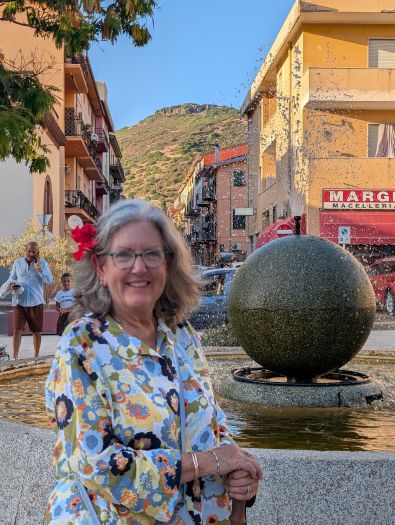
Projects are finally done and Pandora is safely on the dock with AC running happily. So last night we took the dink into town and had a lovely dinner. The atmosphere was magical and with cooler temperatures finally here, I even wore long pants.
After the two kilometer run up the river, skimming along, we tucked the dink into a spot on the dock between two local fishing boats in the center of town. We headed to our favorite bar for negronis made with local vermouth. They were fabulous and a great way to celebrate finally being ready to depart which we expect to do tomorrow, Monday.

While we were eating dinner later we saw a shrine to the Virgin Mary that had been set up on the town square fountain, not ten feet from where we were sitting.

Half way through our order of steamed mussels we heard a brass band in the distance. They emerged from a narrow alleyway and passed us. It was quite a spectacle.
The link looks nasty but give it a try and see what we saw. For some reason when I put up short videos and they end up in “shorts” they never render correctly here.We also visited the big church in town and it was in full swing with a choir singing. We were both quite moved.
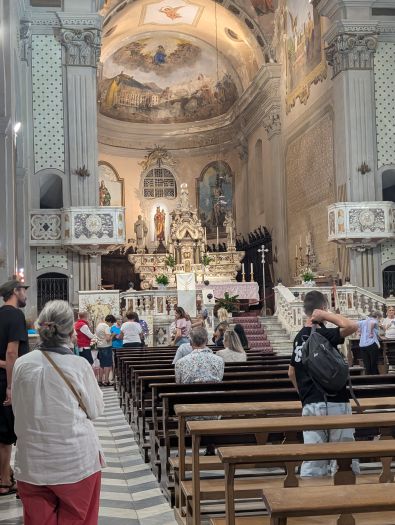
All and all, it was a magical evening and especially needed after so many days struggling to install the alternator and charger/inverter.
The city looks so wonderful in the evening, especially the fort on the hill.

The waterfront all lit up in a warm glow.
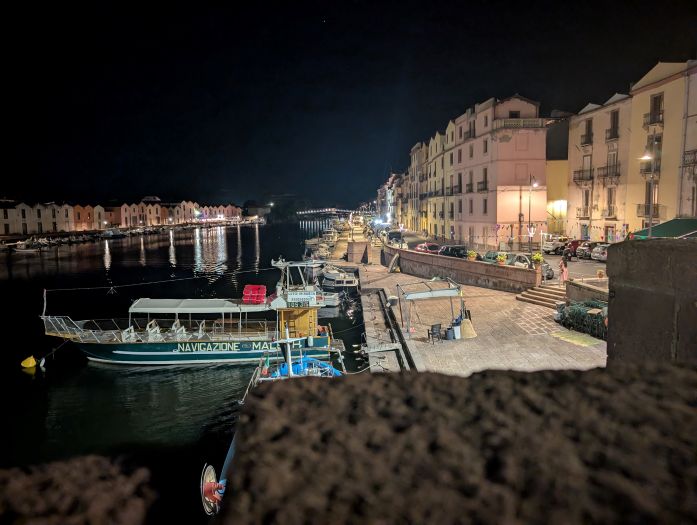
And on the river on our way back to Pandora.
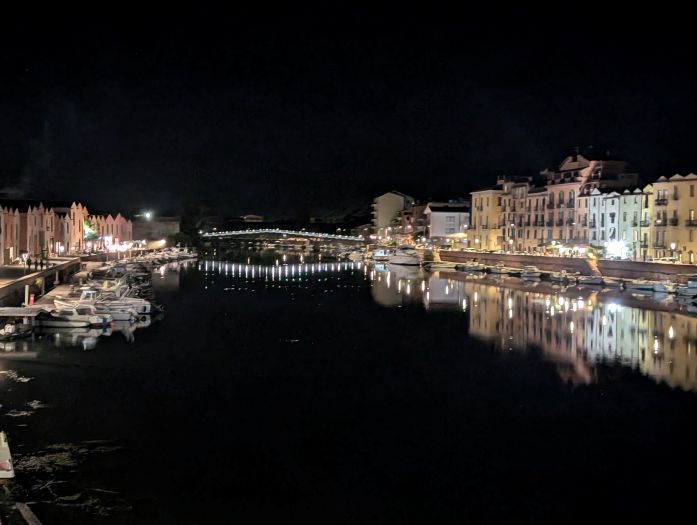
It was a great way to finally celebrate being finished, at least for now, with repairs to Pandora.
I have written, and complained, about the lack of communication from Nautical Pinna, the yard in Bosa, Sardinia as well as the individual that I hired to keep things on track for repairs to Pandora in Almerimar, Spain last winter. While some of the needed work done, and was fine, getting information from the yards and contractors was excruciating. But the biggest problem is that the more complex jobs, like sourcing a proper alternator or charger/inverter was just not possible in Almerimar or Bosa.
When I agreed to bring Pandora to Bosa I had no idea how much work would be needed but as work on the charger/inverter never happened in Almerimar, Pandora arrived with a completely dead unit and a failed, the second one, alternator on the engine. And to add insult to injury, my starter battery suddenly failed. Thanks to the builder for putting a combiner button to start the engine with the house bank.
Anyway, by the time Pandora was hauled in Bosa the list of repairs was long.
After months of sending notes to the yard secretary, the only person in the yard that speaks any English, and getting only occasional replies, I realized that I had to bring along the alternator and inverter/charger as excess luggage and install them myself. That seemed to be a good idea but, as is always the case with boat jobs, getting the equipment into service was no simple task and has ultimately taken me a week and a half to accomplish.
I should note that while I am generally a handy guy, I am totally out of my depth when it comes to electronics and when a possible failure of the new units, from a bad installation on my part, and no way to source new ones on a timely basis, my anxiety was at an all time high as I began putting everything together.
Access to the alternator on the engine was the first step but the new alternator looked very different than the old one so the wiring was not obvious and Balmar’s information on hookup was marginal at best.
The new alternator didn’t quite line up to where the old unit was installed and some modifications needed and with having two fail in the last year, I could not risk a third.
To help sort all of this out, enter Chat GPT to help interpret the instructions. I subscribe to a low level of “thinking” and with a lot of back and forth, the alternator was finally in and functioning. Note that this photo was taken before I had tidied up all the wires so don’t think that I am a sloppy installer, just confused.
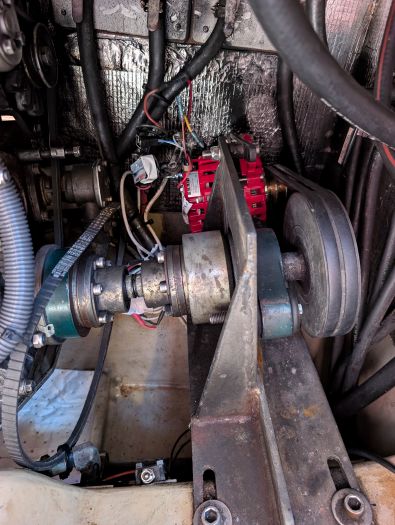
Putting the new alternator in place was only half of the job as the unit has an external controller to ensure that the alternator is not overworked, a problem when feeding lithium batteries which can accept power so fast that the alternator, in the hot engine compartment, can quickly overheat. I didn’t realize that when the yard installed the lithium batteries a few years ago, they did not install a temperature sensor on the alternator, a critical piece of equipment that will turn down the unit when it gets too hot. Well, as it turns out, that is likely what killed the two prior alternators and here I am still without a sensor on the new unit. I didn’t know then what I didn’t know. Now I do…
The first time I turned it on it ran up to full output and quickly reached dangerous a dangerous temperature. What I also did not fully appreciate was that the external alternator controller had not been set to limit output so the alternator was immediately working too hard. Now I know that the original lithium installers had not adjusted the unit appropriately, in addition to not installing a temperature sensor.
This was clearly another example of “I didn’t know then what I didn’t know.” Now I know that the best way to solve overheating, without an temperature probe, is to limit output to about half of what it is rated for. The settings are complicated but with support from AI, I was able to configure the controller and after several test runs of the engine, things seem to be ok. I will still have to get a temp sensor but for now fingers crossed.
This was the first time that I had ever used AI to work on something technical and in some ways it helped a lot and in other ways, made it much harder.
I was able to point it toward key installation instructions and after a few moments of “thinking”, it came back with a recommendation. Mostly, this worked but it often contradicted itself and asked for repeated testing, which became very frustrating. However, by the time I got to the inverter/charger, the stakes were that much higher and after a few days fussing over two wires and here they went, I upgraded to a higher level plan which did the trick.
Sadly, the inverter/charger is squeezed behind some complex cabinetry which had to be completely removed.
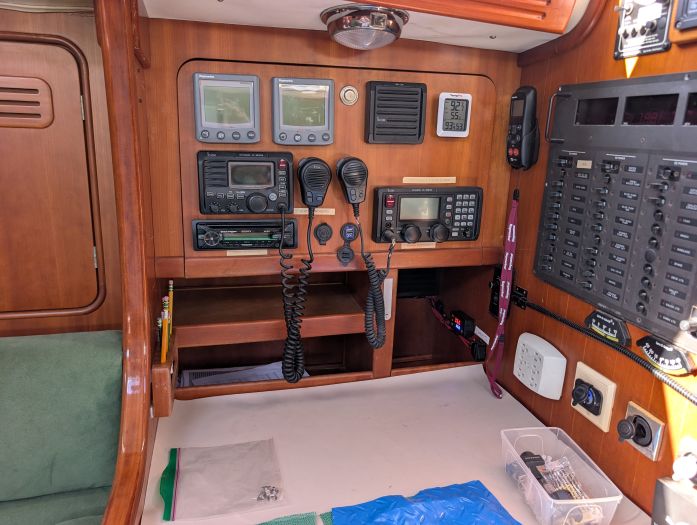
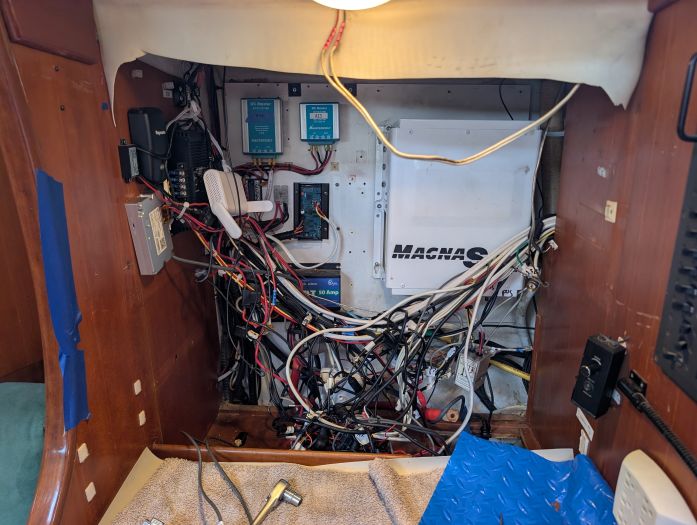
It took hours to remove all of it, nearly a whole day. Cabinetry removed and all the mess exposed. The Magnum is very heavy and I had to get someone from the yard to heft out the old one and put in the new unit. Along the way the backing board that everything is attached to came free so I had to have them re-epoxy the board back in place. That was a day long setback.
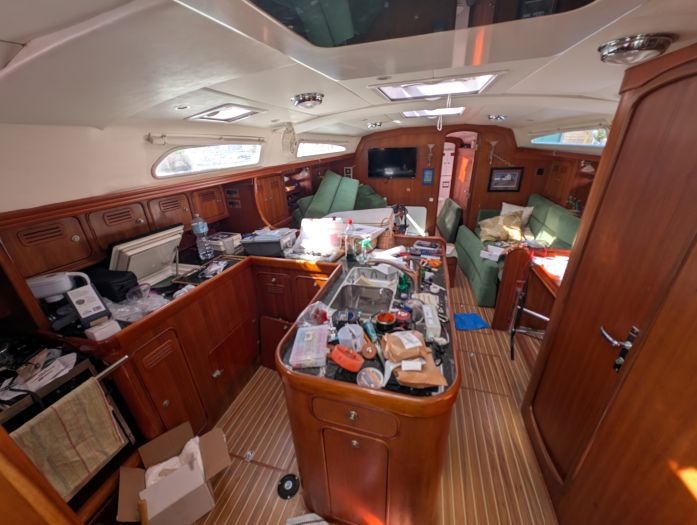
At the “height” of these projects, the boat was totally trashed. And with temperatures in the upper 90s, and Pandora on the hard with no AC, it was HOT working all day.
After getting someone to hoist the new unit into place, now my job was to put all the wires back where they were before I took the old unit apart. I was careful to take a photograph of the wires and where they were in the original installation. Simple enough but for one small detail. There are two blue and two brown and once I had removed them I had no idea where they should go back in the new unit. And that turned out to be a very BIG DEAL that took several days of back and forth to solve. Oh boy, what s..t show that turned out to be. I am generally pretty good about marking wires and taking photos but missed on this one badly.
See two brown and two blue. Oops for not marking which went into which slot. HUGE mistake.
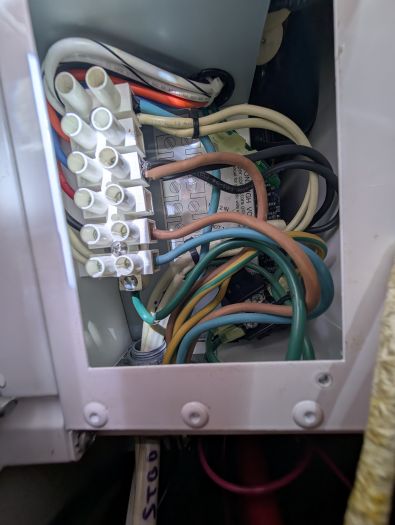
Of course, my biggest concern was if I switched blues or browns incorrectly and caused a fault, my new $2k charger/inverter would end up in the trash and I would be here in Sardinia with no way to get a new one.
So, I consulted with AI. FOR SEVERAL DAYS and we went around and around, testing and retesting and never being quite certain if it was ok. Finally, fairly confident that I was good to go, I energized the system and it worked. Well, sort of worked and didn’t blow up, which was good. One of the cabin outlets worked but the AC, water heater and all the rest of the outlets were dead. Obviously one or more of the blue and brown wires were swapped. Which one?
I spent a day, or was it two?, on this question, with support from AI, with no solution. Was it ok to just swap one and see what happened? I wasn’t confident, nor was AI, that this would be ok and finally after hour after hour, testing and retesting, I decided to upgrade to a higher level of AI thinking, something that my son Chris had suggested a few days earlier.
Somehow in all the fun I had forgotten about that but finally did and within a few hours we had firm answer. Just swap two wires and everything worked. I could have cried I was so relieved and Brenda could have strangled me for taking so long to do the right thing.
I sure wish that I could upgrade my thinking. Alas, no luck with that and in the heat, even worse. What? How do I do that? Huh
So, when all is said and done, it seems that the primary issue with both the inverter/charger and the alternator was high temperature. In the tight cabinet the Inverter/charger was getting too hot and the cooling fan that had been there was no longer working. I didn’t appreciate the risk I was taking by not replacing it. Done now, of course and on a programable thermostat that turns it on and off as needed by a nifty devise I purchased on Amazon.
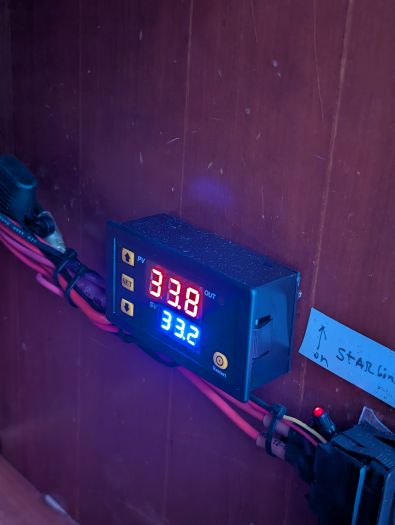
We all know that heat kills, something that has been coming up more and more with the warming climate. And, it turns out that the most logical explanation of what killed my alternator, or two, and my inverter/charger was heat. Hopefully dialing back the alternator output and putting in the fan for the inverter/charger will do the trick. An expensive lesson, to be sure.
Enough of that for now, I hope.
This morning we were treated to a beautiful sunrise and we will be off tomorrow to begin exploring Sardinia and other places to the south.
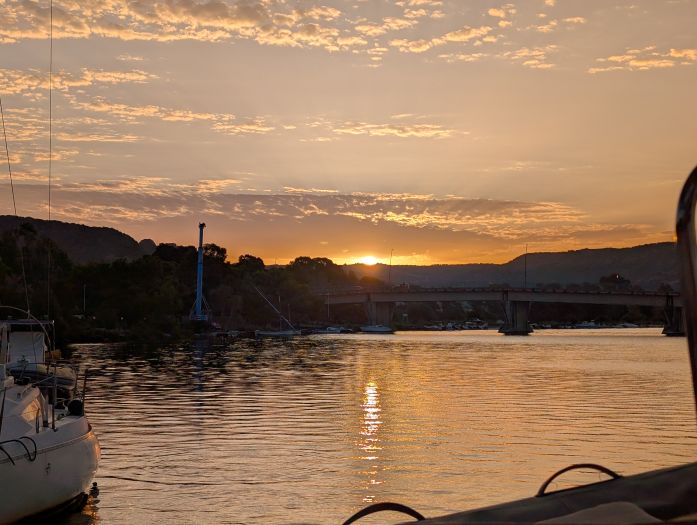
Yes, a beautiful day with no more fixing stuff that I don’t understand. But if I do, at least I can lean on AI to help.
Incredible!