Sometimes being prepared isn’t enough.
When I talk about sailing offshore I often get comments wondering about how scary it must be to be so far from land, of course, followed by something like “what’s the worse conditions you have encountered”.
Fortunately, I have never run into any conditions that were truly life threatening or at least if I did, it wasn’t clear to me at the time.
Life threating our not, I am keenly aware that when I am at sea, hundreds of miles from anything, I am, for all intents and purposes, on my own.
I love to read when I am on passage and it isn’t unusual for me to read a book every day. However, when it comes to subject, I almost never read stories about sailing or worse yet, disasters at sea when I am aboard. Being aboard and in the middle of nowhere is enough excitement so I read books about anything but being at sea. I’ll read books about disasters when I am in my “armchair sailor” mode.
I generally feel pretty safe aboard Pandora, but there are times when I wonder what would happen if we had a major gear failure far from land. I stock spare parts for everything that I can think of and might possibly fix while underway with the hope that what breaks is the stuff that I have spares for. That generally works out but sometimes not. Fortunately, I have never had to deal with a major failure like the loss of the mast or major leak.
When I think of injuries at sea, the first one that comes to mind is falling overboard and the recent fatality in the Bermuda race illustrates this point. It was reported that the skipper fell overboard and was lost. His body was recovered after an extensive search by his crew.
I do not have any details to go on but it reinforces the point that being securely tethered to the boat is the best way to avoid being lost in the wake if you fall in the water. Aboard Pandora, when we are offshore, everyone is to be clipped on at all times, even when in the cockpit and especially on deck. Additionally, nobody leaves the cockpit unless there is someone else in the cockpit to keep a careful view of those on deck. The sad fact is that if someone falls into the water, untethered, especially at night, the odds of finding them is not great.
I can not imagine a more distressing view than to see your boat sailing off into the distance while you float helplessly in it’s wake, in the dark.
There are so many things that can go wrong aboard a sailboat in the ocean and it is important to try and be prepared for anything that might go wrong.
In addition to having the right gear on board it’s so important to get good weather information and to follow it. I have been working with Chris Parker of Marine Weather Center for a decade now and I take his recommendations seriously. I also have a subscription to Predict Wind and can download detailed weather gribs via my Iridium Go. Seeing the graphics on my iPad make it much easier to fully appreciate the weather information that Chris is providing.
This spring, as I was bringing Pandora north from St Thomas, I heard about the loss of Calypso, lost off of the South side of Long Island. Fortunately, the crew was safely rescued. I recall wondering what they were doing in that area at that particular time as the conditions that they encountered were forecasted. I have no idea about what specific circumstances lead to the loss but this video of the rescue is hair raising. Tragic events like Calypso are rare and with modern weather forecasting, it’s easier than ever to avoid conditions like this. This link is a report out of Boston covering event and loss.
Having said that, some years ago I took Pandora on a run from Beaufort NC, to the BVI with the plan of leaving in early January. I had consulted with Chris about that plan in advance of leaving Pandora in Beaufort earlier in the season. For family reasons, I needed to delay my run south until after the New Year and wanted to be sure that a departure at that time was prudent. He said it was and would work with me as I prepared to leave.
As we prepared for departure, Chris told me that there would be a developing ridge near Puerto Rico but that I should be able to get ahead of it as long as I was able to maintain a speed of about 7kts which should allow me to get past that area before the ridge moved into our path. As long as we were south and east of the ridge we’d have good sailing with 10-15kts on the beam, wonderful tradewind sailing.
However, my speed was about a half knot slower than expected and the ridge passed in front of us about 12 hours sooner than forecasted. As a result, our lovely tradewind sail was replaced by 40kts and 20’+ seas from our stern. We had a wild ride for more than four days, surfing down big waves at double digit speeds, a few times cracking 20kts, only to crawl up the back of the wave at 4-5kts. It was way to rough to do much but hold on and not fun at all. It also put a lot of strain on the autopilot that lead to breakage of a critical linkage. Fortunately, I had a spare part but it took hours to locate it and make the swap.
I shudder to think of what that sail would have been like if we had been forced to sail on a beam reach or worse in those conditions as strong wind wind was bad enough.
The simple fact is that when you are at sea, and far from land, you basically just have to do your best to take what is thrown at you. This all sounds pretty terrifying but nasty stuff doesn’t generally come without warning so as long as you are prepared and do what is needed to make the best of difficulty conditions, things generally go pretty well.
With bad weather you generally have time to get used to it. The analogy that comes to mind, and I’ll admit that this comparison is fortunately anecdotal, is to compare what it is like to “inherit” a teenager by marriage, being tossed into the deep end of the pool, as opposed to starting out with an infant and growing up with them for more years before they become surly, or should I say “stormy” teens.
However, in spite of our best efforts, things can still go bad with little warning.
You may have heard about the recent tragic loss of long time cruisers and fellow SDSA members, Annemarie and Frank of SV Escape as they made their way from Bermuda to Nova Scotia this spring. They had hoped to participate in our Homeward Bound Rally from the USVI in May but mechanical issues kept them in St Martin.
After an uneventful run to Bermuda they met crew for the run to Nova Scotia. Facing a narrow weather window they departed, well prepared with a well maintained boat and the experienced crew needed for such a passage.
A few days out, conditions began to deteriorate and as they prepared to reef the main the mainsheet parted, allowing the boom to thrash wildly. As Annemarie and Frank attempted to bring things back under control, both were seriously injured.
As they were so far from land, it took time for the USCG to reach them. Everyone aboard were evacuated yet both Annmarie and Frank succumbed to their injuries during the return to shore.
It’s hard to prepare for everything that you might encounter and in spite of being on a well found boat with experienced crew, things went terribly wrong aboard Escape with devastating circumstances.
This spring, as I made my way back to the US as part of the Homeward Bound Rally, everyone aboard Pandora came down with Covid. Our symptoms proved manageable as we were all fully vaccinated, a good thing, being so far from shore and isolated from medical support. I had spent two seasons in the Caribbean and successfully avoided infection but it finally caught up with me and my crew.
There is no question that everyone who heads offshore wants to be as safe as possible and while tragedy rarely strikes, it is important to be as prepared as we can possibly be.
The terrible loss of Annemarie and Frank reminds us that while tragedies like theirs are rare, there are still risks. We all need to continue to do everything we can to ensure that when we head to sea we are as prepared as we can be with the knowledge that sometimes being prepared just isn’t enough.
Escape was salvaged and is now in Nova Scotia.
SDSA made a donation in memory of Annmarie and Frank to the USCG foundation. 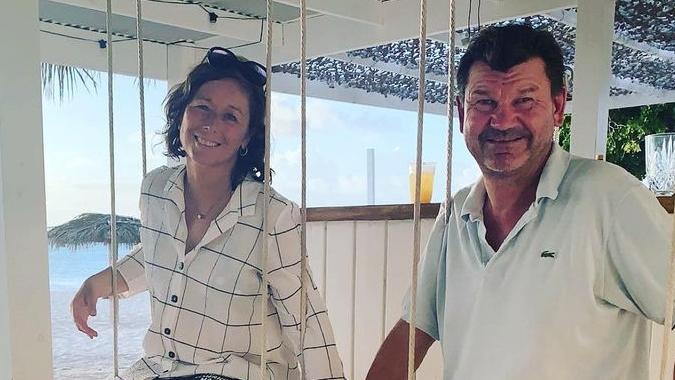 They will be missed.
She wrote in her blog: “We really enjoyed our short visit to St. George’s. We are really looking forward to what Bermuda has to offer in the coming days.
“However, we are well aware that the foreseeable future does not hold just relaxing sightseeing for us. ‘Alex’, the first tropical storm of the season, is approaching.
Registrations for the fall Rally to the Caribbean are running well above any year in recent memory and with the addition of a planned departure from Newport we are expecting very strong turnout.
Everyone involved in the rally, SDSA shoreside support, skippers and crew, are very focused on doing what is needed to prepare for a safe and fun passage and recent tragic events remind us that regardless of how well prepared we are, things sometimes go terribly wrong.
 As for Pandora, all I can do is hope…
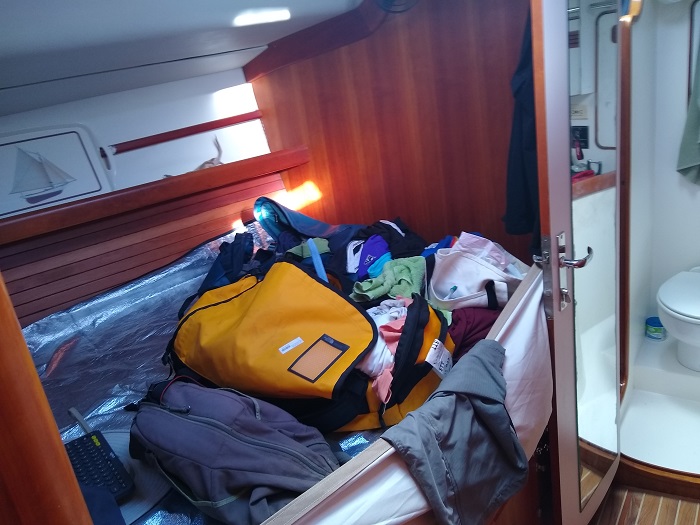
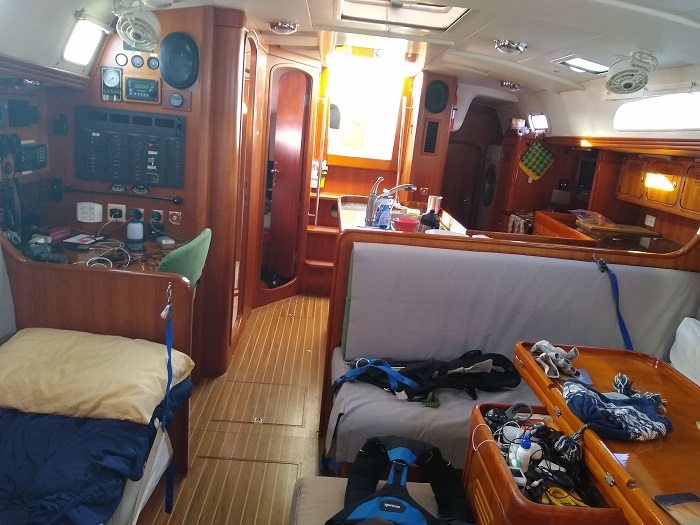 While I’m on the subject, on passage, we store all of our gear up in the forward cabin, complete with lee cloth to keep everything in place.
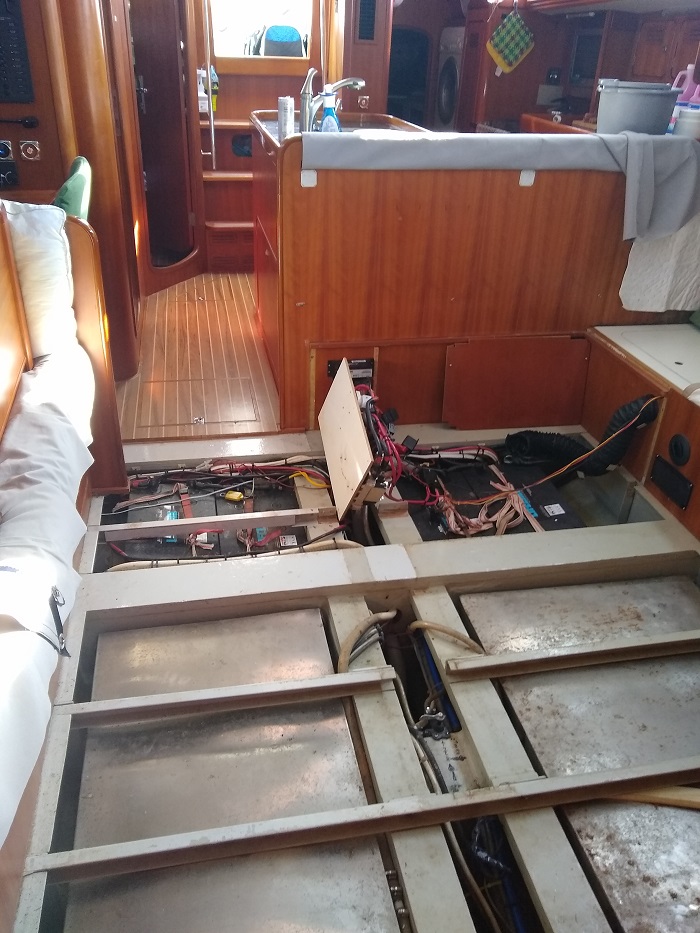
  The batteries are under the main cabin sole and to get at them for replacement, is not a simple job and involved hours of disassembly, something that I didn’t want to pay two guys by the hour to do.
 If history is any guide, the design specs for the water capacity will not match what is actually in the boat. To that point, each of the three fuel tanks are reported to be 50 gallons each but based on how much fuel I have been able to fit into each “empty” tank, I believe that it’s more like 35 gallons of useable fuel per tank.
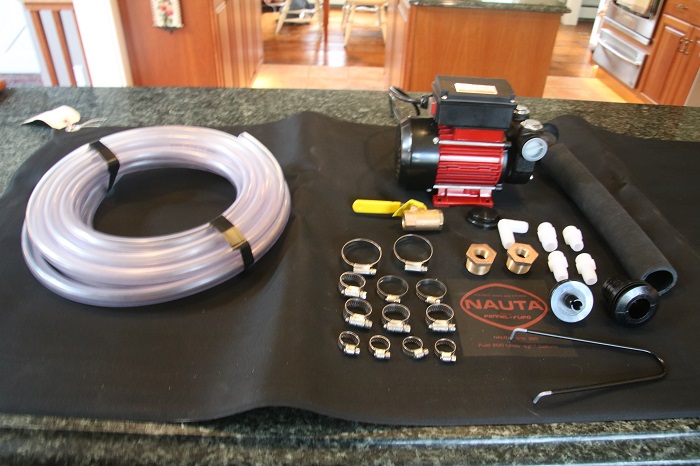
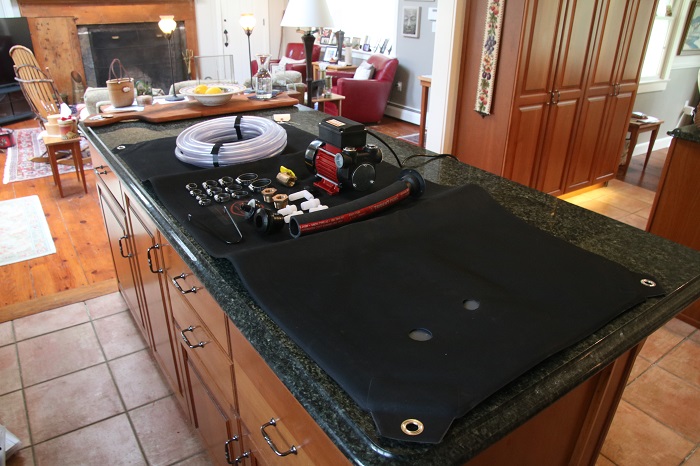 There are a lot of parts involved in setting up the system. The tank does not come with fittings as that gives you the opportunity to put them wherever you wish so you can get good access for filling and transferring fuel at sea. The bladders are often used by sport fishing boats or yachts making a trans-Atlantic run. They come in a variety of sizes, most much larger than what I have installed.
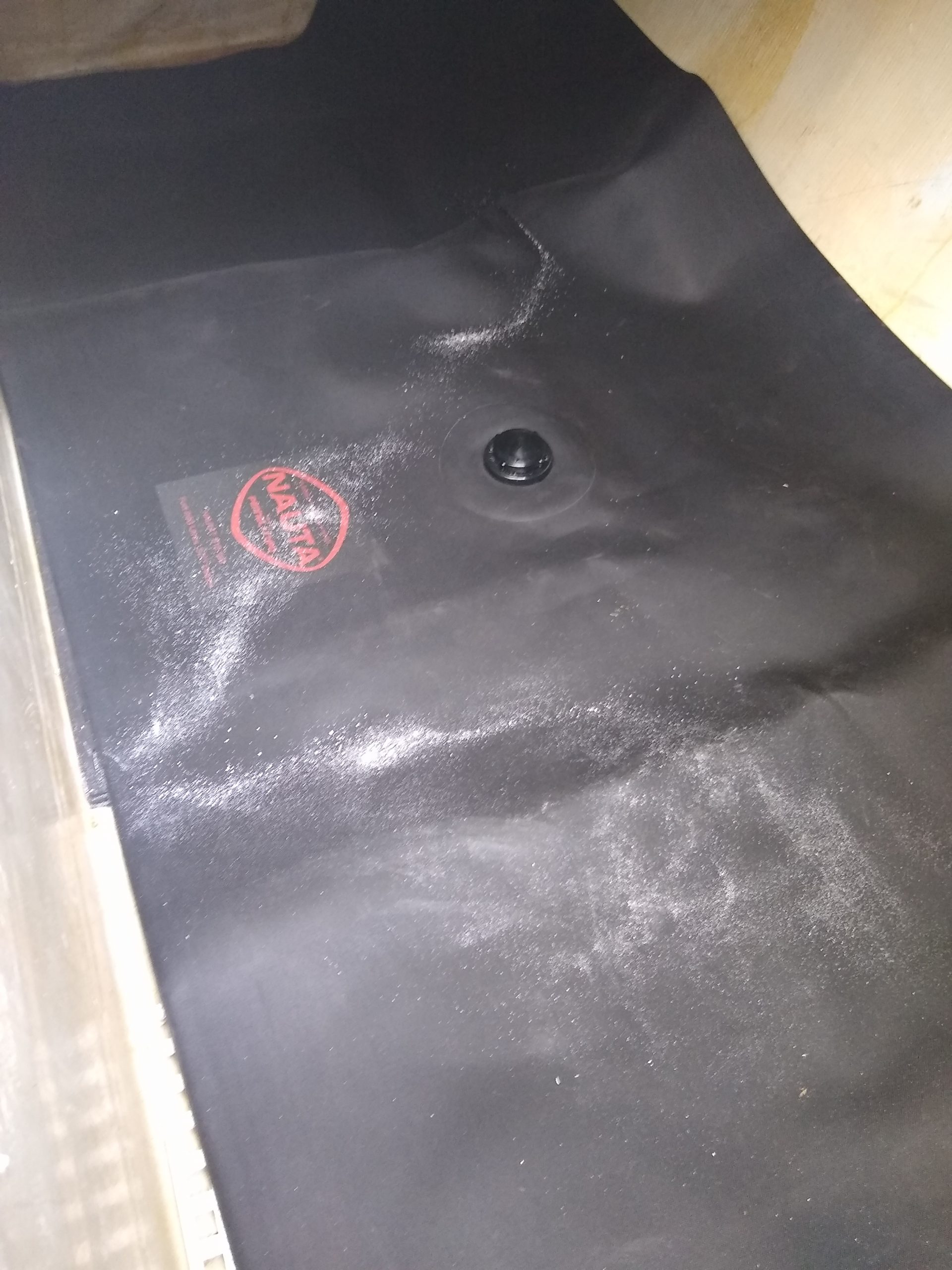
 The bladder, installed, but still empty, in the aft port vented locker.
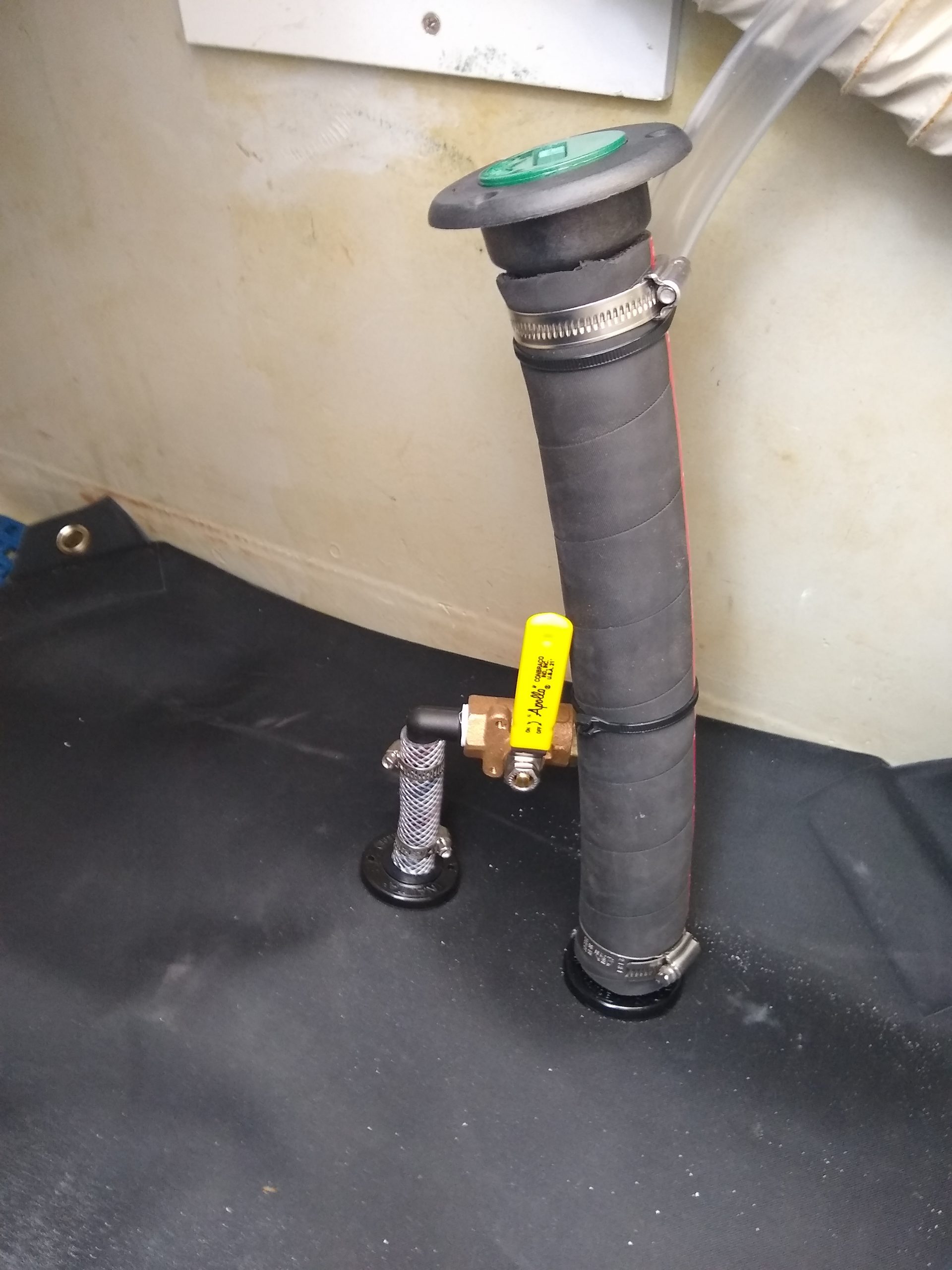
  Here you can see the fill tube, installed near the end of the bladder, with the transfer tube nearby. The clear tube will attach to the transfer pump that will be stored remotely until I use it.
 Unfortunately, I didn’t take a photo of the filled bladder in place. I did have some difficulty in filling the bladder with fuel as when the diesel foamed, which it always does, a large “bubble” accumulated in the highest part of the middle of the bladder. I had some difficulty “burping” out that air. The foam made the bladder look full even though it was nowhere near capacity. I was able to get some of that air out by pulling up on the fill hose. However, that proved to be messy as when the air was released through the fill tube, diesel splattered all over the place. The solution will be to put a vent tube in the highest part of the bladder that I can open up with a valve to bleed off the captured air. There is already a screw fitting in place that I can adapt.