Sail Pandora

Is 600nm to Horta close?  Yes and no…
We are just over 600 miles from Horta and moving along nicely at 6-8kts over the bottom in about 9-12kts of wind.  With a slight current in our favor, we continue to make good time.

I am tempted to say that we are “almost there” as having “only” 600 miles left on a run of 2,000 miles seems like “close” even if it is still quite far away.  Think New York to Chicago far.   

Anyway, I am going with close as we are currently sailing along at a good clip so life is good.  Ask me how far it is if the wind drops and we are just flopping around making no progress.  Then I can assure you, I will feel that we are nowhere near Horta.

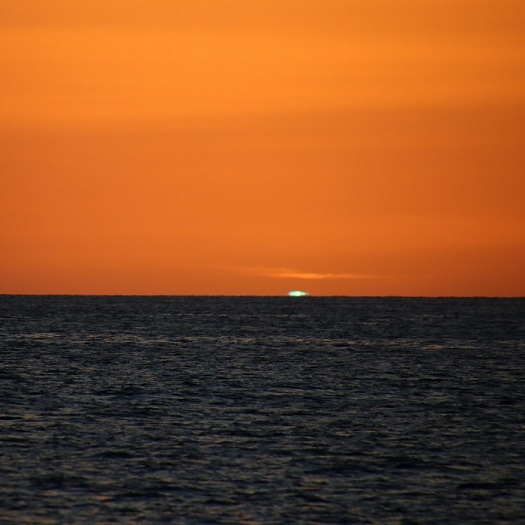
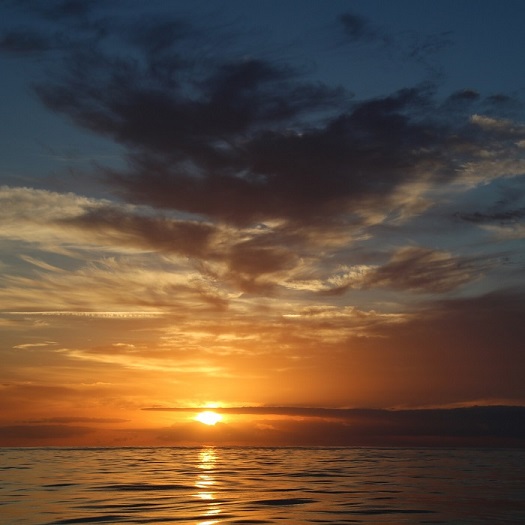
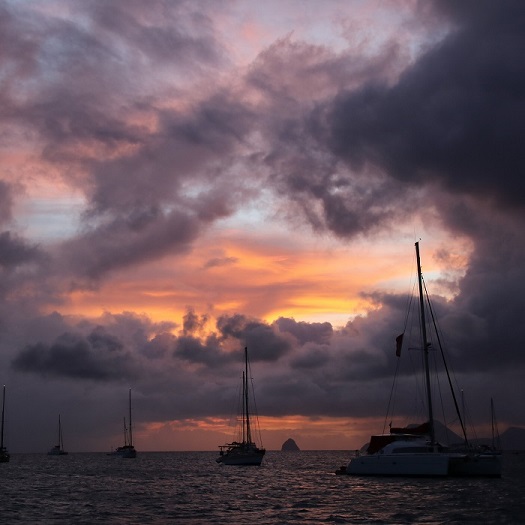
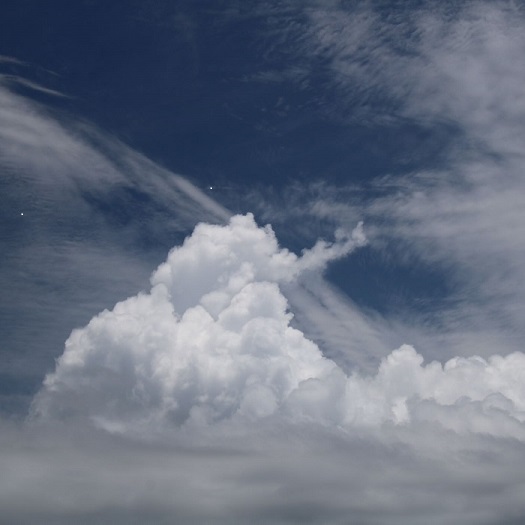
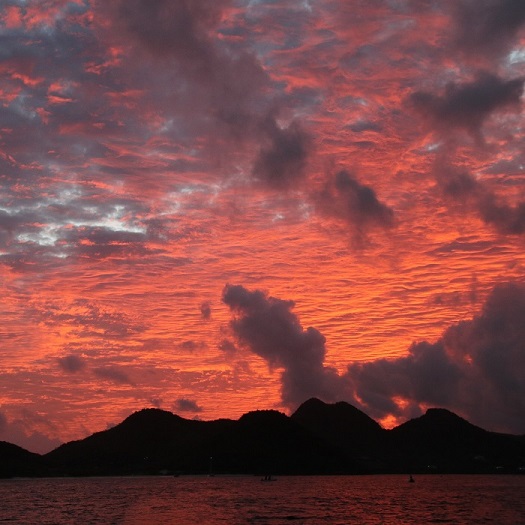
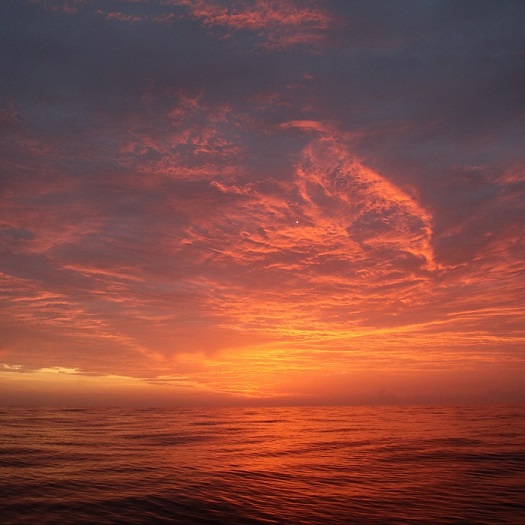
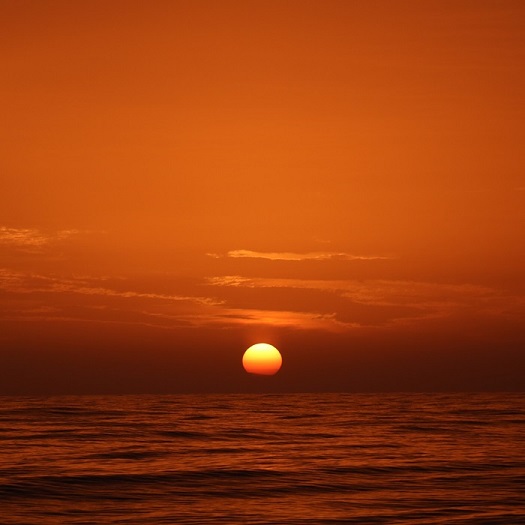
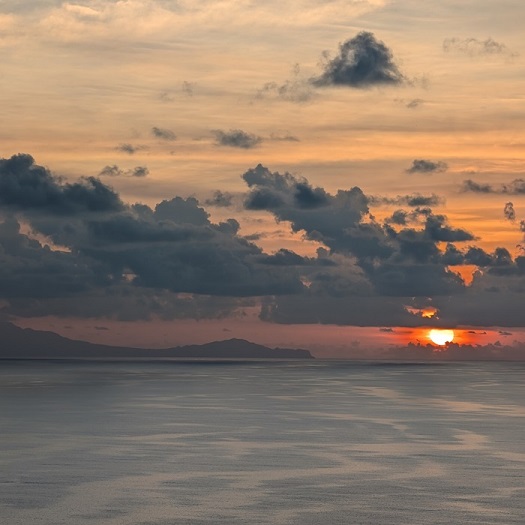
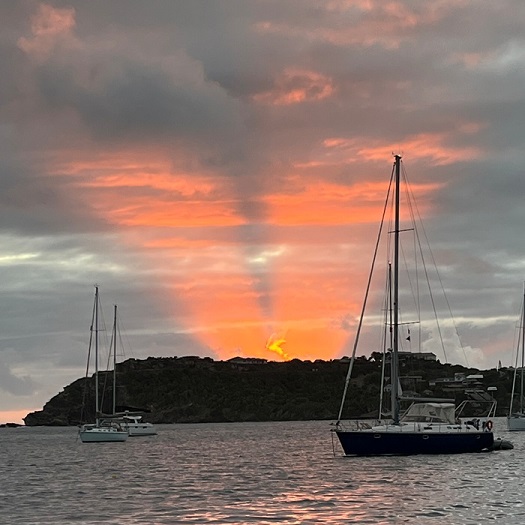
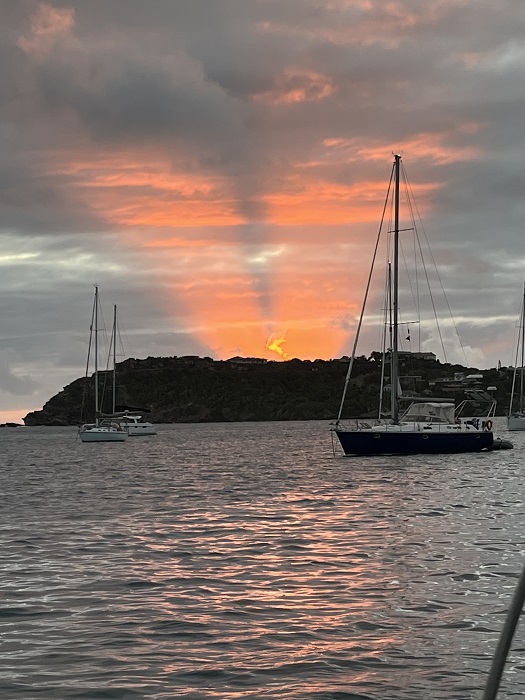
The sunrise this morning, and there is not a lot, other than that, to take pictures of out here, was, well, it was a sunrise.  We had showers and a lot of clouds but now it is sunny.

I also discovered that I am just about out of clean underwear so it was time to do a bit of washing.  Actually, I washed them yesterday and they did not dry.  It is breezy but humid.  I hope that they dry today.  Jason and Ted have made it clear that they hope so as well…

I wrote yesterday about how Chris Parker, our weather router, commented that Pandora was in just about the perfect spot to take advantage of light to moderate winds as we make our way east and said that if things continue as they are, we may not have to motor at all.   Here we are, a few days later, and it is looking good that the run will play out as predicted.   Of course, that assumes no broken stuff.

To that point, we do a “walk around” every day to be sure that there are no signs of chafe or imminent breakage and at least three times now we have made a few modifications to line leads or repairs to address chafe.

And speaking of chafe, I will be contacting a sailmaker in Horta to get some repairs done on my mainsail and perhaps the jib.  It is amazing how much wear and tear there is on a boat that is run 24/7 for two weeks at sea. 

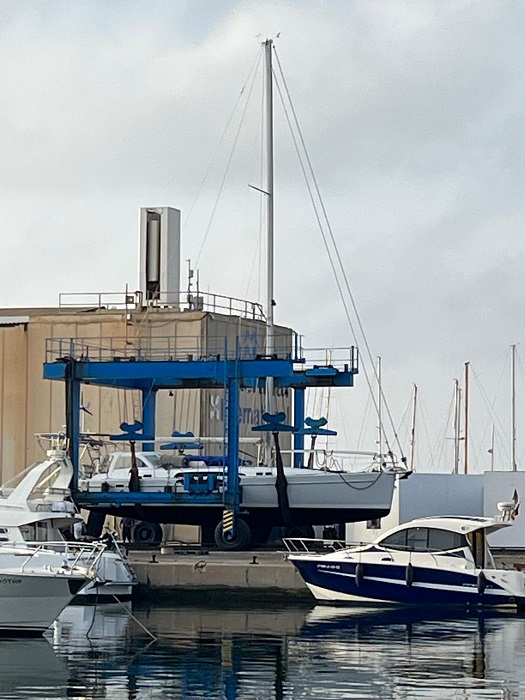
Someone once told me that there is more wear and tear on a boat that is lived aboard, in a single year, than one that is “day sailed” on weekends and vacations for a full decade.   And, Pandora has surely been used plenty.  This season alone I will have covered well over 5,000nm by the time she is hauled in Almeria, Spain.   

I am also confident, and not in a good way, that we have spent way more on Pandora than most will ever spend on their boats in a single year.  Best not to think about that right now…

So, back to Chris’s routing suggestions to avoid a lot of motoring. 

He instructed us to make our way to 41 degrees north and to head east from that point.  We reached 40N yesterday afternoon and are now running due east down the parallel.    By taking this approach, we hope to skirt just north of the windless zone and just south of the strong winds to our north.  The goal is to stay in what I will call the “goldilocks zone”, not too much or too little wind.

The hope is that we will have enough wind to sail on a beam to broad reach (wind from beam to stern quarter) to continue to push us east.  So far, so good…

The dilemma is that if we go too fast, we will outrun the wind as it fills in from the west.  In a way it is self-correcting as our speed is based on the wind.  And, if we go to fast, less wind will slow us down and allow the better winds to catch up.   In theory anyway…

So far, so good.  Details to come…

Fortunately, the most recent run of the GRIBS (graphic wind files) suggest that this strategy will play out and we should, I hope, I really hope, be able to make the entire run with little or no motoring. 

The plan is to continue to move eastward along, or slightly north of, the 41st parallel until the wind clocks from the south to the west and fills in out of the northwest.   At that point, when we are perhaps 200nm from our destination, we will turn to the SE and head directly for Horta. 

As we enter the second week of our passage we have covered a bit more than 1,200 miles at an average speed of a bit over 7kts, which is amazing.  To that point, that is the farthest that I have ever sailed without turning on the engine, by a lot.

Unlike passages to the Caribbean, where we tend to turn on the engine every time the wind gets light, to keep on schedule, on this passage we have been encouraged to be patient so that we will not outrun the wind and end up having to motor through the windless zones.  To try and keep moving would force us ahead of the wind and put us in a position where we would be forced to motor beyond our fuel range. 

All of this goes against my grain as I am generally an impatient person so the experience has been a learning experience.  So far, in a positive way.   Ask me again if the wind dies 🙁

As I mentioned before, a number of boats left a day ahead of us and given our good fortune we have closed the gap with them, well at least with those that have not turned on their motors to keep moving.  So, as they lost their wind, we gained ours. 

Over the next few days Chris feels that the fleet will tighten up and most of the boats should arrive within a day or two of the same date.   There are now a total of 10 boats in the fleet with one just leaving Bermuda, a week after the rest of us due to personal timing issues and weather delays.  Another has been forced to drop out of the rally as they had to turn back and are now stuck in Bermuda waiting for parts for a broken sail furler.

I heard earlier today that because of his delay, he has lost his crew as they “timed out” and need to head home.  I can only imagine how frustrating that must be for the skipper as he does his best to organize the arrival of repair parts, a new crew, that he has not even identified yet, along with a new weather window once everyone arrives.    

And, as June is the beginning of the hurricane season, there is also the issue of an early season storm spooling up toward Bermuda and into his path to the Azores.   Sounds very complicated and I would be stressing.   All of this reminds me of the anxiety I was feeling in St Maarten with my own mechanical issues, thinking that I might have to bag the entire trip.

However, we are well on our way and given the growing certainty that the bulk of the fleet will arrive sometime between next Tuesday and Thursday, it will soon be time to consider scheduling arrival events. 

In addition to some informal happy-hour events, we will have an arrival diner as well as an event at a friend’s home on the nearby island, Pico, a short, 15-20 minute, ferry ride from Horta.  

With Brenda arriving on the 16th, it may be hard to hold off on those two events to allow for her to participate as she will not be there until perhaps as much as 5-6 days after the fleet has made landfall.

A lot of this will depend on what the other boats are planning, how long they will remain in Horta before heading east to the Med or to northern Europe or if they have crew changes that will keep them in Horta for a while. 

When we booked Brenda’s flight months ago, I never imagined that we would be in Horta before her arrival, now perhaps by a full week, as Chris told us that this run usually takes between two and two and a half weeks, involves lots of motoring and probably a gale or two. 

Fingers crossed that things will continue to go well with the weather and that nothing breaks.

So, for now, as we have for the last week, we continue to sail along, making good progress toward Horta.

Oh yeah, one more thing. 

As all of my long-distance passages have been north and south, I have never had to think about time zone changes, beyond the seasonal “daylight savings time” issue and going from east coast and Atlantic zone.

On this passage we will make our way through three time zones, from Atlantic Time to Horta, which is four hours ahead of New York.  This means that we have had to estimate when to turn the clocks forward to ensure that when we approach Horta we well be acclimated. 

So, where to change the clock?  Well, I am glad you asked and here is how we decided to handle things.

The world is round, 360 degrees, and there are 24 hours in a day.  So, divide 360 by 24 and you get 15 degrees of longitude between time zones.  I think that is right.  Anyway, we took the degrees between Bermuda, 64 degrees west, and Horta 28 degrees west, divided by 3 which is the number of time zones and you get 12 degrees, sort of what we are looking for.   We know what time it is in Bermuda and also in Horta so the real issue is where to change the clocks.   So, to divide things up we chose, perhaps a bit arbitrability, that we will move the clock forward by an hour at 42W and 35W.

To that point, we just passed 42W and my iPad has automatically changed so I guess I am right.  It’s magic.  Sort of like a thermos, I guess.  

Ok.  Time to move the other clocks ahead and again one more time in about 300 more miles to get on the same time zone as Horta. 

One more thing.  Jason has his heart set on catching a fish and we have trailed a line for three days now and not a single bite. 

We did see a humpback whale though but it was too far away for a photo.  All we saw was his big pectoral fin splashing the water a few times. 

I am told that near the Azores is a hotbed for whale watching so perhaps we will get lucky and have a closer encounter.  Not too close…I Hope.

Somehow 600 miles does not seem all that far away, for now anyway.  Ask me again tomorrow…

Editor:  As part of the first ever Salty Dawg Rally to the Azores, you can see where Pandora and the other boats are located in real time at the Salty Dawg Azores Rally Map.

If you want to see where Pandora is alone, check out “where in the world is Pandora” at the top of the page or click on this link.

And, as always, you can register to receive a notice when I post, Which I do regularly, at the top of this page.

Pandora’s Point Nemo  

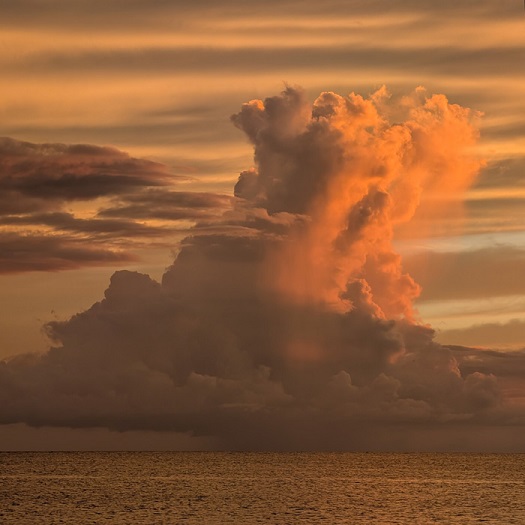
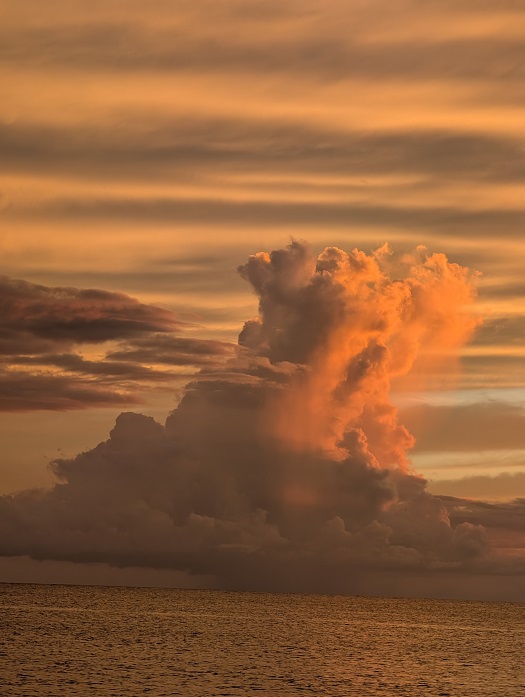
Today started out mostly cloudy but now it’s become a beautiful sunny day.  The clouds to the north were quite dramatic shortly after sunrise today. 

A natural question to ask on passage, beyond “when will we get there?” is how far from land are you.  While the answer to the first question is perhaps next Wednesday, the answer to the second question is clearer, close to Point Nemo.

Later this afternoon, Pandora will be at her furthest point from land in any direction than she will find herself at any point during this passage.  The traditional definition of “Point Nemo” is the point on the planet that is farthest from land in any direction.

The actual Point Nemo is in the middle of the Pacific Ocean, near Pitcarin Island where Fletcher Christian of Mutiny on the Bounty fame, made landfall. 

Another definition has to do with finding the most inaccessible point on the planet, such as the North or South Pole.  I’m going with Point Nemo.

Interestingly, “Nemo” means Nobody in Latin, but that’s another story.

Check out more on Point Nemo here.

This is named after the fictional character, Captain Nemo, in the book by Jules Vern “20 leagues under the sea.”

While Pandora’s Point Nemo is not technically the world’s most remote place, it is Pandora’s most remote place now and EVER as I have no illusion that I will be crossing the Pacific Ocean.

It is Friday morning and it definitely, totally, for sure, feels like we are in the middle of nowhere, 500 miles from the closest land, in this case Newfoundland.

For all practical purposes, we are completely alone except for the occasional ship that passes on the horizon and even the dolphins have abandoned us today.  

And speaking of ships, if we had any difficulty and had to activate our EPIRB, Emergency Position Indicating Radio Beacon, they would be asked to divert and assist us.

No chopper to come to someone’s rescue out here as their operating radius is about 350 miles from shore.

So, exactly where in the world is Pandora?

We are 1,000nm from our home in CT and 2,000nm from Trinidad, where I began this journey in April. 

To continue with distances…

We are closer to Horta, 770nm than from Bermuda, 1,100nm, where we departed for this leg last Saturday.

It is safe to say that we are really, really far from everything but the most unsettling distance of all is the distance from Pandora to the ocean floor, over 16,500 feet down. 

I wonder how long it would take for a penny tossed overboard to fall that distance?  A boat?  Best not to think about that…

Setting that aside, and I must, there is not much going on today unless you count that the wind direction and speed instruments that stopped working.

It took a while but I was able to solve the problem after fussing with wires for about and hour.   I am not certain what the actual fix was beyond a bad connection but they do work now.  

With the operative phrase “for now”. 

As is often said, “everything on a boat is broken, you just don’t know it yet.” 

Sadly, no truer words have been spoken.

Wherever we are, it is nice to know that the “end is near”, of the trip that is, and that we can begin to have confidence about when we will arrive in Horta. 

One thing that I am becoming more confident of is that we will likely beat Brenda’s arrival on the 16th by a few days. 

For now, where are we?  Near Pandora’s Point Nemo.  Of that I am certain.

Editor:  As part of the first ever Salty Dawg Rally to the Azores, you can see where Pandora and the other boats are located in real time at the Salty Dawg Azores Rally Map.

If you want to see where Pandora is alone, check out “where in the world is Pandora” at the top of the page or click on this link.

And, as always, you can register to receive a notice when I post, Which I do regularly, at the top of this page.

Sailing in the Goldilocks zone.  Half way to Horta.

So far, so good and Pandora has made it to the half way point of our 1,800nm run to Horta.  

Since departing from Bermuda, we have been doing very well with daily runs of just under 180 miles, at an average speed of 7.5 kts.   That is quite respectable but the second half is likely to be a LOT slower.

The crew is getting along well and meal planning seems to be acceptable with a decent, I think, variety.  How many ways can you eat pasta?

Some live-to-eat and others, eat-to-live.  Fortunately, the crew of Pandora are in the latter camp which simplifies meal planning, a lot.

There is not a lot to see out here except water but several times today we were treated to a show by some curious dolphins.  They arrived in a rush, danced around the bow, and were gone just as quickly as they arrived. 

It is remarkably difficult to get a shot of them despite their constant antics.

A few shots, if a bit blurry…

Jason and Ted were also trying their best to get a good photo.

We have also seen loads of Portuguese Man-O-War jellyfish.

Earlier today we had to pull down the mainsail as the line that tensions the leech, the aft end of the sail, had chafed through.  Without this line in place, we could not put tension on the leech and the aft end of the sail was fluttering badly.  In the grand scheme of things, it is a minor issue, but the constant fluttering of the fabric would have weakened it badly.

We were able to prepare a temporary fix but the sail will need servicing in Horta.  Oh Well…

At night we split watches with the first beginning when it gets dark, until 22:00.  The second watch from 22:00 to 03:00 and then I take over until the crew wakes up, generally between 07:00 and 08:00.  During the day, nothing formal is needed as someone is always in the cockpit.

For sleeping, I have modified the aft cabin with a board in the middle to allow for comfortable sea berths.  It is a bit tight, but is working out well. 

As I write this, Thursday morning, we continue to head ENE to a waypoint of about 41N, which will put us far enough north to catch better wind and yet not so far north to make for a lot of extra miles or run into gales. 

Horta is located at 38N so we are heading a bit north of that and then will turn to the East and then back down toward Horta to take advantage of a better wind angle.  I hope that this strategy will pay off.  

From the beginning of the run Chris has focused on the importance of being in what I will call the “Goldilocks zone” where we are far enough north to catch favorable winds and yet not too far north to add extra miles to the passage or put us in winds that are too strong.

As of this morning, Chris has become more specific about the best strategy depending on where each of the boats in the fleet is located and given the large windless zone between us and Horta, where each boat lies is particularly important.

Some of the boats left the afternoon before we did and a few others after us.  So, now that we are into our 5th day from Bermuda the “best” place to be is becoming clearer and, as luck would have it, that is pretty much where Pandora is.  Lucky us…

Because we decided to delay our departure from Bermuda by 12 hours to let a band of squalls clear out, we seem to have the good fortune of finding ourselves in the “sweet spot” for catching the best wind. 

If things play out as expected, Chris believes that we may only have to motor for the last 24 hours of the trip and will have sailed almost the entire 2,000 miles.  Well, we will see about that…

In past years I have motored for as much as 130 hours to make the 1,500-mile run from Hampton, VA to Antigua, the prospect of only 24 hours of motoring on a 2,000-mile-long passage sounds unbelievably lucky. 

Had we been even 100 miles farther north, or south, of our current position we would not be as well positioned to catch the best conditions and our motoring time would likely be at least several days, a big difference for sure.

Who knows when we will arrive in Horta, but for planning purposes, I am estimating somewhere between June 11th or 12th, for a passage time of under two weeks.  That would be amazing as I was expecting the run to be somewhere between 14 and 17 days. 

Of course, it is hard to say exactly what will happen, but for now, based on what Chris has suggested, that is my best guess.

As of now, both the Euro and US weather models are in pretty good agreement so that suggests that conditions will play out as Chris is suggesting. 

Are we in the right place at the right time, what I will call the Goldilocks zone? 

Time will tell.

It always does.

Editor: You can see where Pandora and the others in the Salty Dawg Rally fleet are in real time, at the Salty Dawg Azores Rally Map.

If you want to see where Pandora is alone, check out “where in the world is Pandora” at the top of the page or click on this link.

And, as always, you can register to receive a notice when I post, Which I do regularly, at the top of this page.

48 years ago…

June, 1977 was a big month.

But before I get to that.  Today’s sunrise. 

Ok, I’m back…

Not to put too fine a point on it but 48 years and one day ago the orthodontist removed my braces.  

I was in his office for a routine check, probably one of those visits when they crank things down, one more step to create that perfect smile.

He asked me, “what are you doing this weekend?” to which I answered, “I am getting married, tomorrow”.

With that he stood back, looked at my teeth and decided that enough was enough and said “ok, let’s take them off.”

And with that, no more braces.  Of course, that meant that my late afternoon appointment was now taking a lot longer than anticipated.

And that mattered because my next stop was to head home to get dressed for the rehearsal dinner, which I got to barely in time.

I can only imagine what must have been going through my, soon to be father-in-law’s mind when I was late showing up.  I am afraid that Jack never a card-carrying member of the Bob Osborn fan club. 

Jack, and I never had the nerve to call him “dad”, my future father-in-law was the same guy who greeted me at their front door a few years earlier when I arrived for my first date with his daughter.    I said “I am here to see Brenda” and he said “she will be right out” and closed the door, leaving me on the front porch.   Love at first sight?  Perhaps not.

Anyway, Jack tolerated me and now I was going to be late for his daughter’s rehearsal dinner.   Not a great way to kick things off.

I mention all of this because as of today Brenda and I have been married for 48 years.  Who knew?

And, while I was late for the rehearsal dinner so many years ago, now I am 1,000 miles from anywhere to celebrate Brenda’s any my special day so I guess that makes me REALLY, REALLY LATE for our 48th.  

Well, it could be worse, at least it is not our 50th and I do have Starlink…

I suppose, in a weird sort of way this brings us full circle.   Brenda, against all odds, well at least according to Jack, is still with me.  So there you non-believing-father-in-law.  Take that…

Seriously though, it is a bit depressing to be so far away but at least I know that our son Chris will be holding down the fort and spending the weekend with Brenda, so all is not lost.

And, in less than two weeks, Brenda will be flying to Horta. 

So, after six weeks apart, it will be good to see her again.

Yes, June is a big month.

And there is yet another milestone heading my way in a few days, my 70th birthday.   And I will so, so enjoy spending it with my crew, Jason and Ted.  I am sure that they are equally excited…

One thing that I have been worrying about is how long Brenda will have to wait at her hotel in Horta until I arrive.  It is hard to say but I am still optimistic that we will get there a few days before she arrives.  

Having said that, since leaving Bermuda on Saturday, and we are now into our 5th day at sea, we have been barreling along at a good clip.  We have covered over 700 NM but still have over 1,000 miles to go.

Being somewhat, sorta, kinda, half way there is not nothing but it is too soon to say when we will arrive. 

Our speed over the bottom today is in the 9-10kt range due to a bit of help from the Gulf Stream which is giving us a nice lift. 

Chris Parker has given us a waypoint to head for that is about 330 miles away to the ENE and then we will turn east toward Horta at about 40 degrees north.

The problem in knowing when we will arrive, in spite of day after day of 180+ mile daily runs, we expect that the wind will pretty much die in a day or two. 

And, Chris is telling us that if we turn on the motor we will likely stay ahead of the winds that are expected to fill in behind us.  So, Chris is suggesting that we sail, not motor, slowly, to the east and wait for the winds to catch up with us.

And, if we do, he is predicting that we should be able to sail much of the way to Horta.  Turn on the motor, to keep moving and we will be ahead of the wind and will have to commit to upwards of 800NM of motoring, which is not appealing or practical.  And, we might still arrive at about the same time if we were patient and just waited. 

While we have been making terrific time since leaving Bermuda, clocking 180nm a day for 5 days now, close to a personal best for me and Pandora.  After we run out of wind, we have no idea how long we will be creeping along, waiting for the wind to fill in.

And, when it does, it will not be very strong so we will likely be making perhaps 140-150nm a day, once we get some wind for sailing, and even that that might be wishful thinking. 

When will we get there?  Probably before Brenda arrives on June 16th but beyond that, I have no idea.

Ok, perhaps I will speculate, and that suggests arrival on the 13th or 14th.   Of course, that assumes that we are a day from our next waypoint and carry wind until then.  After that, two days of little or no wind and after that, the remainder of the trip at a low 140nm a day.

“Sure Bob, good luck with that…”

One thing I am certain of, well mostly, somewhat certain of, is that we will arrive in June and likely before Brenda arrives on the 16th

And we will be together again for a month of exploring the Azores together.

Yes, June has turned out to be a very good month.  Even if I was late for the rehearsal dinner. 

Good thing I was not late for our wedding. 

It is a bummer that I am not with Brenda today but at least I can take comfort in knowing that our son Christopher, on the left, will be “holding down the fort” in my absence.

Note: This is not a current photo.

Remember:  You can see where Pandora and the others in the fleet are in real time, at the Salty Dawg Azores Rally Map.

If you want to see where Pandora is alone, check out “where in the world is Pandora” at the top of the page or click on this link.

And, as always, you can register to receive a notice when I post, Which I do regularly, at the top of this page.

Staying in touch, or not…

Last evening I spoke with both Brenda and our son Christopher on WhatsApp at the same time.  While we have done these many times at home, it was a first for me aboard Pandora. 

Being on the phone with both “in the middle of nowhere” was a big deal and a first for me.    

It was so nice to talk to them and while the call did not last all that long, we covered a lot of ground.

The call got me thinking about how things have changed since Brenda and I began cruising together back in the 80s.

And, if you are curious, here I am in my “office.”   Sorry, no sunrise photo today.  Too cloudy at dawn.

But, before I get to that, a bit of a progress update.   And, please indulge me on this as I too am bored to distraction by blogs that give a detailed description of miles made, nights anchored, average speed and other “details” that only an accountant would love.   And no, I do not have a thing against accountants, as somebody must make sure that it all adds up.

Anyway, since we departed Bermuda, we have traveled a bit over 500 miles at an average speed of a little over 7kts, a good showing for a cruising boat.

Chris Parker, our weather router has us continuing to the ENE and assumes that we will begin to lose the wind after about another 300 miles or so on this course.   After that we will turn more easterly and will likely have very light wind for a few days.

He cautions us not to motor as that will keep us ahead of the wind that should fill in behind us and if we continue to move forward even a little bit, it will be that much longer until the wind catches up with us. 

I do not do well with “wallow” when there is very little wind, we wallow so we will have to see how that goes.

The good news is that if we endure the slow speeds for a few days, we may be rewarded by decent wind to sail much of the rest of the way to Horta.  Fingers crossed…

Details to come, I guess.

So, back to the topic of staying in touch and my call with Brenda and Christopher last night.

When Brenda and I began weekend and vacation cruising aboard our 20’ Cape Cod catboat in the 80s, communication aboard was very crude.

To be aboard a boat meant that the only way to talk to anyone was to talk on the VHF radio so if we wanted to talk to a “land person,” we had to go ashore and use a pay phone.

We were generally isolated when we were on the boat.

By the time we headed down the ICW to Florida and the Bahamas we had cell phones but even then, there were many areas along the coast that had no coverage so keeping in touch was hit or miss. 

And, if we wanted to do a blog post, we had to contend with limited data on our phones or to head ashore and find wi-fi. 

While cellular coverage in the Bahamas was pretty good, calls back to the US were expensive and phone data was scarce.  As a result, we were constantly trying to find a Wi-Fi network.  I had a Wi-Fi booster aboard but it was a cat and mouse effort to find an unsecured Wi-Fi or to find a way to get a password. 

After a few seasons in the Bahamas, we headed to Cuba where our cellular service was totally cut off and if we tried to log into the local carrier, all we got was a message “forbidden.” 

During those years in the Bahamas and the months in Cuba in 2016, one of the only ways to get messages in more remote areas or when I was offshore was with the Single Sideband Radio, a sort of HAM radio on boats.

This expensive and complicated device, which I still have aboard, was difficult to use and to get good reception was more of a “black art” than anything else.  For email I relied on an obscure device, a pactor modem, that interfaced between my radio and laptop. 

Getting “online” was a slow process that relied on a few widely spaced base stations, Panama, Trinidad, and Rocky Hill, NC.  I used propagation tables on my laptop that would guide me as to which station would work at any given time of day based on the height of the sun and current sun spots that effect radio transmission.

And, to make matters even more complex, only one user could log onto a base station at any given time so it was a constant game of “cat and mouse” to slip in when the station was free.   I hated it but there was not really any other option.   

Until just a few years ago, the SSB was really the only way that I could stay in touch when I was offshore and even the simplest email could sometimes take 10-15 minutes to send or receive.  

Then Starlink was born and it changed everything.

I think that it was three seasons ago that I first heard of Starlink.  I was participating in a rally from Hampton VA to Antigua and the fleet was terribly delayed and ended up leaving 11 days late. 

Knowing that there was likely going to be a long delay, I rented a car and headed back to CT from Hampton.   Most all boats lost crew, who were unwilling to risk missing Thanksgiving with their family and it was a mad scramble to find replacements.

So, with that nearly two weeks delay we scheduled several additional zoom weather briefings with Chris Parker.  As we dialed in from home or with local Wi-Fi you could see in the background home offices, kitchens, and the interior of boats.

However, suddenly, there was one boat that showed the skipper aboard his boat with a view of his wake streaming off to the horizon.  He was aboard one of the Bahamas boats that had not been delayed. 

I was stunned.  How could someone have video offshore?   It was Starlink.  Amazing.

When I arrived in Antigua and tied up in Nelson’s Dockyard a boat next to me had this crazy looking rectangular Starlink “dish” sitting on his cabin top.   He offered for me to log in and try it. 

I could not believe how fast it was and after chasing Wi-Fi for years, I HAD TO HAVE ONE.

The bad news is that I was in Antigua and the only way to get one was to have it brought down from the US.  As luck would have it, one of the Salty Dawgs had family flying to Antigua and they offered to bring it down to me.

Anyway, I got one about two weeks later and set it up.  The setup process was so easy and within 15 minutes we had broadband.  I was hooked.  

A few years earlier I had crewed on a 140’ motor yacht from the Hamptons to Ft Lauderdale and had a taste of broadband on passage and it worked well enough to do blog posts but was not nearly as fast as Starlink.  And, the service cost $5,000 a month, clearly beyond the reach of “mere mortals”. 

As great as that service was, I never imagined that I would ever be able to do a simple phone call or a video call aboard Pandora.

But, now I can. 

We live in a connected world and while I do my best to avoid “doom scrolling” I do spend a lot of time checking email to be sure that I do not miss anything but until Starlink, all that stopped when I was “off the grid.”

Some cruisers look forward to being “away from it all” when they are at sea but I need to be in touch. As Brenda is not with me for the “long stuff,” I miss her terribly and need a “Brenda fix” often.

I need to be connected!

So, last night’s call with Brenda and Chris was a milestone of sorts where we had a nearly seamless call that sounded as though they were nearby.  Sure, there can be dropouts but that is because I only boot up the system briefly, make calls and turn it off and it takes a while for the service to stabilize.

Starlink, well at least the antenna that I have, is power hungry and to use the service offshore can be pricey.  In addition to the $165 a month for basic service, I pay $2 a gigabyte for data offshore.   

That does not sound like much but it can add up to several GB per day, even if the calls are brief and it would be quite easy to run up a $300 bill after a few weeks at sea. 

And, speaking of power, having lithium batteries that take a charge much faster than the old lead acid batteries, plus 1,050 watts of solar and the wind generator, mean that I can mostly keep up with the power requirements of refrigeration, instruments, computers, water maker and an assortment of devices that need to be charged along with Starlink.    

So far, and on other passages since upgrading to more solar, wind and lithium, I can generally handle all of this without mechanical charging.  Before all of this I had to run the engine twice daily.  And, each year the power requirements continue to grow so we will see what the future holds.

Sure, in the grand scheme of things, Starlink is not very expensive but the offshore “by the Gig” charges and heavy power requirements, combine to keep usage in check.

Over the last decade things have changed so much it is hard to imagine what the future will hold.

However, for me, staying in touch is key. 

And that goes double for June 4th, Brenda’s and my 48th wedding anniversary and on the 8th, my 70th birthday. 

Unlike some, I do not want to be off the grid, ever…  Well, perhaps for a few hours…

I think that I will try to ring up Brenda, just to say Hi!

Editor:  You can see where Pandora and the others in the Salty Dawg Azores rally fleet are in real time, at the Salty Dawg Azores Rally Map.

If you want to see where Pandora is alone, check out “where in the world is Pandora” at the top of the page or click on this link.

And, as always, you can register to receive a notice when I post, Which I do regularly, at the top of this page.

Scroll to Top