Sail Pandora

Is your boat safe from a hurricane?

Over the years I have wondered about the wisdom of keeping a boat anywhere in the Caribbean during the hurricane season.

And, with Beryl breaking records for her intensity and how early in the season she developed, is also making many wonder what the future holds. This link reviews a number of factors that make Beryl an outlier.

To name a few: Beryl was…

  1. The strongest July Atlantic hurricane on record with maximum sustained winds of 165mph.
  2. The earliest category 5 Atlantic hurricane on record, two weeks sooner than any prior recorded storm.
  3. The strongest to ever hit the southern Windwards. Only two other category 4 hurricanes had ever been recorded to hit near Grenada, St Vincent and the Grenadines.
  4. Earliest 150-mph hurricane in any season and the farthest south ever recorded.
  5. First June category 4 hurricane. Beryl gained Category 4 intensity in the Atlantic basin. Only three other hurricanes gained Cat. 4 intensity prior to August.
  6. Easternmost “major” June hurricane on record as a Category 3 storm this early in the season, roughly 2,000 miles farther east than Alma in 1966.

All and all, this season is forecast to be intense, with many storms expected and to see the path of destruction of Beryl, especially in areas that are not normally struck so violently, is sobering.

So, back to summering in Trinidad. With so many of our friends singing the praises of Trinidad for years we opted to leave Pandora there to get some major work done. Seeing the destruction that Hurricane Beryl has brought to the area has certainly given me pause for thought.

We chose Trinidad as it is the island that has the lowest frequency of hurricanes of any in the Caribbean, with, I think, a single hit by a major storm in 100 years.

Many opt to stay in Antigua, St Lucia and other islands assuming that those areas are fine for a number of reasons like: “the boats are tied down with straps” or “the yard is protected by nearby hills”, or “the odds are that a hurricane will hit a particular island in any given year are low”, or “Well, my insurance company covers my boat during the hurricane season, even in the hurricane zone.” and what now seems like the best one “Well, Grenada hardly ever gets hit with a hurricane”. Sadly, Beryl proved that otherwise with extreme and widespread damage.

The problem with these arguments are that “you just don’t know” and in any given year a hurricane can strike just about anywhere in the eastern Caribbean with perhaps the notable exception of Trinidad but with warmer sea temperatures, it’s possible that this will change in the future.

One of my friends says “well, any given island may only get hit once in a decade so the odds are in your favor.” Not sure I buy this logic as I think about it this way. Imagine that you could cross a busy street without looking and that the likelihood was that you’d only be struck and killed on one out of ten crossings. I doubt that you would take that risk and yet cruisers leave their boats in yards that have a history of being hit by major storms assuming that the odds are in their favor.

Many cruisers choose to summer in Grenada in the water as it is a quick overnight run to Trinidad if things look iffy. This AIS screen shot taken the day before Beryl hit the island. I am told that upwards of 100 boats ran south in advance of Beryl and took shelter in Trinidad and most are still there with many loading up with donated supplies to take back to Grenada and the islands to the north that sustained the worse damage.

Some choose to roll the dice and stay put, assuming that they can keep their boat off the beach. I don’t know exactly where this photo was taken but a day like this would not be my first choice.

For those that stayed in Grenada, a place that many feel is safe from most hurricanes, and did not head south to Trinidad, and some didn’t fare so well.

And while many consider Grenada to be safe during the hurricane season, the northern part of the island sustained a lot of damage but noting quite compares to the hit that nearby Carriacou took. This video illustrates a level of destruction that is hard to imagine.

And, this is certainly not the first time that the eastern Caribbean has been faced damage of this magnitude. Let’s not forget how things ended up for the Moorings fleet in the BVI following Irma, in spite of being well prepared to weather a storm. When a major storm makes a direct hit there is really nothing that can be done to keep the infrastructure intact. Think sustained winds of nearly 200mph,

A common reason that cruisers feel safe in leaving their boat within the hurricane zone is that their boat will be tied down with heavy straps, designed to keep the boat upright. Here is a screen shot from the video above illustrating how little good strapping down a boat does when conditions are this severe.

In fact, the reason that the Salty Dawg Rally goes to Antigua was the result of the last major storm to hit the BVIs. I had campaigned to move the rally to Antigua as a better option for the rally as the island has more resources and entertainment options for the Dawgs than the BVIs but it wasn’t until the BVIs were so terribly damaged that the switch happened.

The following year the rally was split between Antigua and the BVIs but that was the last year and now Antigua is the destination and most everyone seems happy about that decision.

I do worry about what would happen if a major hurricane were to strike Antigua and the effect that it would have on the destination of the rally. It is sobering to see the destruction that has occurred on islands that have suffered direct hits over the years and how long it has taken to rebuild. Given the fact that Barbuda, only 25 miles from Antigua was flattened the same year that the BVIs were hit, I suppose that it is only a matter of time until something terrible happens in Antigua as well.

With rising sea temperatures, this year and into the future, it is likely that the region will see a greater number of more powerful storms.

With insurance premiums increasing so much over the last few years, I am also assuming that seeing such a powerful storm so early in the season will lead to further increases in what it costs to insure cruising boats.

In spite of the terrible destruction, the cruising community has really stepped up and many boats that took shelter in Trinidad will be heading north in the coming days to deliver supplies to those who have lost so much.

Many business in Trinidad have donated supplies.

Here are some of them, under cover, at Powerboats Marina in Trinidad, ready to load.

Unfortunately, there is ample evidence that the frequency and strength of storms will be increasing and it is safe to say that storing your boat on any island within the hurricane belt is a gamble, perhaps now more than ever.

For now, unless you live aboard and are able to make a run for it when a storm is heading your way, Trinidad seems like the best option and hopefully changing weather patterns will not rob us of what appears to be the last place for safe storage.

Is your boat safe from a hurricane? Time will tell but for sure it has a lot to do with “location, location, location”

Pandora’s refit. New decks

In my last post I reviewed how the problems with Pandora’s decks developed and talked about the plan to bring her back to new, or better.

A huge amount has been accomplished in a short time since leaving Pandora in Trinidad in May and I am excited about how things are going.

The guy who is leading the way on this project is Amos, of Perfect Finish and the work that they are doing is first rate.

Mid project, Pandora is a mess, as you’d expect. But, with four guys working every day, a lot is getting done.

In my last post I showed how the old deck had been removed and core cleaned out completely. It was hard to believe that this mess would ever be cleaned up.

After removing all the damp core and running high speed fans for days to be sure that everything is dry. They tested again with a moisture meter, just to be certain. After that a barrier coat of epoxy was applied with a spatula to fully seal the lower laminate.

A barrier coat is critical, and had the lower and upper laminates been properly sealed when Pandora was built, the problem of dampness would not have happened in the first place. After the exposed lower deck was fully sealed, all areas that were anything less than perfectly level and smooth were filled in with fabric and thickened resin and then sanded perfectly smooth.

As you can imagine, with the deck core and laminate removed, there needed to be additional support down below to keep the decks from loosing proper shape so they set up a series of carboard tubes to shore up the deck and keep it perfectly level. That was a nice touch and something that was not obvious to me as important.

Then the area of the decks that separated the cabin top from the deck and rail from the outboard section of the deck were sealed with thickened resin and fiberglass fabric before the loose areas above the joint were cut out and ground down flush with the deck. This ensures that there is now way that moisture could migrate from one area to the other.

This is a closeup of the finished deck, cabin, rail joint after the extra fabric is ground off. With that sort of positive barrier from one area to the next, there is no way that any moisture will ever migrate where it doesn’t belong.

Amos has told me that he expects that the project will be mostly complete by early August and I think that I will try and head to Trinidad for a few days to be sure that I am comfortable with the work.

As I mentioned some time ago, I was a bit anxious about having so much work done when I am so far away and now that we are less than two months into the job, I am so pleased with progress.

When I think back to the battery installation two years ago and how badly that went, the contrast is huge. To work with vendors that truly appreciate business it is refreshing and so different than getting work done at many places here in the US where it seems that vendors often treat you like they are doing you a favor.

My only regret is that I didn’t take Pandora there sooner.

My work with Salty Dawg has me hosting a number of webinars for our members and, based on my experience with the businesses in Trinidad, I am planning a “why Trinidad” webinar in a few weeks.

I have asked Amos to describe how he has approached the Pandora job as his attention to detail is worth sharing. I have also asked Jesse James, a self styled “cruiser’s guide to all things Trinidad” to talk about visiting the island.

The island and work that’s being done is so much better than I had expected and I am looking forward to sharing the story with others.

Of course, Pandora’s refit is not yet done but so far, I am impressed.

More to come.

Pandora’s big adventure (refit)

Last month I left Pandora in Trinidad to have a number of major projects done to prepare her for her next big adventure, the run next June to the Azores and onto Portugal.

While I have been spending plenty of “boat dollars” over the last 8+ years to keep her in good shape, the work that is being done this season sets a new high bar on upgrades and maintenance.

For years now, friends have been encouraging me to make the run south to Trinidad instead of bringing Pandora home but I just couldn’t bring myself to be without a boat for such a long time. To have her “on the hard” from May through October, thousands of miles from home, seemed terrible to me but after over a decade slogging south in the fall and north in the spring, burning nearly 3 months a year, thousands of ocean miles and wear an tear on the boat and me, it was time.

The list of work being done has grown to include the complete removal of all bottom paint, some major deck work, varnishing down below and other items to numerous to mention. The list is so long that the group doing the refit only has three jobs planned for the summer and is fully booked.

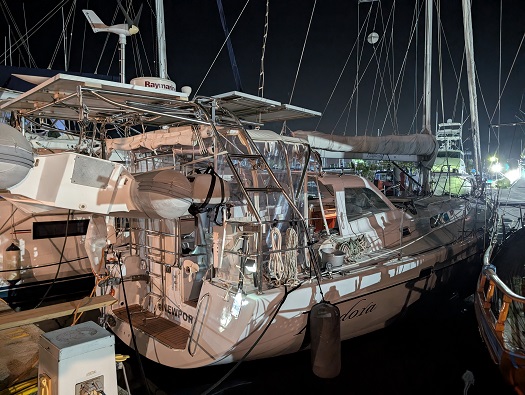
The first part of the process to prepare for the jobs was to install a proper cover as the sun is very intense and showers are common during during the summer rainy season. The details of the cover are impressive, far more intricate than what you generally see in the US. And, as it is very hot in Trinidad, good ventilation is critical. The entire structure is constructed of hoops of PVC pipe covered with shrink wrap and the sides are set up in such a way that the cover stands out from the sides of the boat, allowing for good ventilation.

The cover is done to a very high standard and is set up in a way that it leaves the solar panels open to the sun. Note the details at the stern with an awning over the transom and yet allows for easy access. And, having good ventilation is also key to keeping the AC unit operating efficiently.

I am impressed with the attention to detail in how the cover was constructed and the fact that the cover does not touch the paint in any area is a big plus. It also allows for any work on deck to be covered and yet still keep it from getting too hot. Well, “too hot” is a relative issue. It’s always hot…

The first part of the job was to remove the many layers of bottom paint that have built up over the years. It is the first time that all paint has been removed since the boat was commissioned in 2007. The paint was so thick that it was flaking off in all sorts of areas and impossible to keep smooth.

The first part of the job was to apply paint remover and give it all a good scraping.

Then the boat was tented and all remaining paint sanded completely off. I can only imagine how hot it must have been to do this job in full gear.

See the bottom, paint free. Then they turned their attention to the hull, polishing it to a high shine.

The next step is to coat the topsides with a thick coating of protective wax that will keep any contaminants or overspray from messing things up. It will be fully removed in the fall and any nicks and scratches repaired.

The biggest component of the refit will be to remove sections of deck that are wet. Fortunately, the damage is limited to the side decks and the rail, cabin top and dodger are completely dry. When I first discovered the problem last summer and took a moisture meter to the entire boat, inch by inch, I was relieved to discover that the problems were concentrated in areas that were fairly simple to repair. Don’t get me wrong, it is a huge job but when it is done all areas that could conceivably get wet will be replaced with foam core along with unaffected areas treated to ensure that no problems occur down the road.

In all honesty, after more than a decade running back and forth to points south, I should have taken Pandora to Trinidad two years ago. However, the decision was clear when I discovered the moisture problems last summer when I was planning to paint the decks myself.

Pandora, hull #3 of only three built of this design, might as well be a custom boat and when the side decks were laid up, the builder did not use a proper fairing to seal the decks and when the paint wore thin, water leaked into the core and made a huge mess.

The good news is that the moisture is limited to the open expanses of the side decks and virtually no hardware is affected so the repairs are fairly straight forward. The bad news is that it means ripping up about 40′ of deck. That sounds terrible but with labor rates in Trinidad relatively low, compared with US prices, it’s not nearly as bad as it would be in the US. Never the less, this will be the most expensive refit to date.

I hired a group aptly named “Perfect Finish” to do the job and over a period of about a month last summer, I shared details of the problem with them, did a number of video calls from aboard Pandora and we settled on pricing with a firm quote to do the job. Happily, now that the decks are all opened up and they now see the details first hand, they are standing by their quote.

The first step, beyond checking moisture levels was to carefully cut the perimeter of those areas that are to be replaced. Note that the portions of deck that have been removed do not invade the toe-rail or cabin sides which makes the fix much more straight forward.

The photo below shows the extent of the damage and it looks terrible. The plan will be to replace the soggy balsa core with foam and then replace the fiberglass before putting on a substantial epoxy barrier coating. After that Awlgrip and a non-skid surface. The problem, that lead to this, was that the fabric itself was not thick enough and there was not not a substantial enough epoxy barrier applied before painting the decks so when the deck paint became worn, water got in.

Opened up it looks plenty scary. The good news is that I know a number of boats that have had this sort of work done by this group and it worked out very well. And, the guy in charge of the job knows that I am a very fastidious owner.

After all the decks are repaired, the entire deck, cabin and cockpit will be barrier coated and repainted with non-skid in the mix along with the entire cockpit. Basically, every thing above the rail will be newly finished. As the topsides paint has been kept up every year, Pandora will look like a new boat.

Because of the deck moisture problem, the wainscoting in the forward cabin sustained water damage and it is all being stripped down to clean wood, bleached and coated with 10 coats of varnish.

The companionway has received a fair amount of spray over the years and was not finished to withstand conditions like that. As a result, it was quite water-stained. Again, sanded, bleached and ten coats of varnish, along with the steps which will have integrated non-skid applied.

Additionally, I have asked them to refresh the varnish on the dining and cockpit tables along with cleaning up a number of other worn varnished areas below along with a refresh on some of the cabin headliner.

I also arranged with a canvas guy to service all parts of the enclosure and replace most of the vinyl as well as the top of the sail cover which is sun damaged. All and all, all of the canvas and glazing in the enclosure and bimini etc. are getting a refresh.

And, as if all this is not enough, all of the tempered glass windows in the hard dodger are being removed and re-bedded. This image is from some time ago but there are two tempered glass windows on the front and really big ones on the side. All will be removed and replaced with new adhesive. And, the center section, that is showing age now, is getting new glazing.

As big a list as this is, there’s more and when Pandora emerges sometime later in the summer she will look like a new boat. I am quite excited and look forward to visiting in August to inspect the work.

After reviewing everything in August, I will return home and then go back in late October to put her back in the water and move her up to Antigua to welcome the Salty Dawg fleet in mid November.

Pandora has been well used and driven hard for thousands of miles since we purchased her in 2015 so it is time to take a hard look and address whatever is needed to keep her in good shape as we prepare Pandora for our next big adventure, crossing the Atlantic and time aboard in the Mediterranean, beginning next year.

It’s hard to imagine what the future holds but I can’t help but wonder what my Dad, now gone for ten years, would say if he was with us now. I can still remember when he said to me “Bob, wouldn’t it be great to take Pandora through the straights of Gibraltar?”

Yes Dad. That’s the plan.

Our next big adventure? Pinch me…

The dark side isn’t all that dark…

Today at 06:00 George and I pushed off from the dock in Chesapeake City to transit the Delaware River and head north to New York and onto Essex. Our next planned stop is perhaps Sandy Hook or perhaps somewhere in NY Bay. I guess we will have to see how the run goes. It was a simple departure compared to a sailboat where there are plenty of lines to pull and very different accommodations.

I, for one, have always imagined heading to a trawler at some point, although I am not above declaring those who have as having “gone to the dark side”.

The tides heading east through the Canal run fast and while the charts called for a strong tide against us this morning, that wasn’t the case. We had a fair tide and a bit of a push for the full transit.

Once we began heading down the Delaware River we began feeling a bit of foul tide, as expected but that should turn in our favor in a few hours. As George runs at a bit over 8kts, we do make a bit more progress than I’d be doing with Pandora under power when we move about 6kts. Not a big difference but that’s another 50 odd miles in a 24 hour run.

With 50 or so miles between the Canal and the mouth of the Delaware River, we should get there mid afternoon and then turn left and up the NJ coast for NY.

There’s not much to photograph along the way. How about the Salem nuclear plant.

In honor of the nuke, a photo of solar aboard. Both green? Tough to say but there is clearly a renewal of interest in nuclear as an option for carbon and global warming. Funny how the threat of everyone’s TVs turning off is changing some attitudes toward nuclear power and, I suppose, nuclear waste. As long as it’s NIMBY!

Salem has been in operation since 1076 and is certified to continue through 2036 and 2040 for units one and two respectively. That is a long time and given the growing concerns about carbon emissions, we are likely to see more plants being built in the coming years. More to come on all that, I guess.

It’s a busy day on the river with a number of small trawlers doing the run along with us. I expect that we will all arrive at the mouth of the river at about the same time.

George uses the Navionics charting program on his iPad and taught me something about that program that I had not known. It seems that the program will automatically chart a course for you adjusted for water depth and air draft, to pick the fastest route.

In the case of Pandora with a 63′ mast and gear, we’d be run down to the mouth of the river but with George’s boat set to a safety water depth of 10′ and a air draft, clearance, of 15′, the program routed us across some more shallow areas and through Cape May. I did not know that the program would do that. You learn something new every day.

Here’s the route, compliments of Navionics. It’s magic!

Departing from the dock this morning was a very simple affair. George fired up the engine, I tossed off the lines and off we went. Not a lot of fuss, no pulling up sails, and due to his shallow draft, 4.5′, no fear of running aground.

More to come I guess. One thing though, if the engine quits, no sails.

With apologies to Scarlett O’Hara: “I won’t think about that today, I’ll think about that tomorrow.”

Or, as Rhett Butler, sort of, said, “frankly my dear, I don’t give a damn.” Well, not until something bad happens, at least…

Besides, if the engine were to die, sailboat or not, there’s no wind today. Flat calm.

I could get used to this. Perhaps the dark side isn’t all that dark after all.

Historic Chesapeake City: A trip down memory lane.

As I write this, I am on passage from Baltimore to Essex, helping to bring a friend’s, new to him, 36′ Nordic tug. Oddly, as a boat owner for decades, this is the first time that I have helped someone else move a boat any distance and my first time on a powerboat.

I could get used to this. Lots of room.

My friend, and often crew member, George and I drove down to Baltimore on Wednesday evening and, after a bit of provisioning this morning, headed off to Chesapeake City, one of my favorite spots. George has helped me on the Caribbean run a number of times and has been a longtime sailor.

This week was a big one for him as the day before he closed on the sale of his old boat and now we are bringing his new boat up to CT.

He seems pretty happy to be at the helm although some of the systems are still a bit of a mystery to him. We won’t dwell on our runup on a mudbank shortly after leaving the slip. No, we won’t talk about that. Spoiler: We got off and George is still smiling.

Chesapeake City, located on the C&D canal, connects the upper Chesapeake with the Delaware River, it is a great staging place for a run down the river, up the NJ coast to NYC and then down the Sound to Essex.

As the weather isn’t looking all that for another day, we decided to spend two nights in Chesapeake City before heading down the river. The run down the River and up the NJ coast will be an overnight. It has been years since I have been up past NYC, through the East River so that will be fun.

In fact, the last time I was through there was with Brenda on our first run south in 2012. It was quite an experience knowing that we were heading away from home for many months and that our trip would take us all the way south to FL and the Bahamas.

Our son Chris was a grad student at Columbia at the time and raced us down the East River, all the way to the Battery.

We beat him and waved to him as we pointed the bow to the lower harbor and a bit bitter-sweet to head toward Sandy Hook and begin a new chapter afloat. I wrote about the experience in this post, Brenda’s tears and all.

At the time I had no idea how far our travels would take us. Neither did Brenda… But that’s another story as we gear up to head to the Mediterranean next spring.

Anyway, I have now been to Chesapeake City a number of times over the years and it is nice to be here again, this time with George. However, nothing will quite compare to that first visit with Brenda so many years ago. Since you asked about that visit, here is a link to a post about that first visit in this post.

Last night we anchored in the basin, newly dredged by the Army Corps. Last time I was here I ran Pandora aground when we rounded the point to enter the basin with our 6’6″ draft. It’s a lot deeper now as the entire basin has been dredged this year.

This morning we pulled up to the free dock. Pretty nice spot.

The town was originally formed to support the canal, which was much more primitive at that time, only a few feet deep and the boats had to be towed through by mules who walked along on a path alongside the canal. It is much improved now. The downtown streets are lined with tiny homes, many with beautiful gardens.

I’ll bet that the owners of these homes had mixed emotions about the addition of this bridge that now looms over the canal. The good news is that the bridge opened up the town to many more visitors but it can’t be fun to have a huge bridge tower over your quaint little home, I’d think.

Tomorrow we will head out early and make our way, sadly against a foul tide, to the Delaware river for what will be our first overnight on George’s new boat. Our run will take us up to NYC and his first up the East River. George has crewed for me to the Caribbean a few times but always directly from Montauk south.

We visited the Canal Museum that tells the story of what is one of only two sea level canals, those without locks, in the US.

The most amazing thing about the canal is that it was originally dug by raw human labor including the most major work that was done during the depression when it was enlarged from a modest waterway to one that can handle many of the largest ships in the world today.

Before it was dug deep enough to avoid the need for locks, it required a way to pump in water to feed the locks and allow boats to be raised and lowered. The pump was steam powered and moved 1,000,000 gallons of water per hour. That’s amazing as the engines were only 125hp and each scoop of the wheel moved 20,000 gallons, enough to fill a swimming pool. A remarkable feat of Victorian engineering.

The pump no longer functions but is preserved in the museum.

The two engines and water wheel combined take up three rooms. This small model shows the two steam engines that power the water wheel. The photo above is the left pump.

Some of the specs for the engines that ran for over 80 years with only a single breakdown.

As you can imagine, it took a lot of people to service the canal, including dining and lodging, workers and visitors that were transiting the canal.

Many of the modest homes, Inns and shops are still here, lining the streets of the tiny downtown area.

One cuter than the next.

So, tomorrow at 06:00 we head out for our 65 mile run down to the mouth of the Delaware and the 110 miles up to the lower harbor of New York, at Sandy Hook.

That will be the first big trip for George and his new boat but this visit has been more of a trip down memory lane for me.

I like being here. A lot has happened since that visit…

Scroll to Top