


The people of Cuba, uncommonly nice.
We anchored off of a small resort island, Cayo Levisa, our last stop before we head the 60 miles to Marina Hemmingway and Havana prior to heading back to the U.S.. This lovely little island offers great protection from the coming cold front that should hit us tonight bring with it strong northerly winds for the next few days. There aren’t too many spots along the northwest coast of Cuba that provide good protection from such winds and being safe and comfortable is key for us as we prepare for the weather.
Our first night here Brenda made a wonderful pasta dish of bacon, tomatoes and fresh bok choi. I mention this, not because it was a particularly unique dish as Brenda’s a great cook and we east very well aboard Pandora, but because it’s been 15 days since we have been anywhere to get fresh produce and our stores are pretty low. I should note, we still aren’t anywhere near a produce stand so that begs the question of exactly where we were able to get fresh bok choi. Hold that thought for the moment.
I have been struggling for the last few weeks of exactly how to describe the wonderful interactions we have had with the people, especially in the rural areas, here in Cuba and perhaps our “bok choi experience” is a good example.
As we move from place to place in Cuba, our travels are strictly monitored by the Guarda Frontera, a military/police force that check us in and out again from most of the places that we visit with the exception of the most rural cayos. When we arrived here at Cayo Levisa, I headed ashore with our papers, passports, list of Pandora’s particulars, our USCG documentation and “despacho” or cruising permit to check in.
I was met at the dock by someone from the resort who informed me that I had to return to Pandora and wait there for two hours until the Guarda Frontera officer arrived from the mainland on the 18:00 ferry to check us in.
At the appointed hour the officer arrived on what appeared to be a dive boat from the resort which circled Pandora as it arrived, officer waving, and continued to the dock. I jumped in my dink and headed to shore. As is nearly always the case, I was greeted warmly by just about everyone on the dock including the Frontera officer, dressed in his uniform. Black shoes, slacks and white dress shirt, complete with “official” looking epaulets on each shoulder.
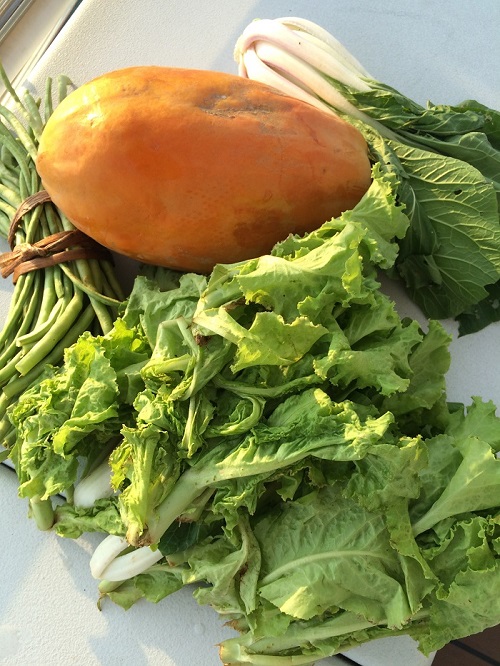
The captain of the dive boat also introduced himself with a hearty handshake and presented me with a perfectly ripe, enormous papaya. Now, I can’t say that I am a huge fan of papaya but I was very touched by the gesture. So, back to Pandora I went with the officer and my papaya to complete our paperwork. Sometimes the officers make a brief inspection of Pandora but in this case he didn’t and just filled out his paperwork. They almost always ask questions about us and the boat that go beyond the information that they need for their forms so it’s clear that they are just curious about the boat, us and our travels. It’s pretty clear that they don’t see many cruisers, especially from the U.S. and are always interested in learning more about us. Brenda and I always enjoy these friendly exchanges.
Questions answered, we said our goodbyes and I took him back to the dock. I was still thinking about the gift of the papaya and had decided to give the captain a bar of soap as a thank you. The captain accepted my gift with a hearty “gracias” and motioned for me to wait a moment. He retreated to his cabin and emerged with a bundle of fresh greens, bok choi, leafy lettuce and some green beans, delivered with a big smile. Now it was my turn and he gently let me know that if I had a tube of silicone or perhaps a spare screwdriver aboard he’d be very pleased as it was tough for him to get such things in Cuba.
 Now, the more jaded among you might say that the whole exercise was designed to soften me up so I’d give him something, and clearly it was. However, the process was done with such care and grace that I found it to be quite charming and a good example of our many exchanges where Pandora’s crew received something and so did they.
I told him, as best I could that I’d see what I could do and would see him “manyana”. We parted with smiles. The next day I presented him with a “Vicegrip” wrench that I had that was a duplicate in my tool box. He seemed to be very pleased.
There are so many basics that we take for granted in the U.S. that Cubans just don’t have access to. As a result, they are always looking for items to check off of their “wish list”. Razors and lengths of line for boats are always very popular. I wish that I had known as I have hundreds of feet of extra line at home that I’d be happy to give away. Perhaps next time.
Another wonderful exchange occurred a few days ago when we were approached in a very remote anchorage by two fisherman that wanted to sell us some lobster. They approached us in a small rough rowboat and showed us their catch. They had come over to us from a “fishing station” a sort of “home base” on the water, a number of shacks and docks built on pilings out in the water where they managed their catch and lived between trips to the reef to fish.
Anyway, we bought their lobster for a few CUCs each. 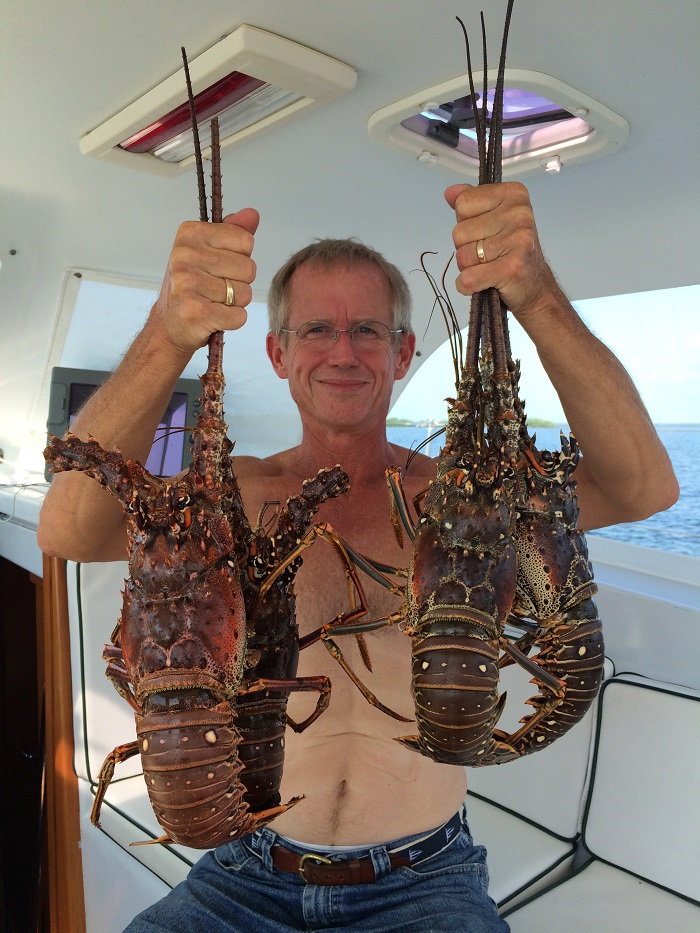 After our deal was done one of the fisherman took off his cap and retrieved a single playing card, the queen of hearts. After a bit of back and forth, it became clear that he was asking if we had any playing cards. I didn’t know if he wanted to play cards with us or if he wanted cards but I “played” along anyway.
One thing led to another, I went below and returned with a deck of cards. His reaction was amazing. He and his partner both clapped their hands and let out a “whoop”. What a great reaction and a good example of our many exchanges over the last two months here in Cuba. In the U.S. it is so easy for us to get just about everything we need but here in Cuba they are on a constant quest for even the simplest items. This experience was another example of the very friendly “culture” we have encountered, especially here in rural Cuba where the simplest gesture or “gift” is so appreciated. I expect that this will be lost in the coming years as Cuba reengages with the U.S. and consumer goods are more readily available to them.
Don’t get me wrong, it is unfortunate that the fisherman had to work so hard to get something as simple as a deck of cards, but it was his approach and the gentle manner that struck me as so “Cuban”. And I, for one, was pleased to be so appreciated by such a simple gesture of the gift of a deck of playing cards. (Brenda wrote about this encounter too, but with her own take, and you might want to check it out at www.argoknot.com)
While I am on the subject of fisherman, how about this “boat”, more of a raft made of a framework of boards on top of what appeared to be truck tire tubes stretched out with the cut ends tied with rope. I can’t believe that they row miles offshore in these fragile craft.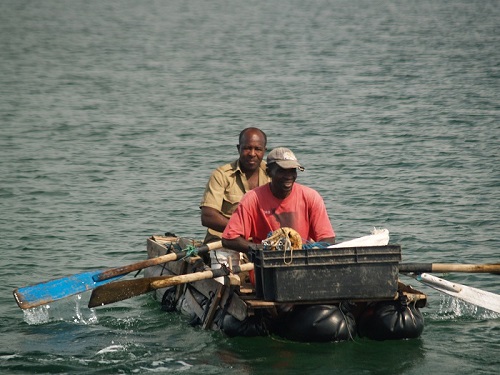 We bought some lobster from them too (our freezer is jammed now) and as they headed away they hoisted a rough sail to help them on their way toward the mainland, still miles away. What a sight.
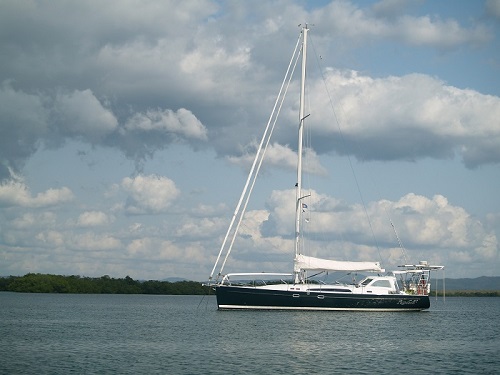
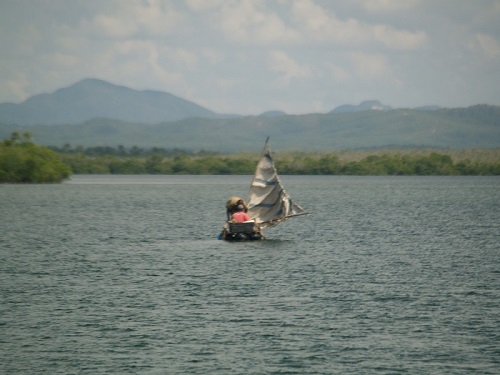 As we made our way up the northwestern coast of Cuba over the last week we have visited some beautiful cayos with just spectacular scenery. This shot of Pandora with the mountains in the background was particularly lovely.
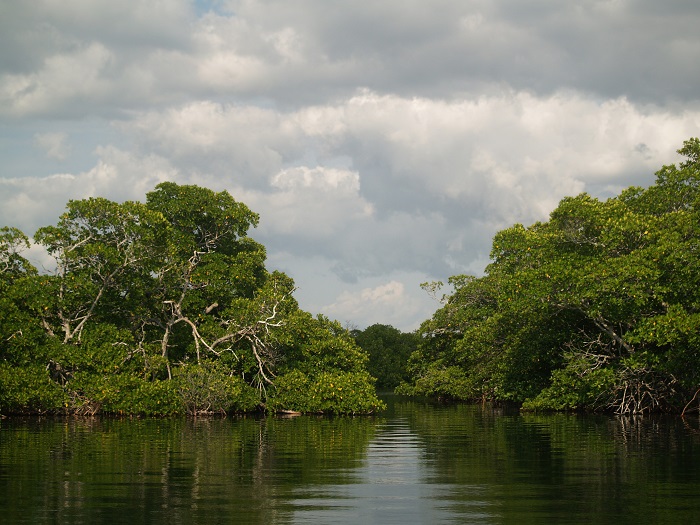
 We anchored in the lee of some remarkable mangrove stands, some of which had trunks that were 18” in diameter and perhaps 60-75’ tall. I have never seen mangroves of that size and have to wonder just how old they must be.
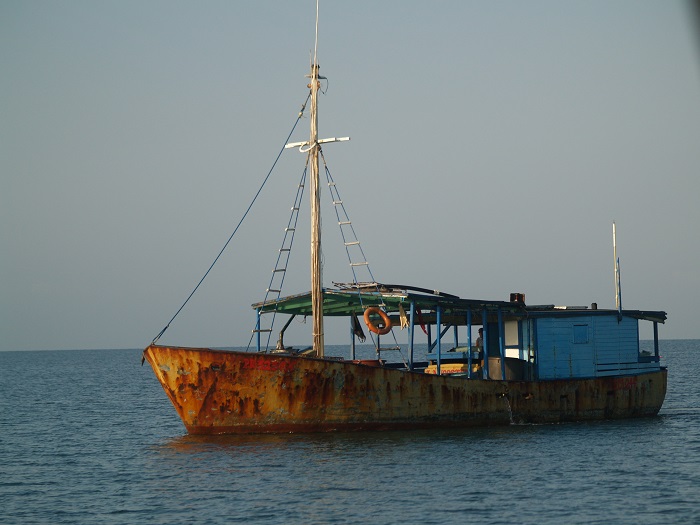
 In one of the spots we anchored for the night, we shared the cove with a group of fisherman on a ferocement boat. The boat was very rough construction of iron bars with a cement coating. I expect that they don’t last very long but this type of boat is very popular here in Cuba.
 They waved to me, I visited and was invited aboard. The captain was very nice but his English was no better than my Spanish.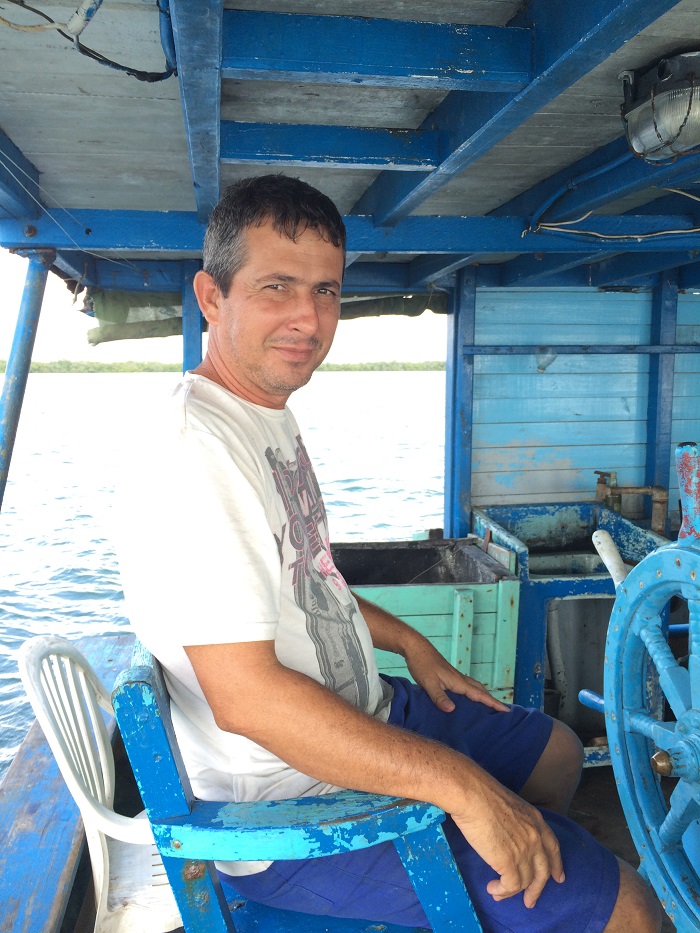
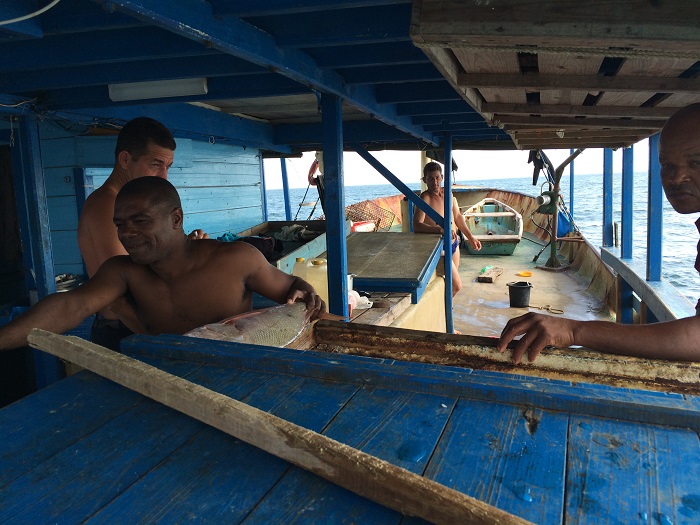 One of the crew was happy to show me some of their catch.
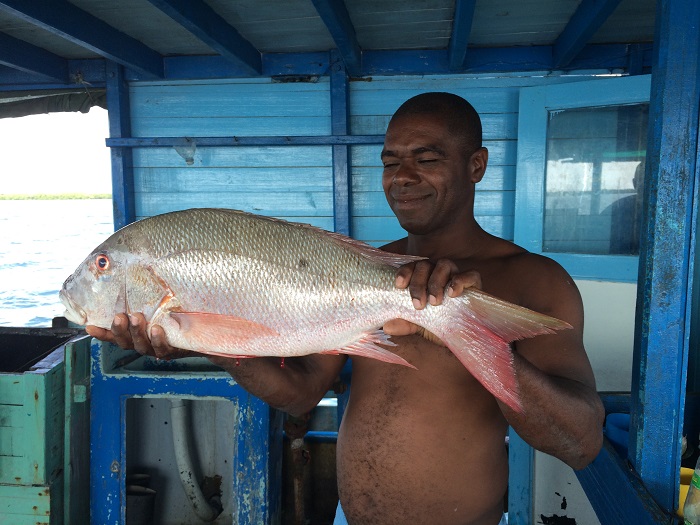 The next morning Brenda and I watched as each crew member donned a wetsuit and jumped in the water. After a while we realized that they were picking up sea cucumbers from the bottom of the bay and filling their “baskets”.
 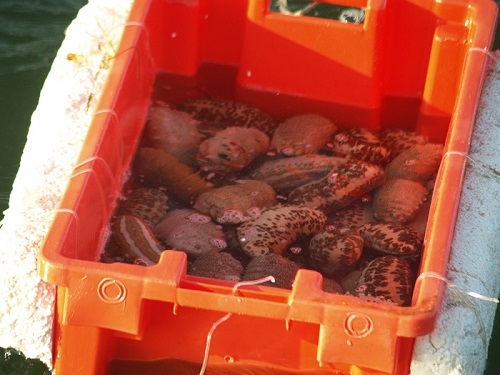 I haven’t seen this on any menus here in Cuba so perhaps they export their catch. I know that sea cucumbers are very popular in Japan.It seems that like so much of life in Cuba, these fisherman are very opportunistic and catch whatever they can. Fish one day, lobster the next and then on to sea cucumbers. Their fishing techniques are so low tech that they are easy on the environment as they don’t have access to the sorts of equipment that is the mark of “industrial fishing” elsewhere. I expect that a more “open” Cuba will lead to overfishing.
Earlier this morning I spoke with Chris Parker about the coming cold front and learned that there isn’t likely to be another “window” to make the 60 mile run to Havana for perhaps a week. That’s a long time but fortunately, this is a lovely spot and the holding is good so, wind or not, we will certainly enjoy spending time here until we can continue our run east to Havana.
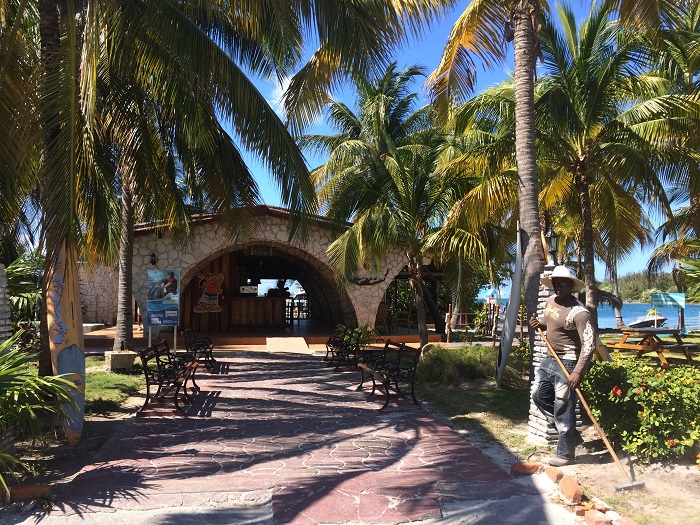
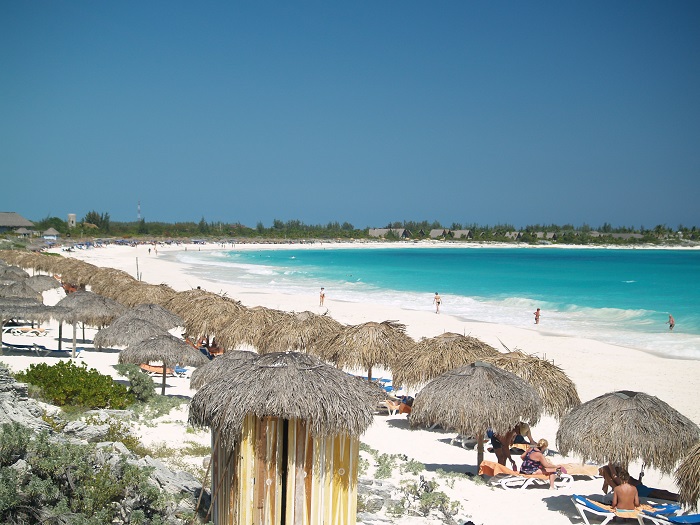
The island is a resort with perhaps 50 bungalows and a nice restaurant along with a great beach so being “weathered in” won’t be so bad. It will certainly be better than being stuck in a mangrove swamp with 500,000 of my closest “no-see-um” friends, that’s for sure.
After we visit Havana and head home to the U.S., it will be good to be back in “civilization” but we will look back fondly to the wonderful people we have met in our nearly two months of cruising Cuba. I have never encountered a group of people who are harder working or approach life with more grace and it has been an inspiration to experience, first hand, their pluck and determination.
Cuba will certainly change in the coming years and I encourage you to visit here soon to see for yourself this very unique place and culture of uncommonly nice people.
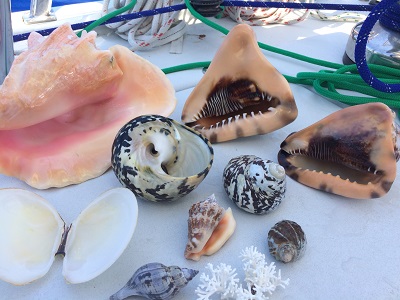
 And, there is a great view of Pandora right out in front.
  Interestingly, a cerveza (beer) is $1CUC if you buy a single can or a case in a grocery and the price doesn’t change if you purchase a full case. And a beer in the bar is also $1CUC, the same price as in the grocery. Go figure. To that point, we have found that most consumer goods seem to be sold at set prices regardless of where you purchase them. For diesel, it’s always a pretty high $1 CUC/liter as the price is set by the government.
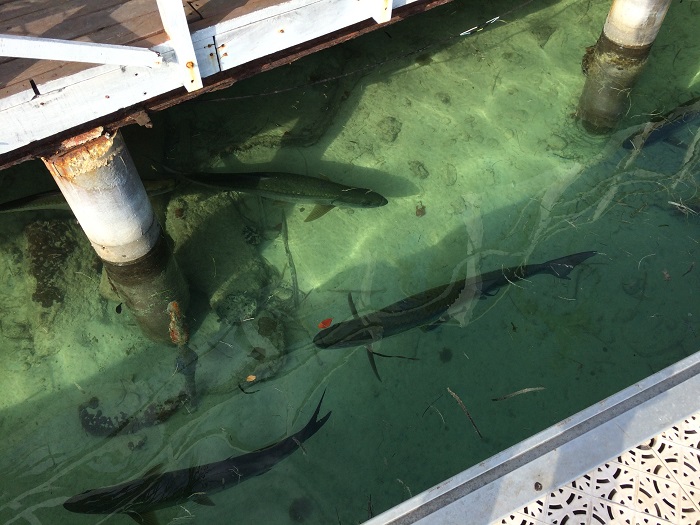 This area of Cuba is known for spectacular diving and I have to say that the amount of sea life, even close to the marina is remarkable, especially compared to The Bahamas, where we have spent a lot of time.
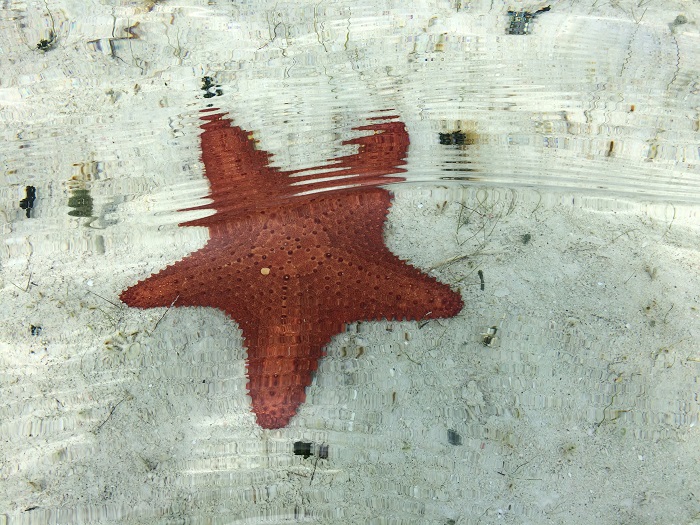
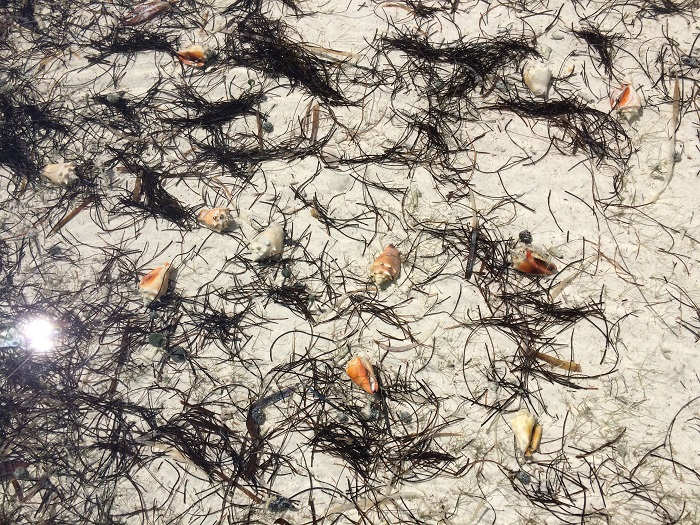 If you didn’t see the ripple on the water you’d never know that this starfish was even in the water. This one measures a foot across.
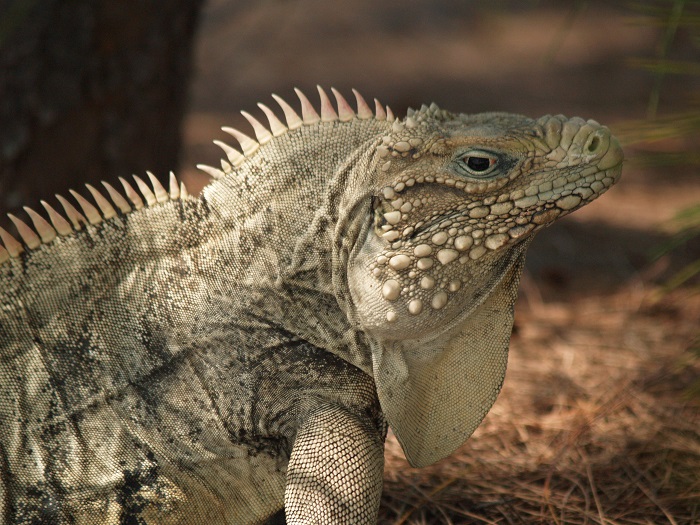
  And, just above the surf line there is a very healthy population of iguanas. This big guy was looking for a handout and was pretty intimidating at over 4’ long. There are some like this in the Bahamas too but they only populate a very few islands. Here in Cuba they are on many islands. A few years ago one of the Bahamas colonies was wiped out in a hurricane and some “stock” from here was used to repopulate. They are pretty fearsome looking creatures.
 I expect that once Cuba is “discovered” by folks from the U.S., there will be much more pressure on the environment. Yes, there are a lot of tourists from all over the world here but I expect that an “American Invasion” is going to have a big impact.
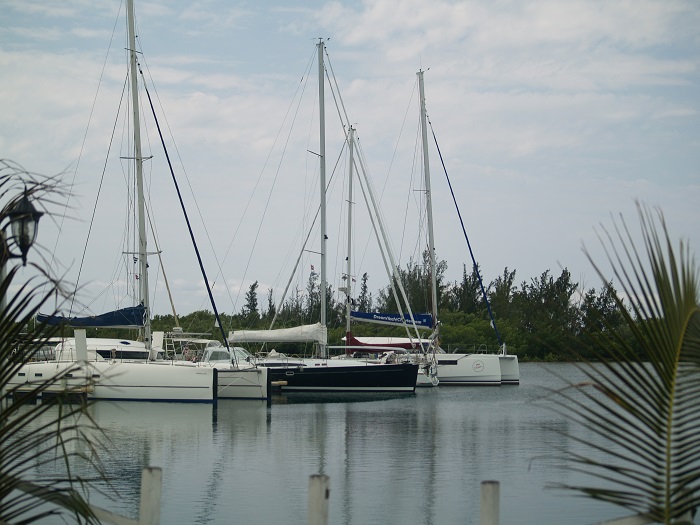
 This huge catamaran makes the rounds between here and Cienfuegos as we have seen her several times including blasting by us on her way back toward Cienfuegos as we made our way here the other day. Catamarans are clearly the popular choice verses monohulls here in Cuba and there is a busy charter community, both bareboat and crewed.
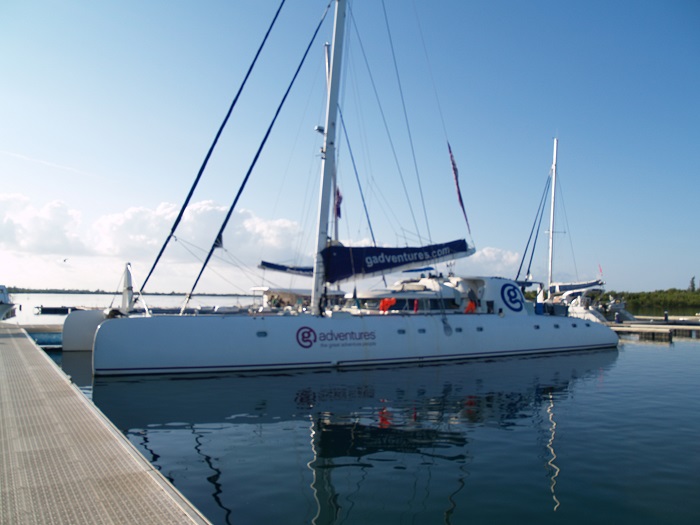 Every day dozens head out for snorkel trips here at the marina and to head to some of the nice reefs nearby. The crowds aboard those boats are a bit different than what Brenda and I experience aboard Pandora where the mantra is “six for cocktails, four for dinner and two (that’s us) sleep on board”.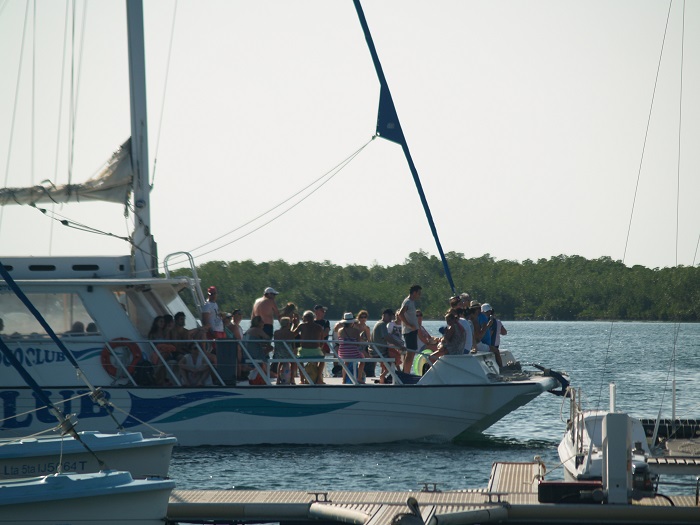
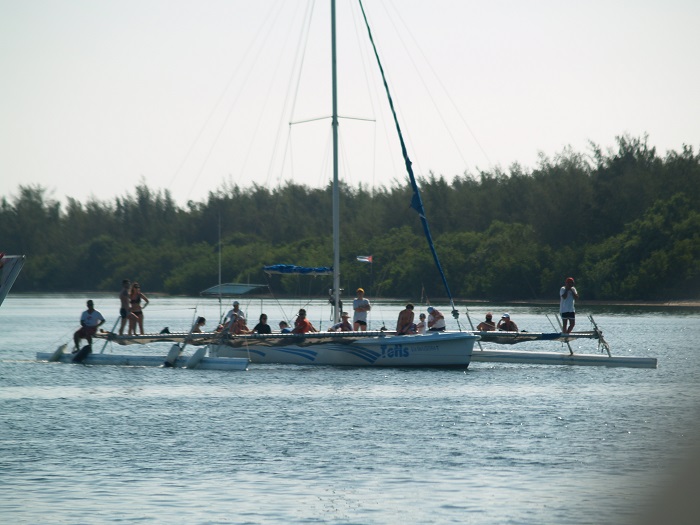 While there only a handful of boats here it’s a very international group including France, Luxembourg, England, New Zealand, Norway, Sweden and even Russia. And then there was little old Pandora with us Yanks. Here’s some highlights from just the last two days.
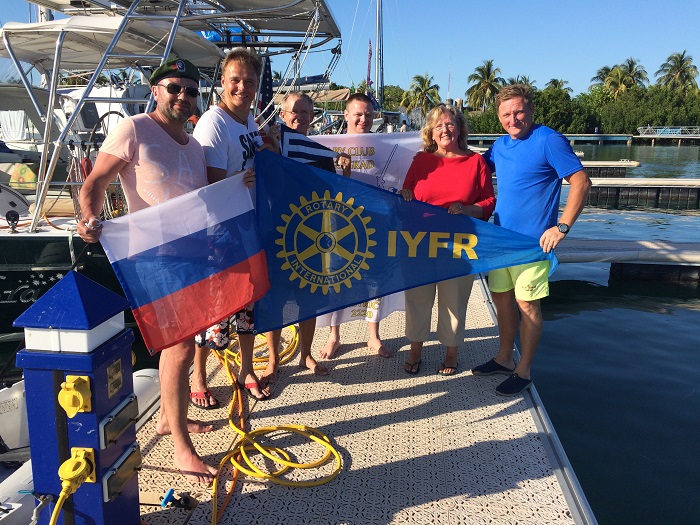
 A group of guys chartering a boat here on holiday from Russia. Did you know that there is a branch of the “Rotary” in Russia and one that’s focused on sailing? It never occurred to me. it’s the International Yachting Fellowship of Rotarians. No kidding and Oleg Karpeev, is the president. They posed with me and Brenda near Pandora. One of them was even named Igor (the first real live Igor we have ever met) and their English was WAY better than our Russian. Everyone had to get into the shot. They were a lively group.
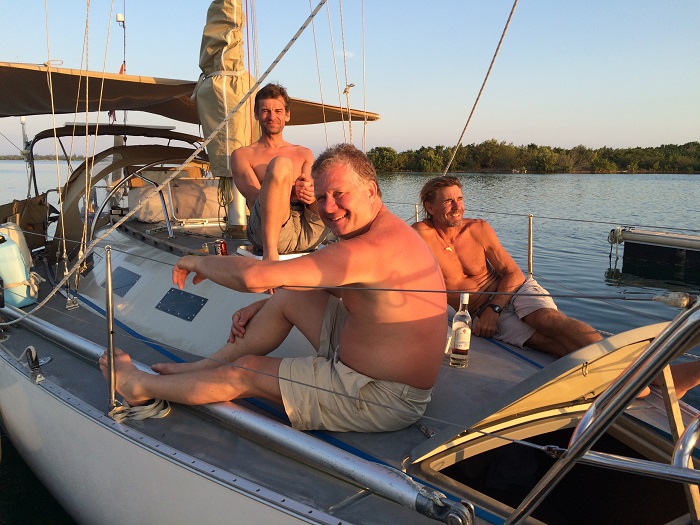
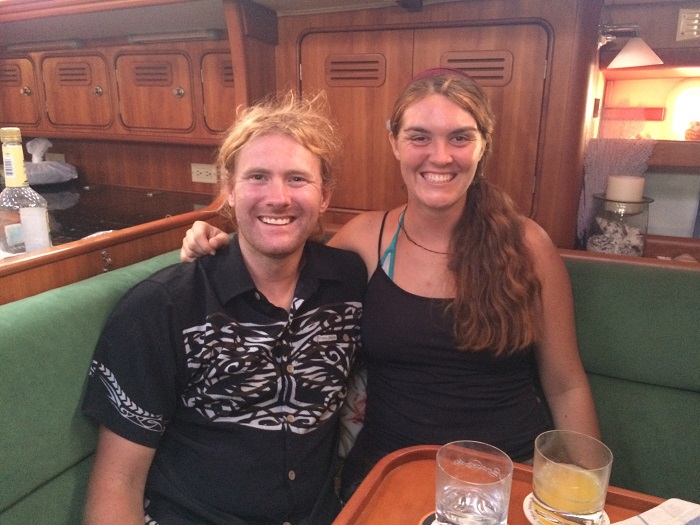
 We also enjoyed cocktails with a young couple Monique and Garth, barely 30 years old, who have been sailing for three years, beginning in New Zealand aboard their boat Heartbeat. They have made it all the way across the Pacific, “up hill” against the trades and if that’s not amazing enough, they both suffer from “mal-de-mer” for the first few days of every passage. Tough “kids”. After Cuba they will be sailing to Europe or “wherever”. Monique keeps a blog, which I have not yet checked out, at svheartbeat.blogspot.com. I understand that they post about weekly. I look forward to following their travels. We tried to convince them to visit us in CT but were unsuccessful. Oh well, perhaps we’ll visit them in New Zealand someday. That would be great fun.
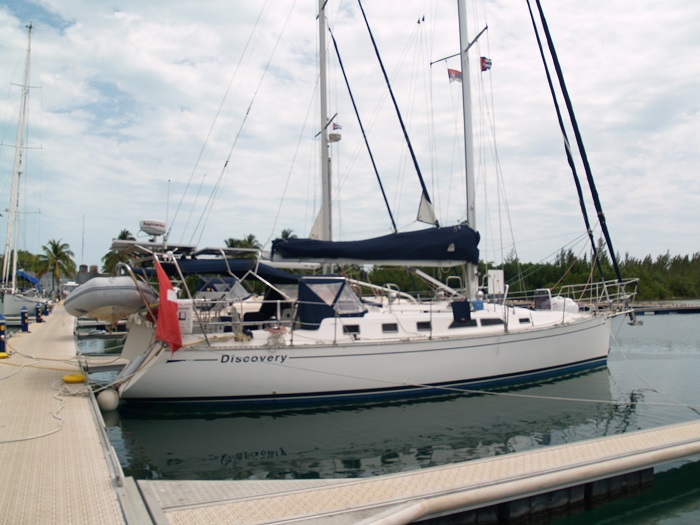
 Firmly secured in the “It’s a very small world” department, this SAGA 43, sistership to our last Pandora, Discovery, was recently purchased by a Swiss couple was on the dock next to us. They had looked at our old Pandora last winter while we were in the Keys and then decided to purchase my friend Carl’s Discovery instead. Bumping into them here is further proof that it is indeed important to be on your best behavior wherever you go as you just never know who you are going to run into. The folks in the sailing group SSCA call this “leaving a clean wake” and we are sure glad that we have. Well, as well as we know, anyway.
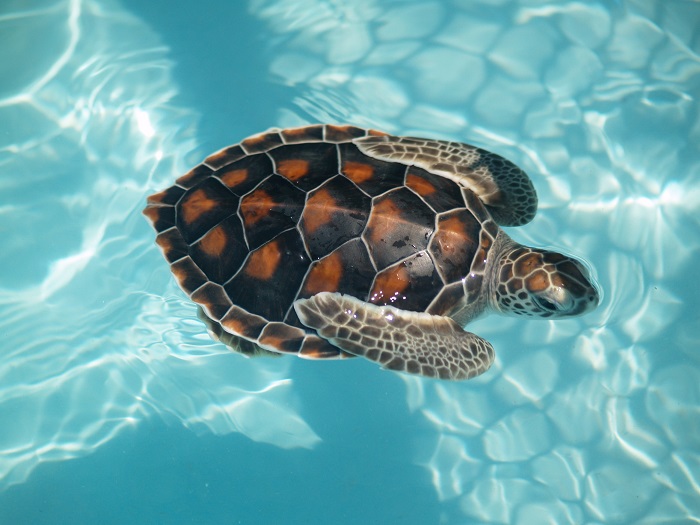
 One of the most beautiful beaches in Cuba is on this island and each year thousands of sea turtles agree and visit here to lay their eggs. In order to ensure the future of these magnificent creatures, the island has established a turtle “nursery”. They dig up the eggs and transplant them to a protected area and then raise the hatchlings in pens so that they can later release them into the wild. This way the survival rate is much higher.
 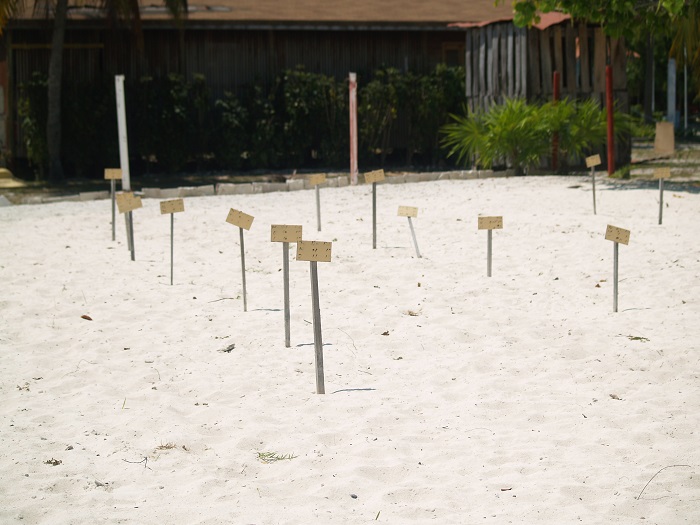 This little guy was about 15’ long. A beautiful creature.
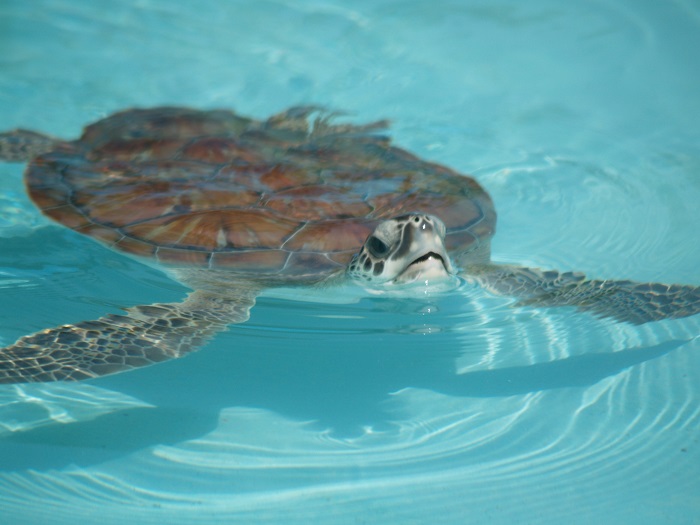 Several pools were full of little 6’ long juveniles. The patterning on their shells is remarkable. I was amused by how the placed their front flippers while resting. “look MA, no hands”
 This area is also the first we have seen since entering Cuba that has nice beaches. Much of the coastline is very rugged east of here and there is a healthy collection of lighthouses. The designs are all over the lot. For sure, most of them are quite utilitarian and seem to shout, “stay away”. Oddly, this one on the NW corner of the island is on a craggy point perhaps a mile from deep water.
 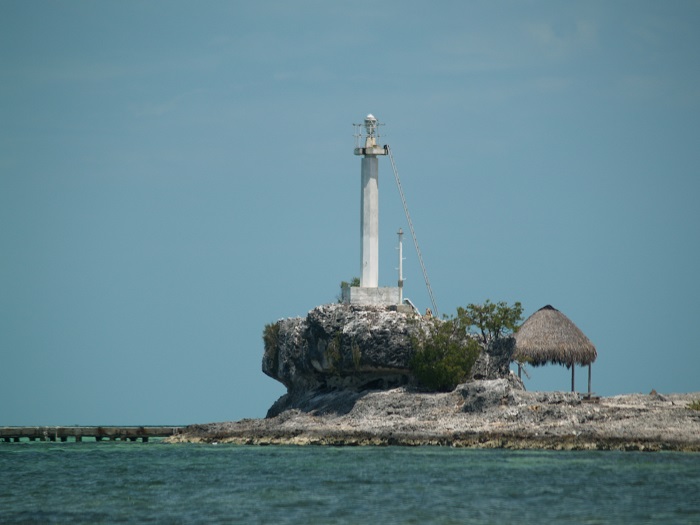 We have seen quite a few marks that are placed a good distance inside the shallows so you have to pay very careful attention to the charts lest you get into shallow water where you don’t expect it. We have heard a number of cruisers who know of friends who have lost their boats.Pix
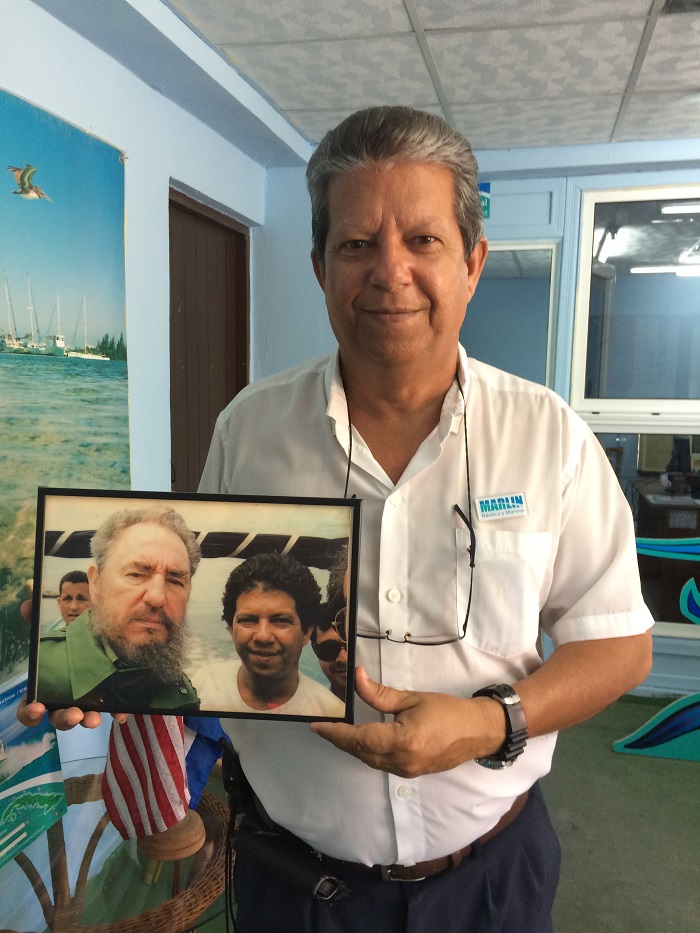
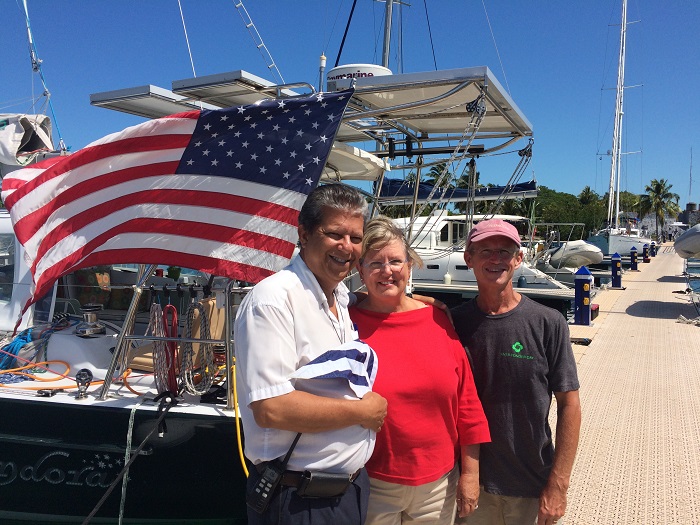 Later I visited with him in his office and he showed me that he has both American and Cuban flags on his desk.
 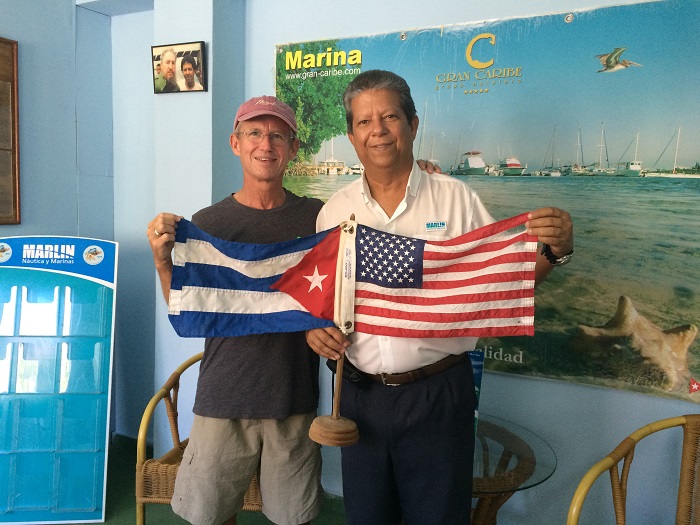 With things changing in many ways, perhaps there will be an opportunity for Pier to visit us in the U.S. to talk about visiting his homeland. That would be terrific. I am sure that there would be lots of interest on our end for sure.
 All and all, being in the “other” Largo has been a treat and it’s going to be tough to pry ourselves loose from here as we continue our journey west.
 Here in Cayo Largo, an island far from the coast and a major tourist spot, the process is much simpler and here at the marina it has proven to be very simple indeed.. The official responsible handling such things actually came out to Pandora, took our $50CUC renew fee along with our passports and said that she’d take care of everything. And, as promised, she did and delivered our “new” visas back to the boat this morning. How great (and simple) is that?
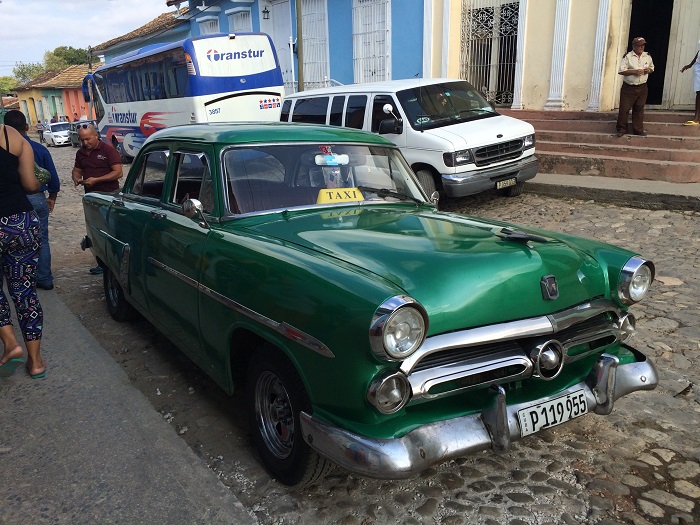 The ride took us through some beautiful country with miles of sugarcane fields and mango trees. Along the way we also happened upon an amazing site, thousands of land crabs, pretty big at about 8-12” wide, making their way across the road, some with limited make that VERY LIMTED success, in making the crossing, Ie: crushed by passing cars.
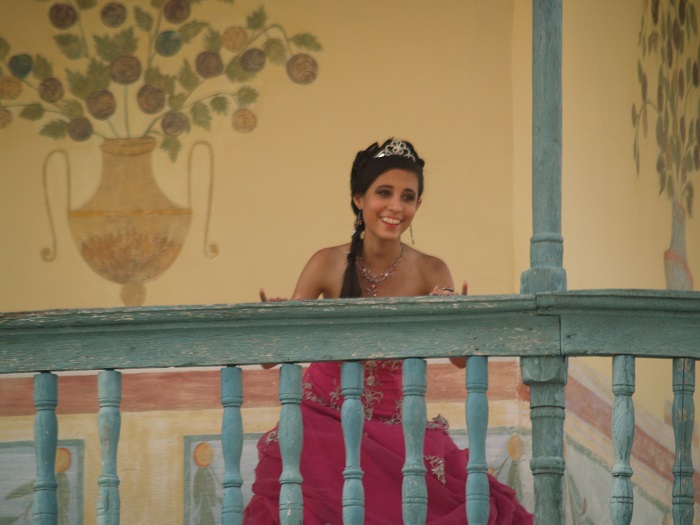
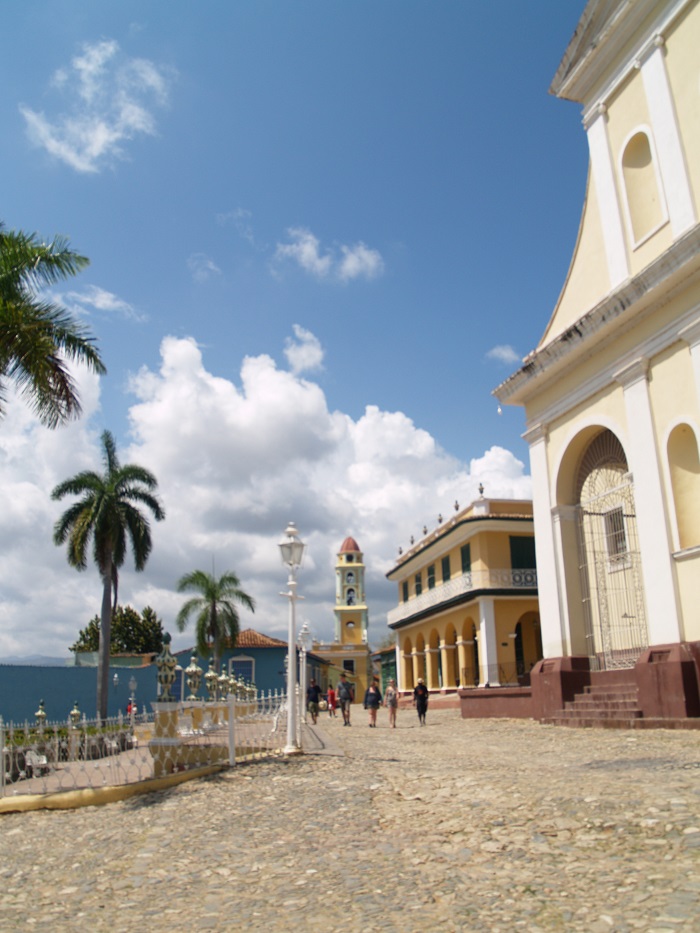 On the balcony of one of the buildings on the square there was a young girl posing for a photo shoot. She looked lovely in her ball gown.
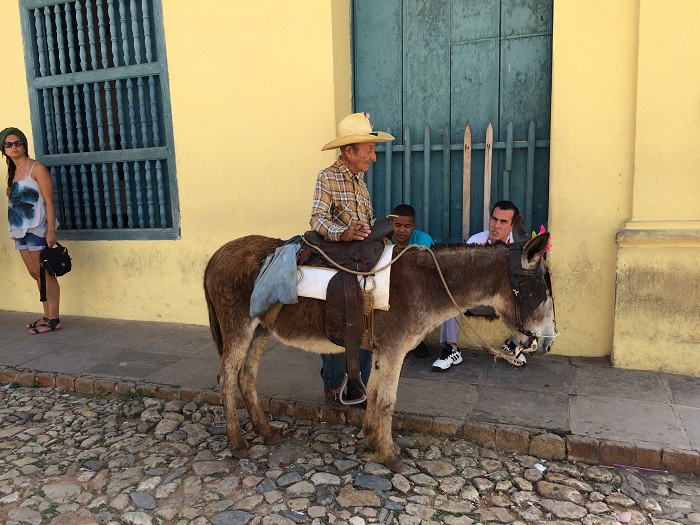
  As a contrast, how about this donkey and cigar smoking old guy? I sure hope that nobody ever refers to me with that phrase. “Yeah, that’s Bob, you know, the old cigar smoking guy.” So far, so good.
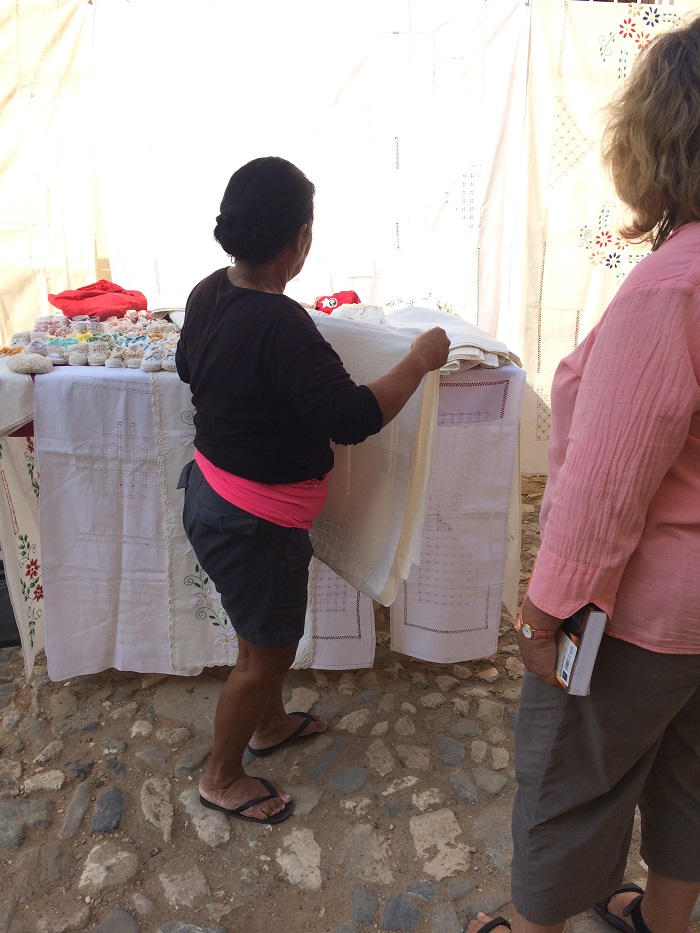
 There were many craft stalls on the side streets. Brenda purchased a lovely hand finished table cloth. Those who know here are aware of her “linen problem”. Good place for Brenda to visit to “scratch her itch”and scratch she did.
 For me, we purchased a “guayaberia”, a traditional Cuban cotton wedding shirt. Sorry, no picture but you’d recognize it if you saw one.
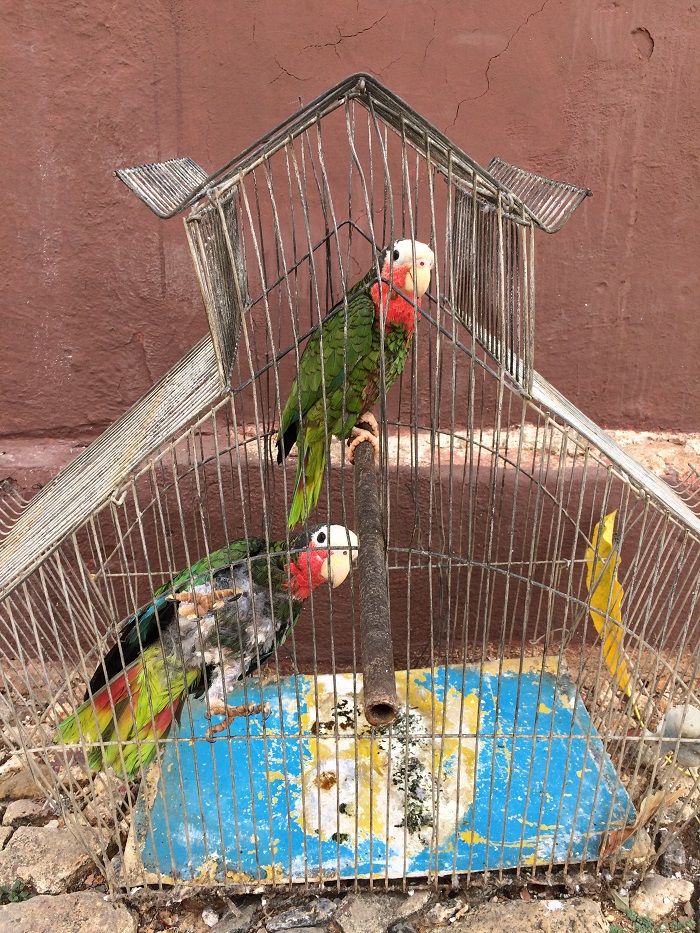
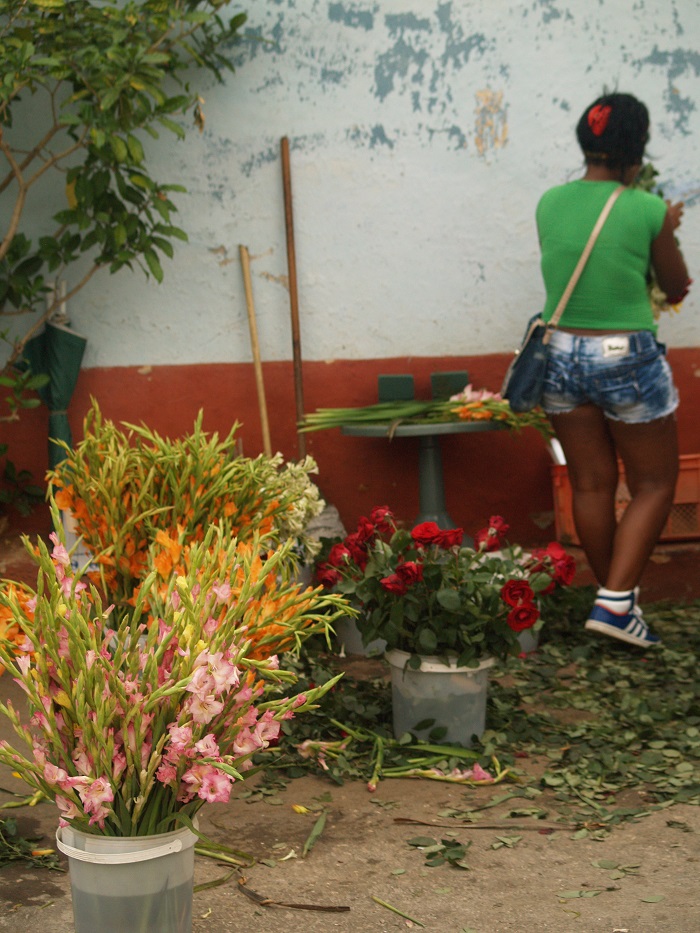 As always, cages with exotic birds most everywhere. It’s not uncommon to see cages hung in windows along the street with little colorful finches.
 As just about everyone is in Cuba, Trinidad is very focused on “touristas”. However, there are plenty of Cubans going about their daily lives here and it was nice to see a group of students on an outing.
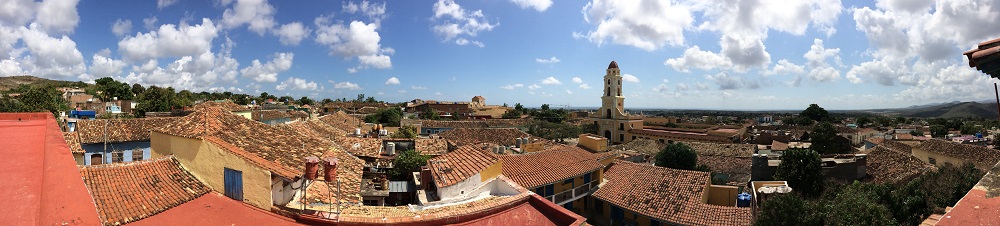
 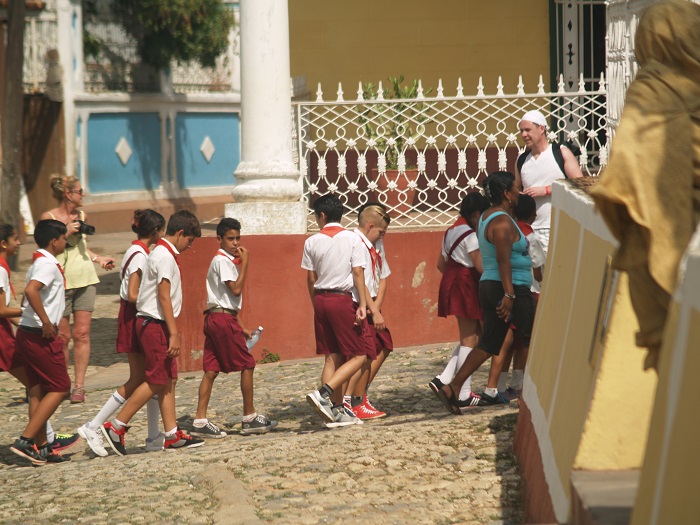 In Cuba all students wear uniforms. It’s a nice touch. The color of the fabric tells you what grade level they are. We were “invited” to climb up to a rooftop to view the city. Only $1CUC each. Such a deal! Such a view!!!How about a panorama? Click the photo to make it larger if you wish.
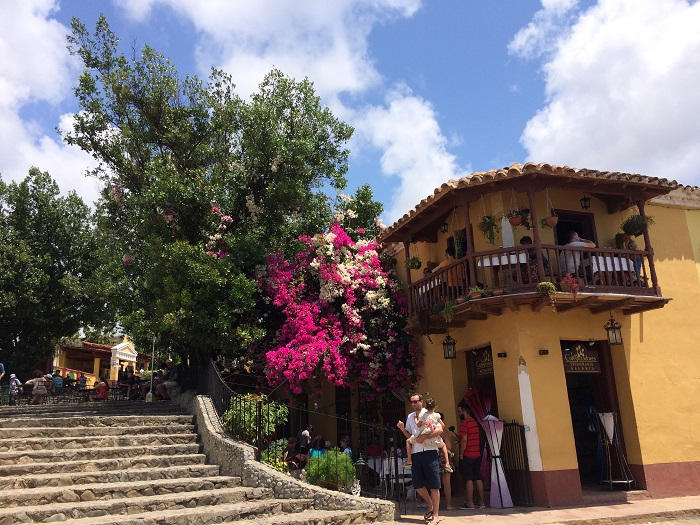
 The highlight of the day was lunch on the balcony of this quaint restaurant. And, the food was good too.
 It’s been a few days since we left Cienfuegos to make our way here to Cayo Largo. As we left the harbor we saw this lovely fort. It was certainly a very different world way back when such a fort was needed to protect the city from invaders. I expect that those entering the harbor at that time probably weren’t “touristas”
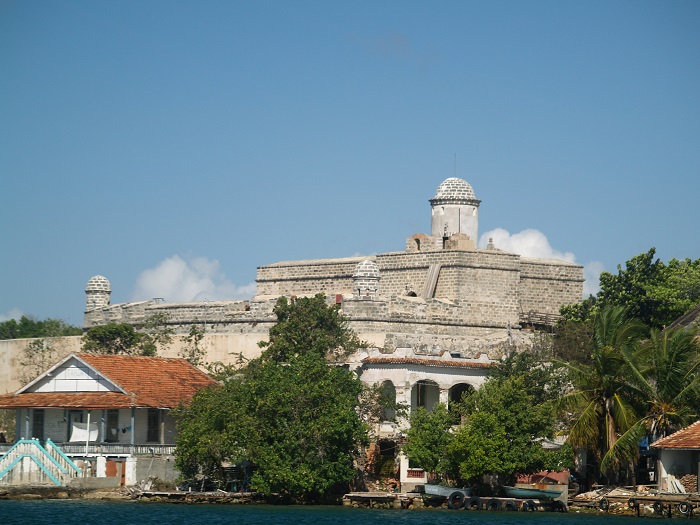 We stopped at an uninhabited cayo for two nights. It was a bit rolly with a wrap-around swell from the ocean. Brenda didn’t like that, even a little bit. Pretty rugged coastline with some nice reefs for snorkeling.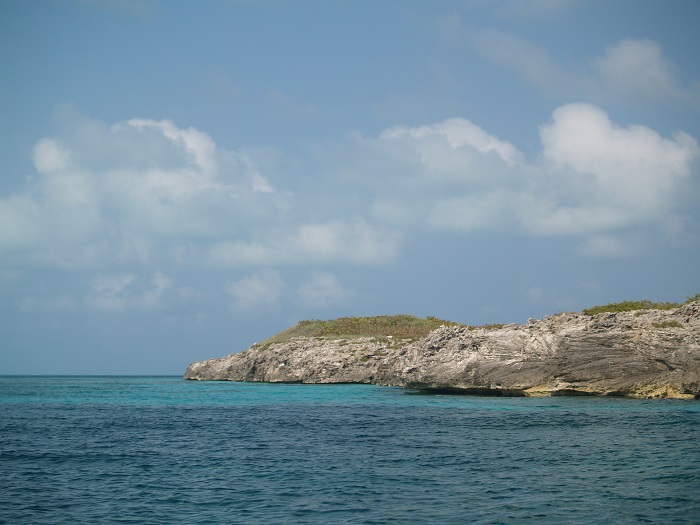
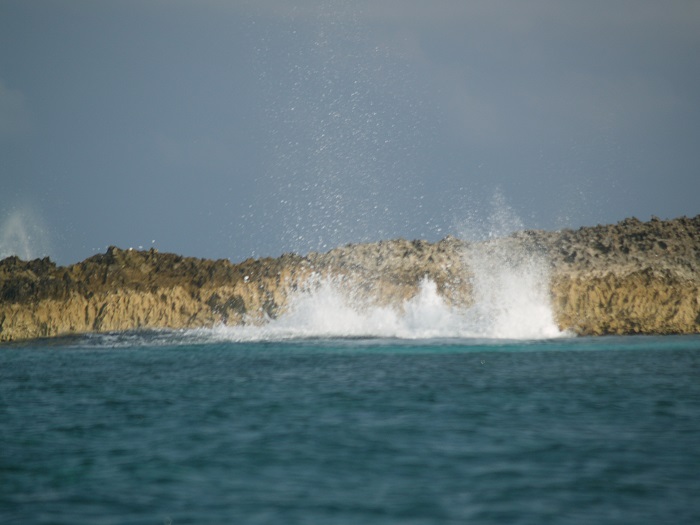 Well, I guess that’s about it for now as I sit here in Pandora’s salon enjoying the cool AC. However, it’s not that great as we can’t run it very cold or we blow a fuse. The electrical power at marinas in Cuba is suspect at best but “sort of cool” is better than hot. It’s a nice change of pace and I am not complaining.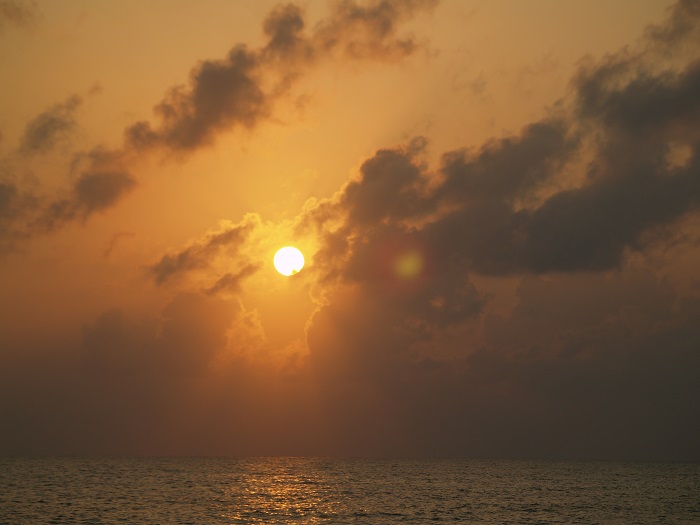
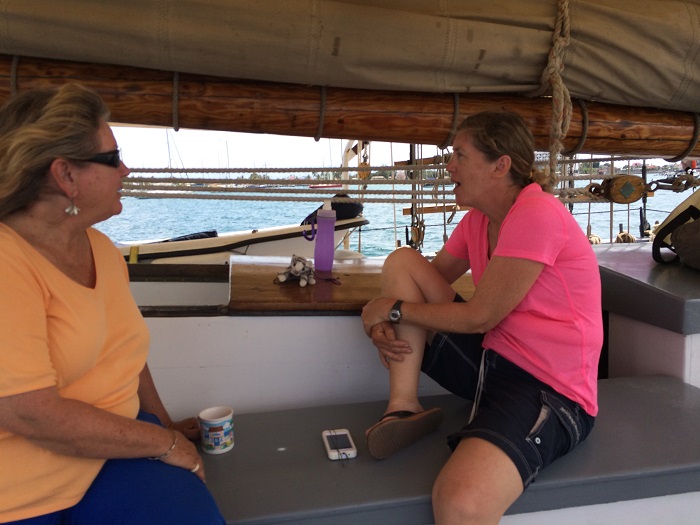
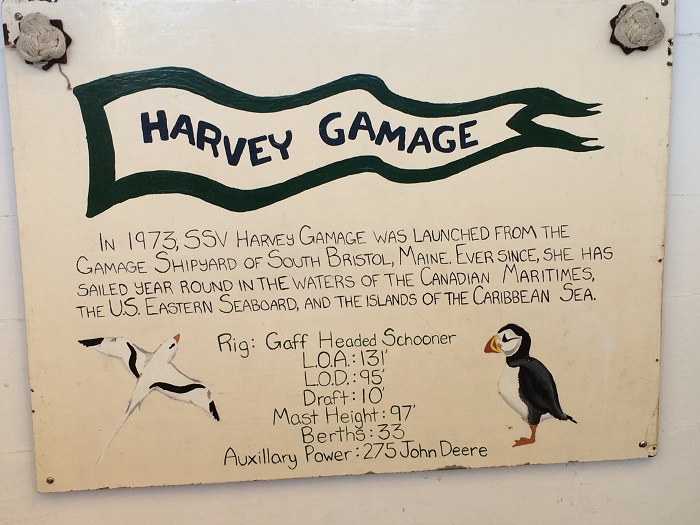
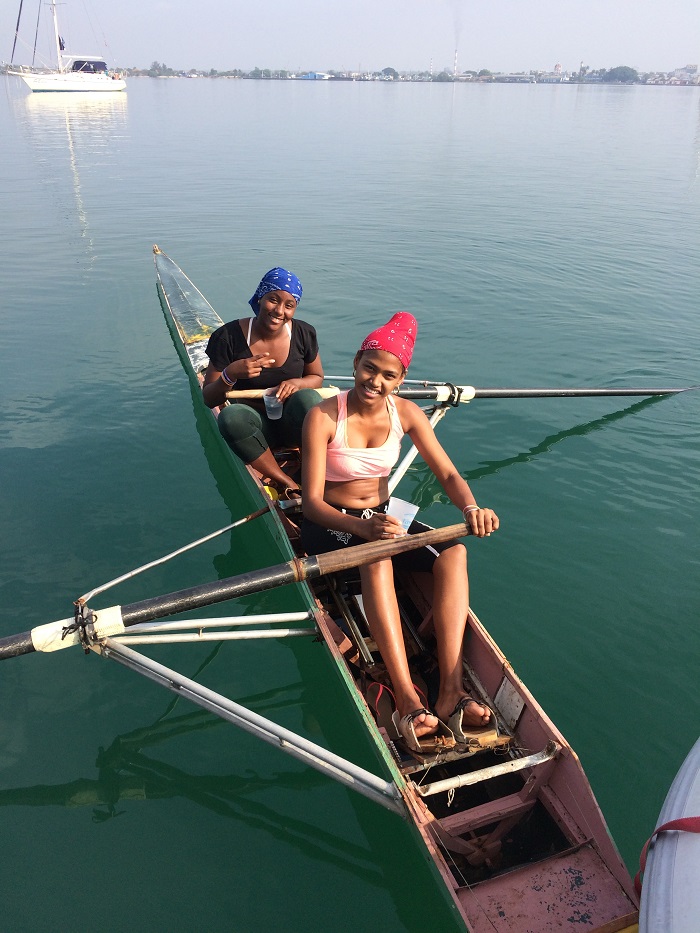 Interestingly, the other day, the Harvey Gamage, a schooner from Portland Maine that does educational programs, arrived here in the harbor. We have seen her many times over the years as we cruised in Maine. I stopped by to say HI and learned that they are visiting Cuba to check out possible options to hold educational programs in the future. They too had taken a long time to get the appropriate approvals to come here.
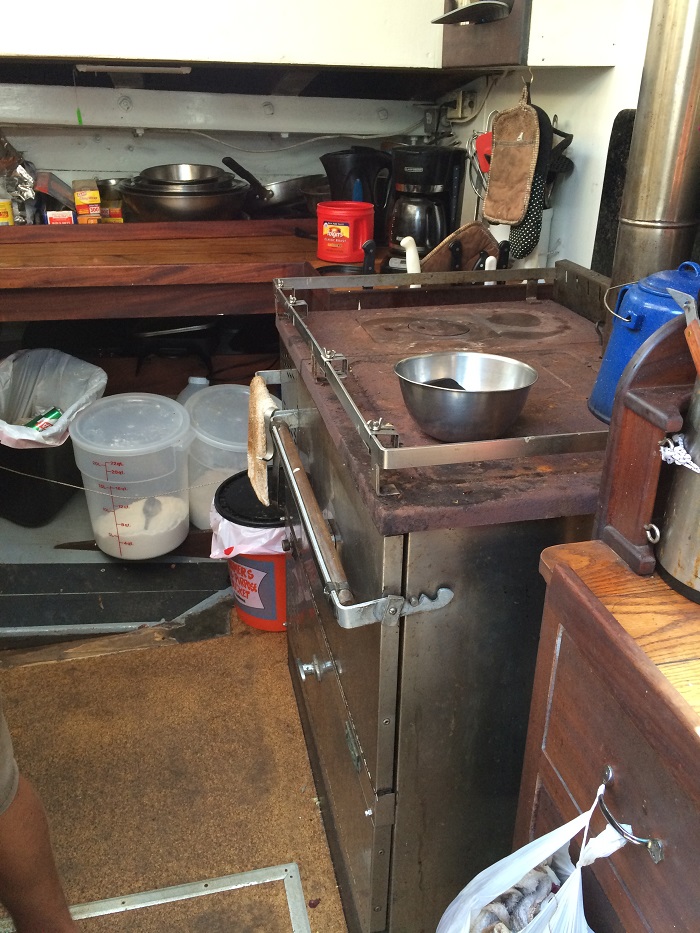
 They do their cooking on a diesel fired stove, I think they call it “the beast”. It takes over an hour to heat up so they have to be sure that they are really ready to be hot and NEED to have something cooked before they commit to all that heat down below. I’ll bet that it can make the galley nearly uninhabitable on a hot day.
  Did I say that it’s hot here?
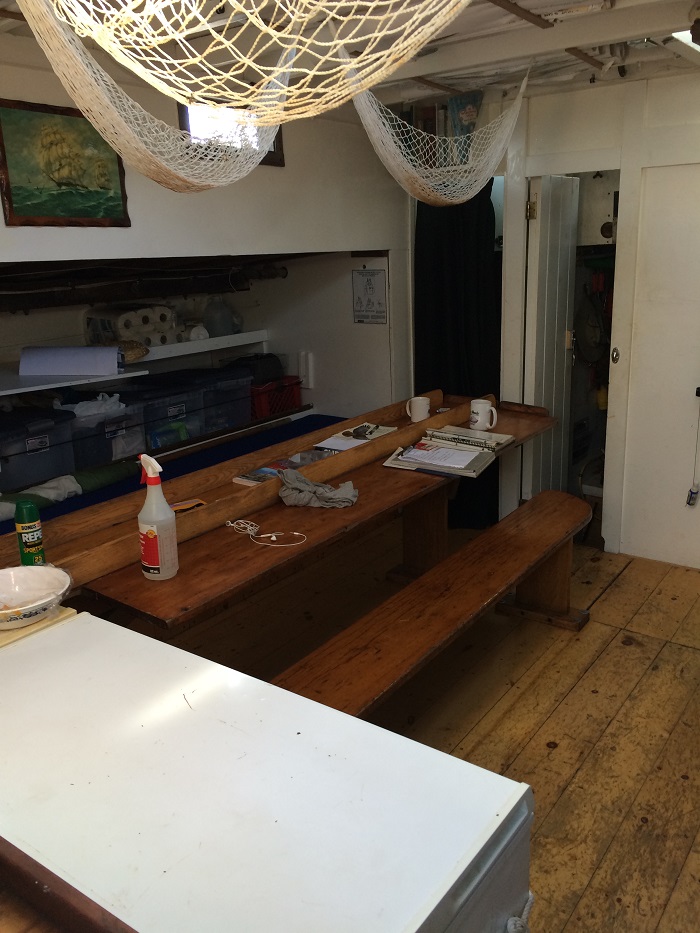 The Harvey Gamage was built in 1973 in South Portland Maine, the last ship to come from the yard of the same name. She splits her time between New England and the Caribbean on her educational mission. She’s nearly 100’ long and draws 10’. That’s a lot of boat and just cooking for a hungry group of hard working sailors would keep things hopping and hot up in the galley.
 On deck she’s all business and well maintained.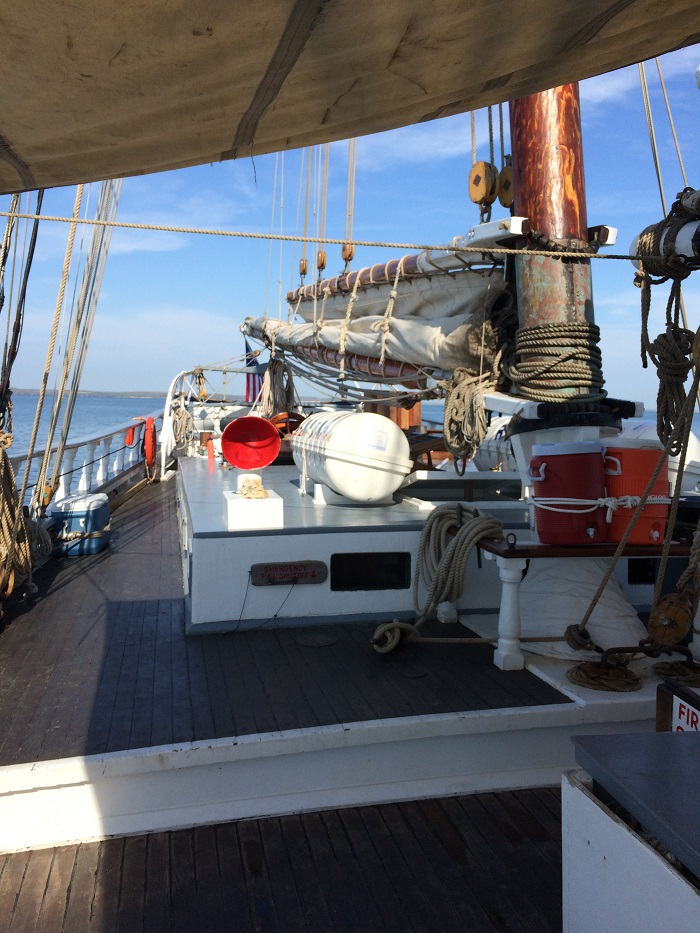
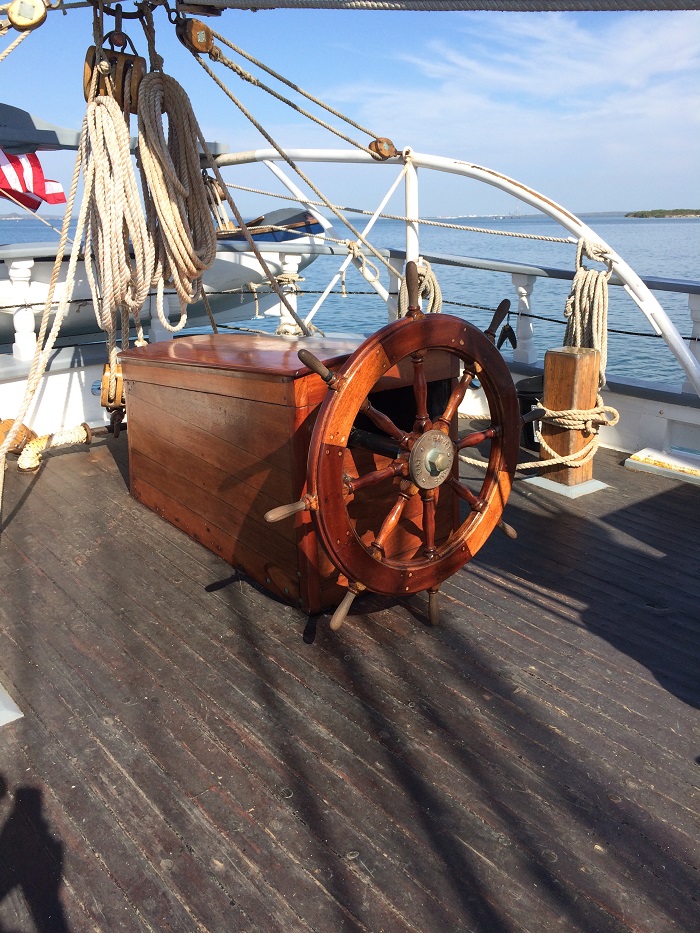
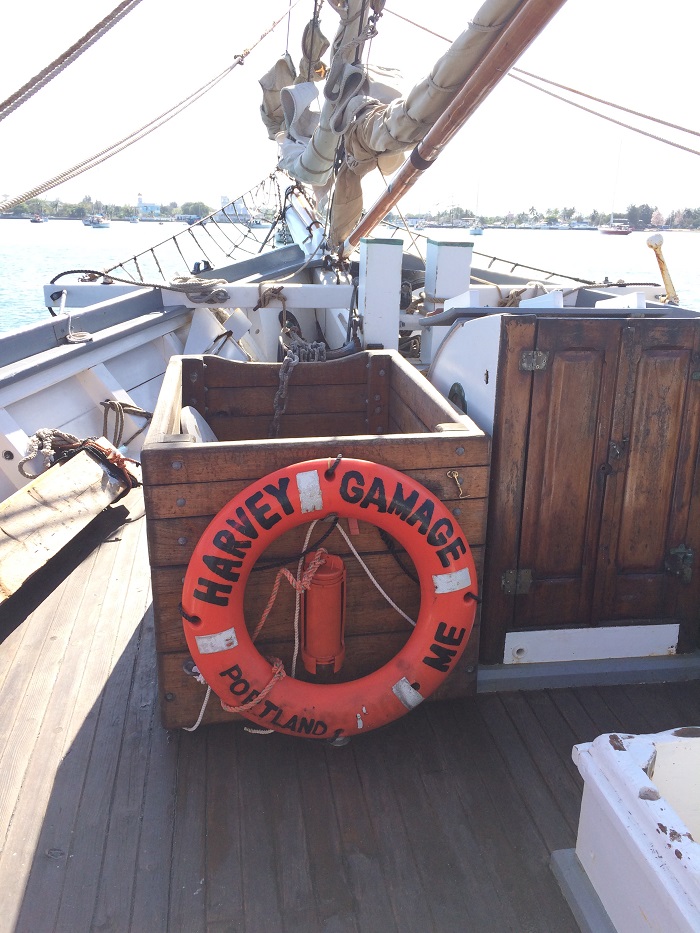
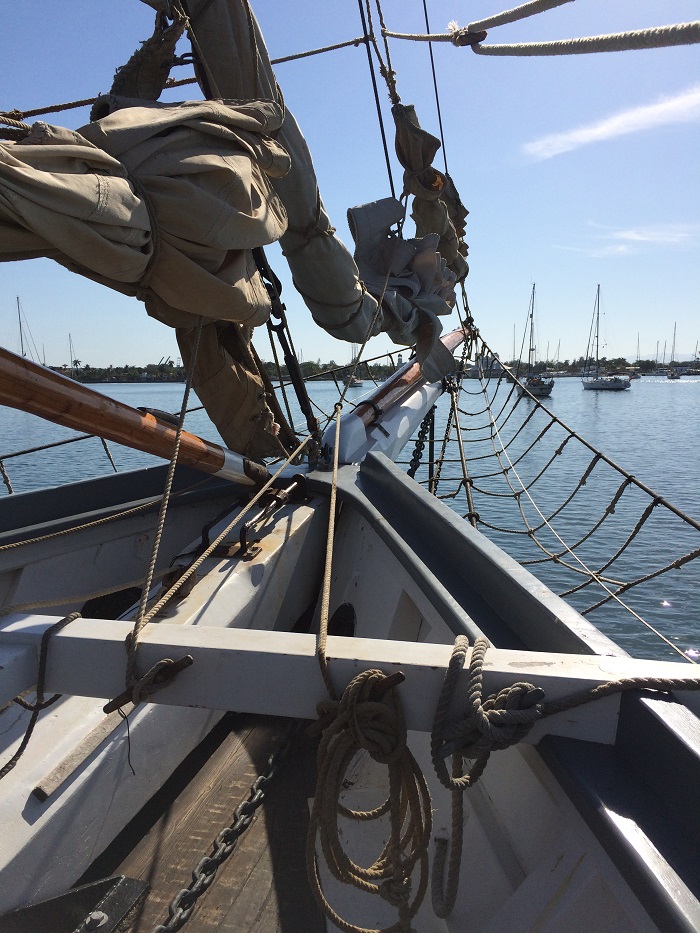 It would be great to have her visit the CT River Museum in Essex to put on one of her educational programs. I am sure that the community would really embrace any activity that they brought to town. However, with a mast height of 97’ and a CT River Rt 95 Highway bridge clearance of 81’ it might take some surgery with the top mast to make it under, even at low tide. It’s still worth exploring though so I think I’ll pay another visit to her before we leave here in a few days.