


St Kitts, an island of many faces
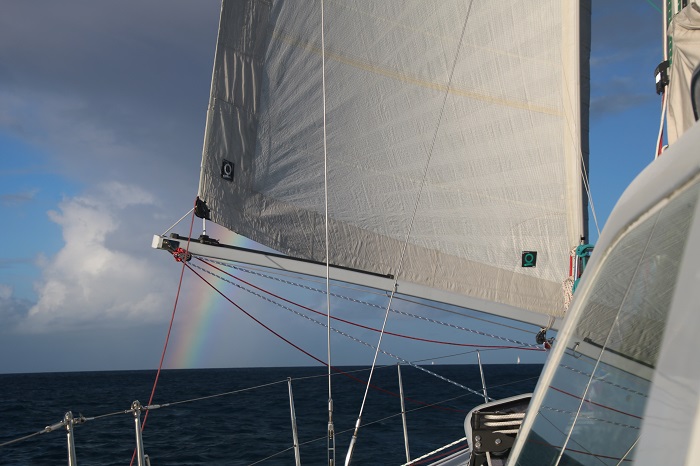
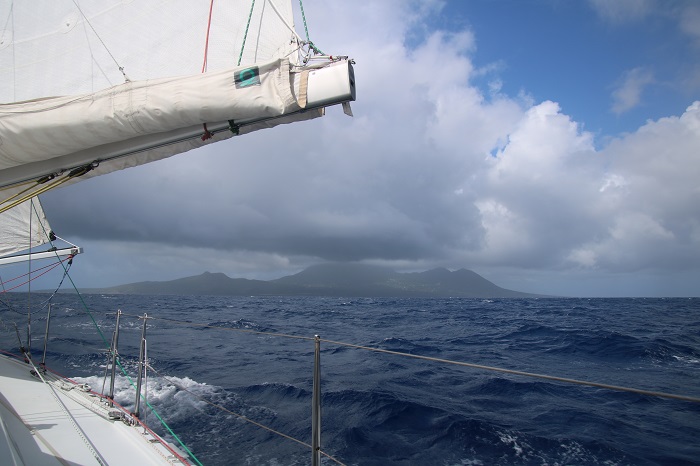
It’s been a few days now that we have been here in St Kitts and we are hopeful that we will be able to leave for Guadeloupe over the weekend. The problem has been the winds, the strong Christmas winds more specifically, that have made sailing south problematic.
For several months during the winter the winds can be pretty stiff, in the high 20s and sometimes gusting into the 30+ range. Last winter we found ourselves stuck in Antigua for several weeks when the winds picked up and just about everybody sticks in place until the breezes moderate.
Additionally, because of the height of the island and the clouds that are there most of the time, our solar panels have been coming up short on recharging the batteries. The shorter days of winter complicate that as well so we have had to run the generator for more time than we’d like to keep the batteries up to snuff, make water and keep it hot for showers. This problem will become less of an issue as the days get longer, later in the season. Also, the islands that aren’t as high will be less inclined to precipitate cloud cover. Islands, like Antigua, as one example, with less elevation, don’t get the cloud cover that we have here in St Kitts.
It’s tiring to listen to the sound of the wind in the rigging, especially at night when the winds are stronger. The hum in the rigging punctuated by higher gusts and the boat surging against her anchor can get a bit old.
Don’t get me wrong as it’s not all that bad here in St Kitts, a beautiful island. As I write this we are sitting in a pavilion in this very high end development overlooking a beautiful pool and beach. Not a bad view to be doing a post while enjoying. 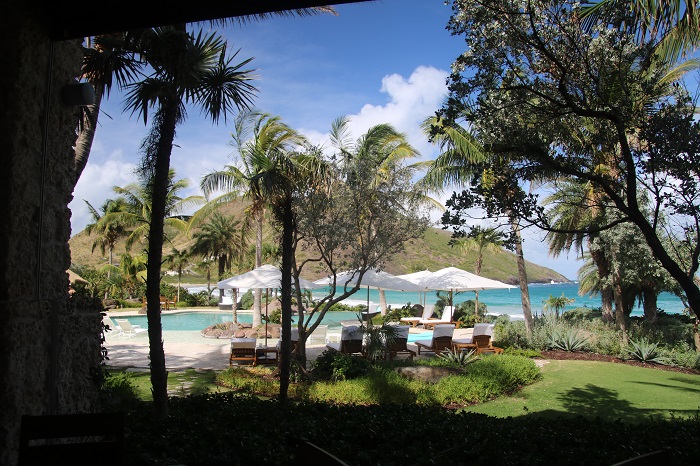 As an added bonus, as it’s so far from the normal tourist locations, we have the place mostly to ourselves. No cruise ship tour bus mobs here.
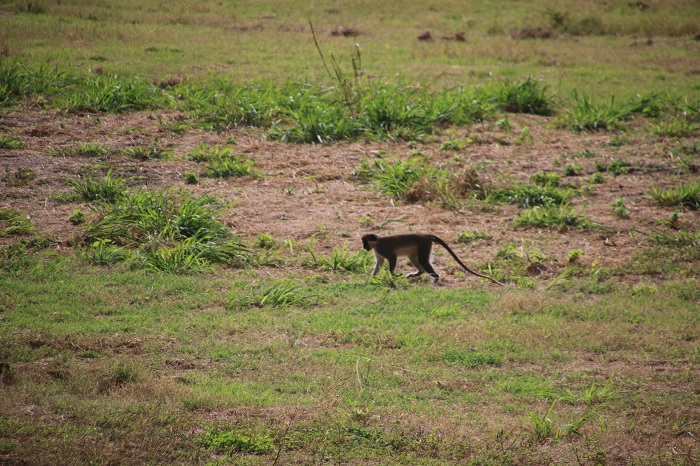
This is the view of the main building known as “the Pavilion”, nestled in an exclusive community. 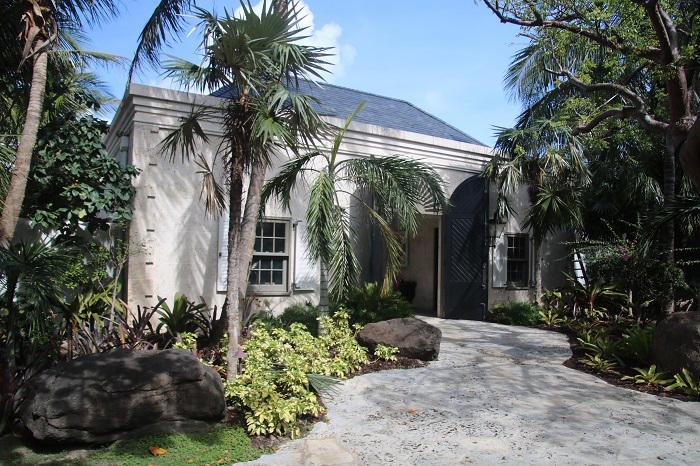 This place is about a mile of so walk from the marina and along the way we spied a troupe of monkeys.
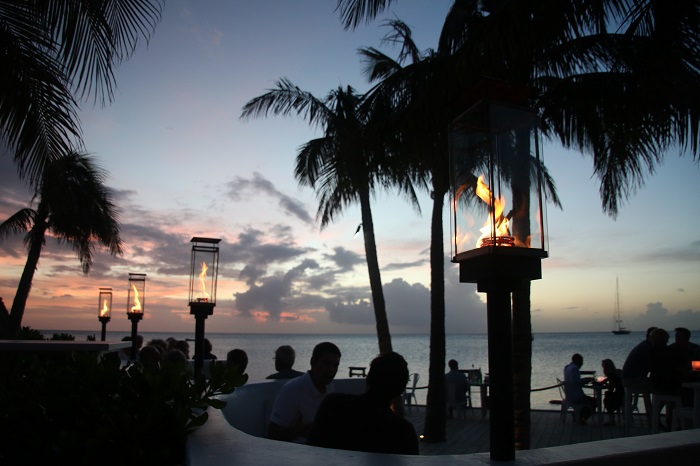
  Last evening we went out for drinks with our friends at yet another lovely spot that’s part of this development. It’s right on the water with a view of the western horizon, perfect at sunset. Can you say “happy hour”? Happy, indeed. Just love the “turbine lamps”. Our son Rob would be all over these and want them for his own patio. The flame swirls in a lovely arc. Pretty ethereal.
  We have been spending time ashore each day and the four couples we are here with spent time touring the island together a few days ago. We hired a driver for the day and drove around the entire island, stopping along the way.
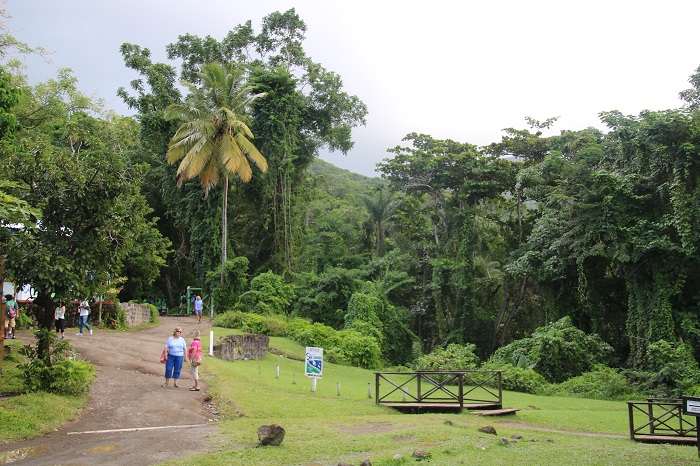
This end, the southern part, of the island is more arid than the higher parts of the northern part, so we were excited to see the rain forest.
Sugarcane production was big business here and it was interesting to see the remnants of an old railroad that runs around most of the island. This trestle is evidence of what was once a dominant business on the island. 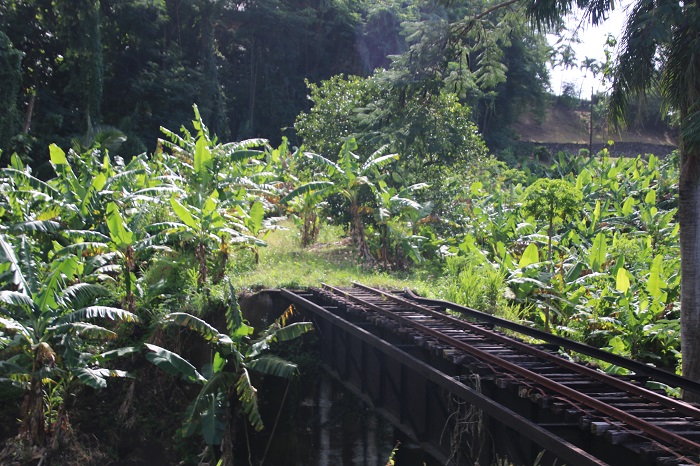 We visited the ruins of a water powered “factory” facility that once processed raw sugarcane and produced rum. It was in a beautiful area complete with some of the old cast iron equipment and the remains of an aqueduct that brought water to the cane crusher from the mountains.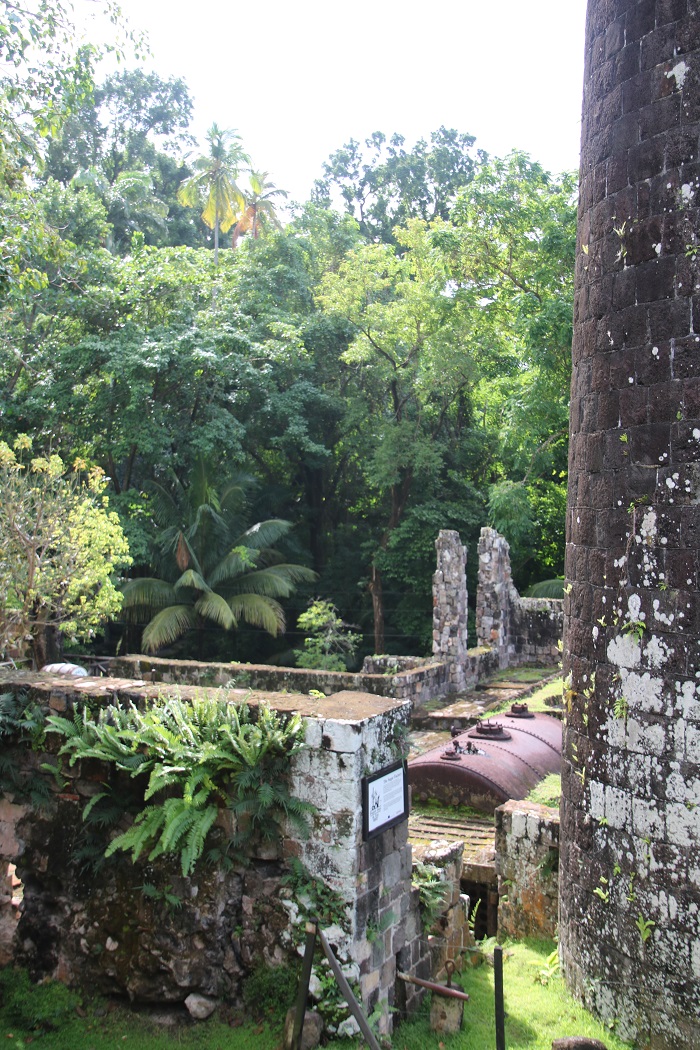
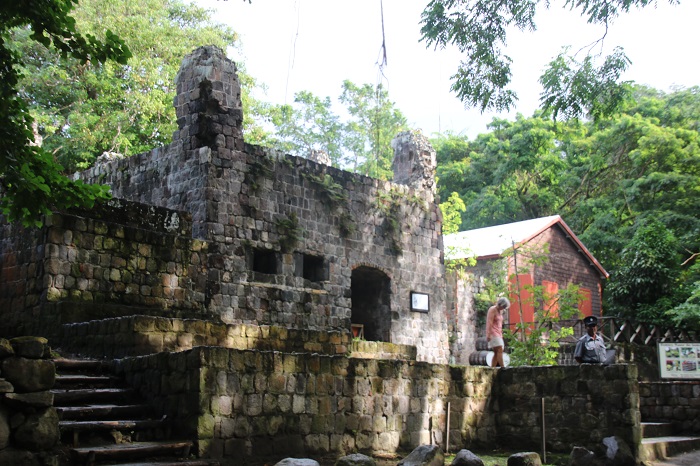 Everything was wet from the near constant rain that comes and goes briefly each day. The guide told us that this area of the island gets over 150″ of rain a year verses 50″ or less in other areas of the island. For comparison, the definition, in Wikipedia of a rain forest is one that gets between 98 and 177 inches of rain per year so this clearly qualifies. It’s remarkably lush with moss and ferns everywhere.
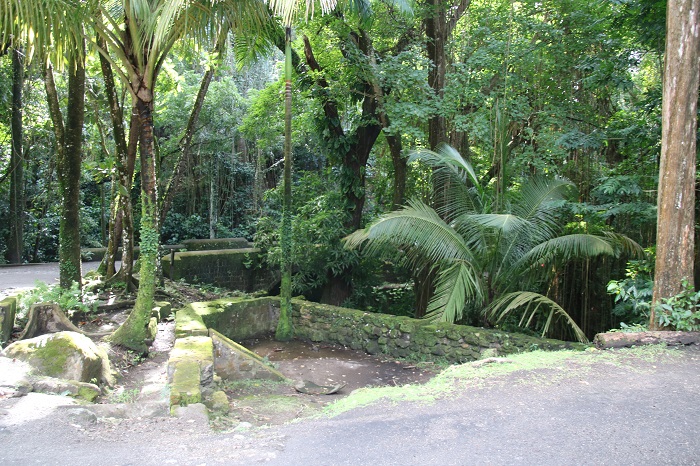 After seeing such dry areas it was amazing to see green grass and ferns everywhere.
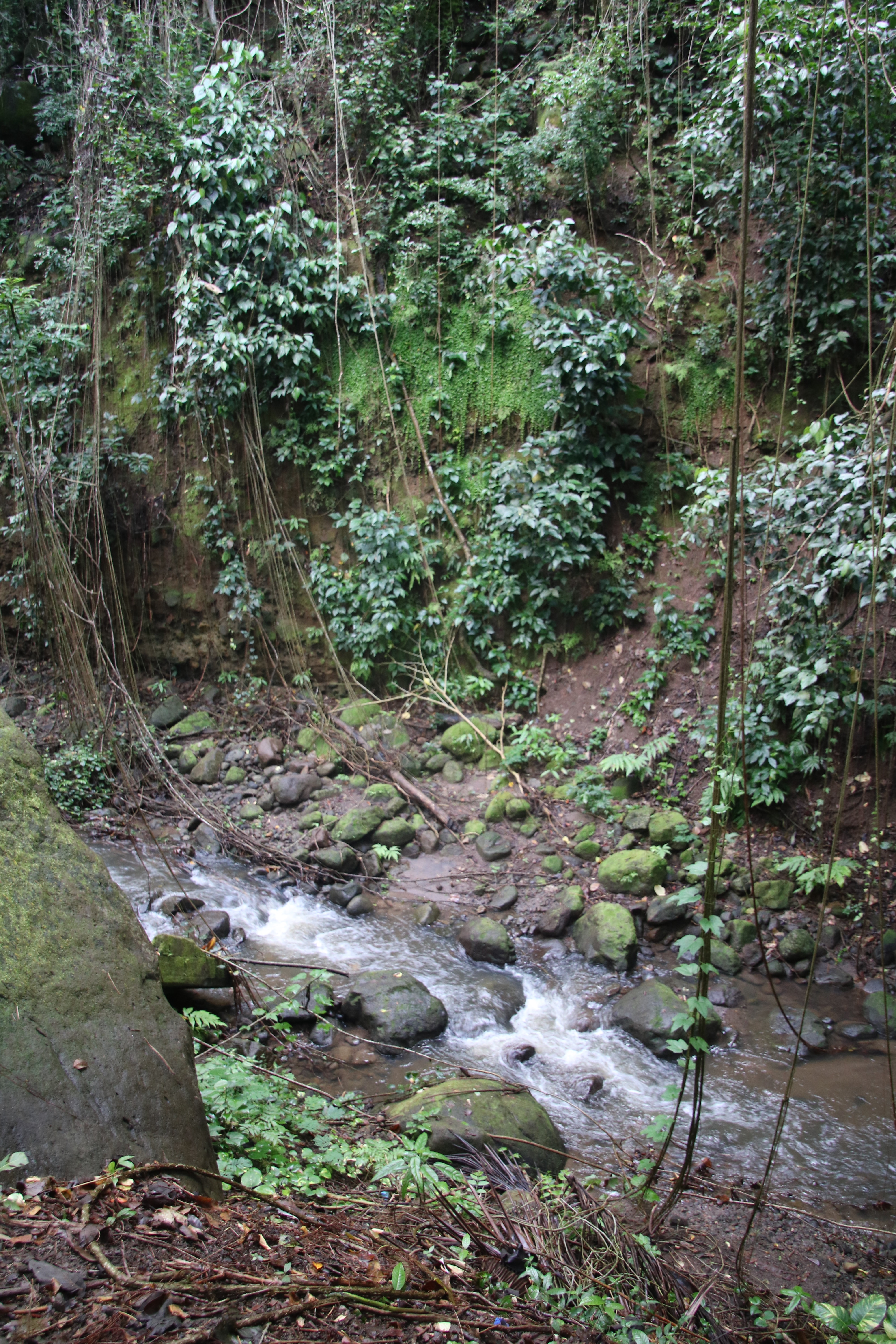
  After spending so much time on islands where the primary source of water was through reverse osmosis, it’s a treat to see rivers and streams everywhere. Here on the other end of the island it’s quite arid and I expect that the primary source of water is RO. Amazing since the island just isn’t that big.
 As you’d expect, where there is rain forest there is zip-lining.
 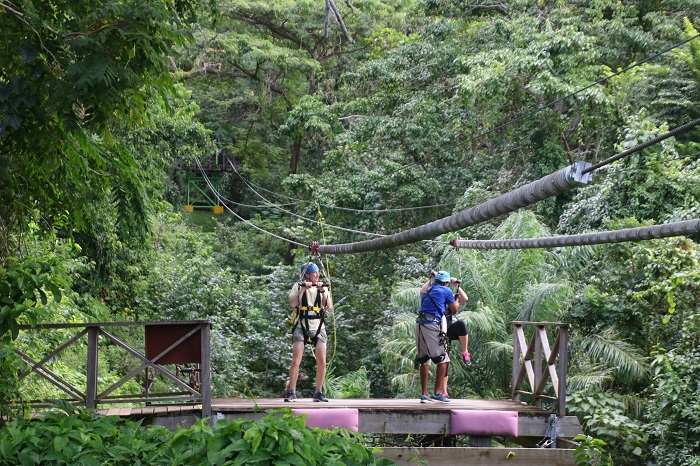 I would have loved to take a turn at that however, with 8 of us sharing a van and trying to see the island in a single day, there wasn’t much time to dawdle.
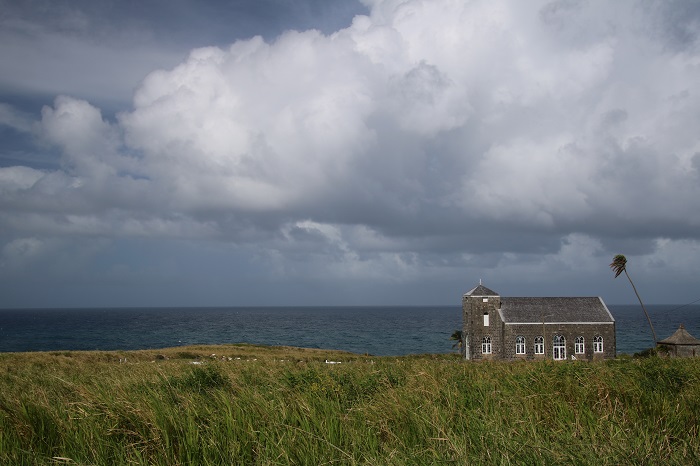
Along the way we stopped at a tiny spot for lunch. I expect that the owners were related to the driver. Not much to look at, not even a little bit actually, but the food was excellent. 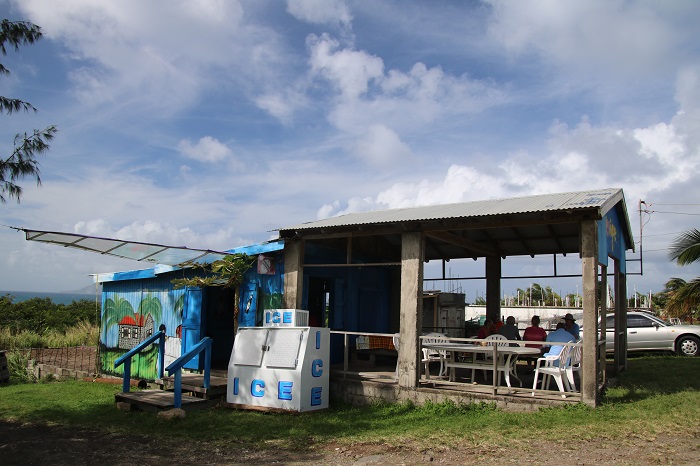 It was interesting to see, all within a few hours, everything from lush forest, open pasture and arid hillsides dominated by cactus on such a small island. A beautiful church perched near the sea. Looked pretty exposed but beautiful.
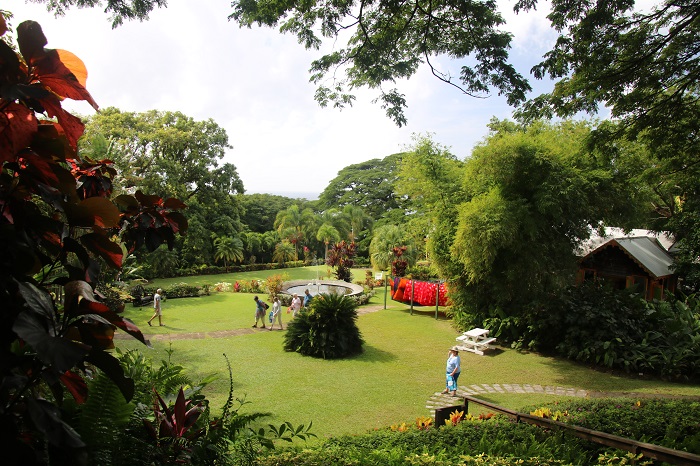
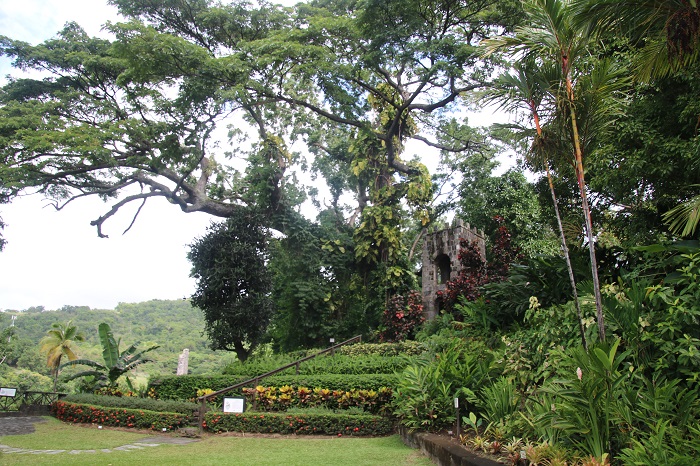
  Along the way, nestled in the rain forest, was a lovey sort of botanical garden/batik factory. I had to work hard to get photos that weren’t overrun with cruise ship tours. However, it was set in a beautiful surrounding.
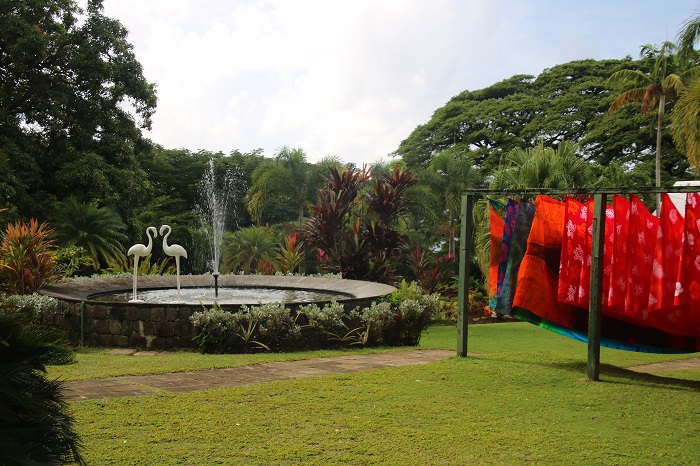
  The fabric that they dyed was hung outside to dry in the breeze.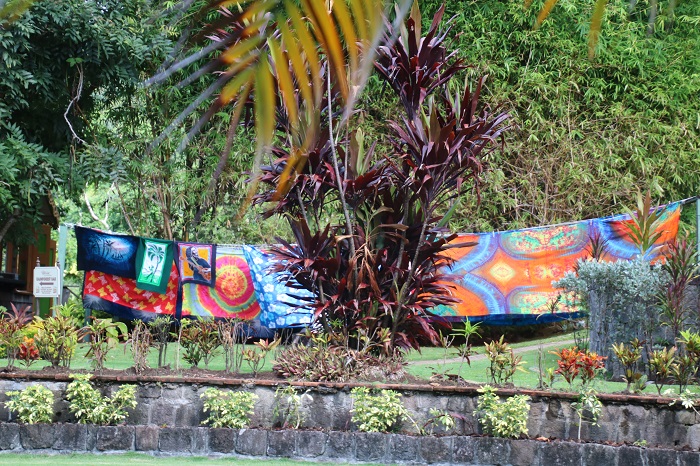
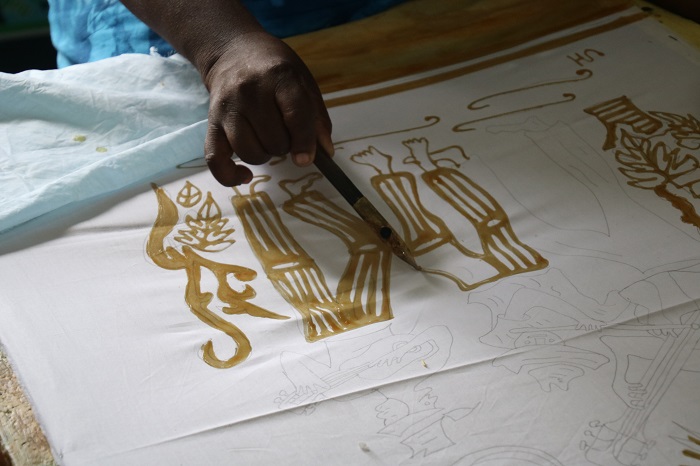
 They had an area where they demonstrated the technique. Brenda and I had both done this technique in college I think and the smell of the wax, a mixture of paraffin and beeswax immediatly brought back memories.
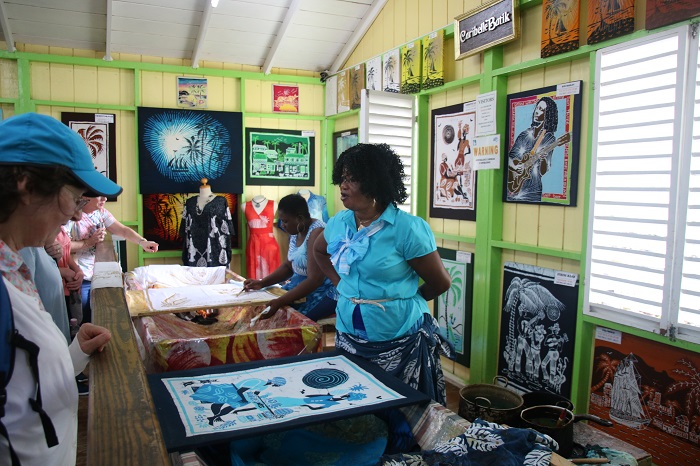 The complex patterns of color are built up by sequentially waxing various areas of fabric and then dying in progressively darker colors. In the end, the wax is taken out of the fabric and it’s sewn into various items for sale.
 Everywhere you turned the view was charming if a bit crowded with tourists.
 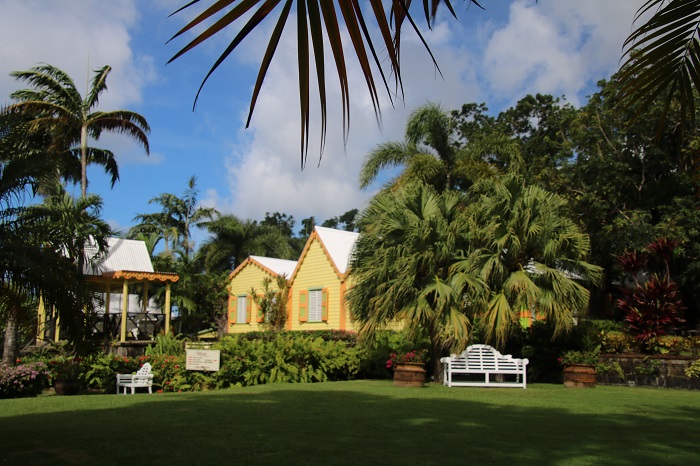 Even the entrance to the facility was charming and well thought out.
 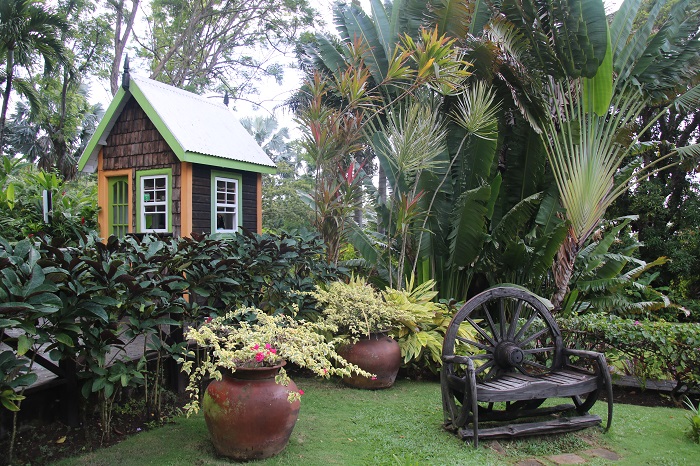 There are ruins of an old bell tower, once used to signal the slaves when their time in the cane fields began or ended. This may be the only one left as all the others were torn down after the abolition of slavery as symbols of oppression. Legend has it that the owner of this particular plantation was a fairly reasonable “owner”, compared to the others, so his bell tower was preserved.
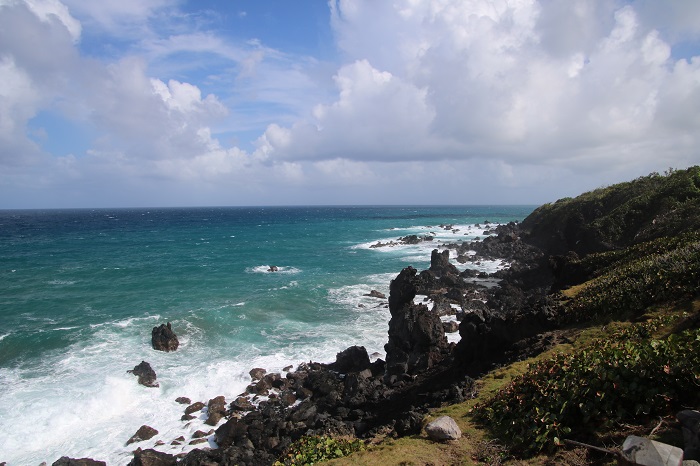
  St Kitts is a volcanic island, as most are in this area, although this one is not currently active. A popular spot to visit is on the most northerly end of the island called “black rock” by the locals. Again, swarmed with tour buses, the view of the volcanic rock was impressive and gives meaning to the term “lee shore”. Not a great spot to run aground. Good luck with that.
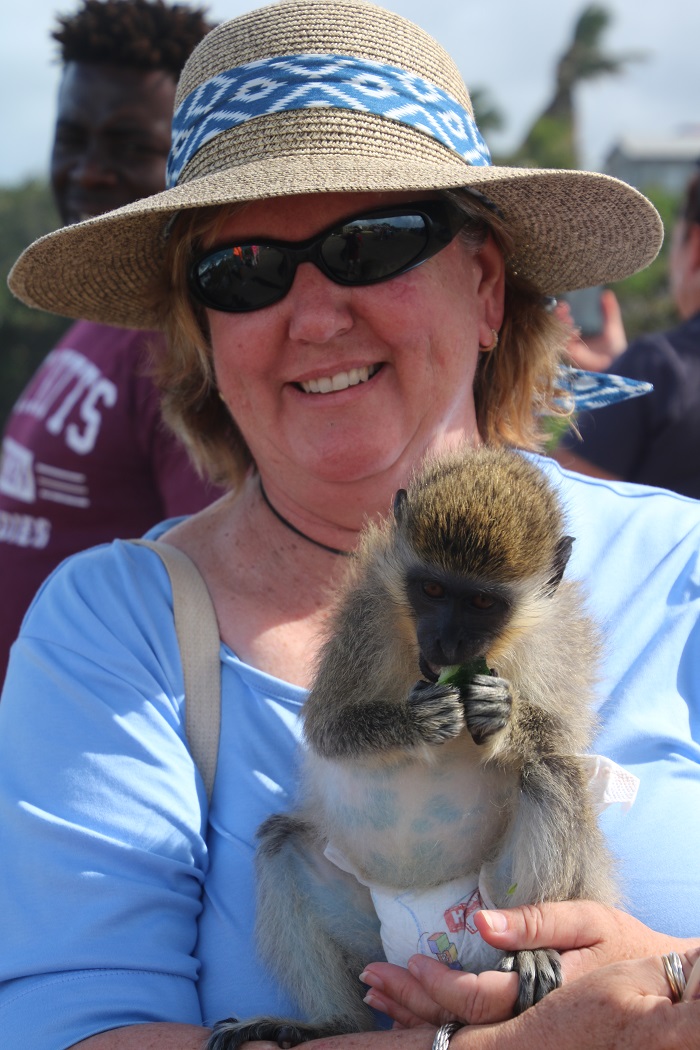
  Of course where their are tourists, there are “entrepreneurs” and in this case, a guy with a monkey. Before she could say “I hope that monkey doesn’t poop on me”, he climbed all over Brenda for a photo moment and a bit of fruit. She, Brenda that is, was a very good sport.
  St Kitts is a remarkable island tempered by the fact that anchoring is only possible in fairly exposed areas. However, when conditions are right, it’s a great place to visit. With everything from arid hillsides with cactus, to lush rain forests, St Kitts is truly an island of many faces.
Hopefully, in the next few days Brenda and I will be able to make our way to Guadalupe. Don’t forget, Monday is Brenda’s birthday. I won’t.
The bad news, and it’s bad, is that we may find ourselves underway on that special day and not in port as we’d prefer. However, it’s nice to know that we will soon be in Guadeloupe, with all the fine French food you’d expect.
I guess I’ll just have to make it up to her somehow. Brenda, would you care for a baguette?
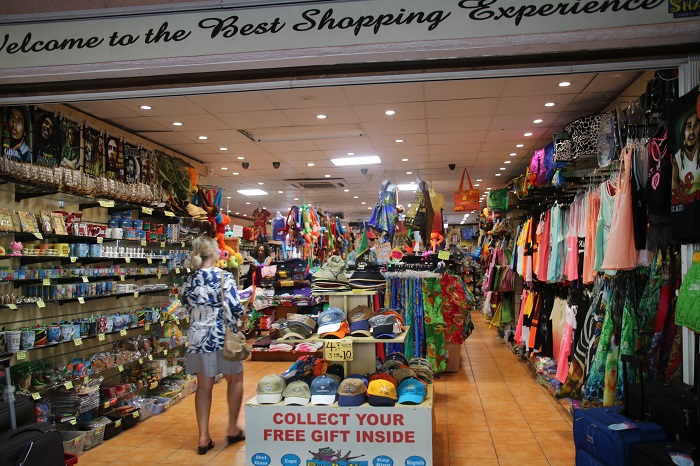
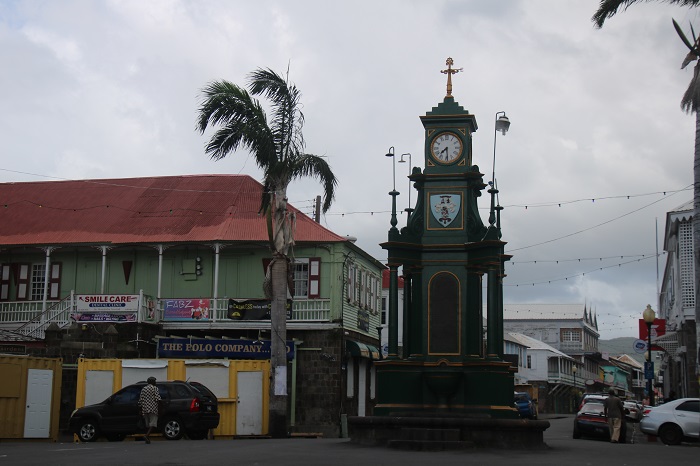 As it was Sunday, most of the businesses were closed which made the streets look fairly abandoned. However, the businesses catering to the cruise ships were open with T shirt shops and duty free jewelry shops dominated the area.
 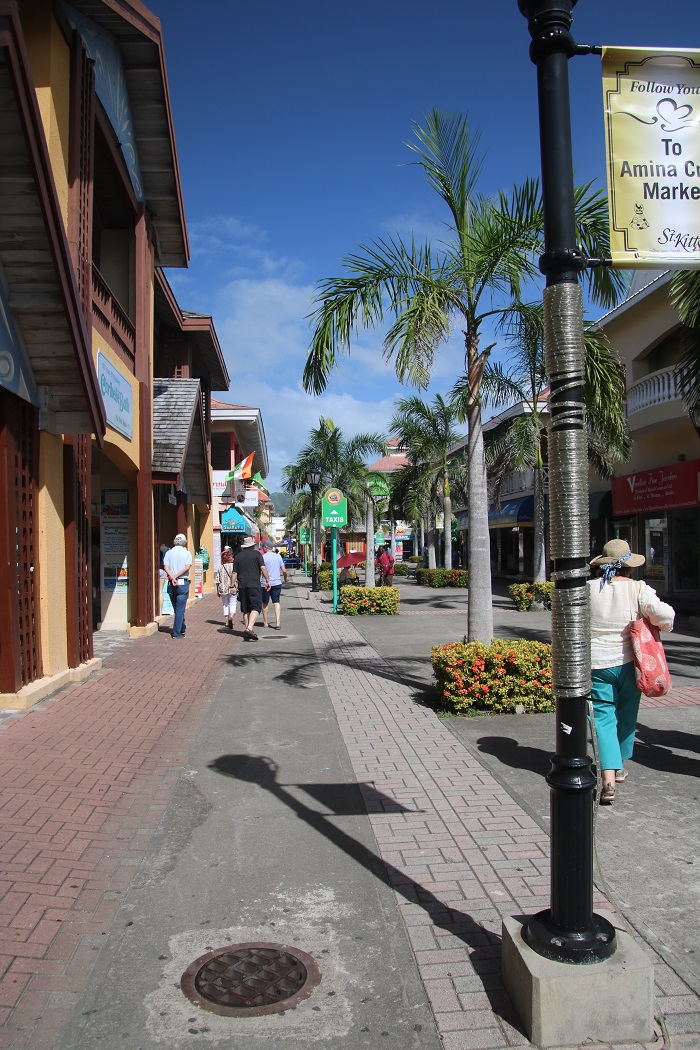 Any interest in a day-glow monkey? I say that as there are green monkeys that run wild on the island so every shop has stuffed monkey toys for sale. To be clear, not real stuffed monkeys.
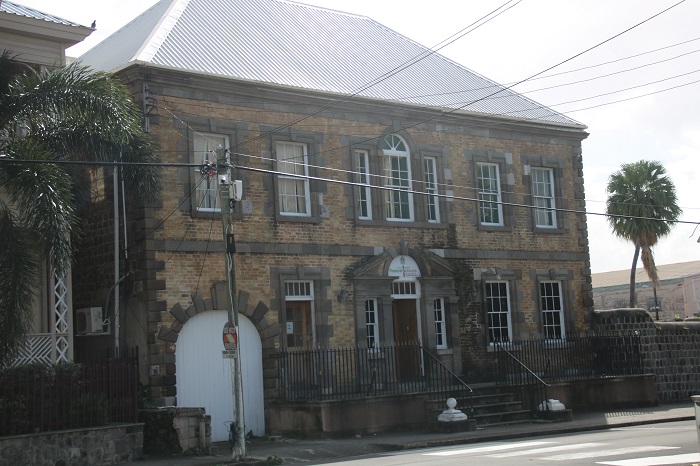
 It wasn’t all tacky as there were some lovely old colonial buildings in the historic area.
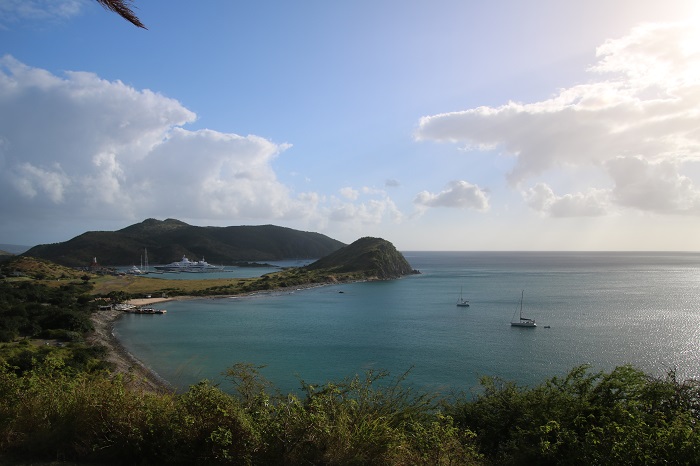
  As we headed back to where we had anchored, we stopped to take in the view. Pandora is anchored behind that little mountain on the point. Notice that there are a few massive yachts in the marina to the left of the point. I was told that the largest, over 300′ long, is owned by a guy that has three other yachts. Not sure if it’s the largest or the smallest but this one alone has a crew of 40. It’s hard to believe that any one individual can accumulate enough wealth to afford one yacht of this scale, let alone four.
 Not us, that’s for sure. However, we can afford a glass of wine or a beer at the marina’s bar. This is the view from our spot in the bar, back toward the overlook where the above shot was taken.
 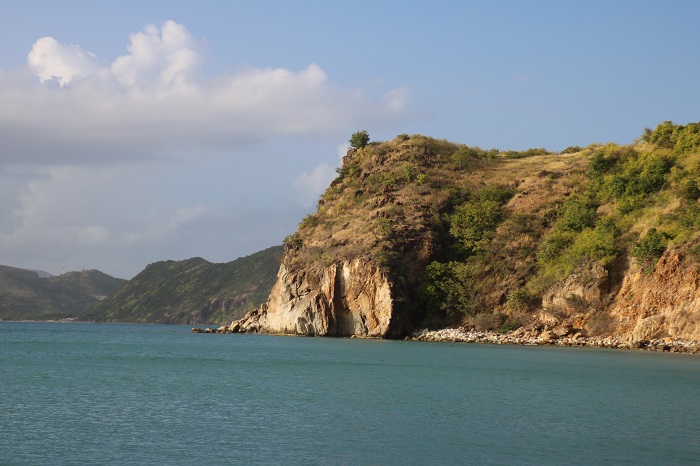 And made even more scenic with our drinks in the picture.
 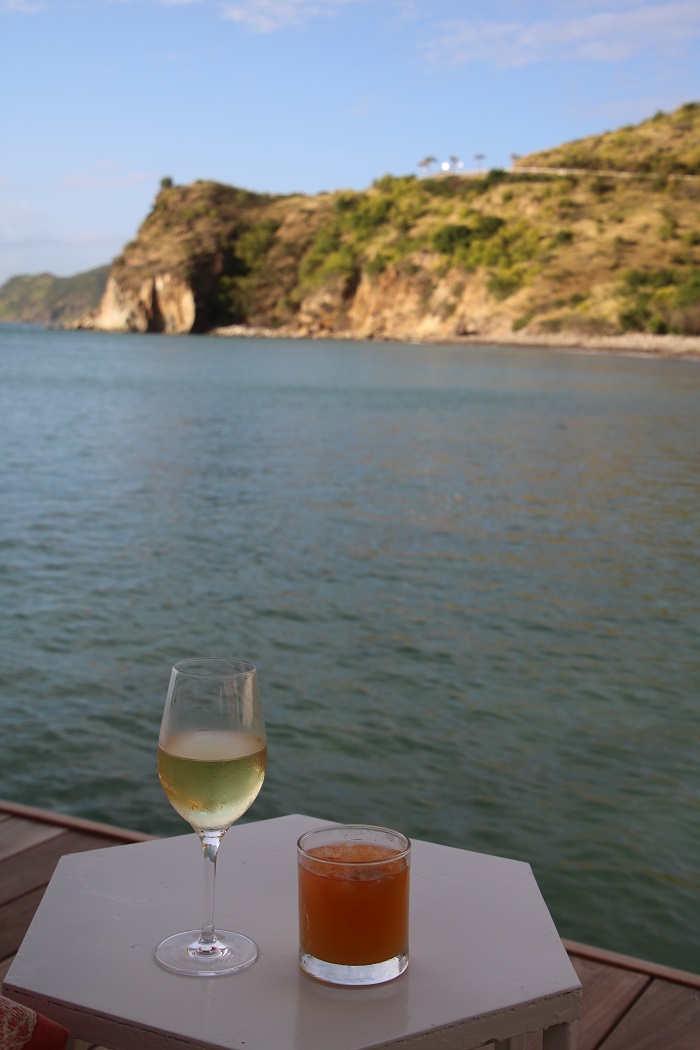 We were comfortably seated in the “chaise lounge” benches, sort of, out of the wind.
 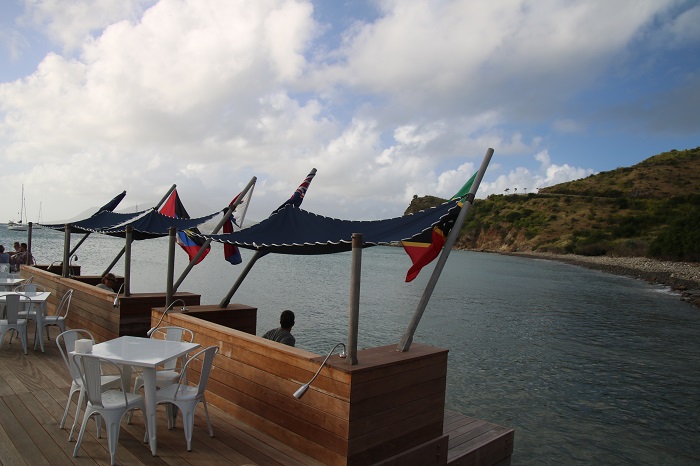 The bar was packed by the time sunset arrived. It was quite dramatic. No green flash though.
 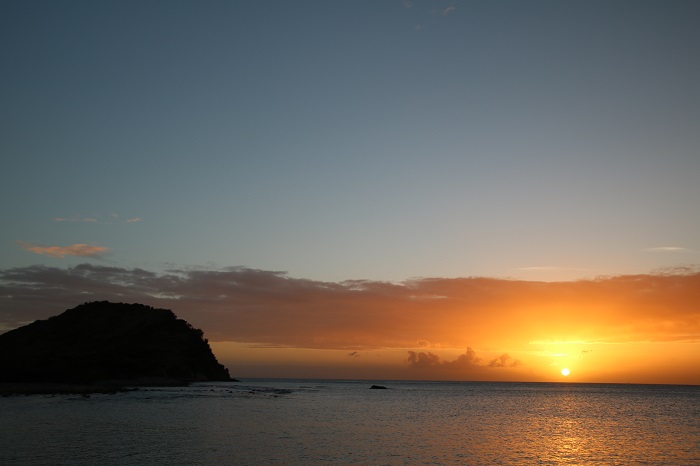 All and all, a nice spot but tempered by the fact that it’s been quite windy and a bit rolly. Unfortunately, many islands down here don’t have good protection from the swells but unlike the Bahamas, where the winds clock regularly as cold fronts push south from the US, here the winds are very consistently out of the east. The only question is how hard they will blow.
 Montserrat is not very large, about 14 miles long and about half that distance wide and has a very steep shoreline that drops to depths of over a mile very close to shore. In 1995 a powerful volcanic eruption destroyed Plymouth, the capital of the island on the western end of the island, violently blowing off the entire top of the mountain and displacing much of the island’s population. Following the eruption, 2/3 of the population left for the UK leaving as few as 1,500 on the island. Since that time, the population has rebounded but is still under 5,000. Fortunately, there was good warning that an eruption was eminent and fatalities were minimal with less than 20 killed. And those were some particularly unlucky individuals that headed back to their homes “one last time” to collect belongings that they had left behind.
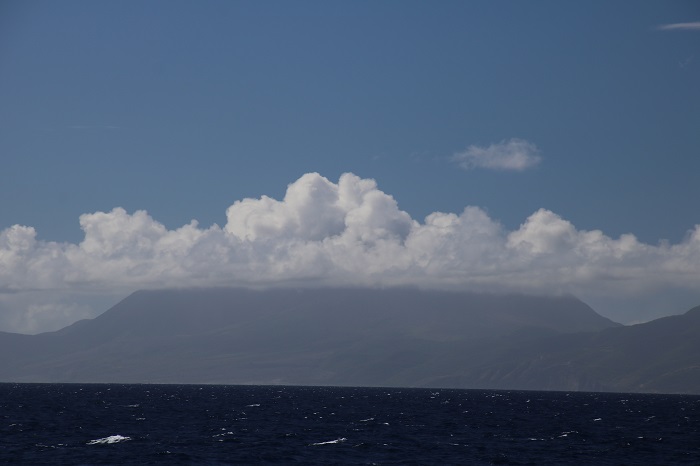 As we rounded the western end of the island it was daunting to see the cliffs rise from the sea. Not a place to be driven onto a lee shore.
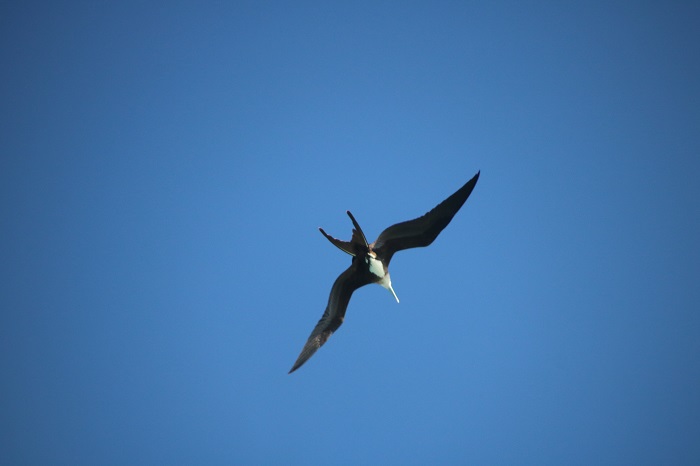
  Overhead the frigate birds circled, looking for fish to catch. These birds are huge, with a wingspan of more than 6′.
  A short distance later the “harbor” came into view.
 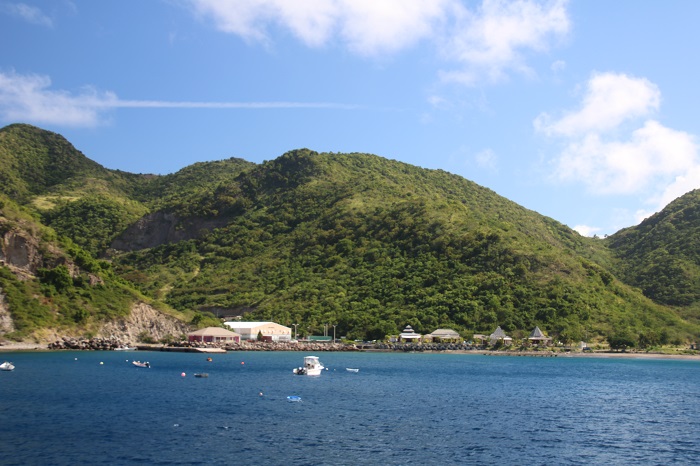 The only way ashore is the ferry dock and that would only be usable in settled conditions with no protection from the seas. With the swells breaking on the beach, there is no way that we’d be able to land with our dink. There was a very small spot in front of the ferry dock that had a place to land though and a ramp for pulling the larger fishing boats ashore.
 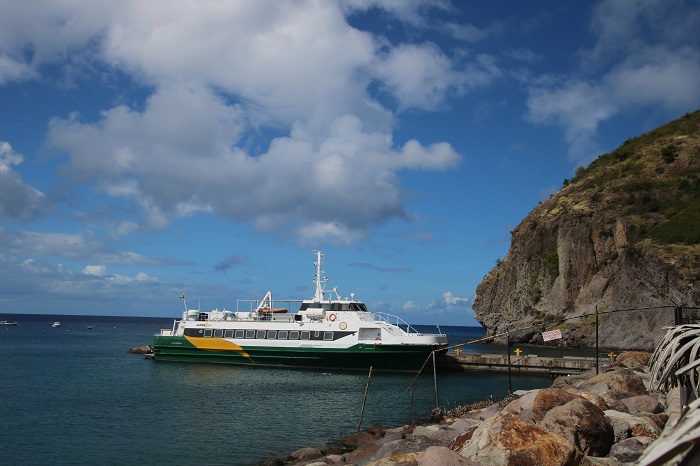 The types of conditions that the island must experience was demonstrated by the huge concrete “jacks” lining the shore. Note the color of the beach, black volcanic sand.
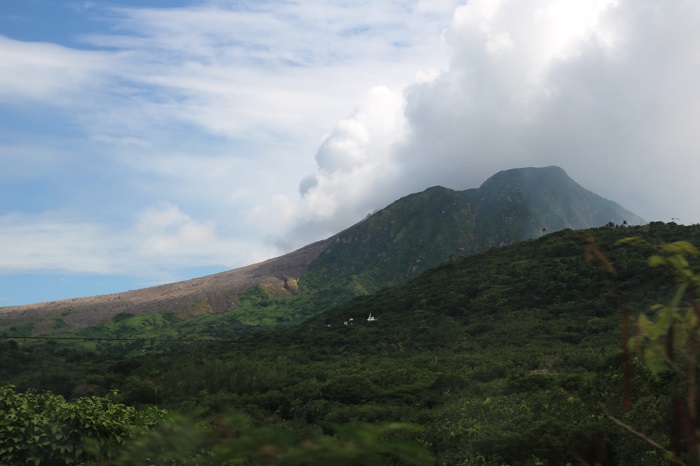
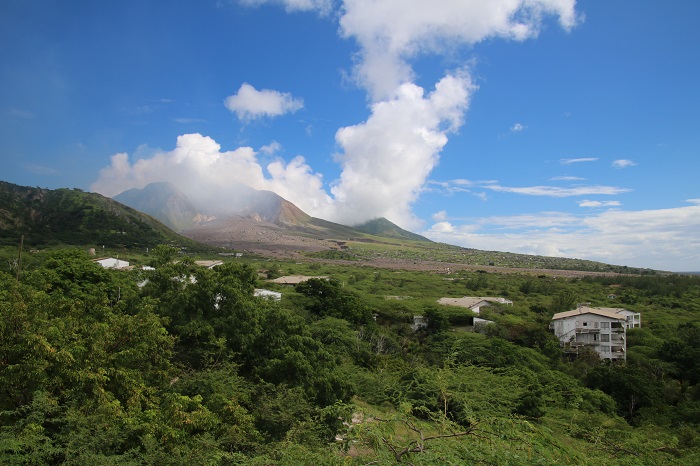
 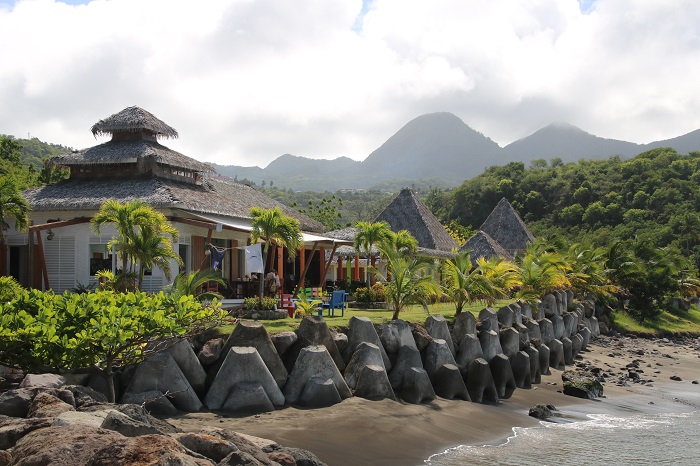 Our group boarded a van for a day of touring the island and in particular, the eastern end where the volcano erupted. We wound our way up impossibly steep switchback turns on our way up the side of the mountain, always with the semi-dormant volcano looming above us. On the left of the photo you can clearly see the remains of the deep layer of ash and rock that devastated the surrounding mountainside.
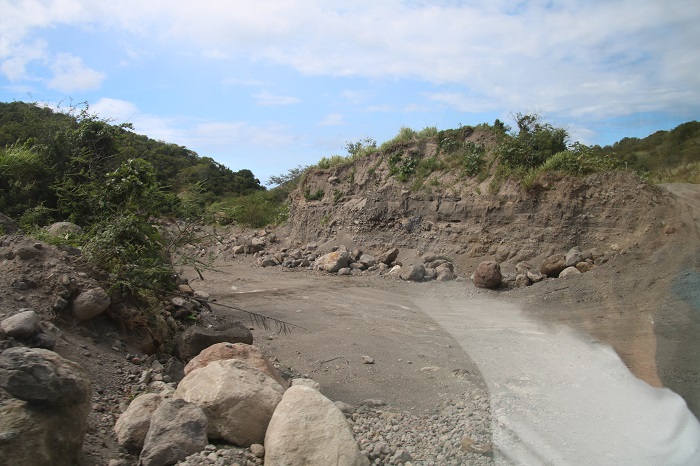
  Everywhere you look there is evidence of volcanic activity, piles of ash pushed to the side of the road and vacant buildings abruptly abandoned.
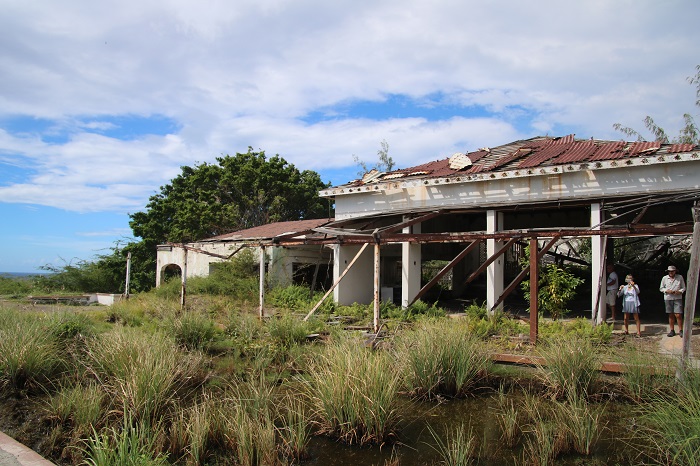
  At an particularly impressive overlook, we entered the ruins of a once grand resort. The floor had a thick layer of ash.
 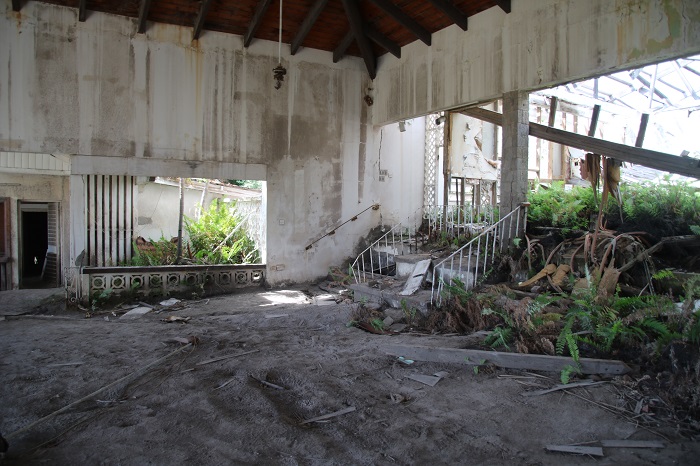 A calculator on the welcome desk suggested how fast everyone evacuated.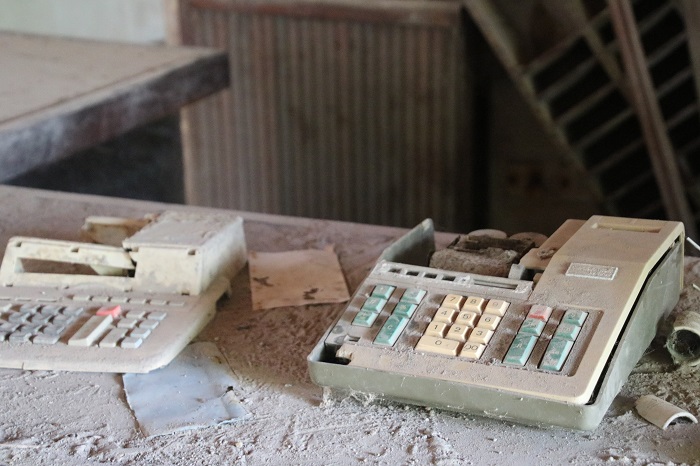
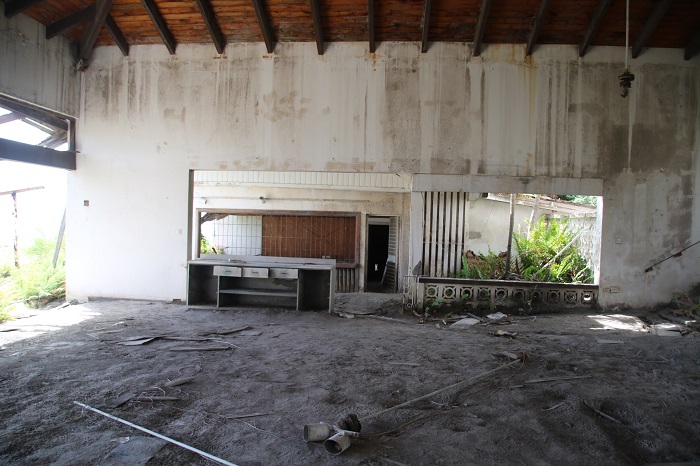 Out back was patio with what was once a lovely pool, now full to the brim with ash. The ash is very fertile though, so nature has quickly taken advantage of the well fertilized soil and turned the pool into marshland.
 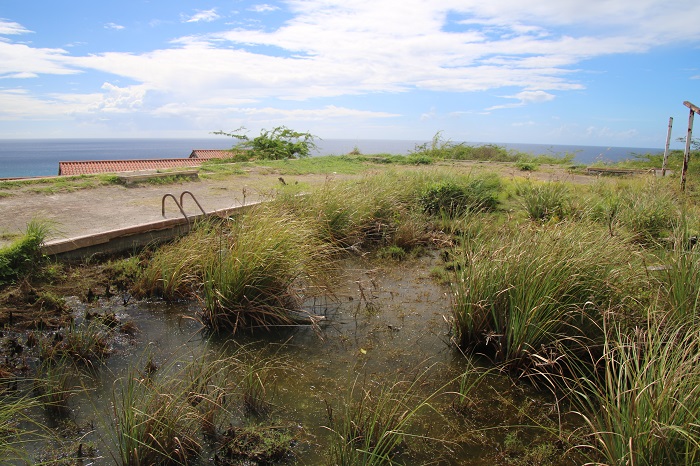 A view back toward the remains of the hotel.
 The view of the volcano in the distance from the hotel.
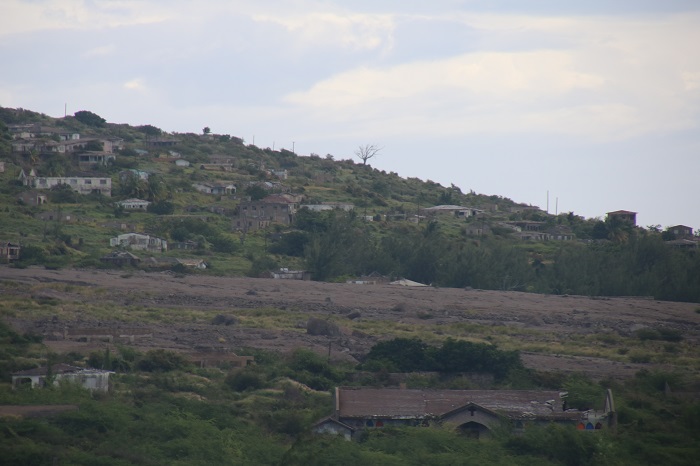
 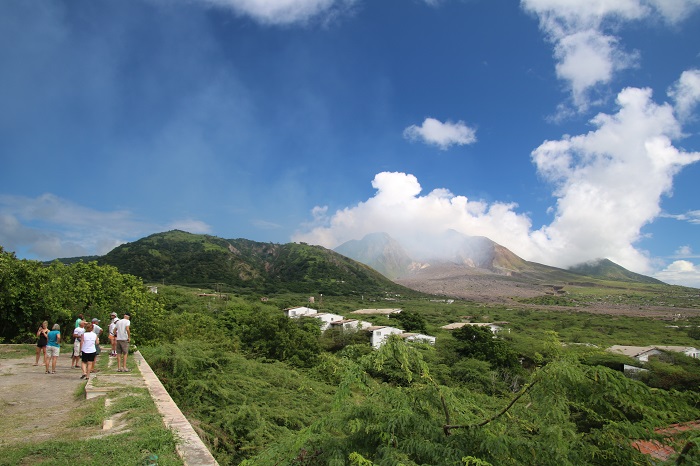 In the distance you can see the remains of the city buildings mostly buried in a field of ash.
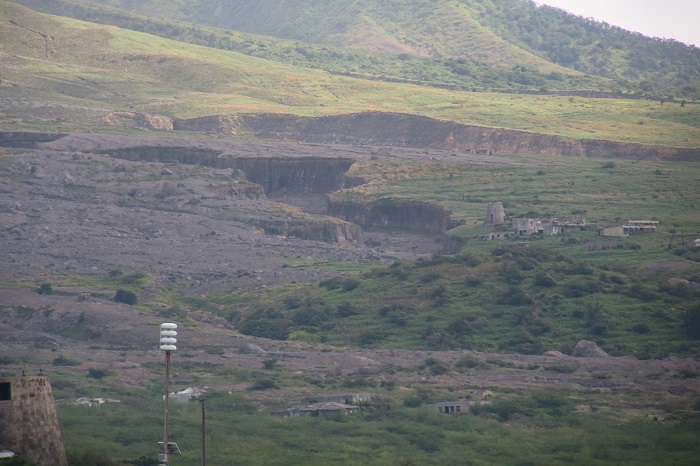
  Following the eruption rain filled the vacant crater at the top of the mountain for several years until the waters finally broke free and rushed in a mad fury to the ocean, carving a deep ravine in the landscape. The round white disks on the pole is part of an island wide early warning system that was put in place after the eruption. It is still tested at noon every day.
  Everywhere you look there is evidence of wonderful homes abandoned. Most have no roofs as the shear weight of the ash from the eruption caused them to collapse.
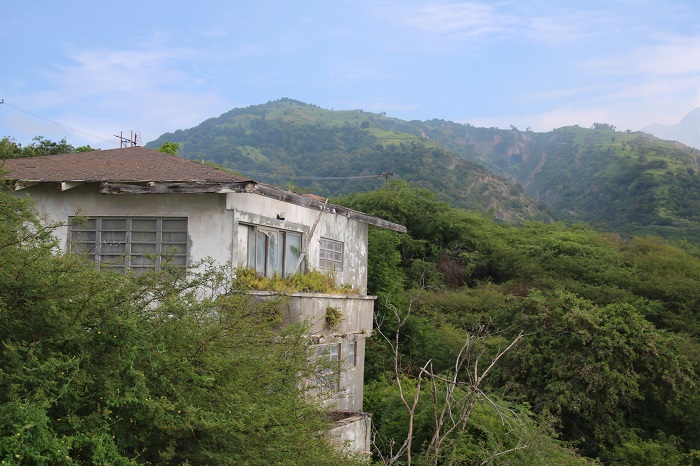 However, in spite of all the devastation there is ample evidence that nature is repairing itself with green landscape filling in nearly everywhere. In the distance there is still smoke mingling with the clouds at the summit, a reminder of what may happen and that the residents of Montserrat should not let their guard down.
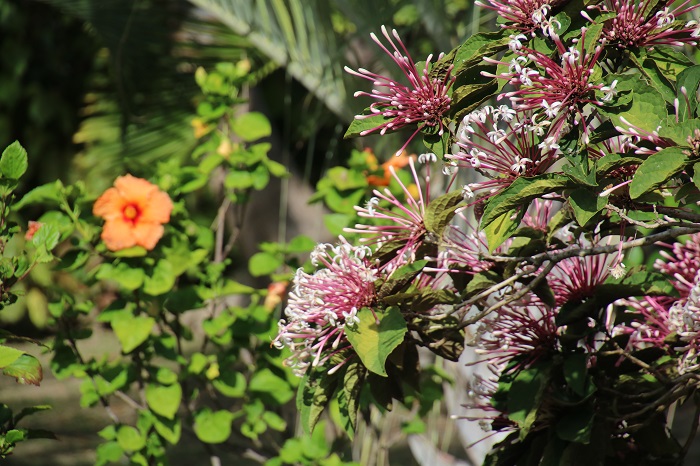
  As we made our way back around the island, there is dense forest with many flowering trees and plants.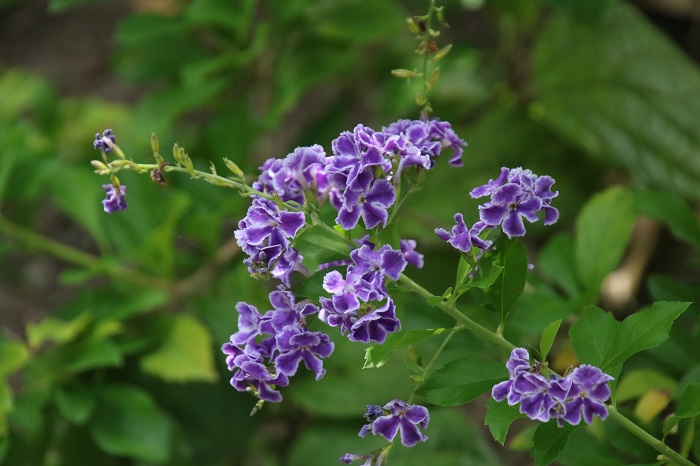
 And this flowering plant clinging to a crack in a whitewashed cement wall of someone’s home is evidence of the power of nature to rebuild in the shadow of unspeakable destruction.
 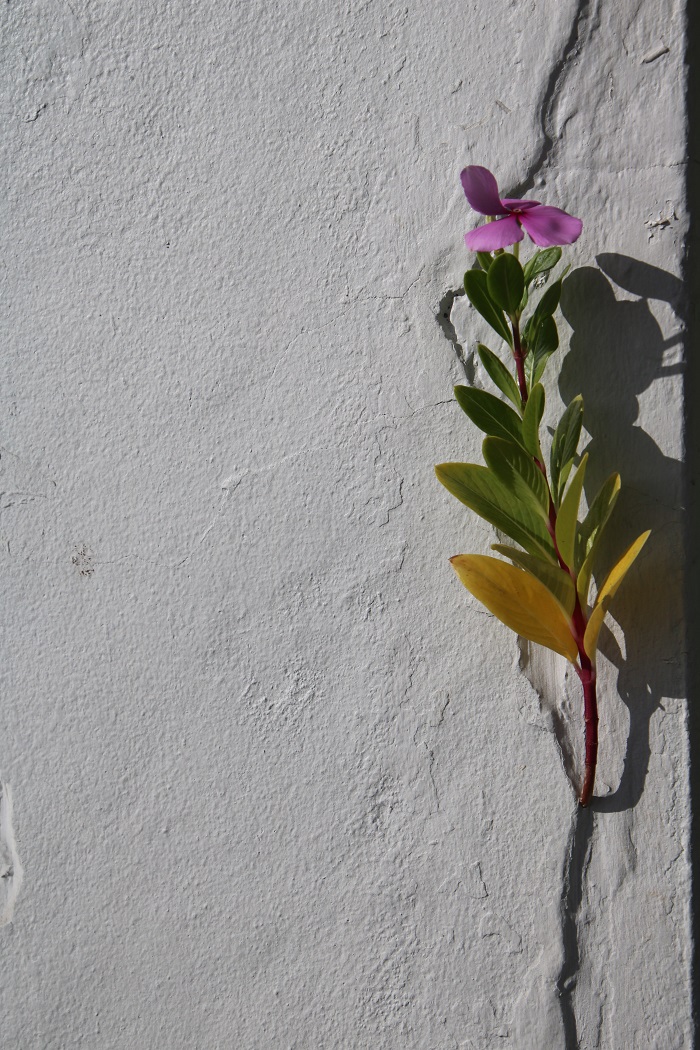 And, it is no wonder that the hearty few that have remained on Montserrat take some comfort in knowing that while the power of nature can destroy, it can also bring life.
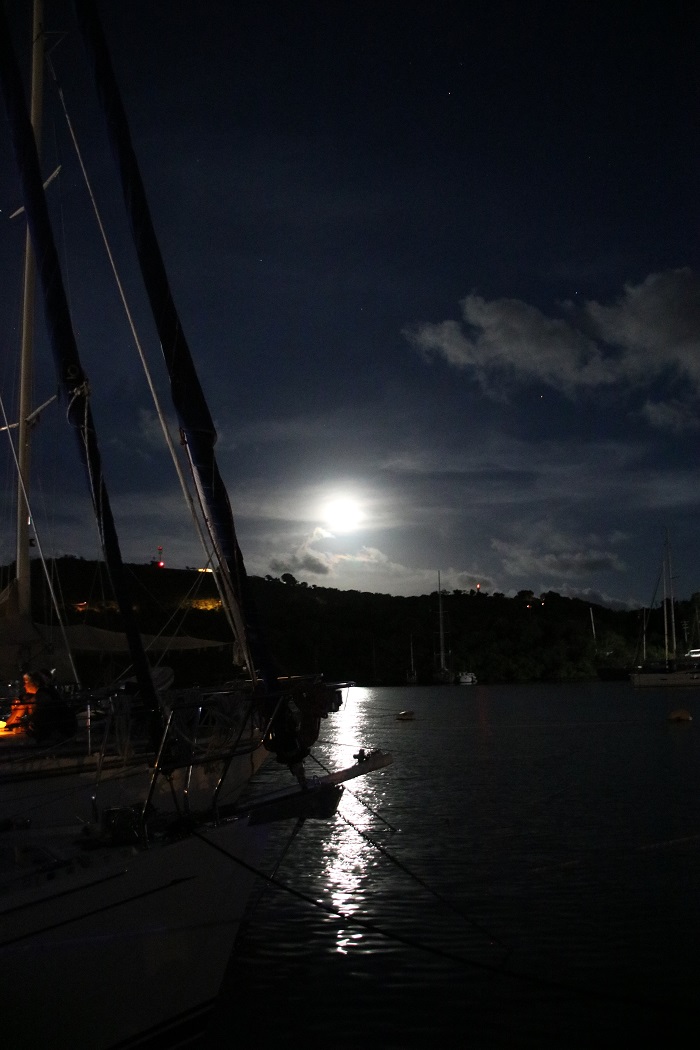 Of course, as it’s only now the 2nd of January, we were in this lovely spot for New Year’s Eve. New Year’s Eve in the Dockyard lived up to it’s reputation and to see fireworks burst aloft at exactly midnight was a wonderful sight, certainly unique in our experience. Not a bad view from Pandora’s bow.
 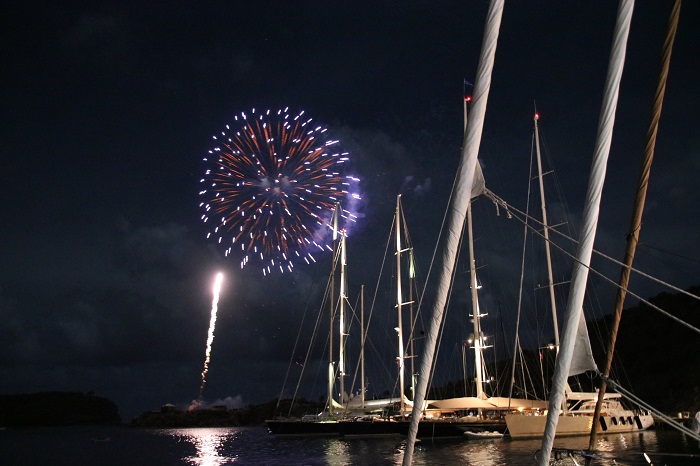 Really spectacular.
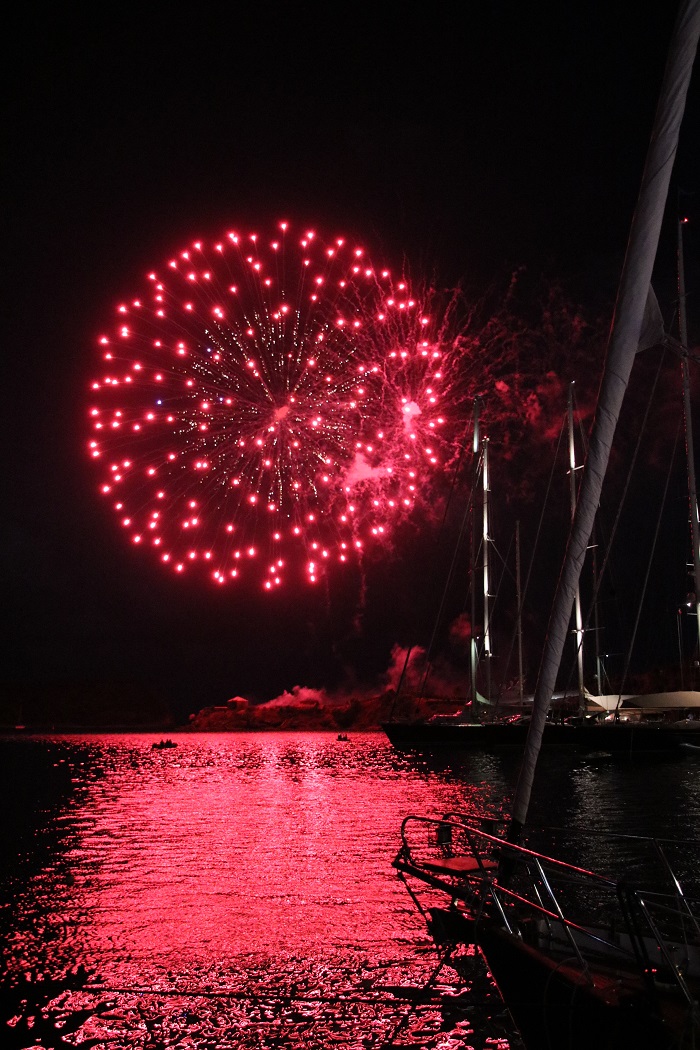 Take your pick. Loved these too.
 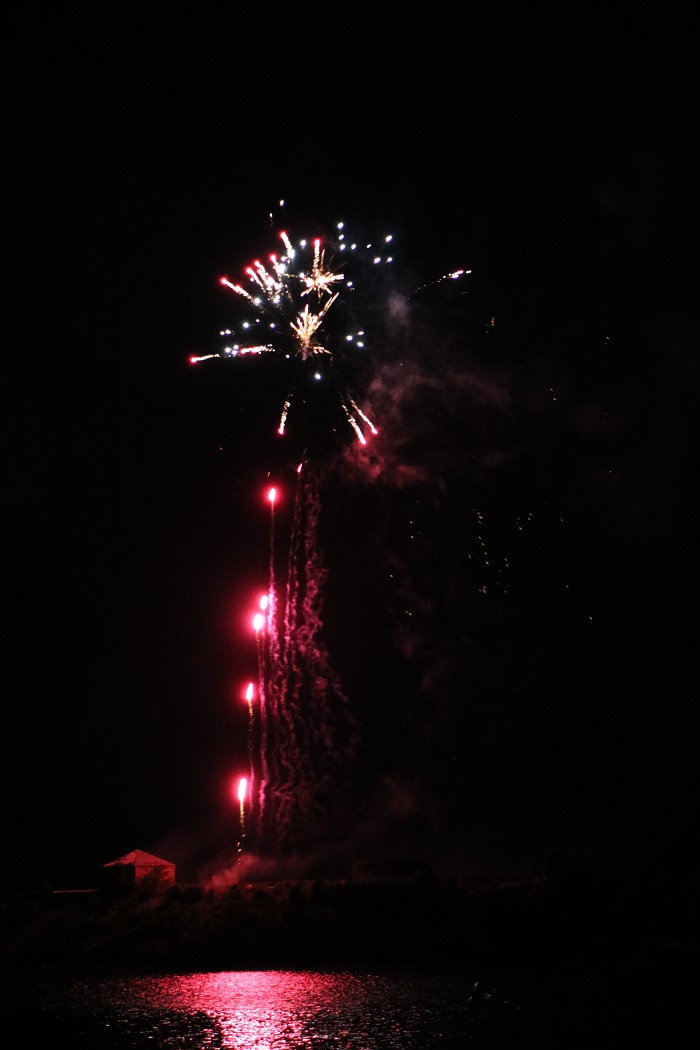 And, of course, the grand finale.
 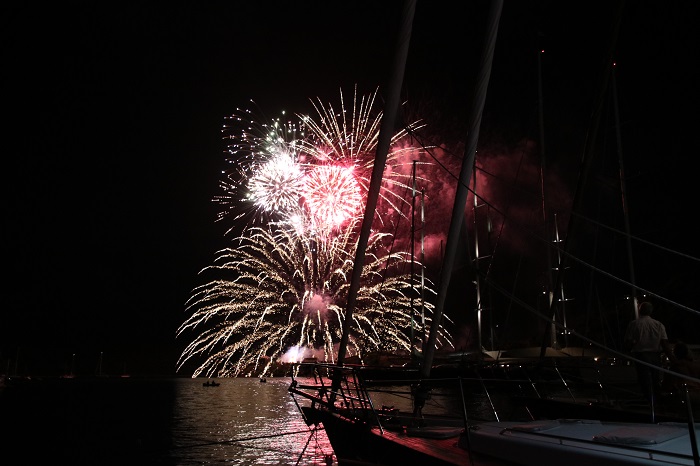 Sure, we have seen fireworks from aboard our boats in the past but never in the “dead of winter” sitting on the bow, cooled by a balmy midnight breeze. If you haven’t experienced it, I heartily recommend that you do. It’s safe to say that some things are just better with a gentle tropical breeze wafting over you.
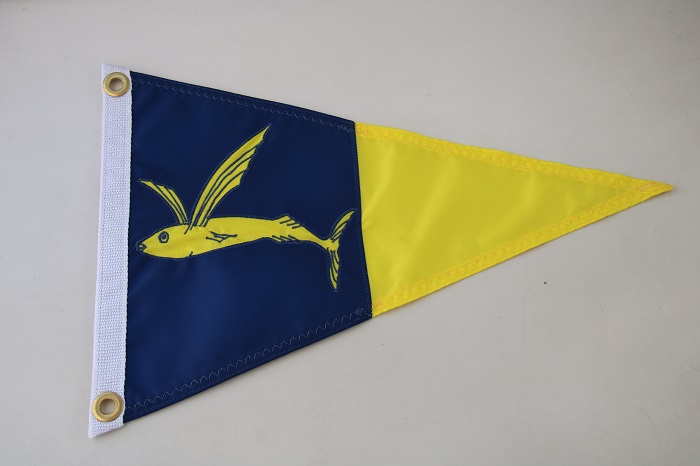 I was approved today and voila, near instant gratification after years of delay. Thanks Bill and of course my old friend Mel for “priming the pump”.
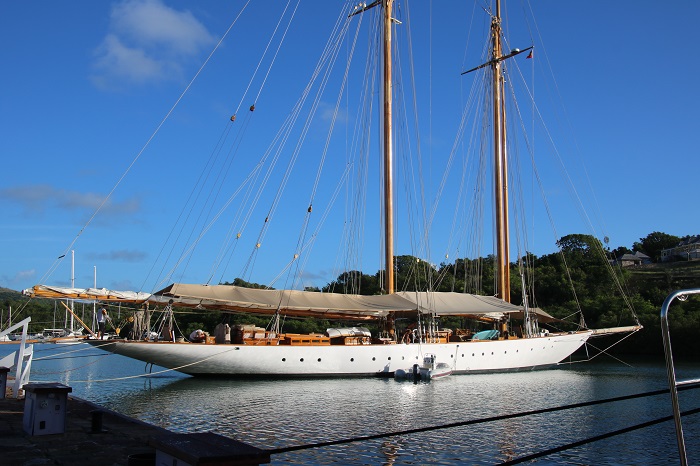
 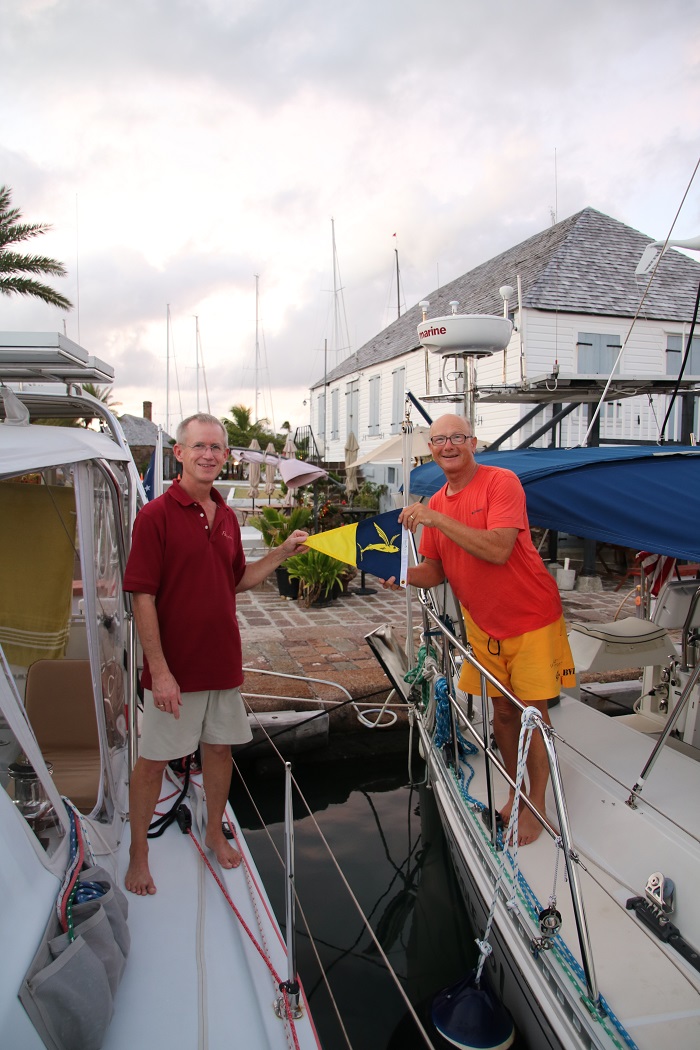 Speaking of awesome.
 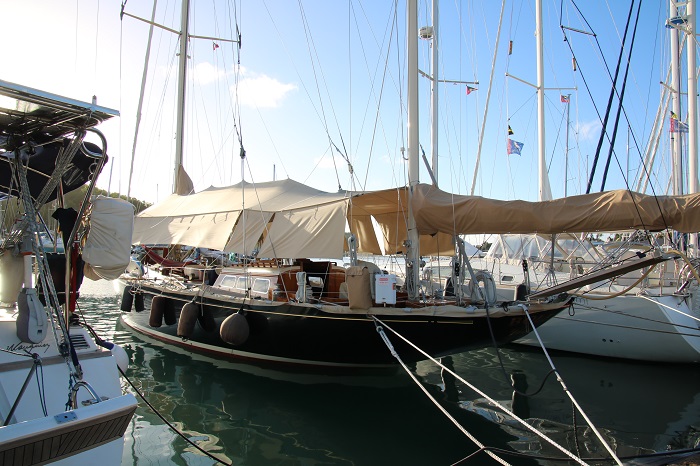 She was designed by Sparkman and Stephens and has an impressive racing pedigree as a successful ocean racer. She’s in magnificent condition having gone though a major refit in Maine in 2009 at Rockport Marine.
 Tomorrow we will pick up our anchor, hopefully without a diver to untangle from all the “classic” items on the bottom of the harbor. Remember that this place has been popular for hundreds of years and a lot of junk has accumulated during that time.